Crab Anatomy: Parts of a Crab and What They Do
Quick answer: The main parts of a crab are a hard upper shell called the carapace, two claws called chelipeds, four pairs of walking legs, eyes on movable stalks, two pairs of antennae, a set of mouthparts, and a small abdomen, or apron, folded flat under the body. Gills sit hidden under the sides of the carapace.
A crab wears its skeleton on the outside. That hard armor protects it, but it also means a crab has to break out of its shell and grow a new one every time it gets bigger.
This guide labels the outside parts of a crab, explains what each one does and then looks inside at its gills, stomach and heart. Many examples use the Atlantic blue crab, one of the best-studied crabs in North America.
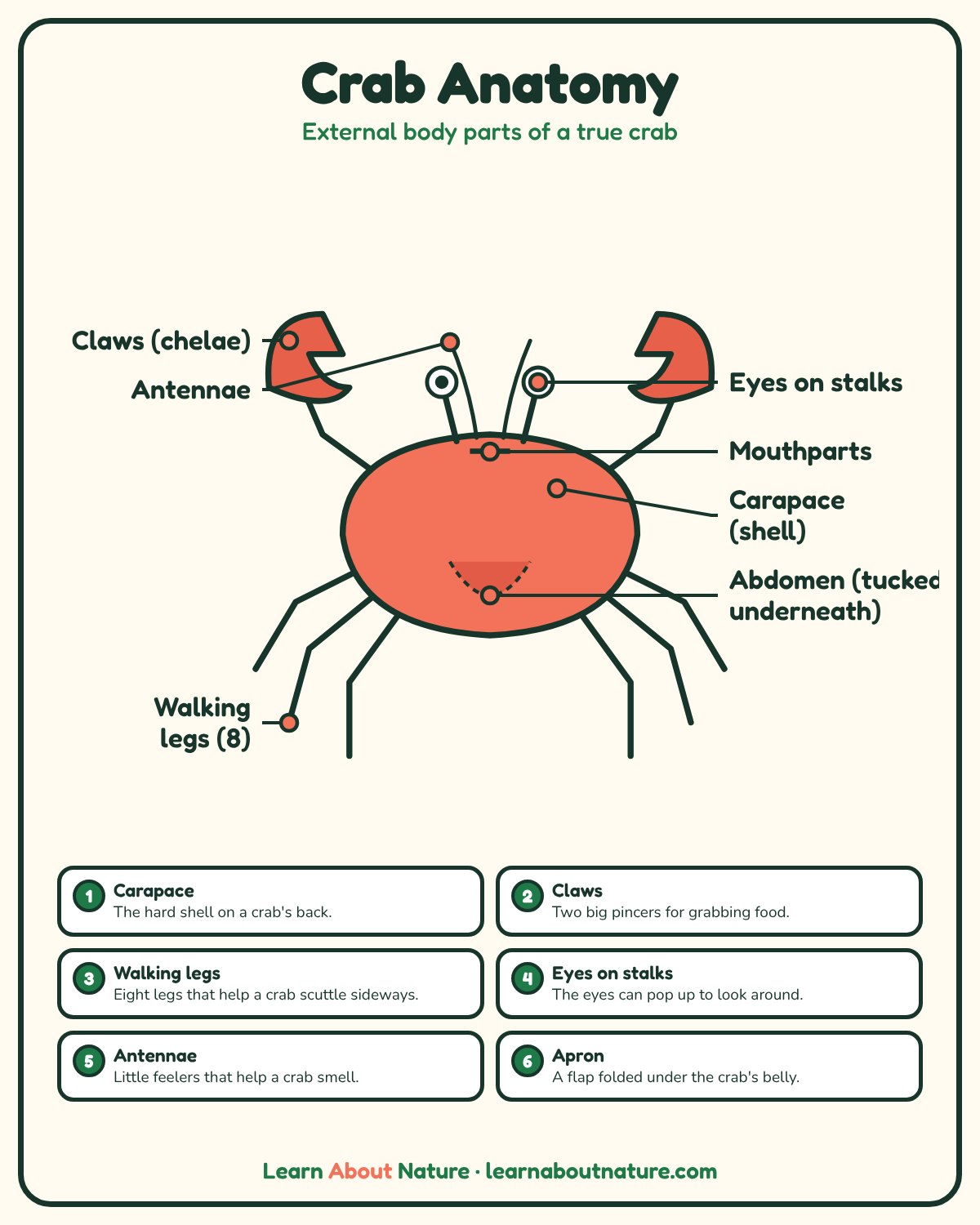
Teachers and students: you’re welcome to use this diagram in lessons and projects with credit to Learn About Nature.
Free printable: Download the Crab Anatomy labeling worksheet (PDF) – label the parts using the word bank. Answer key included.
Parts of a Crab and What They Do
| Part | What it does |
|---|---|
| Carapace | Hard top shell that protects the body and gills |
| Claws (chelipeds) | Grab food, fight and defend |
| Walking legs | Walk, climb and dig; some crabs have swimming paddles |
| Eyes on stalks | Spot movement and can fold away for safety |
| Antennae | Smell, touch and help with balance |
| Mandibles | Crush food at the mouth |
| Maxillipeds | Hold food and help move water over the gills |
| Abdomen (apron) | Folded flap under the body; holds eggs in females |
| Gills | Take oxygen from water |
| Heart | Pumps blood (hemolymph) around the body |
| Gastric mill | Grinds food inside the stomach |
| Hepatopancreas | Makes digestive juices and stores food |
The Crab Body Plan
Crabs are crustaceans, related to lobsters, shrimp and barnacles. True crabs belong to the decapods, meaning ten legs: one pair of claws and four pairs of walking legs.
A crab’s head and thorax are joined into one section covered by the carapace. The abdomen, which forms the long tail of a lobster or shrimp, is short and folded tightly underneath the crab’s body. That tucked-in tail is what gives crabs their compact, wide shape.
External Anatomy: Shell, Eyes, Antennae and Mouthparts
- Carapace: The hard, shield-like top shell. It is part of the exoskeleton, made of chitin hardened with calcium. Its sides curve down to cover the gill chambers.
- Eyes on stalks: Two compound eyes, each made of many tiny lenses, sit on short movable stalks. A crab can raise them to look around or fold them into grooves for protection.
- Antennae: Two pairs of feelers at the front. The small inner pair picks up smells in the water and helps with balance. The outer pair senses touch.
- Mouthparts: Several pairs of small limbs stacked over the mouth. Hard mandibles crush food, maxillae help handle it, and three pairs of maxillipeds hold food and help move water over the gills.
External Anatomy: Claws, Legs and Apron
Crabs can drop a leg or claw to escape a predator, breaking it off at a special weak point. A new limb grows back over the next few molts.
- Claws (chelipeds): The first pair of legs end in pincers called chelae. Each pincer has one fixed finger and one movable finger. In blue crabs one claw has blunter teeth for crushing and the other sharper teeth for cutting.
- Walking legs: Four pairs of jointed legs. In swimming crabs such as the blue crab, the last pair is flattened into paddles.
- Abdomen (apron): The flap on the underside. In blue crabs, males have a narrow, upside-down-T shaped apron, and mature females have a wide, rounded apron that holds eggs. Young females have a triangular apron.
- Exoskeleton: Covers the whole body, legs included. Thin, bendy joints between the hard sections let the legs move.
Internal Anatomy: What Is Inside a Crab?
Under the sides of the carapace are two gill chambers. A blue crab has eight feathery gills on each side. A paddle-like part of the mouthparts beats to pull water in near the legs and push it out near the mouth.
The heart sits in the middle of the body under the carapace. Crabs have an open circulation: blood, called hemolymph, is pumped out through arteries and then bathes the organs directly.
Food passes into a stomach with a gastric mill, a set of hard, tooth-like plates that grind food. A large yellowish organ, the hepatopancreas, makes digestive juices and stores food. Organs near the antennae, often called green glands, help control water and salt.
Crab Senses
Crabs sense their world mostly through smell and touch. Tiny hairs on the antennae, legs and mouthparts detect chemicals in the water, so a crab can find food it cannot see. Balance organs at the base of the small antennae tell the crab which way is up.
Compound eyes are good at spotting movement, which helps crabs notice predators quickly.
How a Crab Moves, Feeds and Grows
Most crabs walk sideways. Their legs bend best to the side, so stepping sideways is quicker than walking forward. Some crabs can walk forward or backward too.
Many crabs eat almost anything: clams, worms, small fish, plants and dead animals. The claws catch and tear food, and the mouthparts shred it into small pieces.
To grow, a crab must molt. It builds a soft new shell under the old one, splits the old shell open at the back and backs out. Until the new shell hardens, it is a soft-shell crab and very easy for predators to catch.
Crabs Compared With Lobsters
Crabs and lobsters share the same basic parts: carapace, claws, walking legs, stalked eyes and antennae. The big difference is the abdomen. A lobster’s abdomen is a long, muscular tail it flips to swim backward. A crab’s is small and tucked away.
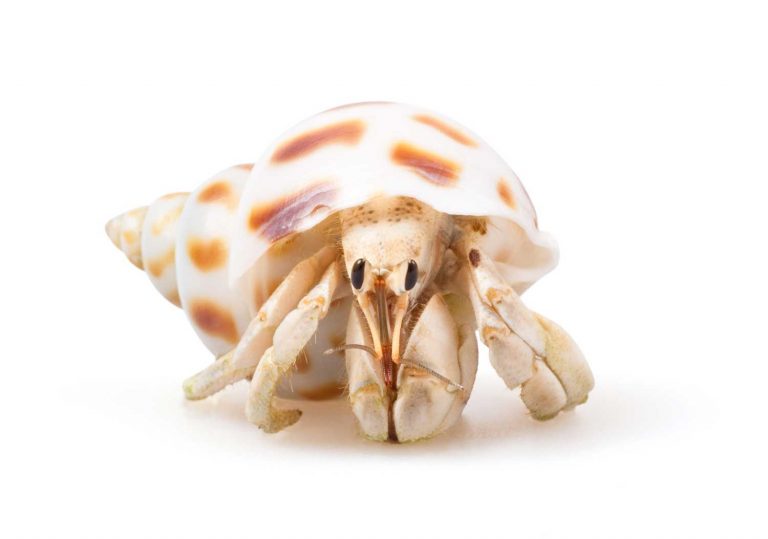
Hermit crabs and king crabs are not true crabs. They belong to a related group and are often recognized by a soft or twisted abdomen or by having only three visible pairs of walking legs.
Fun Facts About Crab Anatomy
- Male fiddler crabs have one huge claw and one small one.
- Mature female blue crabs have red tips on their claws.
- Land crabs keep their gills moist so they can still breathe air.
- The Japanese spider crab has the longest legs of any crab.
Crab Anatomy for Kids
- Carapace: the hard shell on a crab’s back.
- Claws: two big pincers for grabbing food.
- Walking legs: eight legs that help a crab scuttle sideways.
- Eyes on stalks: the eyes can pop up to look around.
- Antennae: little feelers that help a crab smell.
- Apron: a flap folded under the crab’s belly.
Key words: exoskeleton – a hard skeleton on the outside of the body; carapace – the hard shell covering a crab’s back; cheliped – a leg that ends in a claw; molt – to shed an old shell so the body can grow; decapod – a crustacean with ten legs, like crabs and lobsters; apron – the folded tail flap on the underside of a crab.
Try this: Try walking forward and then sideways across the room on all fours while counting your steps, then talk about why a crab’s side-bending legs make sideways walking faster.
Related Guides
- Shark Anatomy
- Jellyfish Anatomy
- Octopus Anatomy
- Shark life cycle
- Fish life cycle
- Jellyfish life cycle
- All animal & plant anatomy diagrams
- Animal & plant life cycles
Crab Anatomy FAQs
How many legs does a crab have?
True crabs have ten legs. The front pair are the claws, called chelipeds, and the other four pairs are walking legs. Some relatives, such as king crabs, seem to have fewer legs because their last pair is very small and tucked under the shell.
Why do crabs walk sideways?
A crab’s leg joints bend mostly to the side, so the legs can reach and push quickly that way. Walking sideways also stops the legs from tripping over each other. Some crabs can walk forward slowly when they need to.
How can you tell a male crab from a female?
Turn the crab over and look at the apron. In blue crabs, males have a narrow apron shaped like an upside-down T. Mature females have a wide, rounded apron, and young females have a triangle-shaped one.
Where are a crab’s gills?
A crab’s gills are hidden inside chambers under the sides of the carapace. Water flows in near the base of the legs, passes over the feathery gills and flows out near the mouth. Moving mouthparts keep the water flowing.
Do crabs have bones?
No. Crabs are invertebrates, so they have no bones inside their bodies. Their support comes from a hard exoskeleton made of chitin and calcium. Because it cannot stretch, crabs must molt to grow.
Sources: Invertebrate Anatomy OnLine: Callinectes sapidus | Lander University; Bay and Rivah Critters: Blue Crab | Virginia Institute of Marine Science; Blue Crab | NOAA Fisheries

Nato is a content writer and researcher with a background in psychology who’s eager to explore the wonders of nature. As a travel enthusiast and animal lover, she hopes to inspire others to discover and cherish the beauty and importance of the natural world. She also writes about the history of candy and snacks for Snack History and about food and healthy eating for The Fitchen.