Blue Whale Facts for Kids: Size, Diet, Habitat and Fun Facts
Quick answer: A blue whale is a giant baleen whale and the largest animal known to have ever lived. It can grow to about 100 feet long and weigh up to about 165 tons. Blue whales swim in every ocean except the Arctic and feed almost entirely on tiny shrimp-like animals called krill.
Imagine an animal nearly as long as three school buses parked end to end. That is the size of a big blue whale. It is larger than any dinosaur scientists have found, and it is the biggest animal known to have ever lived on Earth.
Even more surprising, this giant eats some of the smallest animals in the sea. Here is how blue whales feed, travel, talk and raise their calves, and why people are working to help them recover.
Teachers and students: you’re welcome to use this fact sheet in lessons and projects with credit to Learn About Nature.
Free printable: Download the Blue Whale fact file worksheet (PDF) – draw the animal, fill in the facts and match key words. Answer key included.
Blue Whale Quick Facts
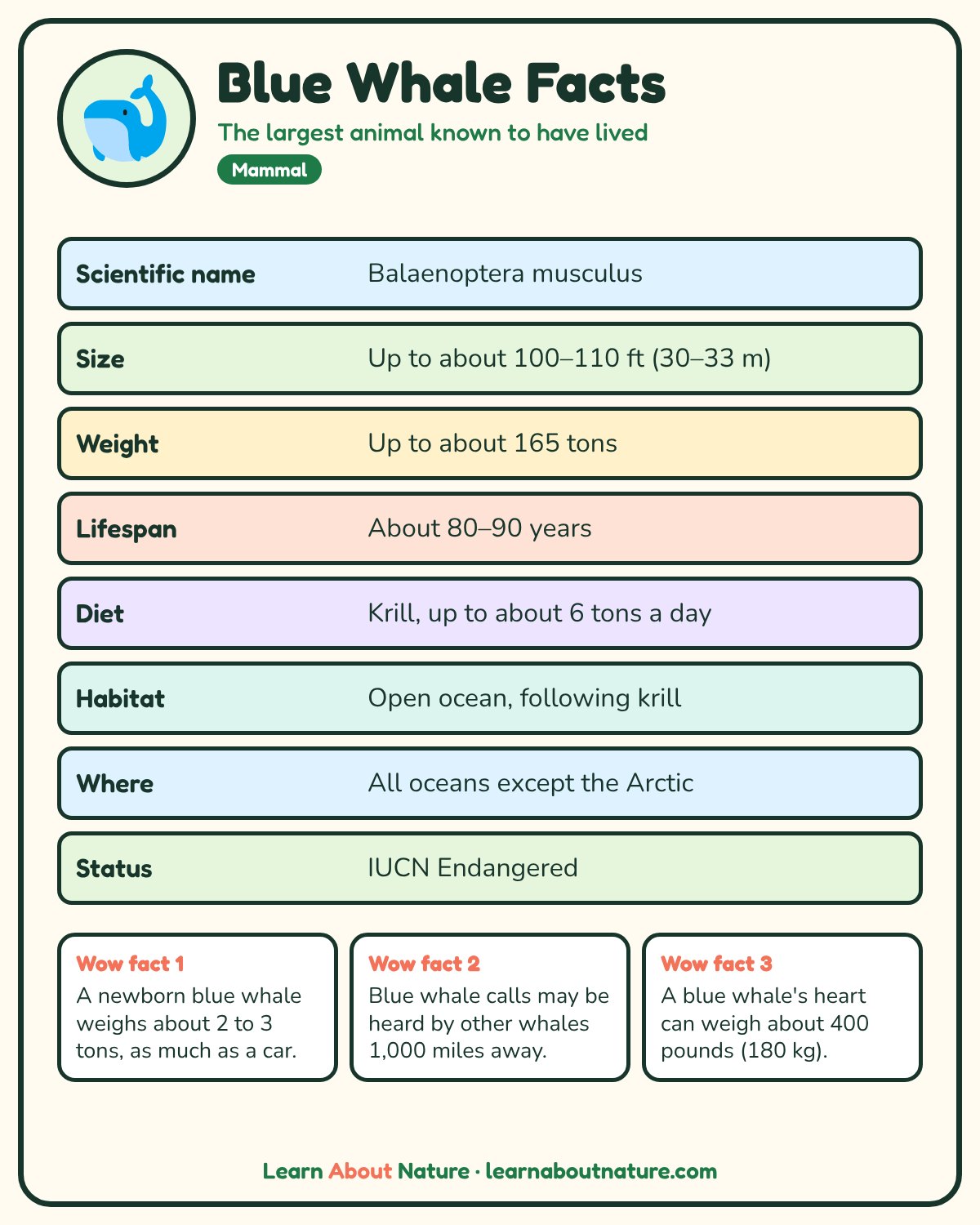
| Class | Mammal |
| Group | Baleen whales (rorquals) |
| Scientific name | Balaenoptera musculus |
| Length | Up to about 100–110 ft (30–33 m) |
| Weight | Up to about 165 tons (330,000 lb) |
| Top speed | Over 20 mph (32 km/h) in short bursts |
| Lifespan | About 80–90 years |
| Baby name | Calf |
| Size at birth | About 20–23 ft long, 2–3 tons |
| Conservation status | Endangered (IUCN) |
What Is a Blue Whale?
A blue whale is a mammal. Like all whales, it breathes air, is warm-blooded and feeds its babies milk. It breathes through two blowholes on top of its head, and its spout can shoot about 30 feet (9 m) or more into the air when it breathes out.
Blue whales are baleen whales. Instead of teeth, they have rows of black baleen plates, from about 70 to 400 of them, hanging from the upper jaw. Baleen is made of keratin, the same material as your fingernails, and works like a giant sieve. Blue whales belong to a group called rorquals, which also includes fin whales and humpback whales.
Where Do Blue Whales Live?
Blue whales live in all of the world’s oceans except the Arctic Ocean. They usually swim in deep, open water, but some come fairly close to coasts where food is plentiful, such as off California.
Many blue whales migrate. They spend summer in cool, food-rich waters, where they feed, and travel to warmer waters in winter to have their calves. Where they go depends mostly on where they can find krill.
Some blue whales in the eastern North Pacific, for example, feed off the coast of California from summer into fall. When the feeding season ends, many of them travel south to warmer waters for the winter.
What Do Blue Whales Eat?
Blue whales eat almost nothing but krill, small shrimp-like animals that swim in huge swarms. To feed, a blue whale speeds toward a big swarm of krill and opens its mouth wide. Folds of skin on its throat stretch like an accordion, so it can gulp a huge mouthful of water and krill. A blue whale has about 60 to 88 of these long grooves running down its throat and belly.
Then the whale pushes the water out through its baleen plates with its tongue. The krill get trapped inside, and the whale swallows them. According to NOAA, the largest blue whales may eat about 6 tons of krill in a single day.
How Big Is a Blue Whale?
Blue whales in the Antarctic are the biggest, reaching about 100 to 110 feet (30 to 33 m) long and up to about 330,000 pounds, or 165 tons. Blue whales in the North Atlantic and North Pacific are smaller, usually up to about 90 feet (27 m). Females are usually a little bigger than males.
Everything about a blue whale is huge. A blue whale heart measured by scientists weighed about 400 pounds (180 kg). Blue whales usually travel at about 5 miles per hour (8 km/h), but they can go faster than 20 miles per hour (32 km/h) for short bursts.
Blue Whale Babies
A baby blue whale is called a calf. A mother is pregnant for about 10 to 12 months and has one calf at a time. A newborn calf is already about 20 to 23 feet (6 to 7 m) long and weighs about 2 to 3 tons.
The calf drinks its mother’s rich milk and grows very fast, gaining about 200 pounds (90 kg) a day. It stops nursing at about 6 to 7 months old, usually around the time the mother and calf reach their summer feeding areas.
Blue whales become adults at about 5 to 15 years old. A mother usually has a calf every 2 to 3 years.
- Pregnancy: about 10–12 months
- Calves per birth: 1
- Size at birth: about 20–23 ft long
- Nursing: about 6–7 months
How Blue Whales Live and Communicate
Blue whales are usually seen alone or in pairs. When food is very plentiful, though, more than 50 may gather in the same feeding area. They spend most of their time feeding and traveling.
Blue whales are among the loudest animals on Earth. They make deep, rumbling calls, many of them too low for people to hear. According to NOAA, in the right ocean conditions these calls may be heard by other whales up to 1,000 miles (1,600 km) away. Scientists think the calls help whales find each other. In some populations, certain repeated calls, often called songs, are made only by males.
Scientists listen for blue whales with underwater microphones called hydrophones. Because each population makes its own kinds of calls, researchers can tell which group of blue whales is passing by, even when they cannot see a single whale.
Blue Whale vs Whale Shark
The blue whale and the whale shark are the two largest animals in the ocean, and both feed on tiny food. But they are very different kinds of animals.
The blue whale is a mammal. It breathes air at the surface, feeds its calf milk and swims by moving its tail up and down. It can reach about 100 feet or more and weigh up to about 165 tons.
The whale shark is a fish, the largest fish in the world. It breathes with gills, swims by moving its tail from side to side and usually grows to about 18 to 33 feet, with the biggest about 61 feet long. Whale sharks live in warm tropical seas, while blue whales often feed in cold waters.
Threats and Conservation Status
In the 1900s, people hunted blue whales for their oil. Hundreds of thousands were killed, including roughly 350,000 in the Antarctic alone in the first half of the century. Whaling peaked in 1930 and 1931, when about 30,000 blue whales were killed in a single season. Blue whales came very close to disappearing. Today they are protected, and NOAA says their numbers are slowly increasing around the world, though they are still far lower than before whaling.
The IUCN Red List lists the blue whale as Endangered (assessed in 2018). The Antarctic blue whale, a subspecies, is Critically Endangered. In the United States, blue whales are listed as endangered under the Endangered Species Act.
Today’s biggest threats are being hit by ships and getting tangled in fishing gear. Ocean noise, pollution and climate change, which can affect krill, may also harm them.
Fun Facts About Blue Whales
Here are a few more blue whale surprises:
- Blue whales are bigger than any dinosaur ever discovered.
- A blue whale calf may drink hundreds of pounds of milk a day.
- Blue whales can live about 80 to 90 years.
- Scientists estimate there are roughly 10,000 to 25,000 blue whales today.
- Up close, a blue whale’s skin looks mottled blue-gray, but underwater it can look bright blue.
Fast Facts for Young Readers
- The blue whale is the biggest animal that ever lived.
- It is a mammal, so it breathes air.
- Blue whales eat tiny animals called krill.
- They use baleen instead of teeth to catch food.
- A baby blue whale is called a calf.
- Blue whales are some of the loudest animals on Earth.
- Blue whales are endangered and protected by law.
Key words: baleen – stiff plates in a whale’s mouth that strain food from the water; krill – small shrimp-like animals that blue whales eat; migrate – to travel from one place to another at certain times of year; mammal – a warm-blooded animal that breathes air and feeds its babies milk; endangered – at high risk of dying out in the wild.
Try this: Measure a blue whale: use a long rope or a trundle wheel outside to mark out 100 feet, then see how many students can stand along it to match one whale.
Related Guides
- Whale life cycle
- Jellyfish facts for kids
- Starfish facts for kids
- Seahorse facts for kids
- Orca facts for kids
- All animal facts for kids
Blue Whale FAQs
How big is a blue whale?
Blue whales in the Antarctic can grow to about 100 to 110 feet (30 to 33 m) long and weigh up to about 165 tons. Blue whales in the North Atlantic and North Pacific are smaller, usually up to about 90 feet. That makes the blue whale the largest animal known to have lived.
What do blue whales eat?
Blue whales eat almost only krill, which are tiny shrimp-like animals. A blue whale gulps a huge mouthful of water and krill, then pushes the water out through its baleen plates. The largest blue whales may eat about 6 tons of krill in one day.
How long do blue whales live?
Scientists estimate that blue whales live about 80 to 90 years, according to NOAA Fisheries. They grow up slowly, becoming adults at about 5 to 15 years old, and a mother usually has only one calf every 2 to 3 years.
Do blue whales have teeth?
No. Blue whales are baleen whales. Instead of teeth, they have hundreds of baleen plates hanging from the upper jaw. Baleen is made of keratin, like your fingernails, and it works like a sieve to trap krill while letting water flow out.
Are blue whales endangered?
Yes. The IUCN Red List lists the blue whale as Endangered, and the Antarctic blue whale is Critically Endangered. Whaling in the 1900s killed hundreds of thousands of blue whales. They are now protected, and their numbers are slowly rising, but ship strikes and fishing gear still threaten them.
Sources: NOAA Fisheries: Blue Whale; IUCN SSC Cetacean Specialist Group: Red List status of cetaceans; Georgia Aquarium: Whale Shark; Wikipedia: Blue whale

Nato is a content writer and researcher with a background in psychology who’s eager to explore the wonders of nature. As a travel enthusiast and animal lover, she hopes to inspire others to discover and cherish the beauty and importance of the natural world. She also writes about the history of candy and snacks for Snack History and about food and healthy eating for The Fitchen.