What Do Beetles Eat?

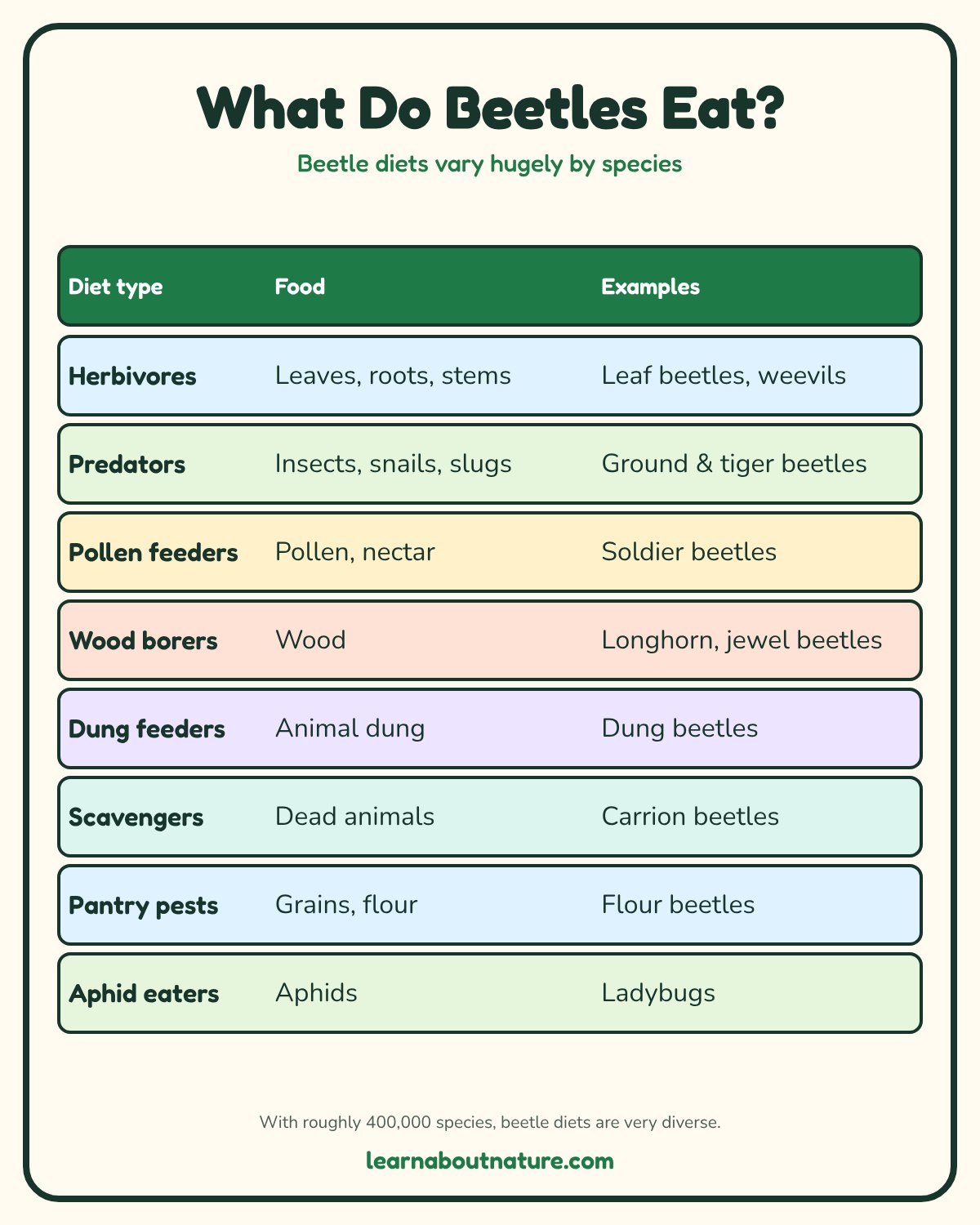
Quick answer: Beetle diets vary widely by species. Many eat plants, leaves, pollen or wood, while others eat other insects, dung, fungi or dead animals. Ladybug beetles eat aphids, and dung beetles eat animal droppings.
Beetles are insects that belong to the order Coleoptera, a name that means “sheath wing” in Greek. Their tough front wings, called elytra, fold over the back like a shield. With about 400,000 known species, beetles eat almost everything you can think of, from leaves and wood to dung, fungi and other animals.
Beetles Quick Facts
| Common name | Beetles |
| Scientific name | Coleoptera |
| Kingdom | Animalia |
| Phylum | Arthropoda |
| Class | Insecta |
| Type | Insect (beetle) |
| Diet | Varies by species: plants, wood, fungi, dung, dead animals or other small animals |
| Habitat | Almost every land and freshwater habitat |
| Native range | Worldwide except Antarctica |
| Size | Less than 1 mm to over 15 cm long |
| Special feature | Hard front wings (elytra) that protect the flying wings |
Some beetles will eat many kinds of food, while others are picky and feed on just one type of plant. Let’s look at the main groups, sorted by what they like to eat.
Plant and Flower Eaters

Blister beetle eating a flower
Many beetles are plant eaters. Adult blister beetles munch on flowers and leaves, while lots of other species chew roots, seeds, fruit or pollen. Some beetles are omnivores and eat both plants and animals.
Leaf-Eating Beetles
Leaf beetles chew holes in leaves or scrape away the soft green tissue between the veins, which is called skeletonizing. A few beetles on a plant do little harm, but large numbers can turn leaves brown and make them fall early. That is why gardeners and farmers often treat leaf eaters as pests.
Cottonwood Leaf Beetle

An anchor stink bug (Stiretrus anchorago) preying on a cottonwood leaf beetle. – Photo by: Lawrence Abrahamson, State University of New York, Bugwood.org
The cottonwood leaf beetle feeds on the young leaves of cottonwoods, poplars and willows. Its larvae feed in groups and skeletonize the leaves, which can slow the growth of young trees.
Elm Leaf Beetle

Elm leaf beetle – Photo by: Didier Descouens
Both the larvae and the adults of the elm leaf beetle eat elm leaves. Adults chew small holes, while larvae skeletonize the undersides. An attack rarely kills a tree, but repeated years of leaf loss can weaken it.
Recyclers: Dung and Dead Matter
Many beetles are nature’s cleanup crew. They feed on dung, dead animals and rotting plants, breaking them down and returning nutrients to the soil.
Scarab Beetles

Green scarab beetle – Photo by: J.M.Garg
The scarab family (Scarabaeidae) is huge. Dung beetles in this family eat animal droppings and often roll or bury balls of dung for their young. Other scarabs, such as chafers, feed on leaves, flowers or roots instead.
Carrion Beetles

Carrion beetle on an empty snail shell
Carrion beetles (family Silphidae) are drawn to dead animals. Many of them eat the dead body itself, and some also hunt the fly maggots that gather there. Burying beetles even bury small carcasses to feed their young.
Clown Beetles
Clown beetles (family Histeridae) are small, shiny and very round. They live in dung, carrion and rotting plants, but they are actually hunters there, eating fly eggs, maggots and other small insects.
Wood-Eating Beetles
Wood-boring beetles lay their eggs on or in trees and logs. The larvae tunnel through the wood as they feed. Most prefer dead, dying or stressed trees, which helps break down old wood in forests.
Bark Beetles

Bark beetle – Photo by: John Tann
Bark beetles are tiny weevils that tunnel just under the bark of trees. Many attack weakened spruce, pine, fir and hemlock trees, and some carry fungi that help them feed. During outbreaks they can kill huge numbers of trees.
Metallic Wood-Boring Beetles

Metallic wood-boring beetle – Photo by: Katja Schulz
Metallic wood-borers (family Buprestidae) are also called jewel beetles because of their shiny colors. Their flat-headed larvae bore through branches, trunks and roots. Most choose dying wood, but a few, such as the emerald ash borer, can kill healthy trees.
Predatory Beetles
Many beetles are hunters. They catch aphids, mites, caterpillars, scale insects and insect eggs, which makes them helpful to gardeners.
Rove Beetles

Rove beetle – Photo by: Bernard Dupont
Rove beetles have short wing covers that leave most of the abdomen showing. With more than 60,000 species, they are one of the largest animal families. Most are fast predators that hunt small creatures in leaf litter, soil, dung and rotting matter.
Ground Beetles

Ground beetle – Photo by: Jon Richfield
Ground beetles (family Carabidae) include around 40,000 species found all over the world. Most hunt at night on the ground, eating caterpillars, slugs, snails, earthworms and other small animals. Some also eat seeds.
Soldier Beetles

Soldier beetle – Photo by: CSIRO
Adult soldier beetles are often seen on flowers, where they eat pollen, nectar and soft-bodied insects such as aphids. Their larvae live in the soil and eat insect eggs and small larvae, including grasshopper eggs.
Weevils
Weevils are beetles with a long snout. Their tiny jaws sit at the tip, which lets them chew into seeds, fruits, stems and grains. Almost all weevils eat plants, and many stick to just one kind.
Boll Weevil

Cotton boll weevil
The boll weevil lays its eggs in cotton buds and bolls. The larvae eat the inside, so the cotton never develops. It was once one of the most damaging crop pests in the southern United States.
Rice Weevil

Rice weevil – Photo by: Olaf Leillinger
The rice weevil attacks whole grains such as rice, wheat, corn, barley and oats. The female drills a hole in a kernel, lays an egg inside, and the larva eats the grain from within. It is a common pest in stored food.
Primitive Weevils

Primitive weevil – Photo by: G. Bohne
Primitive weevils belong to older branches of the weevil family tree. Some adults feed on pollen, and the larvae of many kinds develop inside plant parts such as cones or dead wood.
Leaf-Rolling Weevils

Leaf-rolling weevil – Photo by: Bob Peterson
Female leaf-rolling weevils cut a leaf and roll it into a neat little tube, then lay an egg inside. The larva hatches into a ready-made home and food supply. Their relatives, the tooth-nosed snout weevils, feed on buds, shoots and young fruit.
Black Vine Weevil

Black vine weevil – Photo by: Denny Bruck
Black vine weevils feed at night and leave neat notches around the edges of leaves on plants like rhododendrons, camellias and yews. The real damage comes from the larvae, which live in the soil and eat roots.
Water Beetles
Beetles live in ponds and streams too. Diving beetles are fierce hunters that eat insects, tadpoles and even small fish. Whirligig beetles scoop up insects that fall onto the water’s surface, and crawling water beetles eat mostly algae.
From flowers to fallen logs to the bottom of a pond, there is a beetle that eats almost every kind of food on Earth. That is one reason they are such a successful group of animals.
Beetles FAQs
What do most beetles eat?
Most beetles eat plants, including leaves, roots, seeds, flowers and wood. Many others eat dung, dead animals, fungi or other insects, so beetle diets are very varied.
Do beetles eat other insects?
Yes. Ground beetles, rove beetles, ladybugs, soldier beetles and diving beetles are all predators. They eat insects such as aphids, caterpillars and insect eggs, and some also eat slugs and snails.
Why are dung beetles and carrion beetles important?
They break down animal droppings and dead bodies. This cleans up the environment and returns nutrients to the soil, helping plants grow.
What do weevils eat?
Weevils eat plants. Many feed on one kind of plant, and some, like the rice weevil, eat stored grains. Their long snout helps them chew into seeds and stems.
Are beetles that eat leaves harmful?
A few leaf-eating beetles rarely cause serious harm. Large numbers can strip leaves and weaken plants, which is why some leaf beetles and weevils are treated as garden or crop pests.

Randi Jones is the owner and founder of the Nature Gift Store, an online retailer specializing in nature-themed gifts, educational science projects, live animal nature kits and real butterfly artwork. A biology graduate who fell in love with insects, she founded the company in 2001 to make active learning about nature fun, accessible and engaging for children and adults. Her store offers real butterfly frames, home and garden decor and educational live animal kits, including ant farms, worm farms, tadpoles, ladybugs and hermit crabs, and she runs a bug museum in Washington featuring live animals like Eddie the Iguana alongside other reptiles and insects. Randi wrote most of the guides on this site. They first appeared on her long-running nature sites, including Monarch-Butterfly.com, Ladybug-Life-Cycle.com, Frog-Life-Cycle.com, Dragonfly-Site.com and Butterfly Pictures, which have now been brought together here at Learn About Nature.