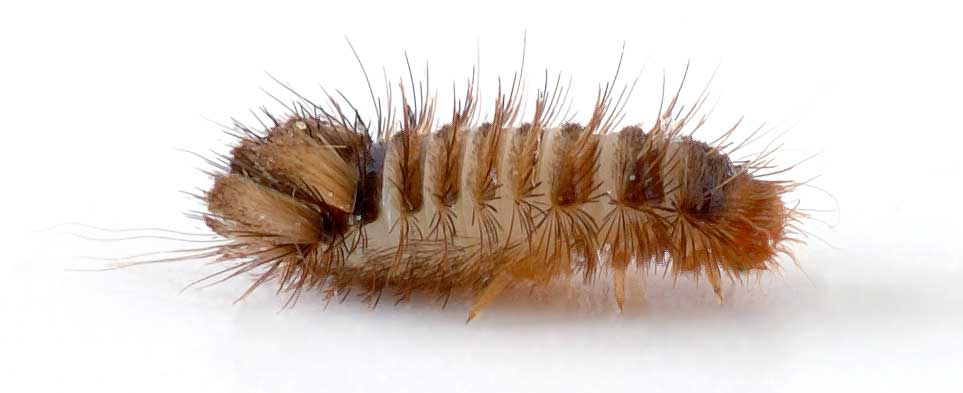
Carpet Beetle Larva
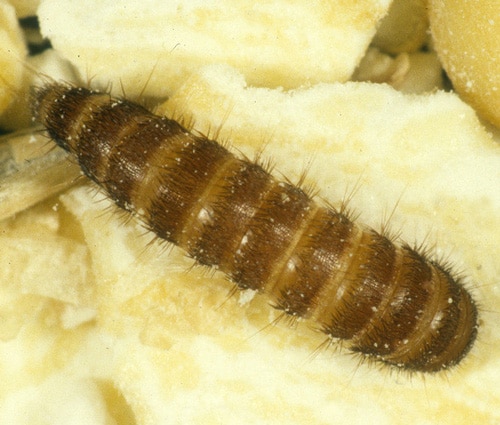
Larvae of the Carpet Beetle
Carpet beetles undergo complete metamorphosis. In length, the life cycle of these beetles ranges from two months to many years. The life cycle of these beetles starts when the adult female beetles lay their eggs. They can lay their eggs indoors and also infest the mice, nests of birds, and other insects also. At a time, female beetle can lay 100 eggs. Within 7 to 35 days, the eggs will hatch into the larva. The larval stage is the destructive stage of these beetles. Adult carpet beetles are fliers so that they can move from one place to another. The larva can survive without food for many weeks. The larva can take over a year to develop into an adult. The duration of the pupal stage varies. And in the spring or summer season, Adult beetles emerge. Within 9 months to 2 years, young beetles develop into adults. Climate and food also affect the development of the beetle.
Anatomy
Carpet beetle larvae are generally carrot to oval in shape and 2 to 3.5mm in length. With golden hairs, they are cream colored. At the stage of development, their golden hairs are placed upon the abdomen. With sharp terminal ends, Hairs of these beetles are Lancelet. At the end of their abdomen, they have a tuft of long hairs. Tan and white striped, they are brown to tan in color.
Life Cycle
The life cycle of these beetles starts when the adult female beetles lays their eggs. They can lay their eggs indoors and also infest the mice, nest of birds and other insects. At a time, a female beetle can lay 100 eggs. Within 7 to 35 days, the eggs will hatch into the larva. The larval stage is the destructive stage of these beetles. The duration of the pupal stage varies. And in the spring or summer season, Adult beetles emerge. Within 9 months to 2 years, young beetles develop into the adults. Climate and food also affect the development of the beetle.
Feeding Habits
Carpet beetle larvae feed on carpet, leather, fur, wool and also hairs of animals. As a result, these beetles infest the carpets, comforters, coat, furniture, pillows, blankets and clothing. They also attack on synthetic fabrics, and they can also feed on them when these fabrics are grubby by oil, perspiration and food. The larva eats animal products because it requires a fibrous protein Keratin, which is found in the tissues of animals. They are active during the daytime. They are also able of surviving long periods of time without any food. But, they have the ability to move from place to place in search of food.
Reproduction
In the spring season, the female carpet beetles can lay 25 to 100 eggs and Within two weeks, these eggs hatch. Under a diversity of temperature and humidity, they are able to mature. Although they do not like bright areas. Carpet beetle larva can take over a year to develop into adults. This stage depends upon the food, climate and food sources.
As a Pest
Carpet beetle larvae are important pest in rugs and wool carpets. They feed on plant materials such as grains, books, pet food and spices. As a pest they damage the household materials and feed on them. They are also considered as museum pests because they are troublesome to the museum. These beetles can cause irreparable damage to the carpets and other products. Their infestations are recognized by their presence, because they gather around lights and windows. They can cause damage to clothing, fur, animal hides and carpets.
Having discovered a fondness for insects while pursuing her degree in Biology, Randi Jones was quite bugged to know that people usually dismissed these little creatures as “creepy-crawlies”.