Salamander Facts for Kids: Habitat, Diet and Fun Facts
Quick answer: A salamander is an amphibian with a long body, a tail and usually four short legs. There are about 850 species, including newts, living mostly in damp forests, streams and ponds across the Northern Hemisphere and parts of Central and South America. Salamanders eat insects, worms and other small animals, and many can regrow lost limbs.
Turn over a damp log in a forest and you might find a small, shiny creature with a long tail that quickly wriggles away. It looks a bit like a lizard, but it is actually a salamander, a cousin of frogs and toads.
Salamanders come in an amazing range of shapes and sizes. Some are smaller than a paper clip, while others are as long as a grown-up person. Some never leave the water, some live their whole lives on land, and some live in dark caves. This guide explains what salamanders are and introduces some of the most famous kinds.
Teachers and students: you’re welcome to use this fact sheet in lessons and projects with credit to Learn About Nature.
Free printable: Download the Salamander fact file worksheet (PDF) – draw the animal, fill in the facts and match key words. Answer key included.
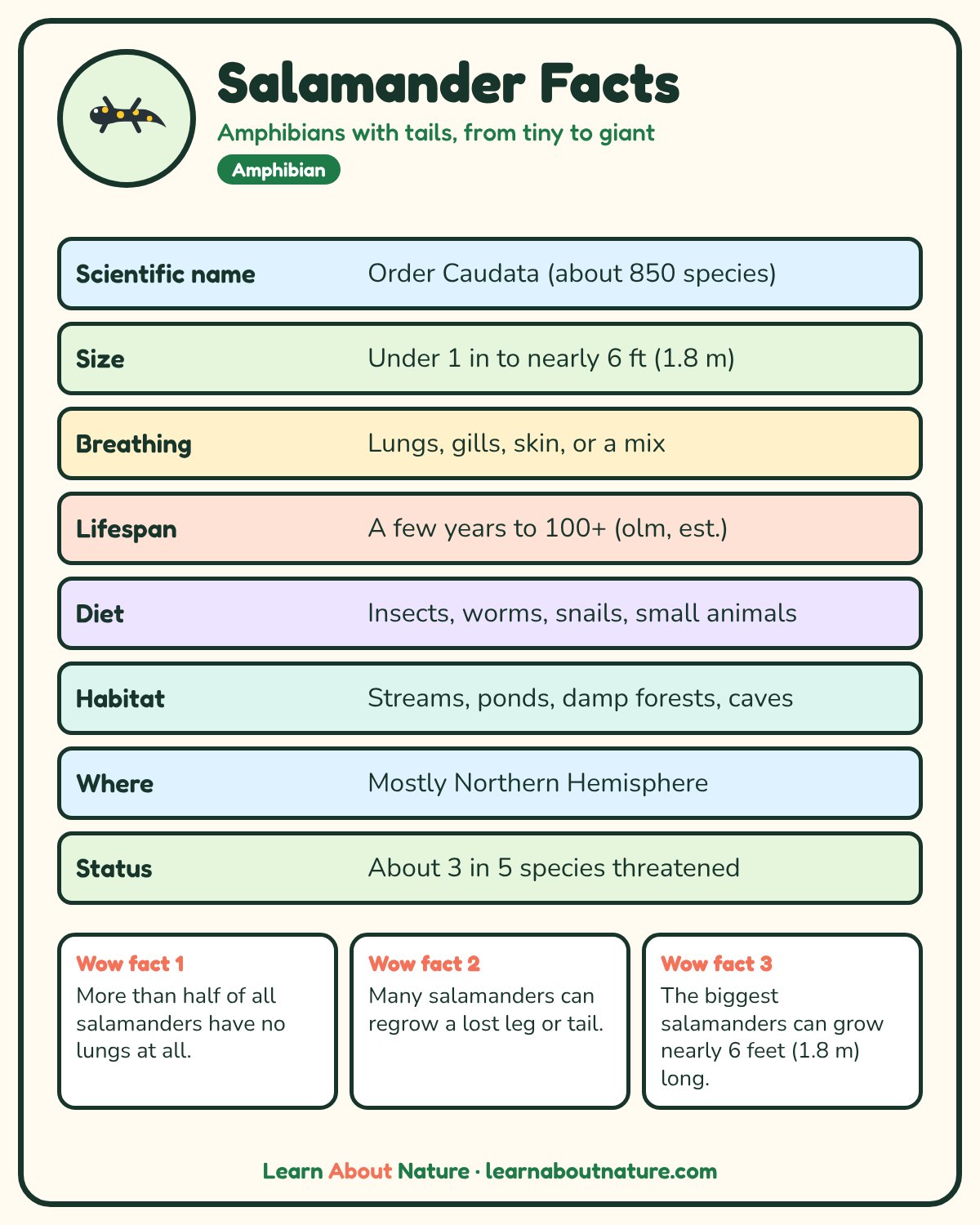
Salamander Quick Facts
| Class | Amphibian |
| Order | Caudata (also called Urodela) |
| Number of species | About 850 (including newts) |
| Size | About 1 in (2.5 cm) to nearly 6 ft (1.8 m) |
| Largest | Chinese giant salamanders (genus Andrias) |
| Largest family | Lungless salamanders (Plethodontidae) |
| Diet | Insects, worms, snails, crayfish, small fish |
| Baby name | Larva (plural larvae) |
| Lifespan | Varies; a few years to an estimated 100+ years (olm) |
| Conservation | About 60% of species threatened (IUCN-based 2023 study) |
What Is a Salamander?
A salamander is an amphibian. Amphibians are cold-blooded animals with soft, moist skin, and most of them start life in water. The amphibian group has three branches: frogs and toads, caecilians (legless, worm-like amphibians), and salamanders.
Salamanders belong to the order Caudata, which means “having a tail.” Unlike frogs, they keep their tails as adults. Most have four short legs, though a few, such as sirens, have only two small front legs.
Newts are salamanders too. They belong to one family of salamanders and often spend part of the year in water and part on land. According to AmphibiaWeb, about 850 species of salamanders and newts are known today, and new ones are still being discovered.
Salamanders vs. Lizards
People often mix up salamanders and lizards because they have a similar shape. But they are very different animals. Lizards are reptiles with dry, scaly skin and claws, and they lay eggs with leathery shells on land.
Salamanders have smooth, moist skin with no scales, no claws on their toes, and most lay soft, jelly-covered eggs in water or damp places. A salamander’s skin must stay damp, so most salamanders avoid hot, dry places.
Where Do Salamanders Live?
Most salamanders live in the Northern Hemisphere, in North America, Europe, Asia and North Africa. One large family, the lungless salamanders, has spread through Central America and into northern South America.
North America has more kinds of salamanders than any other continent, and the Appalachian Mountains of the eastern United States are a world hot spot for them.
Salamanders live in cool streams, ponds, wetlands, damp forests, under rocks and logs, in burrows and in caves. Many hide during the day and come out on rainy nights.
In early spring, on the first warm, rainy nights, spotted salamanders and other mole salamanders walk from the forest to small pools to breed. So many may cross at once that people call it a “big night.” In some towns, volunteers help the salamanders cross roads safely, and some roads are even closed for the night.
What Do Salamanders Eat?
All adult salamanders are carnivores. Small salamanders eat insects, spiders, worms, slugs and snails. Larger ones also eat crayfish, fish, frogs and even smaller salamanders.
Many land salamanders catch prey with a sticky tongue. Some lungless salamanders can shoot their tongues out extremely fast to grab insects. Water-living salamanders often catch prey by opening their mouths quickly to suck it in.
Body, Breathing and Senses
Salamanders breathe in several different ways. Larvae breathe with feathery gills. Many adults use lungs. Almost all salamanders also take in oxygen through their thin, moist skin.
The biggest salamander family, the lungless salamanders, has no lungs at all. These salamanders breathe through their skin and the lining of their mouths. They make up more than half of all salamander species.
Many salamanders are brightly colored. Bright yellow, orange or red often warns predators that the salamander’s skin contains bad-tasting or poisonous chemicals. The rough-skinned newt of western North America has a very strong toxin in its skin, so it should never be handled or put in the mouth.
Salamanders are also champions of regeneration. Many can regrow a lost tail or leg, and some can repair parts of the eyes, heart and spinal cord. Some salamanders can drop their tails to escape a predator, then grow new ones.
Salamander Life Cycle
Most salamanders mate in spring. In many species, the male leaves a small packet of sperm, and the female picks it up to fertilize her eggs inside her body.
Many salamanders lay eggs in water. The eggs hatch into larvae that have gills and a fin on the tail. Over weeks or months the larvae grow legs, lose their gills and change into adults. This change is called metamorphosis.
Other salamanders do things differently. Many lungless salamanders lay eggs on land, and tiny salamanders hatch straight out of the eggs without a larval stage. Some, like the axolotl, stay in their water-living larval form for life. A few keep their eggs inside the body. The fire salamander of Europe gives birth to live larvae, and the Alpine salamander gives birth to fully formed young. In many species, the mother guards her eggs until they hatch.
Famous Kinds of Salamanders
With about 850 species, there are salamanders of almost every shape and size. Here are some well-known examples.
- Chinese giant salamander: one of the largest amphibians in the world, reaching nearly 6 feet (1.8 m). It lives in mountain streams in China and is Critically Endangered.
- Hellbender: a giant, flat-bodied salamander of eastern U.S. streams, up to about 29 inches (74 cm) long. It breathes mostly through its wrinkly skin.
- Axolotl: a Mexican salamander that keeps its feathery gills all its life.
- Spotted salamander: a black salamander with bright yellow spots that breeds in spring pools in eastern North America.
- Eastern newt: its young spend a few years on land as bright orange “red efts” before returning to water as adults.
- Olm: a pale, blind salamander that lives in underground caves in Europe. Scientists estimate it may live more than 100 years.
- Minute salamanders (Thorius): some of the tiniest salamanders, only about an inch long including the tail.
Predators, Threats and Conservation
Salamanders are eaten by snakes, birds, fish, raccoons, skunks and other animals. To defend themselves, they hide, use poisonous skin or drop their tails.
Salamanders are the most threatened group of amphibians. A worldwide study published in 2023, based on IUCN Red List assessments, found that about 3 in 5 salamander species are threatened with extinction. Habitat loss, pollution, climate change and disease are major problems. A fungus called Batrachochytrium salamandrivorans, or Bsal, has killed many fire salamanders in Europe.
On the IUCN Red List, the Chinese giant salamander is Critically Endangered, the axolotl is Critically Endangered, and the hellbender is Vulnerable. Protecting clean streams, wetlands and forests helps salamanders survive. If you find one, look without touching, and put back any log or rock exactly as it was.
Fast Facts for Young Readers
- A salamander is an amphibian with a tail.
- Newts are a kind of salamander.
- Salamanders have smooth, damp skin, not scales.
- Many salamanders breathe through their skin.
- Baby salamanders are called larvae.
- Many salamanders can grow back a lost tail or leg.
- Salamanders eat bugs, worms and other small animals.
Key words: amphibian – a cold-blooded animal with moist skin that usually starts life in water; larva – a young salamander that usually lives in water and breathes with gills; metamorphosis – a big change in body shape as a young animal becomes an adult; regeneration – growing back a lost body part; newt – a kind of salamander that often lives part of its life in water and part on land; lungless salamander – a salamander that has no lungs and breathes through its skin and mouth.
Try this: Make a two-column chart comparing a salamander and a lizard, listing skin, toes, eggs and where each lives. Then draw one of each and label the differences.
Related Guides
- Crocodile facts for kids
- Frog facts for kids
- Axolotl facts for kids
- Komodo Dragon facts for kids
- All animal facts for kids
Salamander FAQs
Is a salamander a lizard?
No. Salamanders are amphibians, like frogs, while lizards are reptiles. Salamanders have smooth, moist skin with no scales and no claws, and most lay jelly-covered eggs in water or damp places. Lizards have dry, scaly skin, claws and shelled eggs.
What is the difference between a newt and a salamander?
All newts are salamanders, but not all salamanders are newts. Newts belong to one family of salamanders. They often have rougher skin and spend part of their lives in water and part on land, returning to ponds to breed.
Are salamanders poisonous?
Many salamanders have chemicals in their skin that taste bad or are toxic to predators, and bright colors often warn of this. Some, such as the rough-skinned newt, are very toxic if eaten. They are not dangerous to touch lightly, but it is best not to handle them, since their skin is delicate.
How do salamanders breathe?
It depends on the species and its age. Larvae use gills. Many adults use lungs, and almost all salamanders also breathe through their moist skin. Lungless salamanders, the largest family, have no lungs and get oxygen through their skin and the lining of their mouths.
What is the biggest salamander?
The largest salamanders are the Chinese giant salamanders of the genus Andrias, which can grow nearly 6 feet (1.8 meters) long. They live in mountain streams in China and are Critically Endangered on the IUCN Red List. Scientists now think there may be several separate species of these giants.
Sources: AmphibiaWeb – Amphibian species by the numbers; Plethodontidae (lungless salamanders) – Animal Diversity Web; Chinese Giant Salamander – San Diego Zoo Wildlife Alliance; Climate change emerges as major driver of amphibian declines globally – Re:wild (2023 Global Amphibian Assessment); Hellbender – National Wildlife Federation; IUCN Red List of Threatened Species

Nato is a content writer and researcher with a background in psychology who’s eager to explore the wonders of nature. As a travel enthusiast and animal lover, she hopes to inspire others to discover and cherish the beauty and importance of the natural world. She also writes about the history of candy and snacks for Snack History and about food and healthy eating for The Fitchen.