Frog Facts for Kids: Habitat, Diet and Fun Facts
Quick answer: A frog is an amphibian with smooth, moist skin, long back legs and no tail as an adult. Frogs live on every continent except Antarctica, usually near fresh water. They eat insects, spiders, worms and slugs. Most frogs begin life as eggs in water, hatch into tadpoles and then change into adults.
On a warm spring night, a pond can fill with croaks, peeps and trills. Those sounds are made by frogs, calling to find mates. Frogs are amazing jumpers, quick hunters and masters of change.
Most frogs start life as swimming tadpoles with tails and gills, then turn into hopping adults with legs and lungs. Here you will learn where frogs live, what they eat, how a tadpole becomes a frog and how to tell a frog from a toad.
Teachers and students: you’re welcome to use this fact sheet in lessons and projects with credit to Learn About Nature.
Free printable: Download the Frog fact file worksheet (PDF) – draw the animal, fill in the facts and match key words. Answer key included.
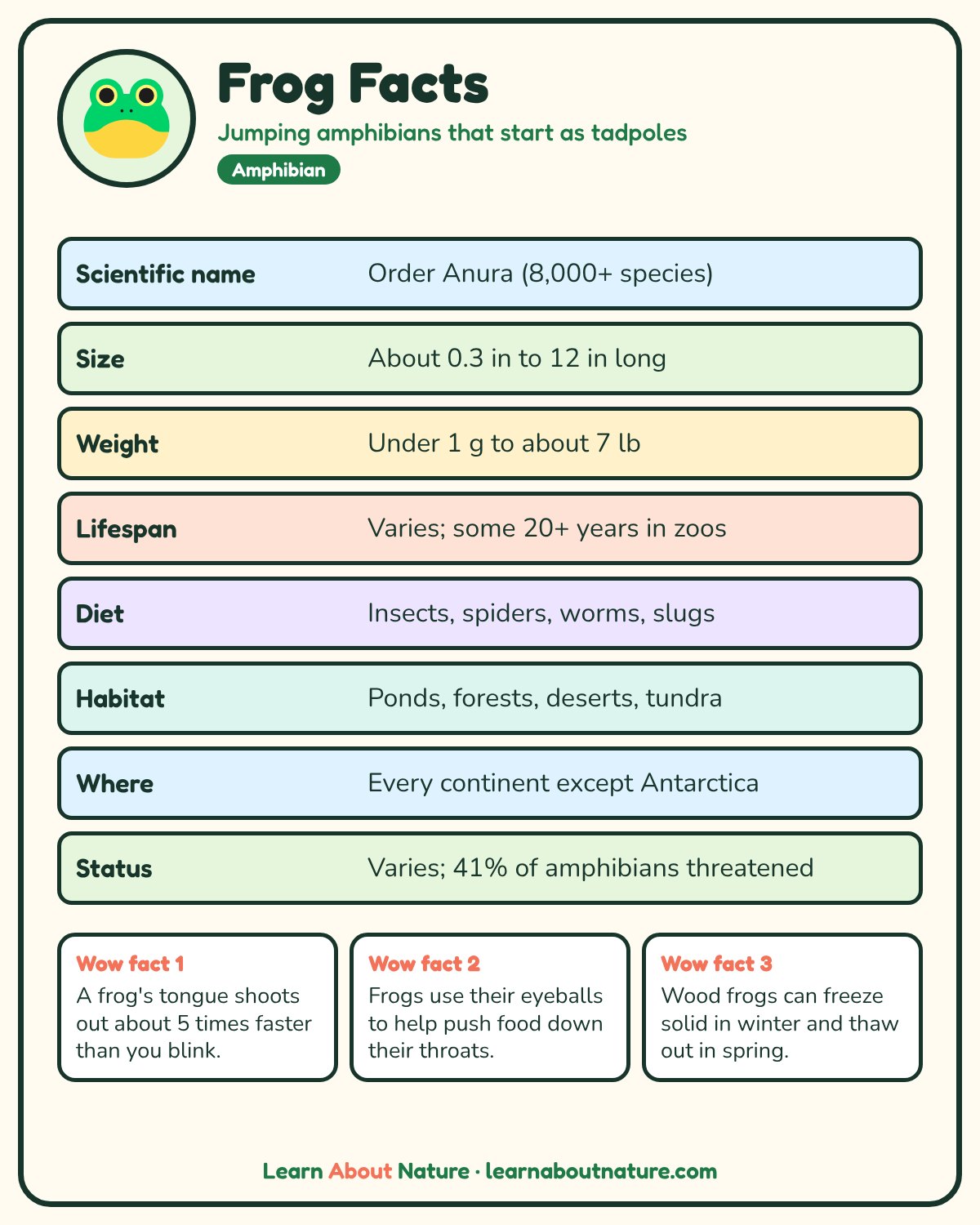
Frog Quick Facts
| Class | Amphibian |
| Order | Anura (frogs and toads) |
| Number of species | More than 8,000 |
| Smallest | About 0.3 in (7.7 mm), from Papua New Guinea |
| Largest | Goliath frog, about 12 in (30 cm) body length |
| Eggs | From a few to more than 50,000, depending on species |
| Life stages | Egg, tadpole, froglet, adult |
| Baby name | Tadpole |
| Group name | Army |
| Conservation | Varies by species; about 41% of amphibians threatened |
What Is a Frog?
A frog is an amphibian, a group of animals that also includes toads, salamanders, newts and caecilians. Most amphibians spend part of their lives in water and part on land. Frogs and toads belong to the order Anura, and scientists have named more than 8,000 species.
Frogs are cold-blooded, which means their body temperature changes with their surroundings. Adults have no tail, a wide mouth, big bulging eyes and strong back legs for jumping and swimming.
Frogs come in many sizes. One of the smallest, a frog from Papua New Guinea, is only about 0.3 inches (7.7 mm) long, small enough to sit on a fingernail. The biggest, the goliath frog of West Africa, can be about 12 inches (30 cm) long from nose to rump and weigh around 7 pounds (3.3 kg).
Where Do Frogs Live?
Frogs live on every continent except Antarctica. Most live in or near fresh water, such as ponds, lakes, streams and marshes, because their skin needs to stay moist and most species lay their eggs in water.
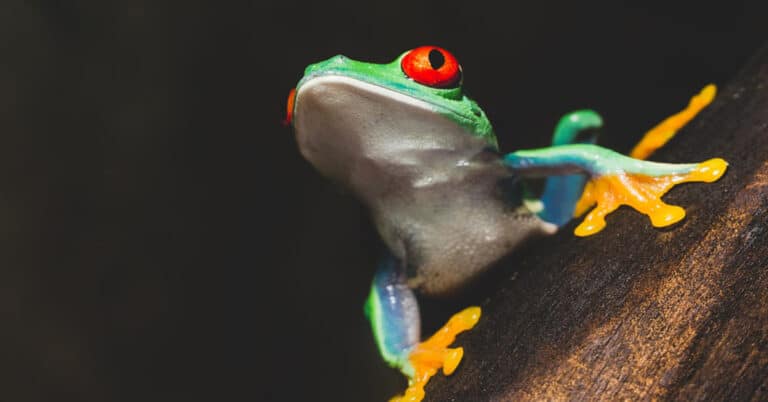
Frogs also live in rain forests, grasslands, deserts and even the cold tundra. Tree frogs climb high in the branches with sticky toe pads. Some desert frogs stay buried underground during dry times and come out after rain. The waxy tree frog of South America spreads a waxy coating over its skin to keep from drying out.
What Do Frogs Eat?
Adult frogs are carnivores. Most eat insects, spiders, worms and slugs. Bigger frogs can catch larger animals, such as mice, small birds and small reptiles.
Many frogs hunt by sitting still and waiting. When an insect comes close, the frog flicks out its sticky tongue. A frog’s tongue shoots out about five times faster than a person can blink. It is very soft, so it wraps around the prey, and special sticky saliva helps it hold on.
Frogs swallow their food whole. When a frog swallows, its eyes sink down into its head. Scientists found that this helps push the food down the frog’s throat.
Body, Skin and Senses
A frog’s skin is thin and moist and covered with glands that make slippery mucus. Frogs can breathe through their skin as well as with their lungs. They also take in water through their skin, so they do not need to drink with their mouths.
Frog legs are built for action. Some frogs can jump more than 20 times their own body length. Webbed back feet help many frogs swim.
Frogs have large eyes that help them spot moving prey and danger. They also have good hearing, and each species has its own call. Some frog calls can be heard about a mile away.
Life Cycle: From Egg to Tadpole to Frog
Most frogs go through a big change called metamorphosis. Here are the main stages:
- Eggs: a female frog lays her eggs, usually in water. Depending on the species, she may lay just a few eggs or more than 50,000. The eggs hatch after a few days to a few weeks.
- Tadpole: a baby frog, called a tadpole, lives in water, breathes with gills and swims with its tail.
- Froglet: the tadpole grows back legs, then front legs. Its lungs develop, and its tail shrinks as the body takes it in.
- Adult frog: the young frog leaves the water with legs, lungs and no tail. Metamorphosis takes anywhere from about two months to three years, depending on the species and the weather.
Frog vs Toad: What’s the Difference?
All toads are really a kind of frog, but people use the word “toad” for frogs with certain features. These are rough guides, and there are exceptions.
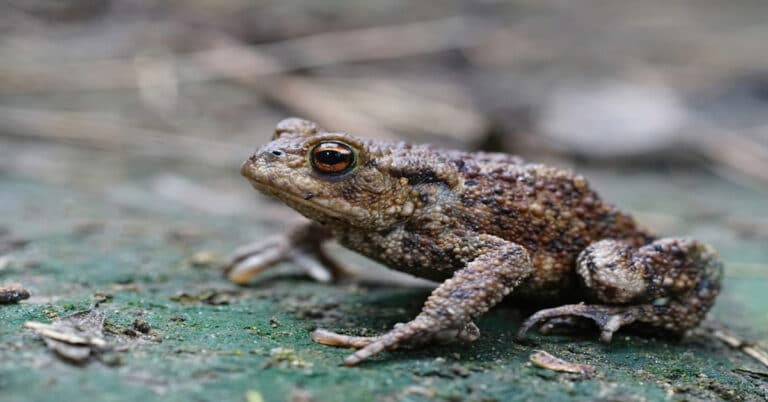
- Skin: frogs usually have smooth, moist skin. Toads have dry, bumpy skin that looks warty.
- Legs: frogs have long back legs for big leaps. Toads have shorter legs and a squat body, and they take small hops or walk.
- Home: frogs usually stay near water. Toads can live farther from water because their skin holds moisture better.
- True toads: scientists call only members of one family, the Bufonidae, “true toads.”
Surprising Survival Skills
The wood frog of North America has one of the strangest tricks in the animal world. It spends the winter in the leaf litter on the forest floor, and in places like Alaska it can stay frozen for up to eight months a year. Ice forms around its organs and under its skin, and its heart stops beating.
How does it survive? Before freezing, the frog’s liver sends out lots of sugar into its cells. The sugar works like antifreeze, keeping ice from forming inside the cells. In spring, the frog thaws from the inside out. Its heart starts again first, then its brain and finally its legs.
Other frogs protect themselves with poison. The golden poison frog, which lives in rain forests on the Pacific coast of Colombia, is only about 2 inches (6 cm) long but has powerful toxins in its skin. It seems to make these from the small insects it eats. Frogs raised in zoos on ordinary food are not poisonous.
Threats and Conservation Status
Frogs are in more trouble than almost any other group of animals. A 2023 study of the world’s amphibians found that about 41 percent of the species assessed are threatened with extinction.
The biggest threat is habitat loss, as wetlands and forests are cleared for farms and buildings. A disease caused by the chytrid fungus has wiped out many frog populations by growing on their thin skin. Climate change, pollution and collecting also harm frogs.
Conservation status varies by species. On the IUCN Red List, the golden poison frog of Colombia is Endangered (assessed in 2017), and the goliath frog is also Endangered (assessed in 2019). Many common frogs are listed as Least Concern. Zoos breed some of the rarest frogs and release them back into the wild.
Fun Facts About Frogs
- Wood frogs can freeze almost solid in winter. Their hearts stop beating, and in spring they thaw out and hop away.
- Some frogs can jump more than 20 times the length of their own bodies.
- A group of frogs can be called an army.
- Frogs breathe through their skin, which is one reason pollution in water can harm them quickly.
- When a frog catches prey, its stretchy tongue works a bit like a bungee cord.
Fast Facts for Young Readers
- A frog is an amphibian.
- Frogs live near ponds, streams and in forests.
- Frogs catch bugs with their sticky tongues.
- Baby frogs are called tadpoles.
- Tadpoles grow legs and lose their tails.
- Frogs can breathe through their skin.
- Toads have dry, bumpy skin, and frogs have smooth skin.
Key words: amphibian – an animal that usually lives part of its life in water and part on land, such as a frog or salamander; tadpole – the young, swimming stage of a frog, with gills and a tail; metamorphosis – a big change in body shape as an animal grows up; chytrid fungus – a fungus that grows on frogs’ skin and causes a deadly disease; gills – body parts that let an animal breathe underwater.
Try this: Draw the frog life cycle as a circle with four stages: eggs, tadpole, froglet and adult frog. Add arrows between them and write one sentence about what changes at each stage.
Related Guides
- Fun frog facts
- Frog Anatomy
- Komodo Dragon facts for kids
- Axolotl facts for kids
- Salamander facts for kids
- Crocodile facts for kids
- All animal facts for kids
Frog FAQs
What is the difference between a frog and a toad?
Frogs usually have smooth, moist skin and long back legs for jumping, and they stay near water. Toads usually have dry, bumpy skin, shorter legs and a squat body, and they can live farther from water. All toads are technically a kind of frog.
How does a tadpole turn into a frog?
A tadpole hatches from an egg and lives in water, breathing with gills. As it grows, it develops back legs and then front legs. Its lungs form, and its tail shrinks away. This change, called metamorphosis, takes about two months to three years, depending on the species.
What do frogs eat?
Most adult frogs eat insects, spiders, worms and slugs. Larger frogs can also eat mice, small birds and small reptiles. Many frogs sit still and wait, then catch their prey with a fast, sticky tongue and swallow it whole.
Can frogs breathe underwater?
Tadpoles breathe underwater with gills. Adult frogs have lungs, but they can also take in oxygen through their thin, moist skin. This skin breathing helps frogs stay underwater for a while, but most adult frogs still need to come up for air.
Why are frogs endangered?
Many frogs are threatened by habitat loss, a disease caused by the chytrid fungus, pollution and climate change. A 2023 study found that about 41 percent of amphibian species assessed are threatened with extinction. Some frogs, such as the golden poison frog, are listed as Endangered.
Sources: Frog Fact Sheet – PBS Nature; Frog – Britannica; What’s the Difference Between a Frog and a Toad? – Britannica; Amphibian Species Numbers – AmphibiaWeb; Wood Frog: Biological Miracle – Gates of the Arctic National Park, NPS; Climate change emerges as major driver of amphibian declines globally – Re:wild

Randi Jones is the owner and founder of the Nature Gift Store, an online retailer specializing in nature-themed gifts, educational science projects, live animal nature kits and real butterfly artwork. A biology graduate who fell in love with insects, she founded the company in 2001 to make active learning about nature fun, accessible and engaging for children and adults. Her store offers real butterfly frames, home and garden decor and educational live animal kits, including ant farms, worm farms, tadpoles, ladybugs and hermit crabs, and she runs a bug museum in Washington featuring live animals like Eddie the Iguana alongside other reptiles and insects. Randi wrote most of the guides on this site. They first appeared on her long-running nature sites, including Monarch-Butterfly.com, Ladybug-Life-Cycle.com, Frog-Life-Cycle.com, Dragonfly-Site.com and Butterfly Pictures, which have now been brought together here at Learn About Nature.