Komodo Dragon Facts for Kids: Habitat, Diet and Fun Facts
Quick answer: A Komodo dragon is the world’s largest living lizard, a type of monitor lizard that can grow about 10 feet (3 meters) long. It lives only on a few islands in Indonesia and eats deer, wild pigs, water buffalo and dead animals. Its bite delivers venom that stops the prey’s blood from clotting.
Picture a lizard longer than a sofa, with a swinging tail, sharp claws and a yellow forked tongue flicking in and out. That is a Komodo dragon. It is not a mythical beast, but it is the closest thing to a real dragon alive today.
Komodo dragons are powerful hunters that can take down prey much bigger than themselves. They also have some surprising secrets, from venom in their mouths to babies that live in trees. Here are the facts about where they live, what they eat and why they are now Endangered.
Teachers and students: you’re welcome to use this fact sheet in lessons and projects with credit to Learn About Nature.
Free printable: Download the Komodo Dragon fact file worksheet (PDF) – draw the animal, fill in the facts and match key words. Answer key included.
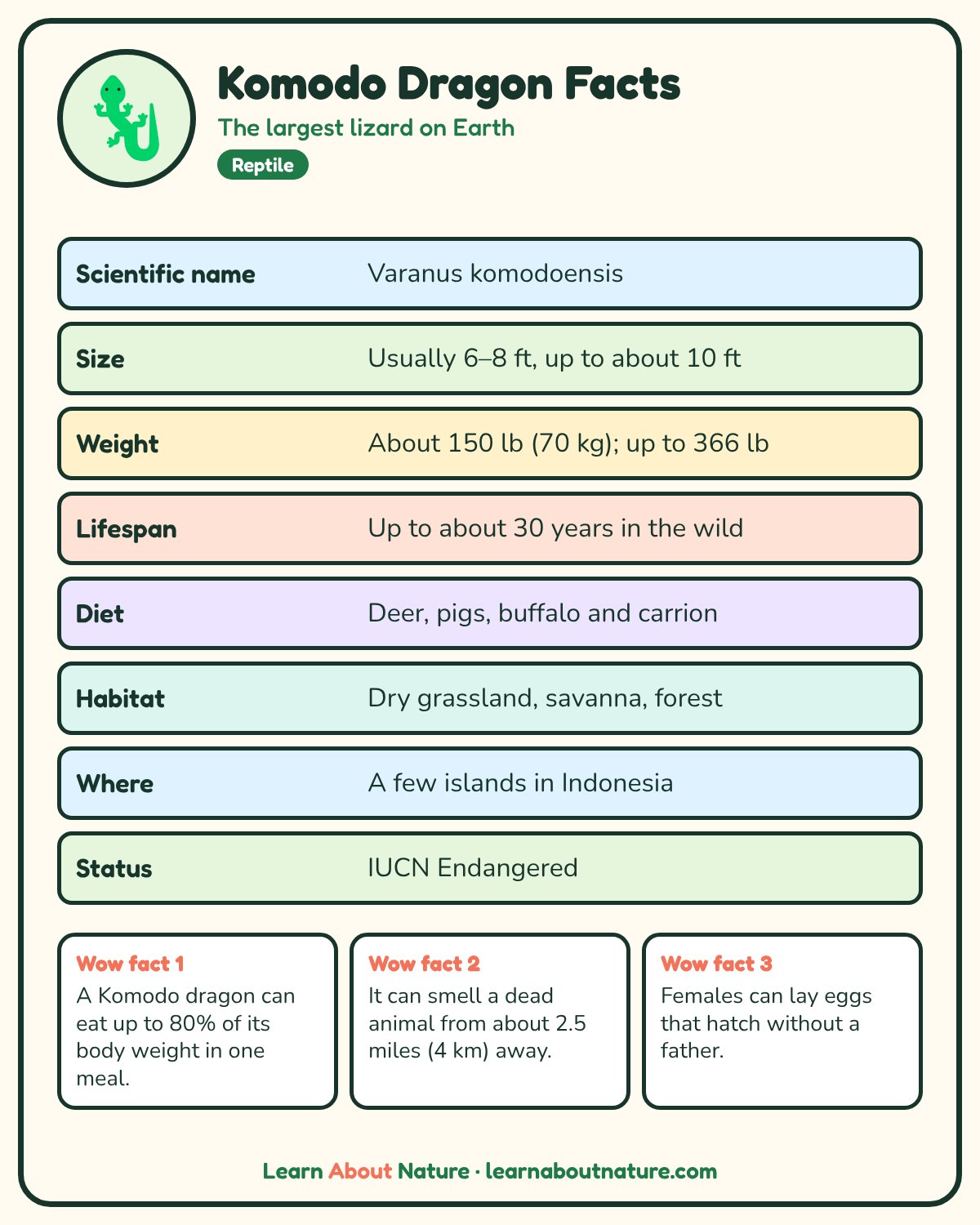
Komodo Dragon Quick Facts
| Class | Reptile |
| Family | Varanidae (monitor lizards) |
| Scientific name | Varanus komodoensis |
| Length | Usually 6–8 ft (1.8–2.4 m); record 10.3 ft (3.13 m) |
| Weight | About 150 lb (70 kg); record 366 lb (166 kg) |
| Top speed | About 10–13 mph (16–20 km/h) in short bursts |
| Eggs per clutch | About 20–30 |
| Incubation | About 7–9 months |
| Baby name | Hatchling |
| Conservation | Endangered (IUCN Red List, 2021) |
What Is a Komodo Dragon?
A Komodo dragon is a reptile and the largest member of the monitor lizard family. Its scientific name is Varanus komodoensis. Monitor lizards live in warm parts of Africa, Asia and Australia, but none of the others come close to the Komodo dragon’s size.
Adults are usually about 6 to 8 feet (1.8 to 2.4 meters) long. Males grow bigger than females. The longest one ever reliably measured was 10.3 feet (3.13 meters) long and weighed 366 pounds (166 kg). A typical wild adult weighs about 150 pounds (70 kg).
Komodo dragons have thick, scaly skin strengthened by tiny bones called osteoderms, which work like a suit of chain mail.
Where Do Komodo Dragons Live?
Komodo dragons live in the wild only in Indonesia, on Komodo Island and a few nearby islands: Rinca, Flores, Gili Motang and Nusa Kode. Together, their home covers less than 350 square miles (900 square kilometers).
These islands are hot and fairly dry. Komodo dragons live in open grassland, savanna, dry tropical forest and along beaches. On hot days they rest in the shade, and at night they sleep in burrows they dig to keep their body temperature steady.
Much of their range is protected inside Komodo National Park, set up in 1980. The park is also a UNESCO World Heritage Site.
What Do Komodo Dragons Eat?
Komodo dragons are carnivores. Adults eat deer, wild pigs, goats and even water buffalo and horses. Deer are their favorite prey. They also eat a lot of carrion, which means animals that are already dead.
Young dragons eat smaller animals such as insects, small lizards, snakes, birds and eggs. As they grow, they switch to bigger prey.
A Komodo dragon can eat up to 80 percent of its own body weight in one meal. It tears off large chunks and swallows them whole, leaving very little behind. After a big meal, it may not need to eat again for weeks.
Body, Senses and How They Hunt
Komodo dragons hunt by ambush. A dragon lies still beside a trail, sometimes for hours, then lunges at passing prey. It can run in short bursts at about 10 to 13 miles (16 to 20 km) per hour. Komodo dragons are also strong swimmers.
Their bite is not especially strong for their size. Instead, they use sharp, curved, saw-edged teeth and powerful neck muscles to make deep cuts. Scientists have found a venom gland in the lower jaw. The venom keeps blood from clotting, so bitten prey loses a lot of blood and goes into shock. The dragon may follow a wounded animal for days until it weakens.
Smell is the Komodo dragon’s most important sense. It flicks its long, yellow, forked tongue to collect scent from the air, then touches it to a special organ in the roof of its mouth called the Jacobson’s organ. This way it can smell a dead animal from about 2.5 miles (4 km) away. It can also see moving objects up to about 985 feet (300 meters) away, but it hears poorly.
Eggs and Baby Komodo Dragons
Komodo dragons mate from about May to August. Males sometimes wrestle, standing up on their back legs and grappling until one is pushed down.
A female lays about 20 to 30 eggs, each about the size of a grapefruit. She often digs her nest into a hillside or uses an old mound nest built by a bird called a megapode. The eggs take about 7 to 9 months to hatch, and the parents do not care for the young.
The babies, called hatchlings, are about 12 to 16 inches (30 to 40 cm) long and weigh less than 3.5 ounces (100 grams). Because adult dragons will eat young dragons, hatchlings climb trees and spend their first few years living in the branches. When they are about 4 or 5 years old and big enough to be safer, they move down to live on the ground.
Komodo dragons can live about 30 years in the wild.
Virgin Births
In 2006, scientists made a surprising discovery about two female Komodo dragons in zoos in England. Each one laid eggs that hatched, even though one of them had never been kept with a male.
DNA tests showed the babies had no father. This kind of reproduction is called parthenogenesis. Because of the way Komodo dragon chromosomes work, babies born this way are always male. Scientists think this ability may help a single female start a new population if she reaches an island alone.
Behavior: How Komodo Dragons Live
Komodo dragons usually live alone. They come together when several gather at a large carcass to feed. Big dragons eat first, and smaller ones wait their turn or keep their distance.
Young dragons sometimes roll in dung to cover their scent, which may help keep hungry adults from noticing them. Like other reptiles, Komodo dragons are cold-blooded. They bask in the sun in the morning to warm up and are most active during the day.
Threats and Conservation Status
Adult Komodo dragons have no natural predators except other Komodo dragons. Their biggest dangers come from people and from a changing climate.
In 2021, the Komodo dragon was moved from Vulnerable to Endangered on the IUCN Red List. Fewer than 1,400 adults are thought to remain. Scientists warn that rising sea levels caused by climate change could flood much of their low-lying habitat in the coming decades. Forest clearing for farms, poaching of the deer they eat and wild dogs and cats that prey on young dragons are also problems.
Most wild Komodo dragons live within protected parks, and their numbers in those parks are watched closely. Zoos around the world breed Komodo dragons to keep a healthy backup population.
Fun Facts About Komodo Dragons
- The Komodo dragon is Indonesia’s national animal.
- Western scientists first described the Komodo dragon in 1912.
- In 1992, the Smithsonian’s National Zoo became the first zoo outside Indonesia to hatch Komodo dragons.
- A Komodo dragon can throw up the contents of its stomach to make itself lighter if it needs to escape.
- Komodo dragons can be dangerous to people, so visitors to Komodo National Park must stay with trained rangers.
Fast Facts for Young Readers
- The Komodo dragon is the biggest lizard in the world.
- It lives on a few islands in Indonesia.
- Komodo dragons eat deer, pigs and dead animals.
- They smell with their long, forked tongues.
- Baby Komodo dragons hatch from eggs.
- Young dragons live in trees to stay safe.
- Komodo dragons are Endangered.
Key words: monitor lizard – a family of large lizards with long necks, strong claws and forked tongues; carrion – the meat of an animal that is already dead; venom – a harmful substance an animal puts into another animal with a bite or sting; parthenogenesis – when a female has babies without a male; hatchling – a baby animal that has just come out of its egg; Jacobson’s organ – a special smelling organ in the roof of the mouth of many reptiles.
Try this: Use a tape measure to mark out 10 feet (3 meters) on the floor to show how long the biggest Komodo dragon was. Then lie down beside it and compare your height with the dragon’s length.
Related Guides
- Crocodile facts for kids
- Salamander facts for kids
- Frog facts for kids
- Axolotl facts for kids
- All animal facts for kids
Komodo Dragon FAQs
Are Komodo dragons venomous?
Yes. Scientists have found a venom gland in the Komodo dragon’s lower jaw. The venom stops blood from clotting, which makes bitten prey lose blood quickly and go into shock. Bacteria in the dragon’s mouth may also cause infection, but venom and deep wounds do most of the work.
How big is a Komodo dragon?
Adult Komodo dragons are usually about 6 to 8 feet long, and males are bigger than females. A typical wild adult weighs about 150 pounds. The largest one reliably measured was 10.3 feet long and weighed 366 pounds, making it the biggest lizard on record.
Where do Komodo dragons live?
Wild Komodo dragons live only in Indonesia, on Komodo, Rinca, Flores, Gili Motang and Nusa Kode. They live in dry grasslands, savanna and tropical forest. Many are protected in Komodo National Park, which was set up in 1980.
Are Komodo dragons endangered?
Yes. In 2021, the IUCN Red List moved the Komodo dragon from Vulnerable to Endangered. Fewer than 1,400 adults are thought to remain. Rising sea levels may flood much of their habitat, and habitat loss and poaching of their prey are also threats.
Can a Komodo dragon have babies without a male?
Yes. Female Komodo dragons can sometimes lay eggs that develop without being fertilized, a process called parthenogenesis. Scientists confirmed this in 2006 using DNA tests on babies hatched at two English zoos. Babies produced this way are always male.
Sources: Komodo dragon – Smithsonian’s National Zoo & Conservation Biology Institute; How Dangerous Are Komodo Dragons? – Smithsonian’s National Zoo; Komodo Dragon – San Diego Zoo Wildlife Alliance; Komodo dragon is now listed as Endangered – Natural History Museum, London; Virgin births for giant lizards – Nature News; Varanus komodoensis – IUCN Red List

Nato is a content writer and researcher with a background in psychology who’s eager to explore the wonders of nature. As a travel enthusiast and animal lover, she hopes to inspire others to discover and cherish the beauty and importance of the natural world. She also writes about the history of candy and snacks for Snack History and about food and healthy eating for The Fitchen.