Axolotl Facts for Kids: Habitat, Diet and Fun Facts

Quick answer: An axolotl is a salamander from Mexico that stays in its young, water-living form all its life, keeping feathery gills and a finned tail. Wild axolotls survive only in the canals of Lake Xochimilco in Mexico City, where they eat worms, insect larvae and small crustaceans. They can regrow lost body parts.
An axolotl (say it “AX-oh-lot-ul”) looks like it is always smiling. It has a wide, flat head, tiny eyes and pink or dark feathery frills sticking out behind its head. Those frills are gills, and they are the key to what makes this amphibian so unusual.
Most salamanders change shape as they grow up and move onto land. Axolotls do not. They stay in the water, keep their baby features and still grow into adults that can have young of their own. Sadly, this amazing animal is now Critically Endangered in the wild.
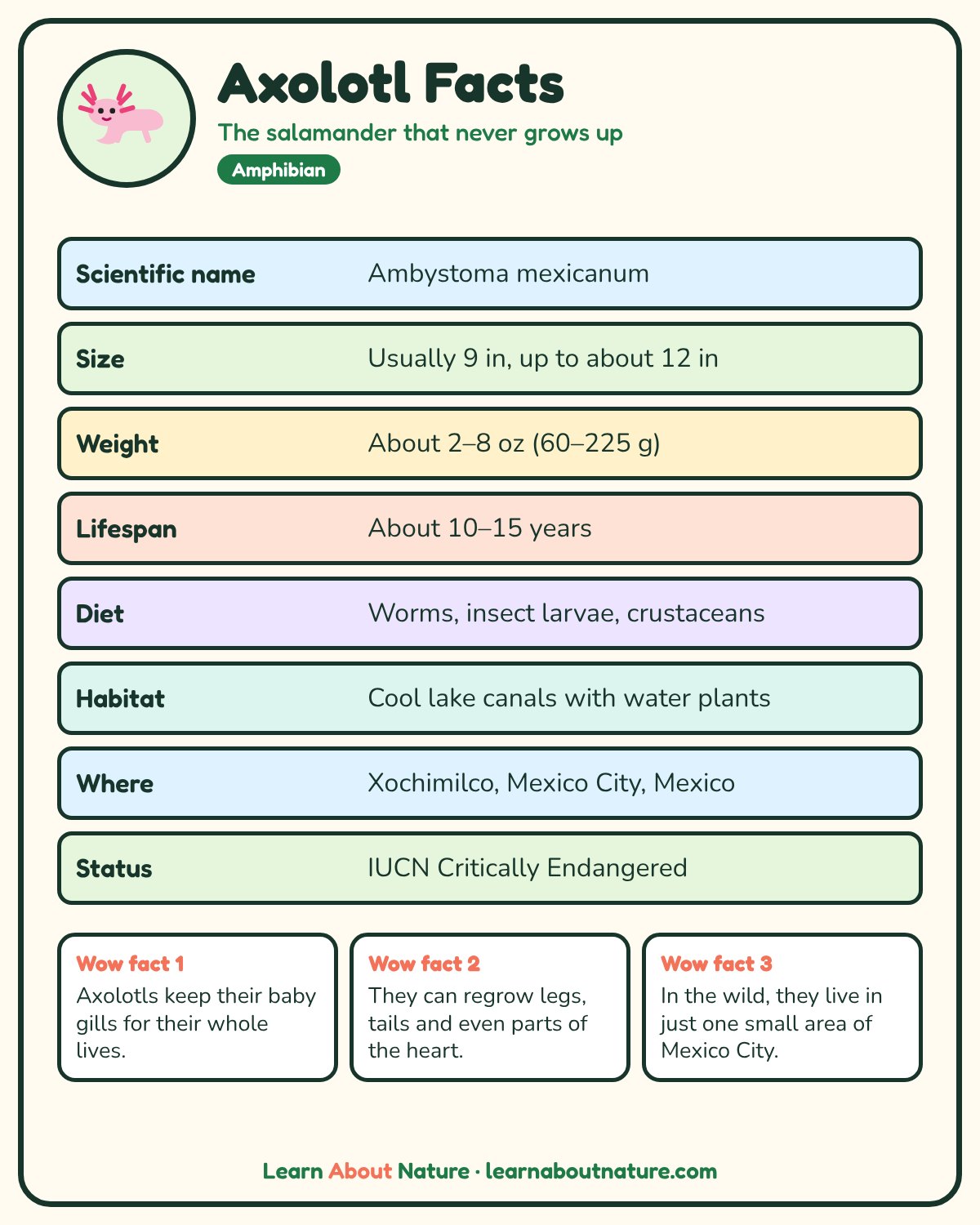
Teachers and students: you’re welcome to use this fact sheet in lessons and projects with credit to Learn About Nature.
Free printable: Download the Axolotl fact file worksheet (PDF) – draw the animal, fill in the facts and match key words. Answer key included.
Axolotl Quick Facts
| Class | Amphibian |
| Order | Caudata (salamanders and newts) |
| Scientific name | Ambystoma mexicanum |
| Size | Usually about 9 in (23 cm), up to about 12 in (30 cm) |
| Lifespan | About 10–15 years |
| Diet | Worms, insect larvae, crustaceans, snails, small fish |
| Eggs per clutch | A few hundred, up to about 1,000 |
| Hatching time | About 2 weeks |
| Baby name | Larva (plural larvae) |
| Conservation | Critically Endangered (IUCN Red List) |
What Is an Axolotl?
An axolotl is an amphibian, the group of animals that includes frogs, toads, newts and salamanders. More exactly, it is a kind of mole salamander. Its scientific name is Ambystoma mexicanum.
The name axolotl comes from Nahuatl, the language of the Aztecs. It is often translated as “water dog” or “water monster” and is linked to Xolotl, an Aztec god. People in Mexico sometimes call it ajolote.
Axolotls are famous for neoteny. This means they keep their young, larval features, such as gills and a fin along the tail, even when they are fully grown adults.
Axolotls are a proud symbol of Mexico City. They appear in Aztec stories, in art and on Mexico’s 50-peso banknote. People living near Xochimilco once caught and ate them, but today they are protected.
Where Do Axolotls Live?
Wild axolotls are found in only one place on Earth: the Valley of Mexico, where Mexico City now stands. They once lived in two large lakes, Lake Xochimilco and Lake Chalco. Lake Chalco has been drained, and much of Lake Xochimilco has disappeared too.
Today, wild axolotls survive mainly in the canals of Xochimilco, a network of waterways in the south of Mexico City. They like cool, still or slow-moving water with plenty of water plants. They spend their whole lives underwater, often resting on the muddy bottom.
What Do Axolotls Eat?
Axolotls are carnivores. In the wild, they eat worms, insect larvae, small crustaceans, snails, tadpoles and small fish.
They do not chase their food very far. Instead, an axolotl opens its mouth quickly, and the sudden rush of water sucks prey inside. Axolotls sometimes swallow small bits of gravel along with their food, which may help grind up food in the stomach.
Body, Gills and Senses
An adult axolotl is usually about 9 inches (23 cm) long and can reach about 12 inches (30 cm). It has four short legs with thin toes, a long tail with a fin, and smooth skin.
The most eye-catching parts are the three pairs of external gills on each side of the head. Their feathery branches take oxygen from the water. Axolotls also have lungs and sometimes swim up to gulp air at the surface, and they can take in some oxygen through their skin.
Wild axolotls are usually dark gray, brown or olive with speckles, which helps them hide on muddy lake bottoms. The pink, white, golden and other colors often seen in pictures have mostly been bred by people. Axolotls have small eyes with no movable eyelids, and they also find food by smell and by sensing movement in the water.
Life Cycle and Babies
In the wild, axolotls breed in late winter and spring. After a courtship dance, the male leaves small packets of sperm on the bottom, and the female picks one up to fertilize her eggs inside her body.
The female then lays her eggs one at a time, sticking them to plants or rocks. She may lay a few hundred and up to about 1,000 eggs. The parents do not look after them. The eggs hatch in about two weeks into tiny larvae that swim and hunt right away.
The larvae grow legs as they get bigger, but they never lose their gills or tail fin. Axolotls can start breeding at about one year old. They can live about 10 to 15 years.
Amazing Regeneration
Axolotls are famous among scientists for regeneration, the ability to regrow lost body parts. An axolotl can regrow a whole leg, including bones, muscles and nerves, without leaving a scar.
They can also repair parts of the tail, spinal cord, heart, jaws and even parts of the brain. Because of this, axolotls are studied in laboratories around the world. Scientists hope that learning how axolotls heal may one day help doctors treat people.
Scientists have bred axolotls in laboratories for more than 150 years, so they are some of the best-studied amphibians on Earth. Captive axolotls should never be released into the wild, because they could spread disease to wild animals.
Threats and Conservation Status
The axolotl is listed as Critically Endangered on the IUCN Red List, and its population is decreasing. The IUCN estimates that only about 50 to 1,000 adult axolotls are left in the wild.
As Mexico City grew, the lakes were drained and the remaining canals became polluted with sewage, fertilizers and trash. Fish such as tilapia and carp were added to the water, and they eat young axolotls and compete with adults for food. Surveys in Xochimilco have found far fewer axolotls than in the 1990s.
Axolotls are kept as pets and in laboratories in many places, so there are many in captivity, but those animals do not replace the wild population. Local farmers and scientists are working to protect them by restoring chinampas, the traditional floating farm plots of Xochimilco, and creating cleaner canals where axolotls can live safely.
Axolotl vs. Other Salamanders
The axolotl’s closest relatives are other mole salamanders, such as the tiger salamander of North America. A young tiger salamander also starts life in water with feathery gills. As it grows, it goes through metamorphosis: its gills shrink, its tail fin disappears, its eyelids develop and it walks out onto land to live under logs and in burrows.
An axolotl skips that change. Scientists think this is linked to the hormones that normally trigger metamorphosis. Living in deep, cool lakes with plenty of food may have made staying in the water a good way to survive, so the axolotl’s ancestors simply never left.
This means an adult axolotl is a bit like a giant tadpole that can lay eggs. It is a good example of how animals can adapt in very different ways to the places where they live.
Fun Facts About Axolotls
- Axolotls are salamanders, not fish, even though they live underwater and have gills.
- Under rare conditions, such as treatment with hormones in a lab, an axolotl can change into a land-living adult form.
- Axolotls have tiny teeth, but they swallow food whole.
- Mexico City has a museum devoted to axolotls, called the Anfibium.
- The mouth curves upward, so axolotls always seem to be smiling.
Fast Facts for Young Readers
- An axolotl is a salamander from Mexico.
- Axolotls keep their feathery gills even as grown-ups.
- They live underwater all their lives.
- Axolotls can grow back a lost leg.
- They suck in worms and tiny animals to eat.
- Wild axolotls are usually dark, not pink.
- Very few axolotls are left in the wild.
Key words: neoteny – keeping young, baby-like features as an adult; external gills – feathery gills on the outside of the body that take oxygen from water; regeneration – growing back a lost body part; amphibian – a cold-blooded animal, such as a frog or salamander, that usually starts life in water; Critically Endangered – the highest risk level for animals still living in the wild; chinampa – a traditional farm plot built up in the canals of Xochimilco.
Try this: Draw an axolotl and label its gills, tail fin and legs. Then draw a land-living salamander next to it and circle the features the axolotl kept from its baby stage.
Related Guides
- Snake facts for kids
- Crocodile facts for kids
- Komodo Dragon facts for kids
- Salamander facts for kids
- All animal facts for kids
Axolotl FAQs
Why are axolotls endangered?
Their home in Mexico City has shrunk as lakes were drained and canals became polluted. Introduced fish such as tilapia and carp eat young axolotls and compete for food. The IUCN lists the axolotl as Critically Endangered and estimates only about 50 to 1,000 adults remain in the wild.
Can axolotls regrow body parts?
Yes. Axolotls can regrow whole legs, tails and parts of the spinal cord, heart and brain, usually without scarring. Their healing powers are so unusual that scientists around the world study them to learn how regeneration works.
Where do axolotls live in the wild?
Wild axolotls live only in the Valley of Mexico. They once lived in Lake Xochimilco and Lake Chalco, but Chalco has been drained. Today they survive mainly in the canals of Xochimilco, in the southern part of Mexico City.
Are axolotls fish?
No. Even though they live underwater and have gills, axolotls are amphibians. They are a type of salamander, related to newts and frogs. They have four legs, and they keep their larval gills and tail fin for life because of a trait called neoteny.
What color are axolotls in the wild?
Wild axolotls are usually dark gray, brown or olive green with darker speckles, which helps them blend in on muddy canal bottoms. The pink, white and golden axolotls seen in photos have mostly been bred in captivity.
Sources: Axolotl – San Diego Zoo Wildlife Alliance; Axolotl – National Geographic; Axolotl population and conservation – SDZWA Library fact sheet; Ambystoma mexicanum – AmphibiaWeb; Ambystoma mexicanum – IUCN Red List

Nato is a content writer and researcher with a background in psychology who’s eager to explore the wonders of nature. As a travel enthusiast and animal lover, she hopes to inspire others to discover and cherish the beauty and importance of the natural world. She also writes about the history of candy and snacks for Snack History and about food and healthy eating for The Fitchen.