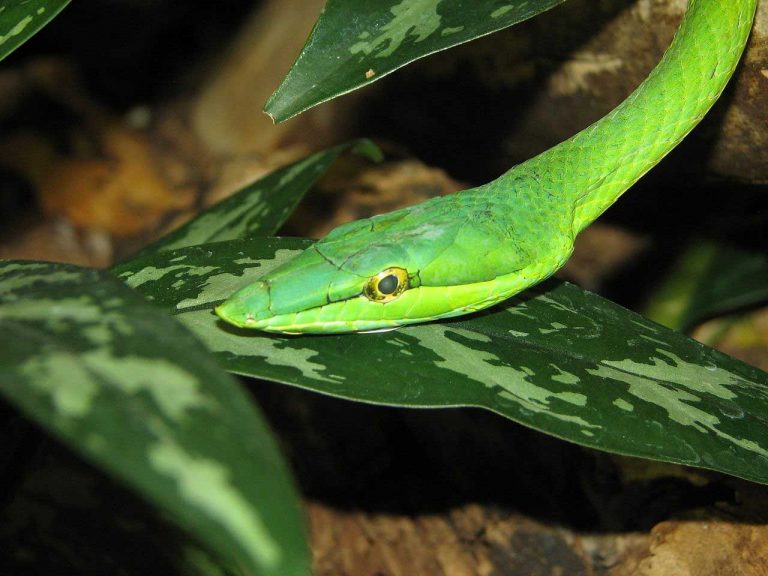
Snake Facts for Kids: Habitat, Diet and Fun Facts
Quick answer: A snake is a reptile with a long, legless body covered in scales. Snakes live on every continent except Antarctica, in forests, deserts, grasslands and even the ocean. All snakes eat meat, such as rodents, eggs, fish and insects, and they swallow their food whole. Snakes smell by flicking their forked tongues.
Snakes have no legs, no eyelids and no outside ears, yet they are some of the most successful animals on Earth. They slither across deserts, climb trees, swim in rivers and even live in the open ocean.
Some people feel nervous around snakes, but most snakes are shy and would much rather slip away than meet a person. Here you will learn how snakes move, how they find food, how they grow and why they matter in nature.
Teachers and students: you’re welcome to use this fact sheet in lessons and projects with credit to Learn About Nature.
Free printable: Download the Snake fact file worksheet (PDF) – draw the animal, fill in the facts and match key words. Answer key included.
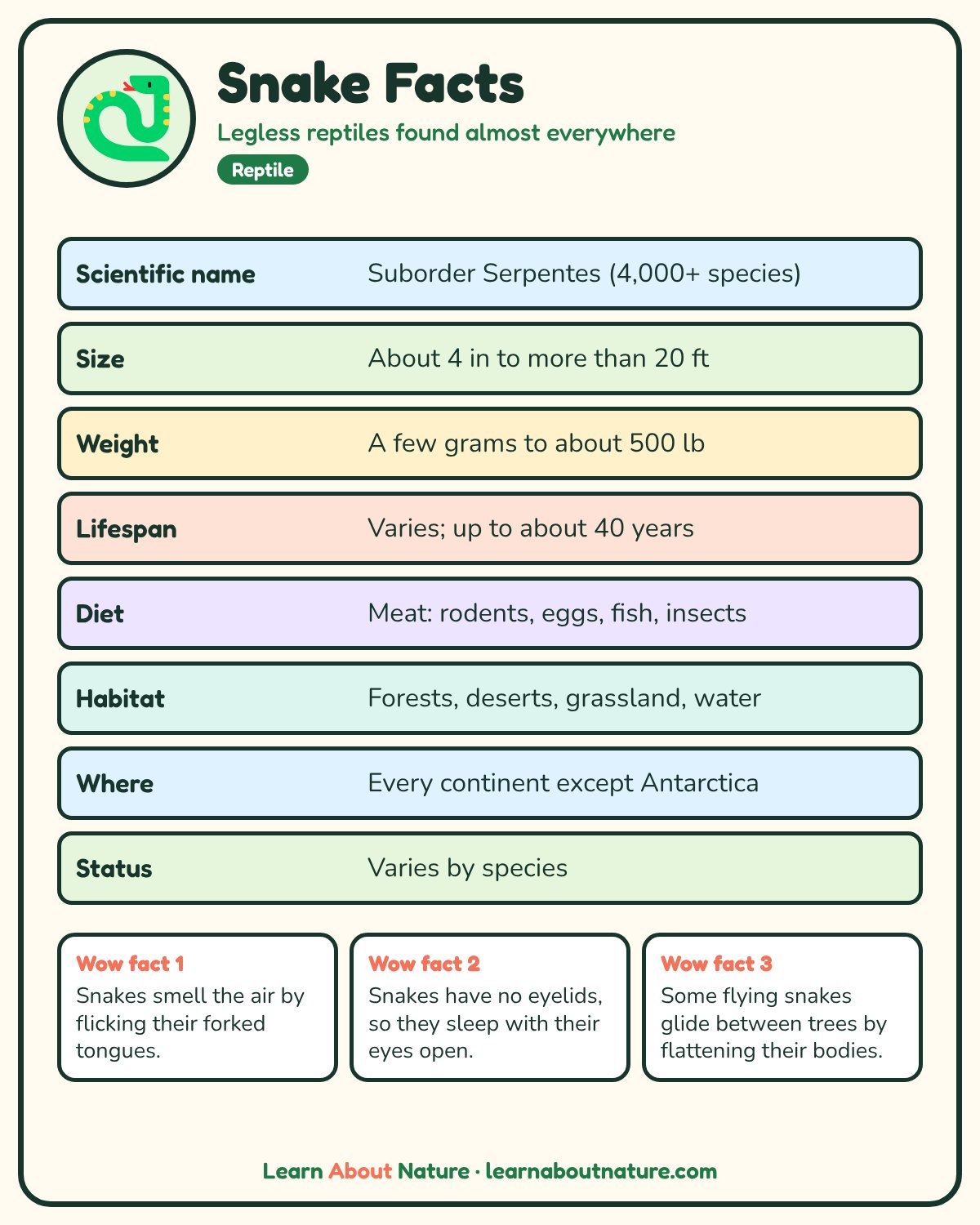
Snake Quick Facts
| Class | Reptile |
| Group | Suborder Serpentes |
| Number of species | More than 4,000 |
| Smallest | Barbados threadsnake, about 4 in (10 cm) |
| Longest | Reticulated python, more than 20 ft (6 m) |
| Heaviest | Green anaconda, up to about 500 lb (227 kg) |
| Eggs per clutch | Usually 2–16; some lay more than 50 |
| Shedding | Adults shed about 2–4 times a year |
| Lifespan | Varies; up to about 40 years in some species |
| Conservation | Varies by species; e.g. king cobra Vulnerable, golden lancehead Critically Endangered (IUCN) |
What Is a Snake?
A snake is a reptile, just like lizards, turtles and crocodiles. Like other reptiles, snakes have scaly skin and are cold-blooded, which means their body temperature changes with their surroundings. Snakes warm up in the sun and cool down in the shade.
There are more than 4,000 kinds of snakes. They come in many sizes. The smallest, a threadsnake from the island of Barbados, is only about 4 inches (10 cm) long. The reticulated python of Southeast Asia is the longest snake and can grow to more than 20 feet (6 meters). The green anaconda of South America is the heaviest, weighing up to about 500 pounds (227 kg).
Where Do Snakes Live?
Snakes live on every continent except Antarctica. You can find them in rain forests, deserts, grasslands, swamps and mountains, and some live higher than 10,000 feet (3,000 meters).
Many snakes live on the ground or burrow underground. Others live in trees, and some live in fresh water. Sea snakes spend their lives in warm oceans and swim by paddling with their flat tails.
Snakes that live where winters are cold often go into a deep rest during the coldest months, sometimes sharing an underground den with other snakes.
What Do Snakes Eat?
All snakes are carnivores, which means they eat other animals. Depending on the species, snakes eat rodents, birds, eggs, frogs, fish, lizards, insects, slugs and even other snakes. The king cobra eats mostly other snakes.
Snakes cannot chew. Instead, they swallow their food whole, usually headfirst. Their jaw bones are loosely connected and their skin can stretch, so a snake can swallow an animal wider than its own head. Backward-pointing teeth help hold the food in place.
A special tube lets a snake keep breathing while it slowly swallows a big meal. After a large meal, some snakes do not need to eat again for weeks.
How Snakes Move and Sense the World
Snakes move by tightening and relaxing muscles along their long bodies. Wide scales on the belly, called ventral scales, grip the ground and push the snake forward. Some snakes move in S-shaped curves, while big, heavy snakes often creep forward in a straight line.
A snake’s forked tongue is its most important sense tool. When a snake flicks its tongue, it picks up tiny scent particles from the air and the ground. The tongue carries them to a special organ in the roof of the mouth called the Jacobson’s organ, which helps the snake “smell” its surroundings.
Snakes have no outer ears, but they can feel vibrations through the ground. Many snakes do not see very well and notice moving things best. Pit vipers, such as rattlesnakes, and some pythons and boas have special pits on their faces that sense the heat of warm-blooded animals, even in the dark.
Shedding Skin and Growing Up
Snakes keep growing all their lives, but their skin does not stretch forever. So they shed, or molt, their old skin. Before shedding, a snake’s eyes turn cloudy and blue. Then it rubs its nose on something rough and crawls out, leaving the old skin behind, often inside out. Young snakes shed often, and adults shed about two to four times a year.
Most snakes lay eggs, usually about 2 to 16 at a time, though some lay more than 50. Other snakes give birth to live babies. This is more common in snakes that live in cold places, high mountains or the sea.
Most snake parents do not look after their young, and baby snakes take care of themselves from the start. The king cobra is unusual: the female builds a nest of leaves and guards her eggs. Many snakes are grown up by 1 to 3 years old, and some can live up to about 40 years.
Venomous Snakes vs Constrictors
Snakes have two main ways of catching larger prey. Some use venom, and others use squeezing. Many snakes, such as garter snakes, simply grab small prey and swallow it.
- Venomous snakes, such as cobras, rattlesnakes and sea snakes, have special teeth called fangs that deliver venom. The venom stops prey from moving or begins to break it down.
- Constrictors, such as boas, pythons and kingsnakes, wrap their bodies around prey and squeeze until it stops breathing.
- Most snakes are not venomous. Venomous snakes use their venom mainly to catch food and to defend themselves, not to chase people.
- Because some snakes are dangerous and it can be hard to tell them apart, the safest rule is to look at wild snakes from a distance and never touch them.
Why Snakes Matter
Snakes are important parts of nature. Many eat rats and mice, which helps keep these animals from becoming too numerous, eating crops and spreading disease.
Snakes are also food for many other animals, including hawks, eagles, mongooses and some other snakes. Scientists study snake venom too, and some medicines have been developed from it.
Threats and Conservation Status
Snakes face many dangers from people. Their habitats are being cleared for farms and cities, they are hit by cars, and some are collected for the skin trade or the illegal pet trade. Many snakes are also killed by people who are afraid of them.
Because there are so many kinds of snakes, conservation status varies by species. On the IUCN Red List, the king cobra is listed as Vulnerable (assessment published in 2012). The golden lancehead, a pit viper found on just one small island off the coast of Brazil, is Critically Endangered (assessed in 2021). Many other snakes, especially common ones, are listed as Least Concern.
Protecting forests, wetlands and grasslands helps snakes, and zoos run breeding programs for some of the rarest species.
Fun Facts About Snakes
- Snakes have no eyelids. A clear scale covers and protects each eye.
- Flying snakes in Asia can glide from tree to tree by flattening their bodies and spreading their ribs.
- Spitting cobras can spray venom up to about 6 feet (2 meters) to defend themselves.
- The king cobra is the only snake known to build a nest above ground for its eggs.
- Some egg-eating snakes have special bones in their throats that crack the eggshell after they swallow the egg.
Fast Facts for Young Readers
- A snake is a reptile with no legs.
- Snakes live everywhere except Antarctica.
- Snakes smell with their forked tongues.
- Snakes swallow their food whole.
- Snakes shed their old skin as they grow.
- Most snakes hatch from eggs.
- If you see a wild snake, look but do not touch.
Key words: reptile – a cold-blooded animal with scaly skin, such as a snake, lizard, turtle or crocodile; venom – a harmful substance an animal puts into another animal with a bite or sting; constrictor – a snake that wraps around its prey and squeezes; Jacobson’s organ – a smelling organ in the roof of the mouth that reads scents picked up by the tongue; shed – to lose an old outer layer of skin so a new one can take its place; carnivore – an animal that eats other animals.
Try this: Cut a long strip of paper and draw scales on it to make a paper snake. Measure it against a tape measure and mark how long the smallest snake (4 inches) and the longest snake (more than 20 feet) would be.
Related Guides
- Snake facts
- Interesting facts about snakes
- Snake Anatomy
- Axolotl facts for kids
- Komodo Dragon facts for kids
- Frog facts for kids
- Salamander facts for kids
- All animal facts for kids
Snake FAQs
How do snakes smell?
Snakes smell mostly with their tongues. When a snake flicks its forked tongue, it collects tiny scent particles from the air and ground. The tongue then touches a special organ in the roof of the mouth, called the Jacobson’s organ, which helps the snake identify food, danger and other snakes.
Why do snakes shed their skin?
Snakes keep growing all their lives, but their outer skin does not grow with them. Shedding lets them replace old, worn skin with a fresh layer. Young snakes shed often, and adults usually shed about two to four times a year, crawling out of the old skin in one piece.
Are all snakes venomous?
No. Most snakes are not venomous. Many catch prey by grabbing it or by squeezing it, like boas and pythons. Venomous snakes, such as cobras and rattlesnakes, use venom mainly to catch food and to defend themselves. It is safest to watch any wild snake from a distance.
What is the biggest snake in the world?
The reticulated python of Southeast Asia is the longest snake and can grow to more than 20 feet long. The green anaconda of South America is the heaviest, weighing up to about 500 pounds. The smallest snake, the Barbados threadsnake, is only about 4 inches long.
Do snakes lay eggs?
Most snakes lay eggs, usually about 2 to 16 at a time, though some lay more than 50. Other snakes give birth to live young. Live birth is more common in snakes from cold places and high mountains. Most snake parents do not care for their babies.
Sources: Snakes – San Diego Zoo Wildlife Alliance; Snake – Britannica; Species Statistics – The Reptile Database; King cobra (IUCN status citation) – Wikipedia; Golden lancehead (IUCN status citation) – Wikipedia

Nato is a content writer and researcher with a background in psychology who’s eager to explore the wonders of nature. As a travel enthusiast and animal lover, she hopes to inspire others to discover and cherish the beauty and importance of the natural world. She also writes about the history of candy and snacks for Snack History and about food and healthy eating for The Fitchen.