Snake Anatomy: Parts of a Snake and What They Do
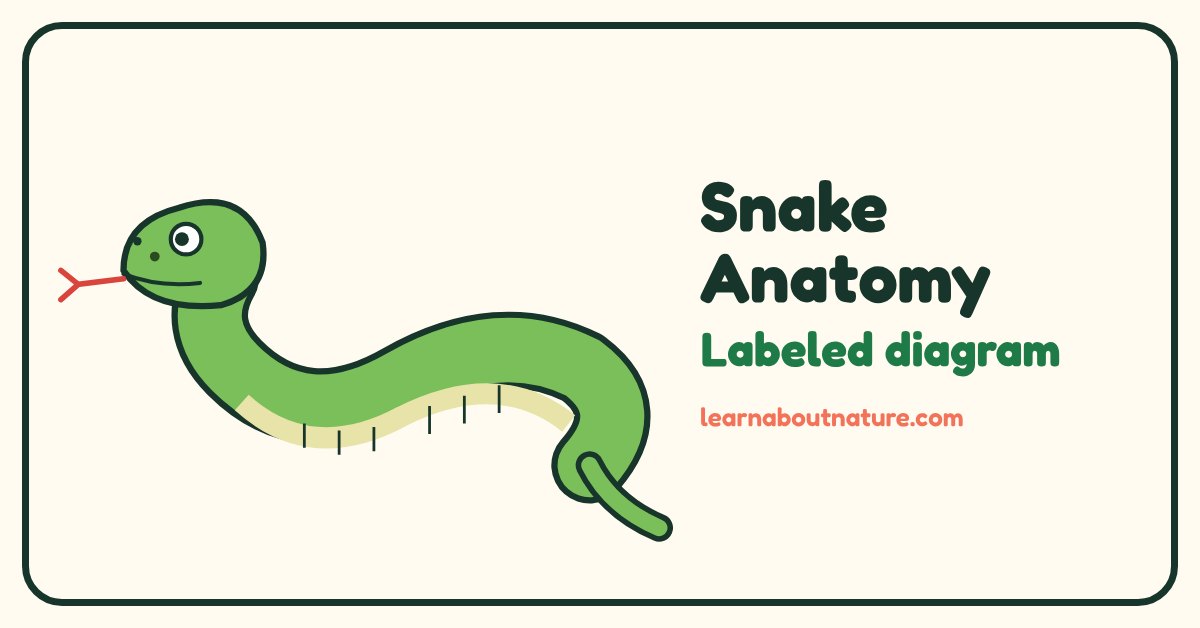
Quick answer: The main parts of a snake are the head, jaws, eyes covered by clear scales called spectacles, nostrils, a forked tongue, a long scaly body with wide belly scales, a vent on the underside, and a tapering tail. Inside, a snake has hundreds of vertebrae and ribs, one long working lung, and stretched-out organs.
A snake looks simple: a head, a long body and a tail. But that plain shape hides some clever engineering. Snakes have no legs, no eyelids and no outer ears, yet they climb trees, swim, burrow and catch prey bigger than their own heads.
This guide labels the outside parts of a snake, explains what each one does, and then looks inside at the skeleton, lungs and other organs that let a legless animal thrive. Britannica lists more than 3,400 species of snakes, so we point out where kinds of snakes differ.
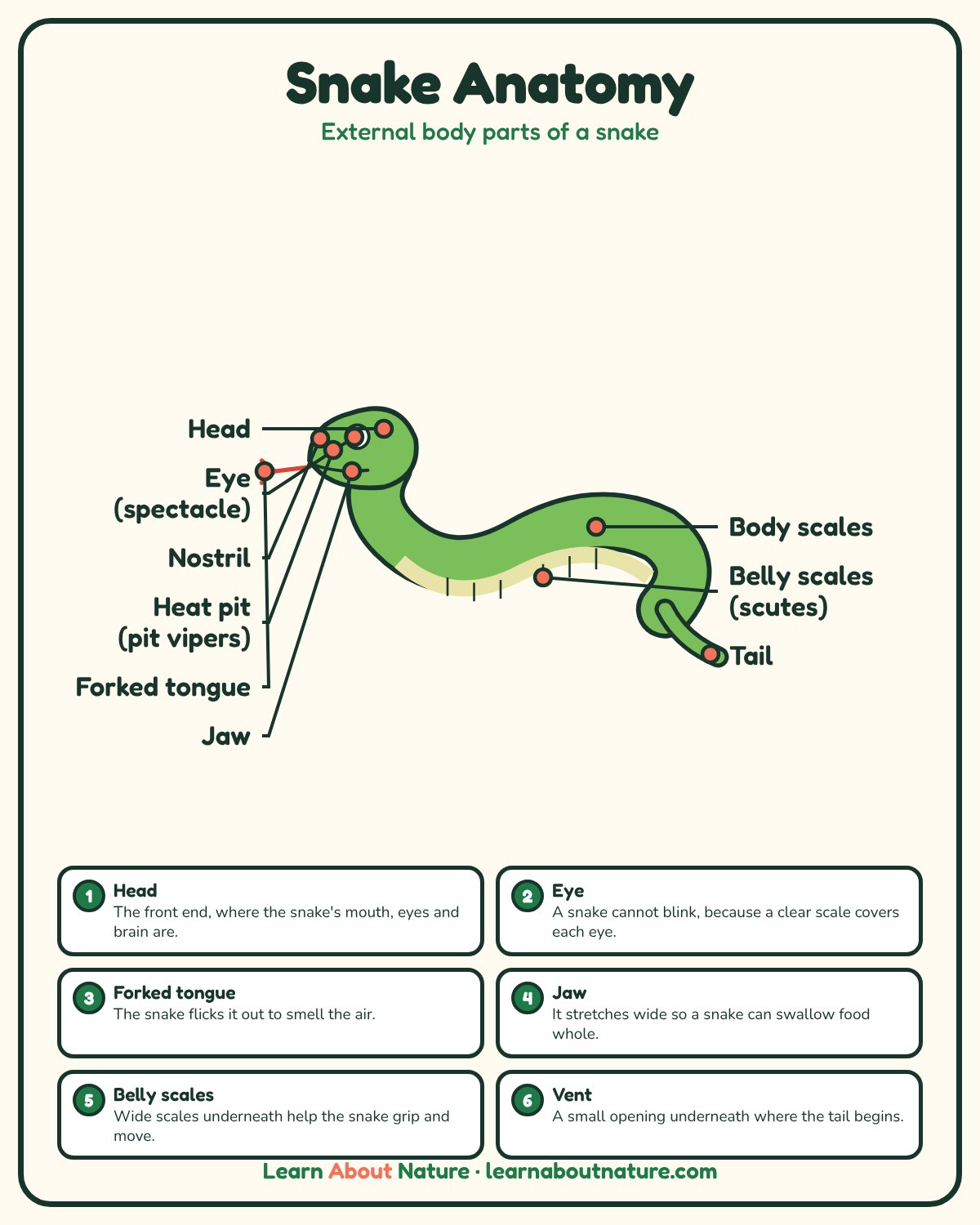
Teachers and students: you’re welcome to use this diagram in lessons and projects with credit to Learn About Nature.
Free printable: Download the Snake Anatomy labeling worksheet (PDF) – label the parts using the word bank. Answer key included.
Parts of a Snake and What They Do
| Part | What it does |
|---|---|
| Head | Holds the brain, jaws and main sense organs |
| Eye (spectacle) | Sees; a clear scale protects the eye instead of eyelids |
| Nostril | Lets air in for breathing and smelling |
| Forked tongue | Collects scent particles from air and ground |
| Jacobson’s organ | Reads scent particles delivered by the tongue |
| Heat pits | Sense warmth from prey (pit vipers, many boas and pythons) |
| Jaw | Loosely joined bones stretch to swallow large prey whole |
| Body scales | Protect the skin and help keep water in |
| Belly scales (scutes) | Grip the ground to help the snake move forward |
| Vent | Opening for waste and reproduction; marks the start of the tail |
| Tail | Balances, grips branches, or rattles in rattlesnakes |
| Right lung | Main breathing organ, long and narrow |
| Backbone and ribs | Hundreds of bones that let the body bend and coil |
The Snake Body Plan
A snake is a reptile with a very long trunk. There is no neck in the usual sense and no clear line between body and head except for a slight narrowing. The tail starts at the vent, a small opening on the underside.
The whole body is built around a flexible backbone. Some species have around 400 vertebrae, and almost every vertebra in the trunk carries a pair of ribs. That chain of bones lets the snake bend, coil and squeeze in every direction.
External Anatomy: Head, Eyes, Nostrils and Tongue
The head holds the brain, jaws and most of the sense organs. Look closely and you will see the nostrils near the tip of the snout and the eyes on the sides of the head.
- Eyes and spectacle: Snakes have no movable eyelids. Each eye is covered by a clear scale called a spectacle (or brille). It is shed with the rest of the skin, which is why a snake’s eyes turn milky blue just before it sheds.
- Nostrils: Two small openings near the front of the snout used for breathing and smelling the air.
- Forked tongue: The tongue flicks out through a small notch in the lips, so the snake can taste the air without opening its mouth.
- Heat pits: Pit vipers, such as rattlesnakes and copperheads, have a pit on each side of the face between the eye and the nostril. Many boas and pythons have smaller heat-sensing pits along their lips.
External Anatomy: Jaws, Scales, Vent and Tail
- Jaws: The two halves of the lower jaw are not fused at the chin. Each side can move on its own, and stretchy skin lets the mouth open around prey wider than the head. Snakes do not unhinge their jaws, as people often say; the bones are just very loosely connected.
- Body scales: Small, overlapping scales cover the back and sides. They are made of keratin, the same protein as your fingernails, and they protect the snake and reduce water loss.
- Belly scales (scutes): Most snakes have a single row of wide, plate-like scales on the belly called ventral scales. Their back edges can catch on the ground, helping the snake push forward.
- Vent: The opening of the cloaca, used to get rid of waste and for reproduction. It marks where the tail begins.
- Tail: The part behind the vent. In rattlesnakes it ends in a rattle made of loose, interlocking keratin segments; in tree snakes it often grips branches.
Internal Anatomy: What Is Inside a Snake?
To fit inside a long, narrow body, a snake’s organs are stretched out and arranged one after another. The heart sits roughly a quarter of the way down the body and has three chambers. The two kidneys are long and lie one behind the other instead of side by side.
In most snakes the right lung does nearly all the work and runs a long way down the body. The left lung is tiny or missing. Many snakes also have a tracheal lung, extra breathing tissue along the windpipe. The windpipe opening, called the glottis, can be pushed forward so the snake keeps breathing while it slowly swallows a large meal.
Venomous snakes have venom glands behind the eyes, connected to fangs. Britannica notes that fewer than 300 snake species are venomous to a degree that matters to people, so most snakes subdue prey by biting and holding or by constricting.
Snake Senses
Smell is a snake’s most important sense, and the tongue is part of it. Each flick picks up tiny particles from the air or ground. Back in the mouth, the tongue tips pass these particles to the Jacobson’s organ (vomeronasal organ) in the roof of the mouth, which reads them as chemical signals. Because the tongue is forked, the snake can compare the left and right sides and follow a scent trail.
Snakes have no outer ears, but they do have an inner ear connected to the jaw bones. They sense vibrations through the ground well and can pick up some low sounds. Eyesight varies widely: burrowing snakes may see little more than light and dark, while some tree snakes see quite sharply.
Heat pits work like a heat camera. The American Museum of Natural History reports that pit vipers can sense the warmth of prey about 1 meter (3 feet) away, even in total darkness.
How a Snake Moves, Feeds and Breathes
Without legs, snakes move by pushing against the ground with muscles, ribs and scales. Common ways include side-to-side slithering (lateral undulation), moving in a straight line like a caterpillar (rectilinear motion, used by heavy snakes such as pythons), accordion-like bunching in tunnels, and sidewinding across loose sand.
All snakes are carnivores and swallow food whole. Teeth point backward, so prey moves only one way: in. The two sides of the jaw take turns pulling the snake’s head forward over the meal. Breathing uses rib muscles, because snakes have no diaphragm.
Snakes Compared With Lizards
Snakes evolved from lizard ancestors, and the two groups share overlapping scales and a forked or notched tongue in many species. The easy differences to spot: most lizards have legs, movable eyelids and outer ear openings, while snakes have none of these.
Legless lizards, such as glass lizards, can be told apart from snakes because they blink and have ear holes.
Fun Facts About Snake Anatomy
- Snakes keep their eyes open even when asleep, because they have no eyelids to close.
- According to Britannica, adult reticulated pythons can be more than 7 meters (23 feet) long, while the Barbados threadsnake averages about 10 cm (4 inches).
- Boas and pythons often have tiny leftover hip bones and small claw-like spurs near the vent, traces of legs their ancestors had.
- A snake sheds its whole outer skin, often in one piece and inside out, including the clear eye caps.
Snake Anatomy for Kids
- Head: the front end, where the snake’s mouth, eyes and brain are.
- Eye: a snake cannot blink, because a clear scale covers each eye.
- Forked tongue: the snake flicks it out to smell the air.
- Jaw: it stretches wide so a snake can swallow food whole.
- Belly scales: wide scales underneath help the snake grip and move.
- Vent: a small opening underneath where the tail begins.
- Tail: the thin end part, which some snakes use to hold on to branches.
Key words: spectacle – a clear scale that covers and protects a snake’s eye; scute – a wide, plate-like scale, like the ones on a snake’s belly; Jacobson’s organ – a smelling organ in the roof of the mouth that reads what the tongue collects; vertebrae – the small bones that link together to make a backbone; cloaca – a single opening for waste and for laying eggs or giving birth; heat pit – a small hole on the face of some snakes that senses warmth.
Try this: Fold a strip of paper into an accordion and push it along a table to copy how snakes bunch and stretch to move through tunnels, then try it on a smooth and a rough surface to see why belly scales need grip.
Related Guides
- Types of snakes
- Turtle Anatomy
- Alligator life cycle
- Turtle life cycle
- Sea turtle life cycle
- Snake life cycle
- All animal & plant anatomy diagrams
- Animal & plant life cycles
See also: Snake Facts for Kids
Snake Anatomy FAQs
Why do snakes flick their tongues?
Snakes flick their tongues to smell. The forked tip picks up tiny scent particles from the air and ground and carries them to the Jacobson’s organ in the roof of the mouth. Comparing the two tips helps the snake tell which direction a scent is coming from.
Do snakes have ears?
Snakes have no outer ears or ear openings, but they do have an inner ear. It is linked to the jaw bones, which pick up vibrations traveling through the ground. Snakes can also sense some low-pitched sounds carried through the air.
How many lungs does a snake have?
Most snakes rely on one long right lung. The left lung is very small or missing, which leaves more room in the narrow body. Many snakes also have extra breathing tissue along the windpipe, called a tracheal lung.
Can snakes unhinge their jaws?
No. Snakes do not unhinge their jaws. The two halves of the lower jaw are not joined at the chin, and several skull bones are loosely connected, so the mouth can stretch very wide. Each side of the jaw moves separately to walk the meal into the throat.
Do snakes have bones?
Yes. Snakes are vertebrates with a skull, a long backbone and many ribs. Some species have around 400 vertebrae, and most of the vertebrae along the body carry a pair of ribs. This makes the body strong but very bendy.
Sources: Snake | Britannica; Snake Anatomy 101 | HowStuffWorks; Pit Vipers Can Detect Prey Via Heat | American Museum of Natural History

Nato is a content writer and researcher with a background in psychology who’s eager to explore the wonders of nature. As a travel enthusiast and animal lover, she hopes to inspire others to discover and cherish the beauty and importance of the natural world. She also writes about the history of candy and snacks for Snack History and about food and healthy eating for The Fitchen.