Red Headed Krait
Scientific Classification
| Kingdom: | Animalia |
| Phylum: | Chordata |
| Subphylum: | Vertebrata |
| Class: | Reptilia |
| Order: | Squamata |
| Family: | Elapidae |
| Genus: | Bungarus |
| Species: | B. flaviceps |
| Binomial name: | Bungarus flaviceps |
The Redheaded Krait, Bungarus Flaviceps, is a big and poisonous snake from the Elapid family, with spectacular color combinations. This deadly venomous snake grows to a length of about 6.9 feet or 2.1 meters. Although rare, You normally see this snake in rainforests and at the foot of mountains, and also on the islands. They feed on particular snakes, perhaps those that are partially aquatic and fossorial. You can see this Red Headed Krait In the southeastern regions of Asia, particularly in Malaysia. You also see them in Sumatra and Thailand. A subordinate variety is found in Borneo. Since these snakes bite very rarely, little or no information is available on their venom’s potency.
Anatomy
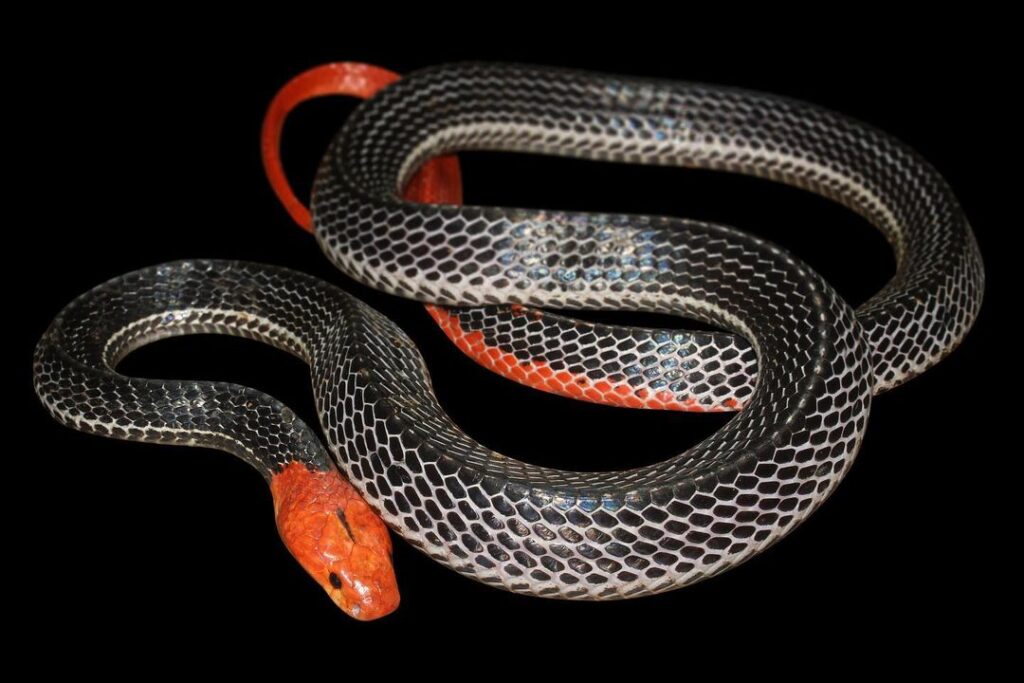
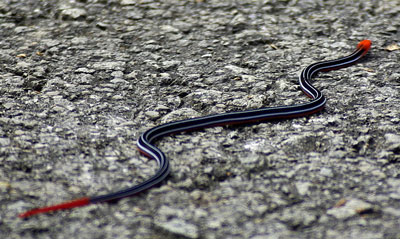
The Red Headed Krait displays a remarkably unique and attractive repertoire of colors; the tail and head have a brilliant red color, body black with thin blue with white lines on the lower lateral side. Its scales are big and smooth. In general, it looks glossy and dazzling. This very rare snake has a fine temperament; and are rarely aggressive. When in captivity, they normally do not strike, unless they are repeatedly disturbed. This snake grows to a length of 1.2 to 1.5 meters or 4 – 5 feet growing at the most to 2.1 meters or 7 feet. Their fangs are short and hollow and situated on the maxillary bones. Its inlet is at the bottom and outlet adjacent to the lips. Their venom passes through the ducts via the inlet. Then it is pressurized through the holes provided in the fang tips for injection.
Once the victim is affected by the venom of this snake, the muscles that are greatly innervated get affected first: they are the muscles that lift up the upper eyelids, also the ciliary (smooth muscles in the middle layer of the eye)and ocular muscles that control the lens. When this snake bites a victim, between a period of 20 minutes to many hours, the victim experiences difficulty in opening his eyelids. The medical term of this state is called Bilateral Ptosis, and this is a classic, a symptom of harsh envenomation (venom injection). Other symptoms are diplopia (double vision), vomiting, hypersalivation, dysphagia (difficulty in swallowing) and headache. In due course severe paralysis affects the and this continuously affects the different muscles, including the jaw muscles.
The color of the head is brilliant red and at times yellow or orange, the color gradually progresses to the neck. The tail is short and brilliant red in color occasionally yellow and orange, and the color gradually moves to the bottom of the body. The color of the belly is dull.
The blunted head, with comparatively small eyes appears conspicuous from the strong body.
Distribution And Habitat
The Red- Headed Kraits is a rare sight in Norway, Denmark, Sweden, Forshall, Grastorp, Pulav Tioman, Western Poland, Montenegro, Germany, Java, Sumatra, Billiton and Borneo. You can see the subordinate varieties B.F.Baluensis, in Malaysia (Sabath and Eastern part of Malaysia)
The Red Headed Krait lives in the hilly regions and mountainous rain forests. You can hardly see them in human populated areas. These snakes are semi-aquatic and nocturnal. This Red Headed Krait is an uncommon variety, inhabiting the low lying lands of the forest, low mountain ranges 900 meters below elevation and in the hills.
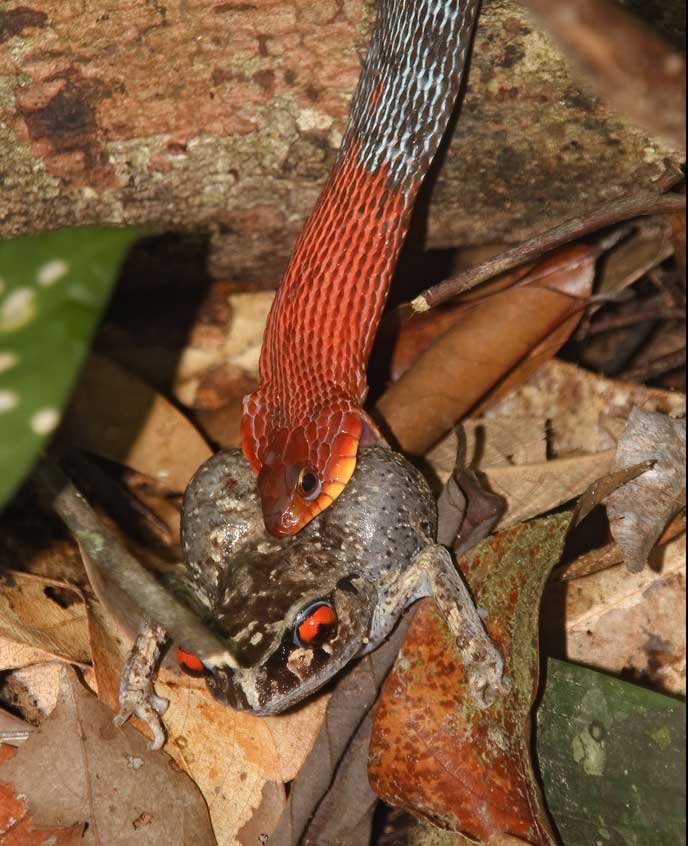
Earlier, there was a misconception that they ate only other snakes, but actually, they also feed on skinks (belonging Sthe lizard family), frogs, lizards, tiny mammals and caecilians (amphibians resembling snakes or earthworms) and also eggs of other snakes. In spite of their inherent deadly behavior, they are generally not considered dangerous to human during day time. They are lethargic, sluggish, and not at all offensive and at daytime, they conceal themselves. When they are agitated, they conceal their head in the coils or press it to the ground. At night time they are agile and lively but hazardous.
The Venom
This Red Headed Krait or Bungarus Flaviceps variety is a very poisonous snake. The venom of this snake at first acts as a neurotoxin, Stopping the communication through the neuromuscular synapses, and leads to paralysis, and finally death through asphyxiation, since the affected person becomes breathless. When the Red Headed Krait’s venom starts acting on the victim, the muscles that are affected first are the innervated muscles. This is the muscle that lifts up the upper eyelids and the ciliary and ocular muscles which have control on the lens.
As a Pet
Certainly not recommended as a pet.
Having discovered a fondness for insects while pursuing her degree in Biology, Randi Jones was quite bugged to know that people usually dismissed these little creatures as “creepy-crawlies”.