Alligator Life Cycle: Stages from Egg to Adult (With Diagram)

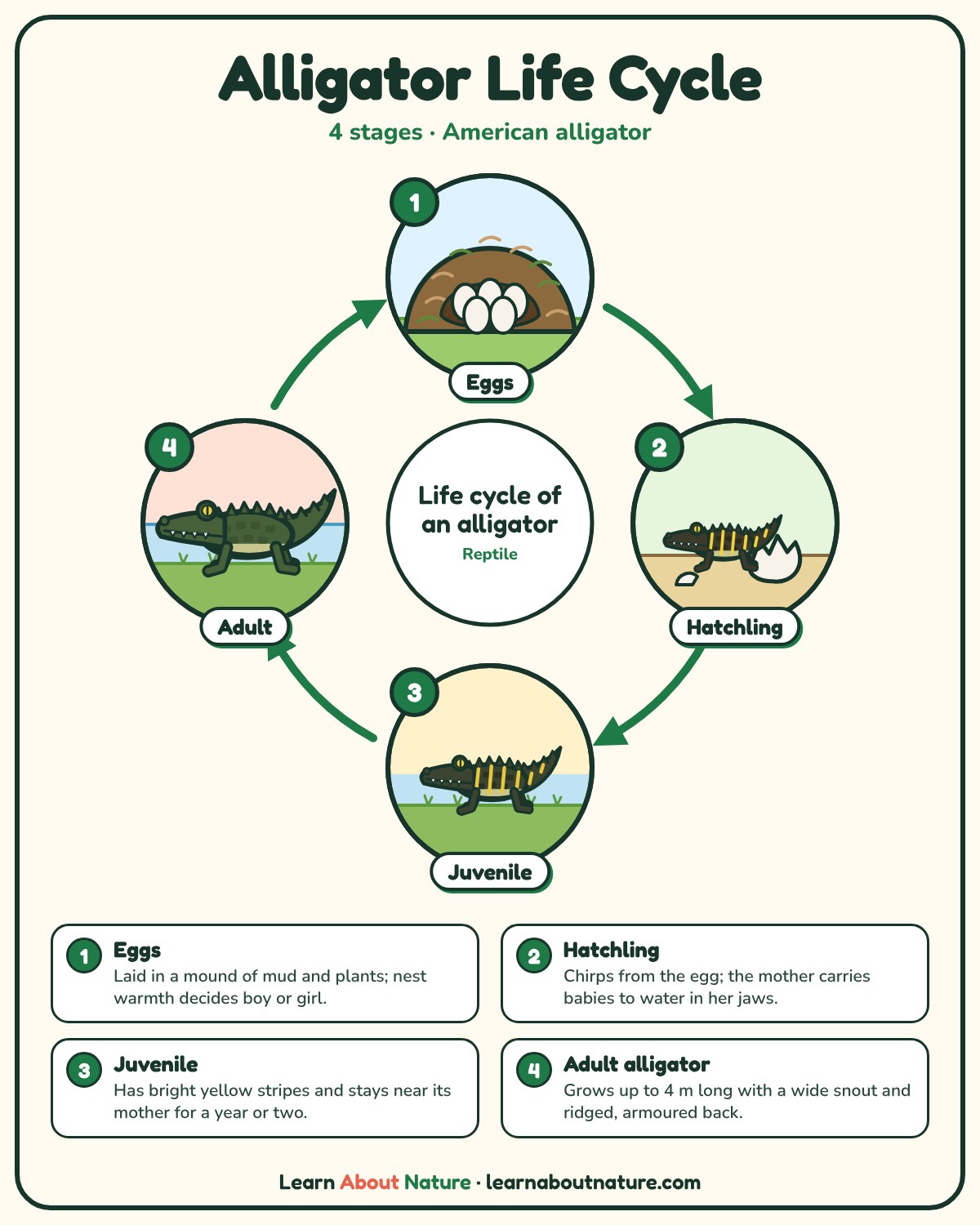
Quick answer: The alligator life cycle has four stages: egg, hatchling, juvenile and adult. A female American alligator lays about 30 to 50 eggs in a mound nest, guards them for about two months, then protects her hatchlings, which take around 10 years to become adults.
The alligator life cycle has four stages: egg, hatchling, juvenile and adult. An American alligator starts life in a leathery-shelled egg buried in a warm mound of plants, hatches as a small, striped baby, grows for years in the swamp, and finally becomes one of the largest reptiles in North America.
Alligator Life Cycle Quick Facts
| Common name | Alligator |
| Scientific name | Alligator mississippiensis |
| Kingdom | Animalia |
| Phylum | Chordata |
| Class | Crocodylia |
| Family | Alligatoridae |
| Genus | Alligator |
| Conservation status | Least Concern |
| Life cycle stages | Egg, hatchling, juvenile, adult |
| Type of development | Hatches from eggs laid in a mound nest |
| Incubation | About 60–70 days |
| Time to adulthood | Around 10 years or more (about 6 feet long) |
| Lifespan | About 30–50 years in the wild |
| Number of eggs | Usually around 30–50 per nest |
Unlike many reptiles, alligators are caring parents. The mother guards her nest for weeks, helps her babies out when they hatch, and protects them for many months afterward. This guide follows the American alligator, which lives in the wetlands of the southeastern United States. Its close cousin, the much smaller Chinese alligator, has a similar life cycle.
Stage 1: Egg
Alligators mate in spring. Males bellow loudly, and both males and females gather in open water to court. In early summer, the female builds a nest near the water’s edge by piling up mud, sticks, leaves and other plants into a large mound, often around 2 to 3 feet (60 to 90 cm) tall and several feet across.
She digs a hole in the top of the mound and lays her eggs inside, then covers them up. A typical clutch holds around 30 to 50 hard-shelled eggs, a little bigger than a chicken egg. As the plants in the mound rot, they give off heat, which keeps the eggs warm, a bit like a compost pile.
Temperature decides boy or girl
Like many turtles, alligators have temperature-dependent sex determination. The temperature inside the nest during the early weeks of development decides whether each baby becomes male or female. A commonly cited rule is that nests at about 86°F (30°C) or cooler produce mostly females, while nests at about 93°F (34°C) produce mostly males, with a mix in between. Because the top and bottom of a mound can be different temperatures, one nest can hatch both.
The eggs take about 60 to 70 days to hatch, usually in late summer. During this time the mother stays nearby and guards the nest. Even so, raccoons and other animals often raid alligator nests, and floods can drown the eggs.
Stage 2: Hatchling
When the babies are ready to hatch, they start making high-pitched chirping or grunting calls from inside their eggs. The mother hears them and digs open the nest. She may gently roll eggs in her mouth to help crack them, and she often carries the hatchlings in her jaws down to the water. Her huge, toothy mouth is surprisingly gentle.
Hatchlings are about 6 to 8 inches (15 to 20 cm) long. They are black with bright yellow stripes, which helps them blend in among reeds and plants. Each one breaks out of its egg with the help of an egg tooth on the tip of its snout. They hatch with a supply of yolk in their bellies that feeds them for their first days.

Baby alligators stay together in a group called a pod, close to their mother. They eat insects, snails, small fish, tadpoles and frogs. Learn more in our guide to what alligators eat. When a baby is frightened it gives a distress call, and the mother comes quickly to defend it.
Hatchlings have many enemies. Herons, egrets, raccoons, otters, large fish, snakes and even bigger alligators eat them. Only a small fraction of hatchlings live to become adults.
Stage 3: Juvenile
Young alligators often stay near their mother for their first year, and sometimes longer. As they grow, they move into their own areas of marsh, swamp, river or lake. Their yellow stripes slowly fade, and their skin turns darker gray and olive.
Juveniles grow quickly when the weather is warm and food is easy to find, and much more slowly in cooler places. Their diet expands as they get bigger, from insects and small fish to crabs, turtles, birds and small mammals. Because alligators are cold-blooded, they spend a lot of time basking in the sun to warm up. In cold winter weather they become sluggish and rest in burrows or deep water, a state called brumation.
Stage 4: Adult
Alligators usually become adults and start breeding when they reach about 6 feet (1.8 m) long. This often takes around 10 years or more, depending on how fast they grow. Adult males are commonly about 11 feet (3.4 m) long and can grow larger, while females are smaller and rarely grow beyond 10 feet (3 m).
Adult alligators are top predators in their wetlands, with very few natural enemies. They catch fish, turtles, birds and mammals, and they have one of the strongest bite forces of any animal. In spring, the adults bellow and court, a female builds a new nest mound, and the life cycle starts again. For more about these reptiles, read our main page on the alligator.
How Long Does an Alligator Live?
American alligators often live around 30 to 50 years in the wild. In zoos, where they are safe and well fed, some have lived more than 70 years. Like many reptiles, alligators keep growing slowly throughout their lives, so the biggest alligators are usually old males.
American alligators were once hunted so heavily that they became rare. Thanks to protection laws and careful management, their numbers recovered, and today they are common again in many southern wetlands. Alligators help other wildlife too: the holes they dig, called gator holes, hold water during dry spells and give fish, turtles and birds a place to survive.
Alligator vs Crocodile and Turtle Life Cycles
Alligators share their life cycle stages with other egg-laying reptiles, but their parenting stands out:
- Crocodiles: Crocodiles also have temperature-dependent sex and protective mothers that carry their babies to the water. Many crocodiles, such as the Nile crocodile, dig a hole in sand or soil for their eggs instead of building a mound of plants. Compare their diets in what crocodiles eat.
- Turtles: In the turtle life cycle, the mother buries her eggs and leaves. The hatchlings get no help from either parent.
- Lizards and snakes: Most lizards and snakes also leave their eggs once laid. Read about the lizard life cycle to compare.

You can see all our animal and plant life cycles to compare alligators with many other animals.
Fun Facts About the Alligator Life Cycle
- Baby alligators start calling to their mother while they are still inside their eggs.
- Rotting plants in the nest mound act like a natural heater for the eggs.
- A mother alligator can carry several hatchlings in her mouth at once without hurting them.
- In freezing weather, alligators sometimes poke just the tip of their snout through the ice so they can keep breathing.
- The alligator snapping turtle shares some of the same southern waters but is a turtle, not an alligator.
- Saltwater crocodiles, the largest living reptiles, are relatives of alligators. Read about them in deadly animals in Australia.
More life cycles
- Turtle Life CycleEgg → hatchling → juvenile → adult
- Sea Turtle Life CycleEggs → hatchling → juvenile → adult
- Lizard Life CycleEgg → hatchling → adult
- Snake Life CycleEgg or live birth → hatchling → adult
- Chicken Life CycleEgg → chick → young bird → hen or rooster
Alligator Life Cycle FAQs
What are the stages of an alligator’s life cycle?
An alligator goes through four stages: egg, hatchling, juvenile and adult. It takes around 10 years or more to grow from hatchling to breeding adult.
How many eggs does an alligator lay?
A female American alligator usually lays around 30 to 50 eggs in a mound nest made of mud and plants.
How long does it take alligator eggs to hatch?
Alligator eggs usually hatch after about 60 to 70 days. The heat from rotting plants in the nest helps keep them warm.
Do alligator mothers take care of their babies?
Yes. The mother guards the nest, digs it open when the babies call, carries hatchlings to the water in her mouth, and protects them for months, often a year or more.
What decides if a baby alligator is male or female?
The temperature of the nest decides. Cooler nests produce mostly females and warmer nests produce mostly males, with a mix in between.

Randi Jones is the owner and founder of the Nature Gift Store, an online retailer specializing in nature-themed gifts, educational science projects, live animal nature kits and real butterfly artwork. A biology graduate who fell in love with insects, she founded the company in 2001 to make active learning about nature fun, accessible and engaging for children and adults. Her store offers real butterfly frames, home and garden decor and educational live animal kits, including ant farms, worm farms, tadpoles, ladybugs and hermit crabs, and she runs a bug museum in Washington featuring live animals like Eddie the Iguana alongside other reptiles and insects.