Crocodile Facts for Kids: Habitat, Diet and Fun Facts
Quick answer: A crocodile is a large, armored reptile that lives in and around rivers, swamps and coasts in warm parts of the world. Crocodiles eat fish, birds, mammals and other reptiles, often ambushing prey at the water’s edge. The saltwater crocodile is the largest reptile alive, and crocodile mothers carry their babies gently in their mouths.
Two eyes and a pair of nostrils poke out of a calm river. The rest of the animal stays hidden under the water, perfectly still. That is a crocodile, a reptile that has been called a living tank because of its tough, bony armor.
Crocodiles are powerful hunters, but they are also caring parents. Here you will learn where crocodiles live, what they eat, how they raise their babies and how to tell a crocodile from an alligator. You will also meet two famous kinds: the saltwater crocodile and the Nile crocodile.
Teachers and students: you’re welcome to use this fact sheet in lessons and projects with credit to Learn About Nature.
Free printable: Download the Crocodile fact file worksheet (PDF) – draw the animal, fill in the facts and match key words. Answer key included.
Crocodile Quick Facts
| Class | Reptile |
| Order | Crocodylia (crocodilians) |
| Example species | Saltwater crocodile (Crocodylus porosus), Nile crocodile (Crocodylus niloticus) |
| Largest | Saltwater crocodile; record about 20 ft (6.2 m) |
| Nile crocodile size | Typically about 16 ft (5 m) and 500 lb (225 kg) |
| Eggs per clutch | About 25–80, depending on species |
| Incubation | About 2–3 months |
| Baby name | Hatchling |
| Lifespan | About 45 years (Nile) to 70 years (saltwater) in the wild |
| Conservation | Varies by species; saltwater and Nile crocodiles are Least Concern (IUCN) |
What Is a Crocodile?
A crocodile is a large reptile with a long snout, a strong tail and thick, scaly skin. Crocodiles belong to a group called crocodilians, which also includes alligators, caimans and the gharial. Scientists count about 27 kinds of crocodilians, and more than a dozen of them are true crocodiles.
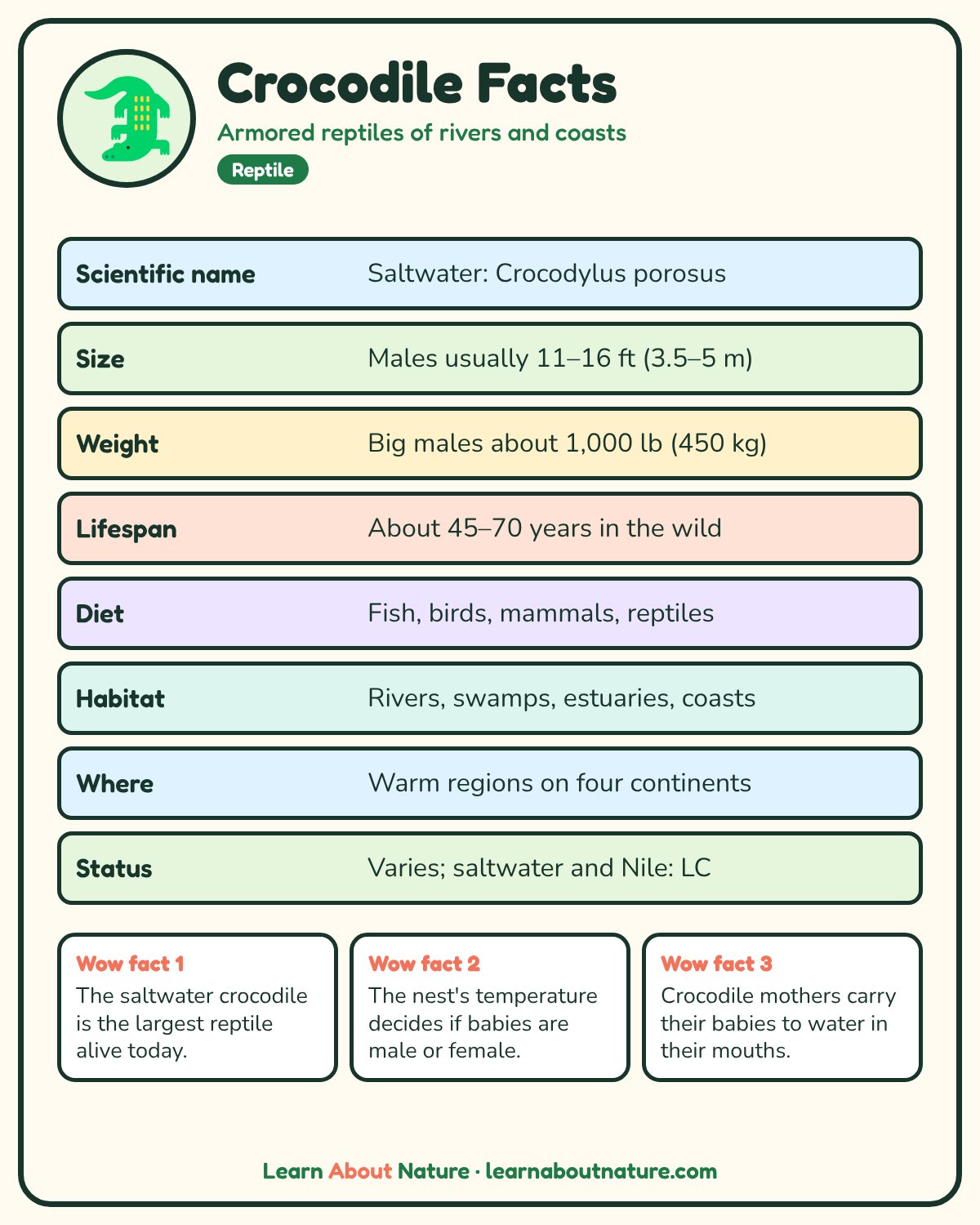
The biggest is the saltwater crocodile, Crocodylus porosus, which is the largest reptile alive today. Adult males are usually about 11 to 16 feet (3.5 to 5 meters) long and can weigh about 1,000 pounds (450 kg), and the longest reliably measured one was about 20 feet (6.2 meters). Females are much smaller, often around 10 feet (3 meters).
The Nile crocodile, Crocodylus niloticus, is Africa’s biggest crocodilian. A typical adult is about 16 feet (5 meters) long and weighs about 500 pounds (225 kg).
Where Do Crocodiles Live?
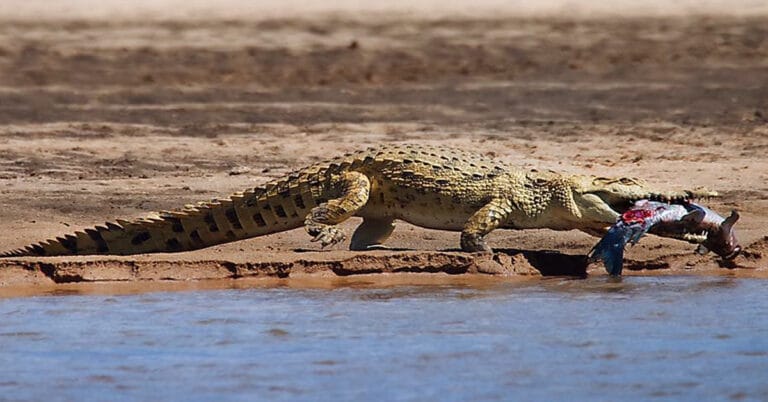
Crocodiles live in warm, tropical parts of Africa, Asia, the Americas and Australia. They spend their lives in and near water, in rivers, lakes, swamps, mangroves and estuaries, where rivers meet the sea.
Saltwater crocodiles range from eastern India and Sri Lanka through Southeast Asia to northern Australia and islands in the Pacific. They can live in fresh water or full-strength seawater and are strong swimmers that are sometimes seen far out at sea. Nile crocodiles live across much of Africa south of the Sahara, along the Nile River and on the island of Madagascar.
Crocodiles are cold-blooded, so they control their temperature by moving between sun and shade. They bask on riverbanks to warm up and slip into the water or shade when it gets too hot.
What Do Crocodiles Eat?
Crocodiles are carnivores, which means they eat meat. Young crocodiles start with insects, crabs and other small animals. As they grow, they move on to bigger fish, birds, turtles and mammals.
Most crocodiles hunt by ambush. A crocodile waits quietly in the water near the shore until an animal comes to drink, then lunges with a burst of speed. Large saltwater crocodiles can catch animals as big as water buffalo. Nile crocodiles eat mostly fish but also take birds and even zebras, and they can eat about half their body weight at one time.
Crocodiles swallow small prey whole and tear bigger meals into chunks. After a big meal, a crocodile may not need to eat again for a long time.
Body and Senses
A crocodile’s eyes, ears and nostrils sit on top of its head. This lets it see, hear and breathe while almost all of its body stays hidden under the water. Its ear slits close when it dives.
Crocodiles have sharp eyesight above water, and their vertical pupils help them see at night. They also have tiny sense organs in their skin that work like motion detectors, so they can feel ripples made by prey in muddy water.
Crocodiles have special glands on the tongue that get rid of extra salt. That is one reason many crocodiles can live in salty water, while alligators mostly stay in fresh water. Bony plates called osteoderms under the scales on their backs act like armor.
Eggs and Baby Crocodiles
Crocodiles lay eggs with hard shells. A female saltwater crocodile builds a nest mound of plants and mud near the water and lays about 50 eggs. A Nile crocodile usually lays about 25 to 80 eggs. Some crocodiles build mound nests, and others dig holes in the ground. The eggs hatch after roughly 2 to 3 months.
The temperature of the nest decides whether each baby will be male or female. This is called temperature-dependent sex determination.
Crocodile mothers are careful parents. The female guards her nest, and when the babies are ready, they squeak and grunt from inside their eggs. She digs them out and gently carries them to the water in her mouth. The hatchlings are only about 8 to 11 inches (20 to 28 cm) long, and the mother keeps watch over them for weeks or months.
Many eggs and young crocodiles are eaten by lizards, birds, big fish and other animals, so only a few grow up. Those that do can live a long time. Nile crocodiles may live about 45 years, and saltwater crocodiles up to about 70 years in the wild.
Crocodile vs Alligator: What’s the Difference?
Crocodiles and alligators are cousins, and they look a lot alike. Here are some ways to tell them apart, though there are exceptions.
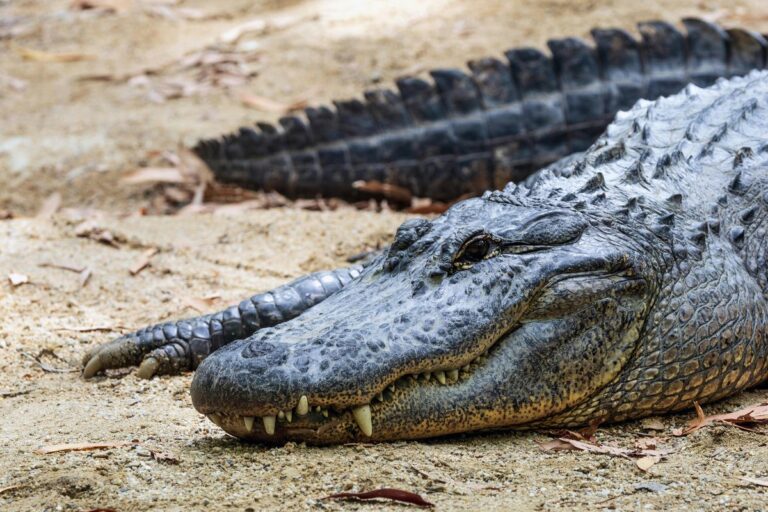
- Snout: crocodiles usually have a narrow, V-shaped snout. Alligators have a wide, U-shaped snout.
- Teeth: when a crocodile closes its mouth, the big fourth tooth on its lower jaw still shows. An alligator’s lower teeth are mostly hidden.
- Color: crocodiles tend to be olive or tan. Alligators tend to be darker gray or black.
- Water: crocodiles have salt glands and often live in salty or brackish water. Alligators mostly live in fresh water.
- Where: alligators live only in the southeastern United States and China. Crocodiles live in many tropical countries.
Threats and Conservation Status
Adult crocodiles have few natural enemies, but people have caused big problems for them. In the past, many crocodiles were hunted for their skins, which were made into shoes and bags. Habitat loss, pollution and getting caught in fishing nets are still threats today.
Conservation status varies by species. On the IUCN Red List, the saltwater crocodile is listed as Least Concern (assessment published in 2021), and the Nile crocodile is also Least Concern (assessed in 2017). Both recovered in many places after hunting was controlled. Other crocodiles are in serious trouble. The Philippine, Siamese and Orinoco crocodiles are all Critically Endangered.
Large crocodiles can be dangerous to people. In crocodile country, people follow warning signs and stay well back from the water’s edge.
Fun Facts About Crocodiles
- Baby crocodiles call to their mother from inside their eggs before they hatch.
- Saltwater crocodiles have been found in water about twice as salty as the sea.
- Hatchling crocodiles sometimes ride on their mother’s back.
- A crocodile’s tail is so strong that it pushes the animal through the water like a paddle.
- Nile crocodile parents may gently roll eggs in their mouths to help the babies hatch.
Fast Facts for Young Readers
- A crocodile is a big reptile with tough, bumpy skin.
- Crocodiles live in rivers, swamps and near the sea in warm places.
- They eat fish, birds and other animals.
- Crocodiles hatch from eggs.
- A crocodile mom carries her babies in her mouth.
- The saltwater crocodile is the biggest reptile in the world.
- A crocodile’s snout is pointy, but an alligator’s is round.
Key words: crocodilian – a member of the group that includes crocodiles, alligators, caimans and the gharial; ambush – to hide and wait, then attack by surprise; estuary – the place where a river meets the sea and fresh water mixes with salt water; hatchling – a baby animal that has just come out of its egg; osteoderms – small bony plates in the skin that work like armor; cold-blooded – having a body temperature that changes with the surroundings.
Try this: Draw a crocodile head and an alligator head side by side from above. Label the snout shape and the teeth you can see on each, then quiz a friend to spot which is which.
Related Guides
- Crocodile life cycle
- Axolotl facts for kids
- Snake facts for kids
- Salamander facts for kids
- Komodo Dragon facts for kids
- All animal facts for kids
Crocodile FAQs
What is the difference between a crocodile and an alligator?
Crocodiles usually have a narrow, V-shaped snout, and their big fourth lower tooth shows when the mouth is closed. Alligators have a wide, U-shaped snout and hide their lower teeth. Crocodiles have salt glands and often live in salty water, while alligators mostly stay in fresh water.
What is the biggest crocodile in the world?
The saltwater crocodile is the biggest crocodile and the largest reptile alive. Adult males are usually about 11 to 16 feet long, and the longest reliably measured one was about 20 feet. Females are much smaller, usually around 10 feet long.
How long do crocodiles live?
Crocodiles can live a long time. Nile crocodiles may live about 45 years in the wild, and saltwater crocodiles can live up to about 70 years. Many young crocodiles are eaten by predators, so only a few reach old age.
Do crocodile mothers take care of their babies?
Yes. A crocodile mother guards her nest for about two to three months. When the babies call from inside their eggs, she helps dig them out and carries them gently to the water in her mouth. She then watches over the young hatchlings for weeks or months.
Are crocodiles endangered?
It depends on the species. The IUCN Red List lists saltwater and Nile crocodiles as Least Concern because their numbers recovered after hunting was controlled. Other species, such as the Philippine, Siamese and Orinoco crocodiles, are Critically Endangered because of hunting and habitat loss.
Sources: Estuarine Crocodile – Australian Museum; Saltwater Crocodile – National Geographic; Nile Crocodile – National Geographic; Crocodilians – San Diego Zoo Wildlife Alliance; Nile Crocodile Fact Sheet: Population & Conservation Status – San Diego Zoo Wildlife Alliance Library; What’s the Difference Between Alligators and Crocodiles? – Britannica

Nato is a content writer and researcher with a background in psychology who’s eager to explore the wonders of nature. As a travel enthusiast and animal lover, she hopes to inspire others to discover and cherish the beauty and importance of the natural world. She also writes about the history of candy and snacks for Snack History and about food and healthy eating for The Fitchen.