Crocodile Life Cycle: Stages From Egg to Adult
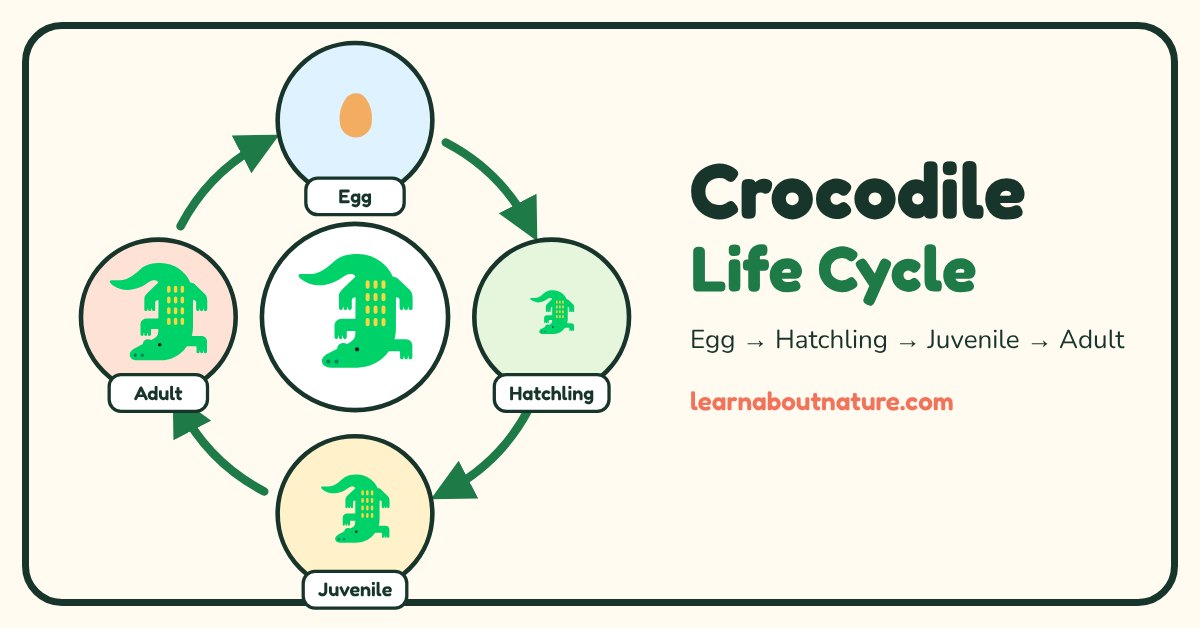
Quick answer: A crocodile’s life cycle has four stages: egg, hatchling, juvenile and adult. The female lays dozens of eggs in a nest and guards them for about three months. Nest temperature decides whether each baby is male or female. Hatchlings are carried to water by their mother, grow into juveniles, and become breeding adults after about 12 years.
Crocodiles are large reptiles that have lived in rivers, lakes and swamps for millions of years. They may look fierce, but crocodile mothers are some of the most caring parents in the reptile world.
This page follows two well-known species: the Nile crocodile of Africa and the saltwater crocodile (also called the estuarine crocodile) of Asia and northern Australia, which is the largest living reptile. Their life cycles are very similar, with a few differences in how they build their nests.
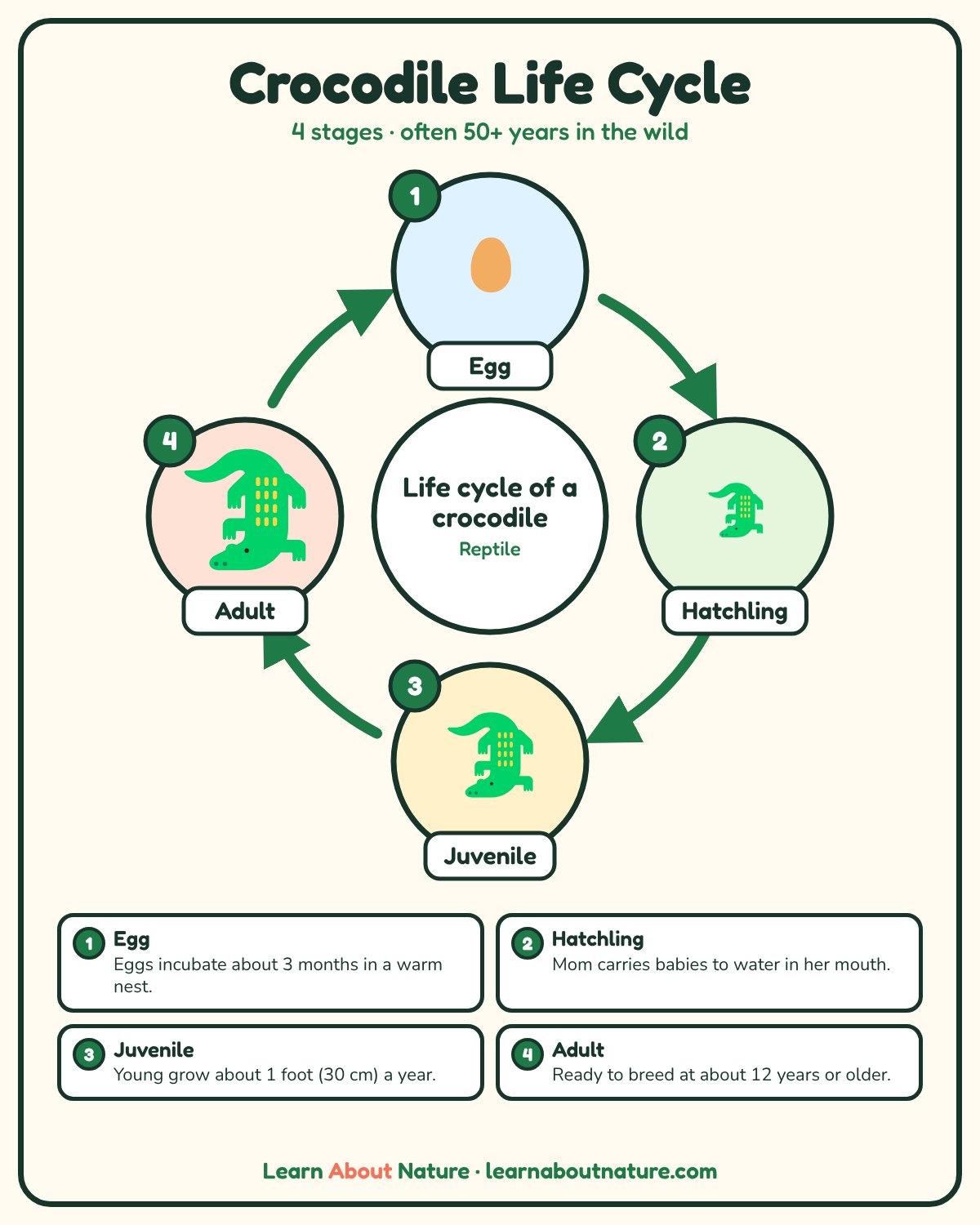
Teachers and students: you’re welcome to use this diagram in lessons and projects with credit to Learn About Nature.
Free printable: Download the Crocodile life cycle worksheet (PDF) – label the diagram, cut and sequence the stages, and match key words. Answer key included.
Crocodile Life Cycle Quick Facts
| Example species | Nile crocodile and saltwater crocodile |
| Eggs per clutch | about 55–60 (Nile); 40–70 (saltwater) |
| Incubation | about 84–90 days |
| Sex decided by | nest temperature |
| Length at hatching | about 28–30 cm (11–12 in) |
| Weight at hatching | about 70–80 g |
| Growth when young | about 30 cm (1 ft) a year (Nile) |
| Breeding age | about 12 years or older |
| Lifespan | thought to be 50+ years |
Courtship and Mating
Crocodiles mate in the water. Before mating, males and females court each other with displays such as rubbing snouts, blowing bubbles and making low, rumbling sounds. Large males defend stretches of river or shoreline, and they may fight rivals for the chance to mate.
In northern Australia, saltwater crocodiles start courting around October and November, and nesting runs from about December to April, during the wet season. Nile crocodiles usually nest in the dry season, when sandy riverbanks are exposed.
Stage 1: Egg
Crocodiles lay hard-shelled eggs, a little like large, long chicken eggs. The two species build very different nests:
A Nile crocodile digs a hole in sandy soil near water and buries her eggs about 30 to 45 cm (1 to 1.5 ft) deep. A typical clutch has about 55 to 60 eggs. A saltwater crocodile piles up a mound of plants and mud on a riverbank and lays about 40 to 70 eggs in the middle. As the plants rot, they give off heat that keeps the eggs warm.
The eggs incubate for about 84 to 90 days in Nile crocodiles and about 90 days in saltwater crocodiles. The mother stays close the whole time, often lying on or beside the nest, and she barely eats. She chases away monitor lizards, birds, mammals and even other crocodiles that try to dig up the eggs.
Temperature Decides Boy or Girl
In crocodiles, a baby’s sex is not set by genes, as it is in mammals and birds. Instead, it depends on how warm the nest is during part of incubation. This is called temperature-dependent sex determination.
In many crocodiles, nests at about 30°C (86°F) or cooler produce females. Nests around 32 to 33°C (90 to 91°F) produce mostly males. Nests that are even hotter can produce females again in some species. In saltwater crocodiles, about 32°C produces both sexes but mostly males, while cooler or warmer nests produce more females.
Temperatures that are far too hot or too cold can kill the embryos. Because of this, scientists are studying how warmer weather caused by climate change could affect crocodile nests and the balance of males and females in the future.
Stage 2: Hatchling
When the babies are ready to hatch, they start making high-pitched chirping calls from inside their eggs. Each hatchling has a small, sharp bump on the tip of its snout, called an egg tooth or caruncle, which it uses to break through the shell. The egg tooth falls off soon after hatching.
Hearing the calls, the mother digs open the nest. She may gently roll eggs in her mouth to help babies break out. Then she carries the hatchlings to the water in her mouth, a few at a time, holding them softly between her powerful jaws.
A newborn crocodile is about 28 to 30 cm (11 to 12 in) long and weighs about 70 to 80 g, roughly the weight of a large egg. Hatchlings stay together in a group, called a crèche or pod, under their mother’s watch. Nile crocodile hatchlings may stay near her for up to about 3 months, and saltwater hatchlings for up to about 5 weeks.
- Hatchlings eat insects, small frogs, crabs and tiny fish.
- They call to their mother if they are in danger, and she rushes to help.
- Nile crocodile fathers have also been seen helping to crack open eggs.
Stage 3: Juvenile
Even with a guarding mother, life is risky for young crocodiles. Crabs, large fish, birds, mongooses, hyenas, other reptiles and even bigger crocodiles eat them. Floods can also drown nests before the eggs hatch. Only a small fraction of eggs ever grow into adults.
Juvenile crocodiles grow quickly at first, about 30 cm (1 foot) a year in Nile crocodiles. As they get bigger, they catch bigger prey, moving from insects and frogs to fish, birds and small mammals.
Young crocodiles hide in thick plants along the water’s edge. Bigger crocodiles may attack them, so juveniles often move away from the area where adults live as they grow.
Like all reptiles, young crocodiles are cold-blooded, which means their body temperature depends on their surroundings. They bask in the sun to warm up and slip into water or shade to cool down. Warmth helps them digest their food and grow, so a sunny basking spot is important.
Stage 4: Adult
Crocodiles grow slowly to adulthood. Nile crocodiles in the wild usually become able to breed at about 12 to 19 years old, when males are over about 2.7 m (9 ft) long and females about 2.4 m (8 ft). Female saltwater crocodiles can breed at about 12 years and 2.3 m, while males mature later, at around 17 years and 3.3 m.
Adult crocodiles are top predators. Nile crocodiles are usually 2 to 3.3 m (6.6 to 11 ft) long, and the biggest can reach about 5 m (16 ft). Adult male saltwater crocodiles are typically 3 to 4 m long and weigh 200 to 300 kg, and some grow even larger. Females are smaller.
Older crocodiles keep growing throughout their lives, but much more slowly, about 2.5 cm (1 inch) a year. When a female builds a nest and lays eggs, the life cycle starts over.
Nile vs. Saltwater Crocodile Life Cycles
Both species follow the same four stages, but they live in different parts of the world and have a few key differences.
- Range: Nile crocodiles live in rivers, lakes and swamps across much of Africa south of the Sahara; saltwater crocodiles live in rivers, estuaries and coasts from India to northern Australia.
- Nest: Nile crocodiles bury eggs in a hole in sand; saltwater crocodiles build a mound of rotting plants and mud.
- Clutch: Nile crocodiles lay about 55 to 60 eggs; saltwater crocodiles lay about 40 to 70.
- Care: Nile hatchlings may stay with their mother for up to about 3 months; saltwater hatchlings for up to about 5 weeks.
- Size: saltwater crocodiles grow larger, and big males can be well over 4 m (13 ft) long.
How Long Do Crocodiles Live?
No one knows exactly how long wild crocodiles live, because they live longer than most research studies last. Saltwater crocodiles are expected to live 50 years or more, and Nile crocodiles are also thought to be long-lived.
Scientists estimate crocodile ages by tagging and measuring the same animals over many years and by studying growth rings in their bones.
Crocodile Safety and Conservation
Crocodiles are dangerous to people. In places where they live, always follow local warning signs, stay well back from the water’s edge, and never feed crocodiles.
Many crocodile populations were hunted heavily for their skins in the 20th century. Protection laws helped species such as the saltwater crocodile recover in Australia, and the Nile crocodile is listed as Least Concern by the IUCN. Some other crocodile species, though, remain endangered because of habitat loss and hunting.
Crocodile Life Cycle for Kids
Here is the crocodile life cycle in simple steps:
- Egg: The mother crocodile buries her eggs in a warm nest and guards them.
- Hatchling: The babies chirp, and mom carries them to the water in her mouth.
- Juvenile: The young crocodile hides in plants and catches bigger and bigger food.
- Adult: The grown-up crocodile is big enough to mate and lay eggs.
Key words: hatchling – a baby reptile that has just come out of its egg; clutch – a group of eggs laid at the same time; incubation – the time eggs are kept warm while babies grow inside; temperature-dependent sex determination – when nest warmth decides if a baby is male or female; egg tooth – a tiny sharp bump a baby uses to break out of its egg; crèche – a group of young animals guarded together.
Try this: Draw a thermometer and color the parts of the scale that would make female and male crocodile hatchlings, then discuss what might happen to nests in a hotter summer.
Related Life Cycles and Guides
- Tortoise life cycle
- Alligator life cycle
- Turtle life cycle
- Sea turtle life cycle
- Snake life cycle
- Lizard life cycle
- All animal & plant life cycles
See also: Crocodile Facts for Kids
Crocodile Life Cycle FAQs
Do crocodiles carry their babies in their mouths?
Yes. When the eggs hatch, a crocodile mother digs open the nest and gently carries the hatchlings to the water in her mouth. Her jaws are strong enough to crush bones, yet she holds the babies softly. She may also roll eggs in her mouth to help them hatch.
How many eggs does a crocodile lay?
It depends on the species and the size of the female. A Nile crocodile usually lays about 55 to 60 eggs, and a saltwater crocodile lays about 40 to 70. Bigger, older females tend to lay larger clutches.
How long does it take crocodile eggs to hatch?
Crocodile eggs usually take about three months to hatch. Nile crocodile eggs incubate for about 84 to 90 days, and saltwater crocodile eggs for about 90 days. Cooler nests take longer, and warmer nests hatch a little sooner.
How does temperature decide a crocodile’s sex?
Crocodiles have temperature-dependent sex determination. The warmth of the nest during part of incubation decides whether each embryo becomes male or female. In many crocodiles, cooler nests produce females and nests around 32 to 33°C produce mostly males.
How long do crocodiles live?
Wild crocodiles are long-lived, but exact lifespans are hard to measure. Saltwater crocodiles are expected to live 50 years or more. Crocodiles grow slowly and keep growing throughout their lives, so the biggest crocodiles are usually the oldest.
Sources: Nile Crocodile Fact Sheet: Reproduction – San Diego Zoo Wildlife Alliance Library; Nile Crocodile Fact Sheet – San Diego Zoo Wildlife Alliance Library; Estuarine crocodile – Queensland Government; Crocodilian Biology: Reproduction – IUCN SSC Crocodile Specialist Group

Nato is a content writer and researcher with a background in psychology who’s eager to explore the wonders of nature. As a travel enthusiast and animal lover, she hopes to inspire others to discover and cherish the beauty and importance of the natural world. She also writes about the history of candy and snacks for Snack History and about food and healthy eating for The Fitchen.