Frog Anatomy: Parts of a Frog and What They Do
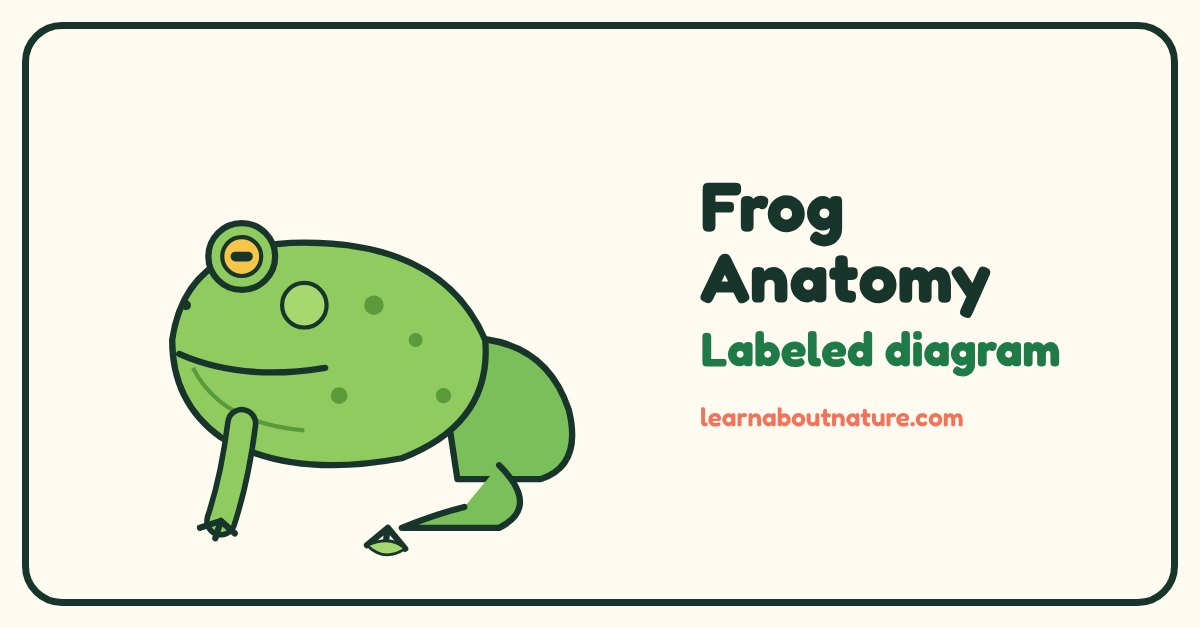
Quick answer: A frog has a wide head with bulging eyes, nostrils on top of the snout and a round eardrum called the tympanum behind each eye. It has short front legs, long jumping back legs, webbed back feet and thin, moist skin. Inside are lungs, a three-chambered heart, a liver, a stomach, intestines and kidneys.
Frogs are amphibians, animals that usually start life in water and later live partly on land. More than 8,000 species of frogs and toads are known, living on every continent except Antarctica.
A frog’s body is built for jumping, swimming and catching food with a quick flick of the tongue. Its thin skin even helps it breathe and drink. This guide explains frog anatomy, from the parts you can see on the outside to the organs inside, using a typical adult frog, such as a leopard frog or bullfrog, as the example.
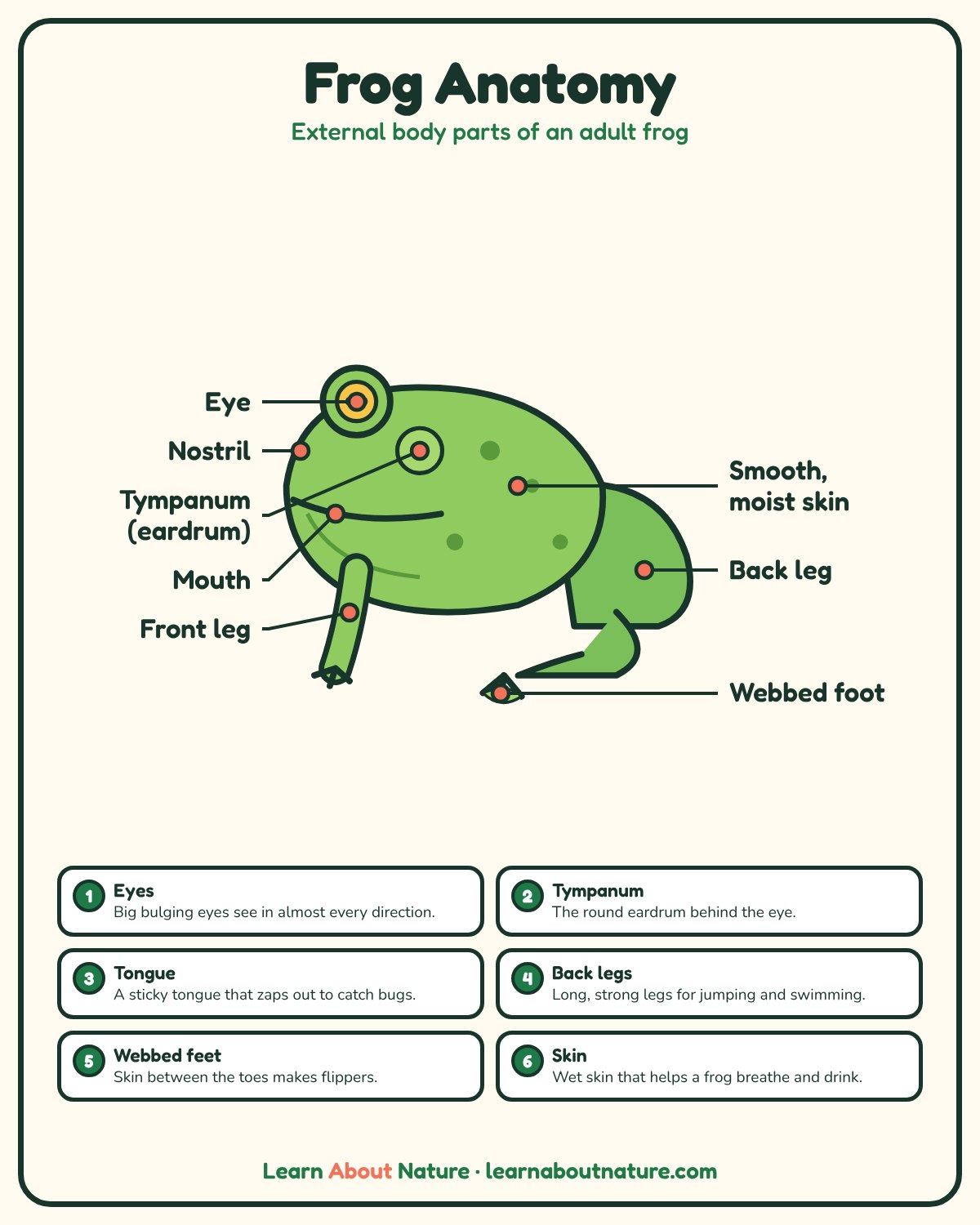
Teachers and students: you’re welcome to use this diagram in lessons and projects with credit to Learn About Nature.
Free printable: Download the Frog Anatomy labeling worksheet (PDF) – label the parts using the word bank. Answer key included.
Parts of a Frog and What They Do
| Part | What it does |
|---|---|
| Eyes | Spot movement; also help push food down when swallowing |
| Nictitating membrane | Clear eyelid that protects and moistens the eye |
| Nostrils | Let air in for breathing and smelling |
| Tympanum (eardrum) | Picks up sound, such as the calls of other frogs |
| Mouth and teeth | Catch and hold prey; teeth grip but do not chew |
| Tongue | Sticky tongue flips out to catch insects |
| Vocal sac | Lets male frogs make loud calls |
| Front legs | Support the body and absorb landings |
| Back legs | Power jumping and swimming |
| Webbed feet | Paddle through water |
| Skin | Breathes, takes in water and protects the body |
| Heart (3 chambers) | Pumps blood to the lungs, skin and body |
| Lungs | Take in oxygen from air |
The Frog Body Plan
An adult frog has a short, wide body, a large head, no neck that you can see and no tail. Its skeleton is built for jumping. The backbone is very short, the hip bones are long, and in the lower part of each leg two bones are joined into one strong bone. Most frogs also lack the long ribs that people have.
Like other vertebrates, a frog has a skeleton, a brain and spinal cord, a heart and blood vessels, and a digestive system. But frogs also have some special features, such as skin that breathes and eyes that help them swallow.
The Head: Eyes, Nostrils, Ears and Mouth
- Eyes: large and bulging, set high on the head. They give a frog a very wide view to the front, sides and partly behind. A clear third eyelid, the nictitating membrane, protects the eye and keeps it moist, even underwater.
- Nostrils: two small openings on top of the snout. Because the eyes and nostrils are high on the head, a frog can float with almost its whole body underwater and still see and breathe.
- Tympanum: the round eardrum behind each eye. It picks up sound vibrations, especially the calls of other frogs. In bullfrogs, males have a tympanum bigger than the eye, while in females it is about the same size as the eye.
- Mouth: very wide, so a frog can swallow large prey whole. Many frogs have small teeth on the upper jaw and two small patches on the roof of the mouth. These teeth grip prey but do not chew it. Toads have no teeth.
- Tongue: sticky and attached at the front of the mouth, so it can flip out quickly to catch insects.
Legs and Feet
A frog’s front legs are short and usually have four toes. They help the frog prop up its body, land after a jump and push food into its mouth.
The back legs are much longer and very muscular. Folded under the body, they work like springs. When the frog straightens them suddenly, it can leap many times its own body length.
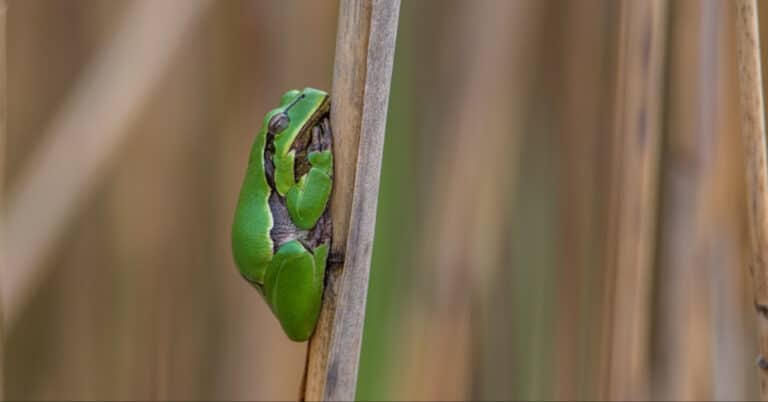
Each back foot has five long toes. In frogs that swim a lot, thin skin called webbing joins the toes, making the foot work like a paddle or flipper. Tree frogs have sticky toe pads instead of large webs, so they can cling to leaves and branches.
Skin: A Frog’s Amazing Covering
Frog skin is thin, smooth and moist. It is full of glands that make slippery mucus to keep it damp. Some frogs also have glands that make bad-tasting or poisonous chemicals to protect them from predators, which is one reason it is best to look at wild frogs without picking them up.
The skin has a rich blood supply, so oxygen can pass into the blood and carbon dioxide can pass out. This only works while the skin is moist. Frogs also take in water through their skin rather than drinking with their mouths. Much of it soaks in through a thin patch on the belly and the underside of the thighs.
Frogs shed the outer layer of their skin regularly. Many species eat the old skin.
Internal Anatomy: Organs Inside a Frog
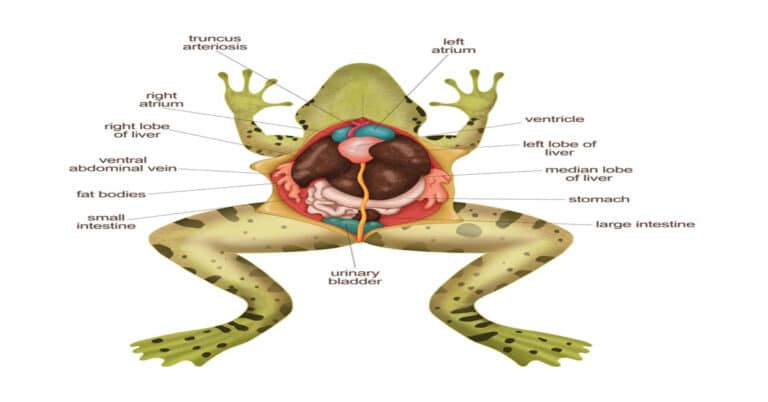
- Heart: a frog’s heart has three chambers: two atria at the top and one ventricle below. Blood from the body and blood from the lungs both enter the single ventricle, but the heart is shaped so the two streams mix only partly.
- Lungs: two thin, simple sacs. A frog has no diaphragm, so it pumps air into its lungs by raising and lowering the floor of its mouth and throat.
- Liver: the largest organ in the body cavity. It stores energy and helps break down food and wastes.
- Stomach: a stretchy bag where food starts to be digested. Frogs swallow prey whole, so the stomach does a lot of work.
- Intestines: long tubes that absorb nutrients from food.
- Kidneys: filter wastes from the blood.
- Cloaca: a single opening at the rear where wastes, eggs or sperm leave the body.
How a Frog Breathes
A frog uses three surfaces for breathing: its lungs, its skin and the lining of its mouth. On land, it uses its lungs and skin. You can often see a frog’s throat pumping up and down as it moves air.
Underwater, or while resting in cold mud during winter, a frog relies mostly on its skin. How much each surface is used depends on the species, the temperature and how active the frog is. Tadpoles are different: like fish, they breathe with gills before growing lungs.
A few frogs go even further. The wood frog of North America can survive being partly frozen in winter. Its heart and breathing stop, and sugar in its blood works like antifreeze to protect its cells. When spring arrives and it thaws, its heart starts beating again.
Senses
Frogs depend most on sight and hearing. Their eyes are excellent at spotting movement, which helps them notice flying insects and approaching predators. Many frogs will ignore a perfectly still insect but snap at one that moves.
Hearing is important because male frogs call to attract mates. Each species has its own call, and females recognize the right one. A bullfrog hears sounds from roughly 100 to 3,000 Hz, a much narrower range than people. Frogs also sense vibrations through the ground and water, and they use smell to find food and places to breed.
How a Frog Eats
Most adult frogs eat insects, spiders, worms and other small animals, and large frogs may eat mice or other frogs. A frog waits, then flicks out its sticky tongue and pulls the prey back into its mouth in a fraction of a second.
Swallowing uses an unusual trick. A frog blinks and pulls its eyeballs down into its head. The eyes press against the roof of the mouth and help push the food down the throat.
Frogs Compared With Toads
All toads are frogs, but the word toad is usually used for frogs with dry, bumpy skin and shorter legs, such as the American toad. Toads tend to walk or hop instead of leaping, often have large poison glands behind the eyes and lack teeth. Typical frogs have smooth, moist skin, long legs and webbed back feet for swimming.
Frog Anatomy for Kids
- Eyes: big bulging eyes see in almost every direction.
- Tympanum: the round eardrum behind the eye.
- Tongue: a sticky tongue that zaps out to catch bugs.
- Back legs: long, strong legs for jumping and swimming.
- Webbed feet: skin between the toes makes flippers.
- Skin: wet skin that helps a frog breathe and drink.
- Heart: a frog’s heart has three parts instead of four like ours.
Key words: amphibian – a cold-blooded vertebrate that usually lives part of its life in water and part on land; tympanum – a frog’s round, flat eardrum on the outside of its head; nictitating membrane – a see-through third eyelid that protects the eye; cloaca – a single opening at the back of the body used for wastes and laying eggs; atrium – an upper chamber of the heart that receives blood (plural: atria); ventricle – a lower chamber of the heart that pumps blood out.
Try this: Measure how far you can jump from a standing start, then compare it with your height. A strong frog can leap many times its own body length; work out how far you would have to jump to match it.
Related Guides
- Frog life cycle
- How to draw a frog anatomy diagram
- Alligator life cycle
- Turtle life cycle
- Sea turtle life cycle
- Snake life cycle
- All labeled anatomy diagrams
See also: Frog Facts for Kids
Frog Anatomy FAQs
What are the main parts of a frog?
On the outside, a frog has bulging eyes, nostrils on top of its snout, a round eardrum called the tympanum, a wide mouth with a sticky tongue, short front legs, long back legs, webbed back feet and moist skin. Inside are lungs, a three-chambered heart, a liver, a stomach, intestines and kidneys.
How many chambers does a frog heart have?
A frog’s heart has three chambers: two atria and one ventricle. Oxygen-rich blood from the lungs and oxygen-poor blood from the body both flow into the single ventricle, but the shape of the heart keeps the two streams partly separate as they are pumped out.
Can frogs breathe through their skin?
Yes. Frog skin is thin, moist and full of blood vessels, so oxygen can pass into the blood and carbon dioxide can pass out. Frogs also breathe with their lungs and the lining of their mouth. Underwater and during winter, many frogs rely mostly on their skin.
What is the circle behind a frog’s eye?
The flat, round circle behind a frog’s eye is the tympanum, its eardrum. It vibrates when sound waves hit it, letting the frog hear calls from other frogs. In some species, such as the American bullfrog, males have a much larger tympanum than females.
Do frogs have teeth?
Many frogs have small, cone-shaped teeth along the upper jaw and on the roof of the mouth, but usually none on the lower jaw. The teeth help grip slippery prey before it is swallowed whole; they are not used for chewing. Toads and some other frogs have no teeth at all.
Sources: Circulatory System: Amphibians – Britannica; All About Frogs – Burke Museum, University of Washington; Frog Fun Facts – American Museum of Natural History; Species Numbers – AmphibiaWeb; How Well Do Dogs and Other Animals Hear? – Louisiana State University

Nato is a content writer and researcher with a background in psychology who’s eager to explore the wonders of nature. As a travel enthusiast and animal lover, she hopes to inspire others to discover and cherish the beauty and importance of the natural world. She also writes about the history of candy and snacks for Snack History and about food and healthy eating for The Fitchen.