Bullfrogs

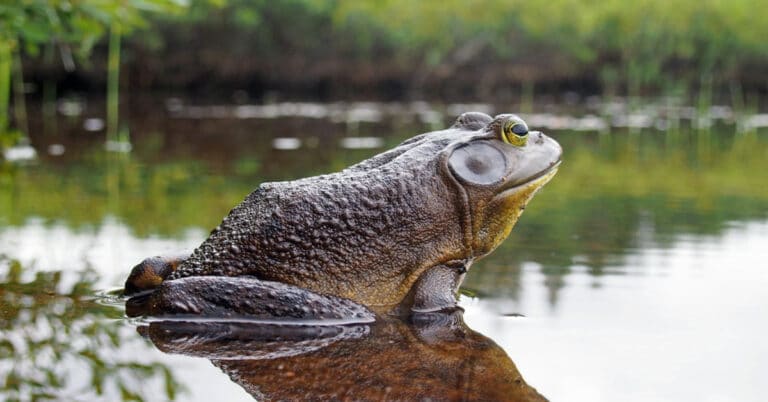
Only 100 years ago if you lived in California or Oregon you might not have ever seen a North American bullfrog. But now bullfrogs are all over North America, and can even be found on other continents. Some scientists think this is a problem because the bullfrog population is growing so quickly in parts of the world where there are no bullfrog predators that they are getting out of control.
Bullfrog Quick Facts
| Common name | Bullfrog |
| Scientific name | Lithobates catesbeianus |
| Kingdom | Animalia |
| Phylum | Chordata |
| Class | Amphibia |
| Order | Anura |
| Family | Ranidae |
| Genus | Lithobates |
| Conservation status | Least Concern |
| Type | Amphibian |
| Diet | Almost anything that fits in its mouth, even other bullfrogs |
| Habitat | Calm water: big ponds, backwaters of rivers |
| Size | Biggest frog in North America |
| Weight | Almost 2 pounds |
| Special feature | Females lay up to 20,000 eggs at once |

How Big Do Bullfrogs Get?
The bullfrog is the largest of all the frogs in North America. Some of them get to be almost two pounds. That is part of the reason that they are in places where they shouldn’t be found. Back in the early 1900�s frog legs became a popular food and people were importing bullfrogs around the world so that they could raise them and have frog legs to eat and to serve in restaurants.
Why Bullfrog Populations Grow So Fast
Bullfrog populations grow so quickly because a female bullfrog can lay up to 20,000 eggs at one time (click to read about the frog life cycle). In places where there are no natural predators to eat the eggs or the tadpoles, most of the eggs live and become full-grown bullfrogs. Other frogs in North America can only lay about 2,000 to 3,000 eggs and most of them don�t live long enough to become full-grown frogs because of the predators

Where Bullfrogs Live and How Far They Jump
Bullfrogs are amphibians and need to live near water, but when it is warm and rainy outside they will move away from the water and you can find them just about anywhere. A bullfrog can jump about six miles in a week and they will hop from large pond to large pond in order to get away from other bullfrogs and animals that will eat them. They live by finding small water sources between large ponds along the way, like puddles and small streams and ponds. Bullfrogs like calm water so you won’t find them as much near rivers, but you might find them near the calmer backwaters of large rivers.
What Do Bullfrogs Eat?
Bullfrogs will eat anything that doesn’t eat them first as long as it will fit in their mouths. They will even eat other bullfrogs, which is why you won’t find armies of bullfrogs in one place very often, and if you do they will be spread out. Groups of frogs are called armies.

Bullfrog FAQs
How big do bullfrogs get?
Bullfrogs are the largest frogs in North America. Some weigh almost two pounds.
What do bullfrogs eat?
Bullfrogs will eat anything that fits in their mouths and does not eat them first. That even includes other bullfrogs.
Why are there so many bullfrogs in some places?
A female can lay up to 20,000 eggs at once. Where there are no predators to eat the eggs and tadpoles, most of them grow up into bullfrogs.
Where do bullfrogs live?
Bullfrogs live near calm water such as big ponds and quiet river backwaters. In warm, rainy weather they can wander far from water.
How far can a bullfrog jump?
A bullfrog can travel about six miles in a week, hopping from pond to pond and using puddles and small streams on the way.

Randi Jones is the owner and founder of the Nature Gift Store, an online retailer specializing in nature-themed gifts, educational science projects, live animal nature kits and real butterfly artwork. A biology graduate who fell in love with insects, she founded the company in 2001 to make active learning about nature fun, accessible and engaging for children and adults. Her store offers real butterfly frames, home and garden decor and educational live animal kits, including ant farms, worm farms, tadpoles, ladybugs and hermit crabs, and she runs a bug museum in Washington featuring live animals like Eddie the Iguana alongside other reptiles and insects.