Elephant Facts for Kids: Habitat, Diet and Fun Facts
Quick answer: An elephant is the largest land animal on Earth. There are three species: the African savanna elephant, the African forest elephant and the Asian elephant. Elephants live in parts of Africa and Asia and eat only plants, such as grass, leaves, bark and fruit. They use their long trunks like a nose, a hand and a straw.
Elephants are giants with gentle habits. They spend most of the day eating plants, they live in close family groups, and they can pick up a single fruit or a heavy log with the same trunk.
There is not just one kind of elephant. Scientists recognize three species, two in Africa and one in Asia. Here is how they live, how their amazing bodies work and why all three need our help.
Teachers and students: you’re welcome to use this fact sheet in lessons and projects with credit to Learn About Nature.
Free printable: Download the Elephant fact file worksheet (PDF) – draw the animal, fill in the facts and match key words. Answer key included.
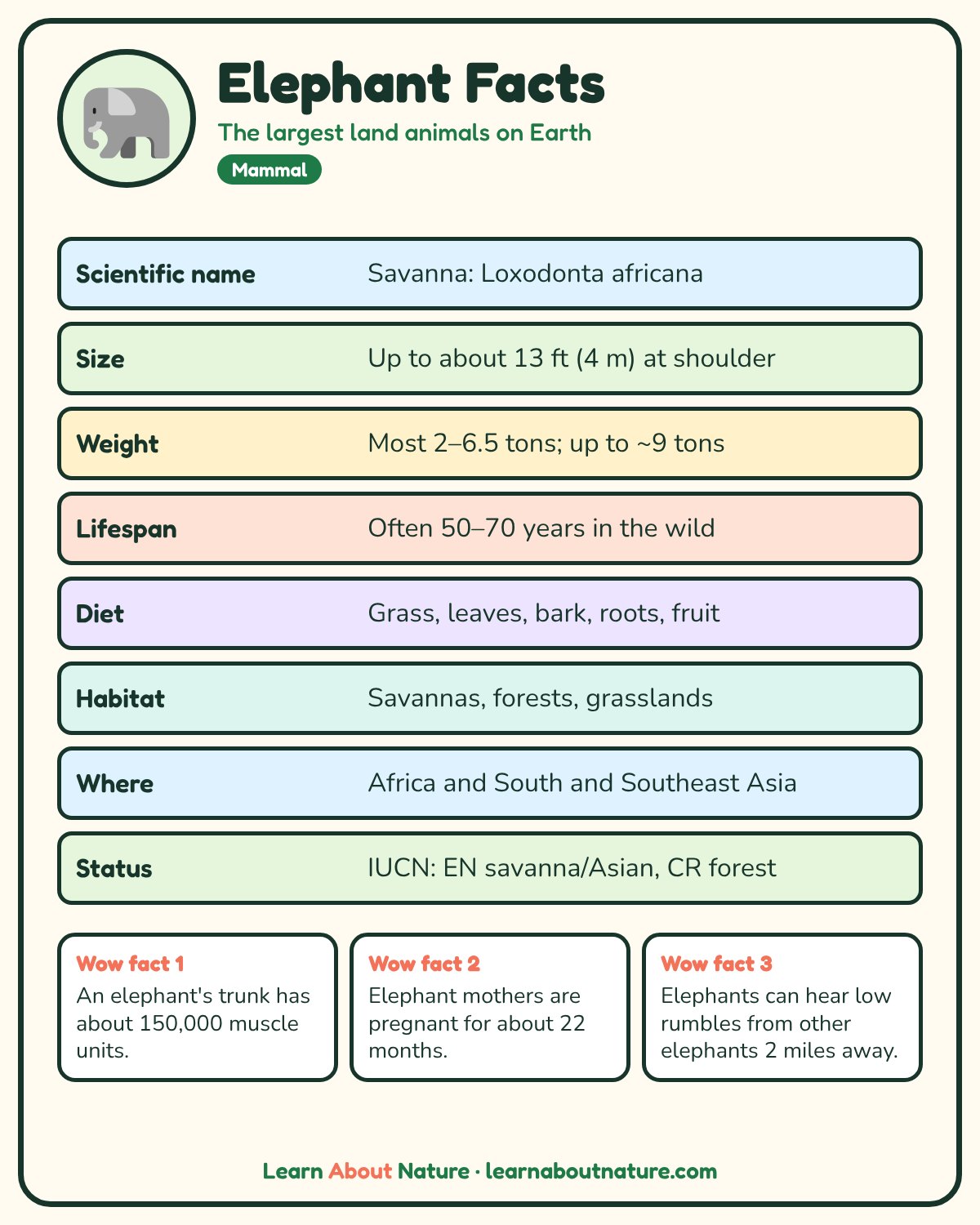
Elephant Quick Facts
| Class | Mammal |
| Species | African savanna, African forest, Asian |
| Height | Up to about 13 ft (4 m) at the shoulder |
| Weight | Most adults 2–6.5 tons; record males heavier |
| Diet | Herbivore: grass, leaves, bark, roots, fruit |
| Pregnancy | About 22 months |
| Baby name | Calf |
| Group name | Herd |
| Top speed | About 15 mph (24 km/h) |
| Conservation status | Savanna and Asian: Endangered; forest: Critically Endangered (IUCN) |
What Is an Elephant?
An elephant is a large plant-eating mammal with a long trunk, big ears and, often, a pair of tusks. Like all mammals, elephants breathe air, have hair (though not much of it) and feed their babies milk.
The three living species are the African savanna elephant (Loxodonta africana), also called the African bush elephant, the African forest elephant (Loxodonta cyclotis) and the Asian elephant (Elephas maximus). The forest elephant was long treated as part of the savanna species, but genetic studies show it is a separate species. The savanna elephant is the biggest of the three and the largest land animal alive today.
Where Do Elephants Live?
African elephants roam across 37 countries in Africa south of the Sahara. Savanna elephants live in grasslands, open woodlands, savannas and flooded grasslands. Forest elephants live in the thick rainforests of Central and West Africa, especially the Congo Basin.
Asian elephants live in India, Sri Lanka and parts of Southeast Asia, including the island of Borneo. They prefer forests and grassy areas with plenty of shade and water. India is home to almost half of all wild Asian elephants.
Elephants need a lot of space. Asian elephants usually walk about 1 to 4 miles (1.6 to 6.4 km) a day, and some herds use home ranges of hundreds of square miles to find enough food and water.
What Do Elephants Eat?
Elephants are herbivores, which means they eat only plants. Their menu includes grass, leaves, twigs, bark, roots and fruit. They use their tusks to strip bark and dig for roots, and their trunks to pull down branches.
Because plants are hard to digest and elephants are so big, they eat almost all day. The Smithsonian’s National Zoo says a wild Asian elephant eats about 165 to 330 pounds (74 to 150 kg) of food a day and drinks about 50 gallons (189 liters) of water. Elephants digest less than half of what they eat, so they leave behind lots of dung, which spreads seeds and feeds insects.
Trunks, Tusks and Ears
An elephant’s trunk is its nose and upper lip joined together. It has about 150,000 small muscle units, so it can bend, curl and twist in almost any direction. The tip is very sensitive, a bit like your fingertips. Elephants use it to breathe, smell, drink, eat, greet each other and spray water or dust over their backs. A trunk can hold about 2 gallons (8 liters) of water at a time. African elephants have two finger-like tips on the end, while Asian elephants have one.
Tusks are really giant front teeth made of ivory. Most African elephants, both males and females, have tusks. Among Asian elephants, only some males grow large tusks.
Elephants also have huge ears. African elephants have the largest ears, and flapping them helps release body heat on hot days. Elephants grow six sets of chewing teeth during their lives, one after another.
Elephant Babies
A baby elephant is called a calf. Elephants have the longest pregnancy of any land animal, about 22 months. A mother almost always has one calf at a time.
A newborn African elephant calf weighs about 200 to 260 pounds (90 to 120 kg), and Asian calves weigh about 150 to 350 pounds (68 to 158 kg). They drink their mother’s milk and may keep nursing now and then for up to about 3 years, while slowly learning to eat plants.
Calves grow up surrounded by relatives. Asian elephant calves start nibbling plants at about 6 months old, and young females usually stay with their mother’s family for life.
- Pregnancy: about 22 months
- Calves per birth: usually 1
- Birth weight: about 150–350 lb (68–158 kg)
- Nursing: up to about 3 years
Herd Life and Communication
Female elephants live in family groups called herds. In African elephants, a herd is led by the oldest female, called the matriarch. She remembers where to find water and food, even in dry years. Herds of African elephants can have from about 6 to 70 members. Asian elephant herds are smaller and usually have no single leader.
Young males leave their family as teenagers. They may live alone or join loose groups of other males.
Elephants make many sounds, from trumpets to deep rumbles. Some rumbles are so low that people cannot hear them. Other elephants can pick up these calls a few miles away, and may even sense them through the ground with their feet.
African vs Asian Elephants
African and Asian elephants look alike at first, but there are easy ways to tell them apart:
- Size: African savanna elephants are the biggest. Asian elephants are a bit smaller, and African forest elephants are smaller still.
- Ears: African elephants have very large ears. Asian elephants have smaller, rounder ears.
- Tusks: Most African elephants of both sexes have tusks. In Asian elephants, only some males have big tusks.
- Trunk tip: African elephants have two finger-like tips; Asian elephants have one.
- Family life: African herds follow a matriarch. Asian herds are usually smaller and have no single leader.
Threats and Conservation Status
Adult elephants have few natural predators, but people are a big threat. Elephants are hunted illegally for their ivory tusks, and their habitat is being turned into farms, towns and roads. When elephants and people live close together, elephants may raid crops, which can lead to conflict.
In the 2021 IUCN Red List update, the African forest elephant was listed as Critically Endangered and the African savanna elephant as Endangered. Forest elephant numbers fell by more than 86 percent over about 31 years, and savanna elephant numbers dropped by at least 60 percent over 50 years. Poaching rose sharply after 2008. The Asian elephant is listed as Endangered in its 2020 Red List assessment.
There is hope. The most recent estimate puts African elephants of both species at about 415,000, and some populations are stable or growing where they are well protected. Roughly 50,000 Asian elephants remain in the wild.
Fun Facts About Elephants
Here are a few more elephant surprises:
- Elephants can run at up to about 15 mph (24 km/h) for short distances.
- An elephant’s skin can be about 1 inch (2.5 cm) thick in places.
- Elephants sleep only a few hours a day.
- Elephants use their trunks to spray dust or water over their bodies.
- An elephant’s tusks grow several inches each year.
Fast Facts for Young Readers
- Elephants are the biggest animals that live on land.
- There are three kinds: two in Africa and one in Asia.
- An elephant uses its trunk to smell, drink and grab food.
- Tusks are really very long teeth.
- A baby elephant is called a calf.
- Elephant families are led by a grandmother elephant.
- Elephants eat plants almost all day long.
Key words: trunk – an elephant’s long nose and upper lip, used like a hand; tusk – a very long front tooth made of ivory; matriarch – the oldest female who leads an elephant family; herbivore – an animal that eats only plants; herd – a family group of elephants that lives together; poaching – hunting animals illegally.
Try this: Fill a cup with water and try to move it to another cup using only a drinking straw. Talk about how an elephant’s trunk can suck up water and squirt it into its mouth.
Related Guides
- Elephant life cycle
- Giant Panda facts for kids
- Zebra facts for kids
- Giraffe facts for kids
- Rhino facts for kids
- All animal facts for kids
Elephant FAQs
How many types of elephants are there?
There are three living species of elephant. The African savanna elephant and the African forest elephant live in Africa, and the Asian elephant lives in India, Sri Lanka and Southeast Asia. Scientists once counted African elephants as one species, but genetic studies showed they are two.
How long are elephants pregnant?
Elephants are pregnant for about 22 months, almost two years. That is the longest pregnancy of any land animal. The mother usually has one calf, which can weigh 150 to 350 pounds at birth depending on the species.
What do elephants eat?
Elephants eat only plants, including grass, leaves, twigs, bark, roots and fruit. They spend most of the day eating. A wild Asian elephant can eat about 165 to 330 pounds of food in one day and drink about 50 gallons of water.
Are elephants endangered?
Yes. On the IUCN Red List, the African forest elephant is Critically Endangered, and the African savanna elephant and the Asian elephant are Endangered. The main threats are illegal hunting for ivory and the loss of habitat to farms, roads and towns.
What is the difference between African and Asian elephants?
African elephants are generally bigger, have much larger ears and two finger-like tips on their trunks. Most African elephants of both sexes have tusks. Asian elephants are a little smaller, have smaller ears and one trunk tip, and only some males grow large tusks.
Sources: IUCN: African elephant species now Endangered and Critically Endangered; Smithsonian’s National Zoo: Asian Elephant; Animal Diversity Web: Loxodonta africana; Britannica: Elephant; WWF: African Elephant

Nato is a content writer and researcher with a background in psychology who’s eager to explore the wonders of nature. As a travel enthusiast and animal lover, she hopes to inspire others to discover and cherish the beauty and importance of the natural world. She also writes about the history of candy and snacks for Snack History and about food and healthy eating for The Fitchen.