Bald Eagle Facts for Kids: Habitat, Diet, Nests and Fun Facts
Quick answer: A bald eagle is a large bird of prey with a white head, white tail and dark brown body. It lives across North America, usually near lakes, rivers and coasts, and eats mostly fish. It is the national bird of the United States and builds some of the biggest nests of any bird.
With its snowy white head, bright yellow beak and huge wings, the bald eagle is one of the most famous birds in the world. It has been a symbol of the United States since 1782.
Not long ago, bald eagles were in serious trouble. Today they are a great conservation success story. Here is how bald eagles hunt, build their enormous nests, raise their young and how they made their remarkable comeback.
Teachers and students: you’re welcome to use this fact sheet in lessons and projects with credit to Learn About Nature.
Free printable: Download the Bald Eagle fact file worksheet (PDF) – draw the animal, fill in the facts and match key words. Answer key included.
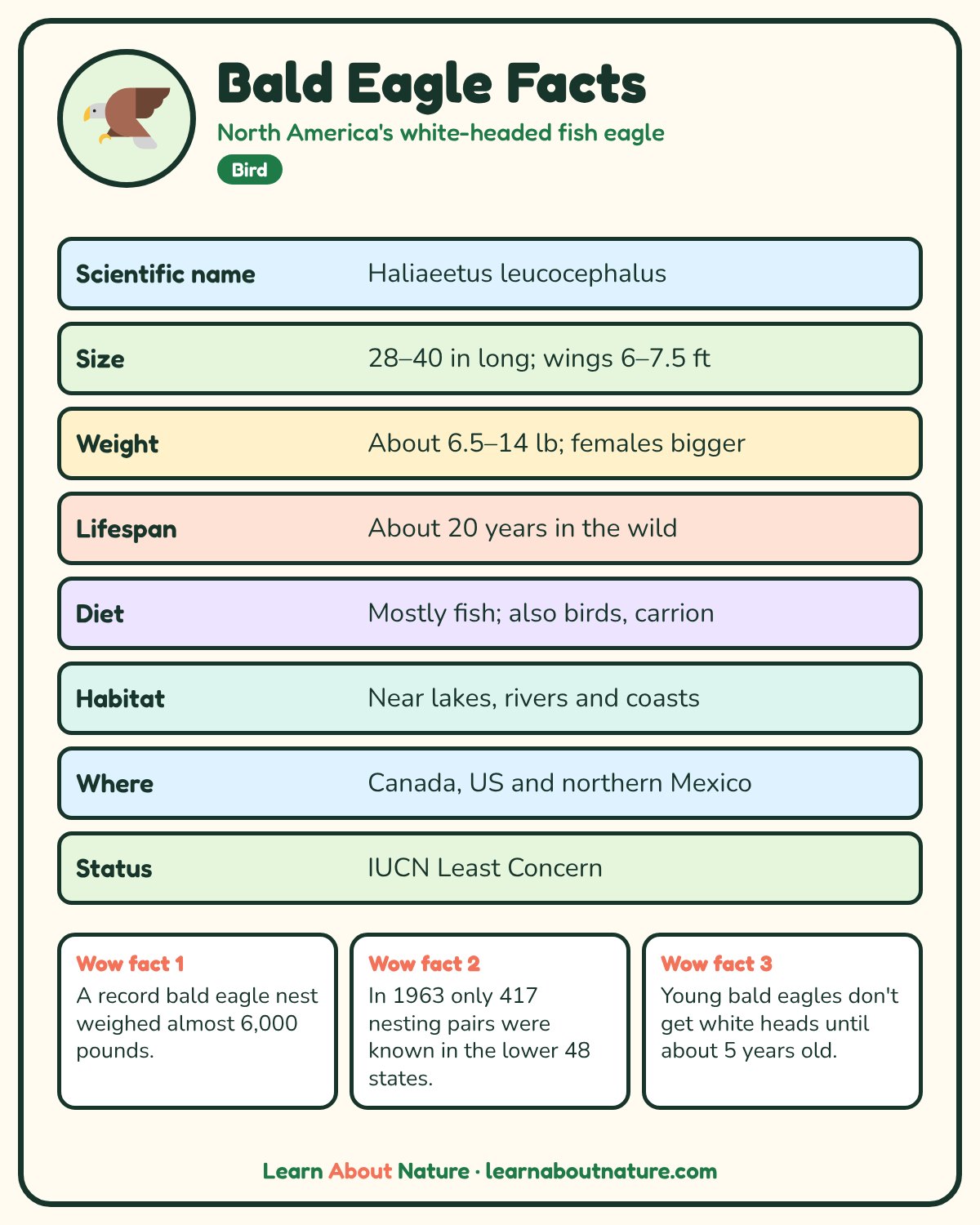
Bald Eagle Quick Facts
| Class | Bird |
| Group | Bird of prey (raptor), sea eagle |
| Scientific name | Haliaeetus leucocephalus |
| Length | About 28–40 in (70–102 cm) |
| Wingspan | About 6–7.5 ft (1.8–2.3 m) |
| Weight | About 6.5–14 lb (3–6.3 kg) |
| Lifespan | About 20 years in the wild; record 38 |
| Eggs | 1–3, incubated about 34–36 days |
| Baby name | Eaglet |
| Conservation status | Least Concern (IUCN) |
What Is a Bald Eagle?
A bald eagle is a bird of prey, also called a raptor. Birds of prey hunt other animals using sharp, curved claws called talons and a strong hooked beak. Bald eagles belong to a group called sea eagles or fish eagles.
Despite the name, a bald eagle is not bald. Adults have a head covered in bright white feathers, which stands out against the dark brown body. They also have a white tail, yellow feet and a large yellow beak.
The bald eagle was chosen as a national emblem of the United States in 1782. In December 2024, a new law also made it the official national bird.
Where Do Bald Eagles Live?
Bald eagles live only in North America. They are found across most of Canada and Alaska, all of the lower 48 United States and parts of northern Mexico.
They almost always live near water, such as lakes, large rivers, marshes and seacoasts, where there are plenty of fish. They like tall, strong trees to perch and nest in. In winter, many eagles gather in big groups at good feeding spots, such as rivers below dams.
What Do Bald Eagles Eat?
Bald eagles eat mostly fish, such as salmon, herring, shad and catfish. An eagle swoops low over the water and snatches a fish near the surface with its talons.
They also eat other birds and small mammals such as rabbits and muskrats, plus crabs, turtles and frogs. Bald eagles are not picky. They often eat carrion, which means animals that are already dead.
Bald eagles are also known for stealing. They often chase ospreys and other birds until they drop their fish, then grab it for themselves. An eagle can eat a big meal and then go for days without food.
Body and Senses
Bald eagles are big birds. They are about 28 to 40 inches (70 to 102 cm) long, with a wingspan of about 6 to 7.5 feet (1.8 to 2.3 m). They usually weigh about 6.5 to 14 pounds (3 to 6.3 kg). Females are about 25 percent bigger than males, and eagles in the far north, such as Alaska, tend to be larger than those in the south.
Eagles soar on wide, flat wings, gliding for long distances with few wingbeats. Their sharp talons grip slippery fish, and their hooked beak tears food into bite-size pieces. They can dive at high speed, though they seldom drop straight down.
Nests, Eggs and Eaglets
During courtship, a pair may lock talons high in the sky and tumble toward the ground together, letting go just in time.
The pair builds a nest of sticks high in a tall, sturdy tree, usually close to the trunk. In the south, they may also nest in mangroves or even cactus. A new nest can take up to three months to build. Eagles reuse the same nest year after year and add more sticks each time, so nests get huge. A typical nest is 5 to 6 feet (1.5 to 1.8 m) wide. The largest ever recorded, in St. Petersburg, Florida, was 9.5 feet wide, 20 feet deep and weighed almost 6,000 pounds.
The female lays 1 to 3 dull white eggs. The eggs are kept warm for about 34 to 36 days before they hatch. The chicks, called eaglets, hatch covered in soft, light-gray down. The parents bring them food for about 8 to 14 weeks until the young are ready to leave the nest.
- Eggs per clutch: 1–3
- Incubation: about 34–36 days
- Time in the nest: about 8–14 weeks
- White head and tail: at about 5 years old
Growing Up
Young bald eagles look very different from their parents. They are mostly brown, with messy white patches and streaks on the body and under the wings. Many people mistake them for golden eagles.
Each year their feathers change a little. Bald eagles get their full white head and white tail at about 5 years old, which is also about when they are ready to raise their own young. In the wild, bald eagles live about 20 years on average. The oldest known wild bald eagle lived to be 38.
Bald Eagle vs Golden Eagle
The bald eagle and the golden eagle are the two big eagles of North America. Adult males of both kinds are about 2.5 feet (0.8 m) long, with wingspans of roughly 6 to 7 feet. Here is how to tell them apart:
- Head: adult bald eagles have a white head. Golden eagles have a brown head with golden feathers on the back of the neck.
- Legs: a golden eagle’s legs are covered in feathers all the way to the toes. A bald eagle has bare yellow lower legs.
- Beak: a bald eagle’s beak is very large for its head. A golden eagle’s beak looks smaller.
- Home: bald eagles stay near water with plenty of fish. Golden eagles prefer forests and grasslands, often far from lakes, rivers and coasts.
Threats and Conservation Status
When the bald eagle became a national symbol in 1782, early accounts suggest there may have been as many as 100,000 nesting bald eagles. Over time, shooting, habitat loss and poisoning made their numbers fall. The biggest problem was DDT, a chemical used to kill insects. It washed into rivers and lakes, built up in fish and then in the eagles that ate them. It made eagle eggshells so thin that they often broke or did not hatch. By 1963, only 417 nesting pairs were known in the lower 48 states.
The United States banned DDT in 1972 and protected bald eagles by law. Slowly, they came back. In 2007, bald eagles were removed from the endangered and threatened species list. By 2018 to 2019, there were about 316,700 bald eagles in the lower 48 states.
The IUCN Red List lists the bald eagle as Least Concern (latest assessment published in 2024). Bald eagles are still protected by law. Today’s dangers include lead poisoning from eating animals shot with lead ammunition, crashes with cars and power lines, and the loss of shoreline habitat.
Fun Facts About Bald Eagles
Here are a few more bald eagle surprises:
- Bald eagle nests are among the largest nests built by any bird.
- When diving, a bald eagle can reach speeds of about 75 to 99 miles per hour (120 to 160 km/h).
- Bald eagles walk with a funny, rocking waddle.
- If a bald eagle lands in water that is too deep to wade, it can “row” to shore with its wings.
Fast Facts for Young Readers
- The bald eagle is the national bird of the United States.
- It is not really bald. Its head has white feathers.
- Bald eagles eat mostly fish.
- They build some of the biggest bird nests in the world.
- A baby eagle is called an eaglet.
- Young eagles are brown and get white heads at about age 5.
- Bald eagles were once in danger, but now there are many more.
Key words: bird of prey – a bird that hunts animals with sharp talons and a hooked beak; talons – the long, sharp, curved claws of a bird of prey; carrion – the meat of an animal that is already dead; eaglet – a baby eagle; DDT – a chemical once used to kill insects that harmed bald eagle eggs.
Try this: Measure an eagle nest: use chalk or string on the playground to draw a circle 9.5 feet across, the width of the record bald eagle nest, and see how many students can sit inside it.
Related Guides
- Eagle life cycle
- Owl facts for kids
- Hummingbird facts for kids
- Penguin facts for kids
- All animal facts for kids
Bald Eagle FAQs
Why is it called a bald eagle if it has feathers?
A bald eagle is not bald at all. Its head is covered in bright white feathers. From a distance, the white head stands out so much against the dark brown body that it can look bare. Young bald eagles have brown heads until they are about 5 years old.
What do bald eagles eat?
Bald eagles eat mostly fish, such as salmon, herring and catfish, which they snatch from the water with their talons. They also eat other birds, rabbits, muskrats, crabs and dead animals. Sometimes they steal fish from ospreys and other birds.
How big is a bald eagle’s nest?
A typical bald eagle nest is about 5 to 6 feet wide and 2 to 4 feet tall. Eagles reuse and add to their nests each year, so some get enormous. The record nest, in Florida, was 9.5 feet wide, 20 feet deep and weighed almost 6,000 pounds.
How long do bald eagles live?
Bald eagles live about 20 years on average in the wild, and the oldest known wild bald eagle reached 38. They can live even longer in captivity. Young eagles take about 5 years to get their white head and tail and start raising young.
Are bald eagles still endangered?
No. Bald eagles nearly disappeared from the lower 48 states, with only 417 nesting pairs known in 1963. After DDT was banned and eagles were protected, they recovered and were removed from the endangered list in 2007. The IUCN Red List lists them as Least Concern.
Sources: U.S. Fish and Wildlife Service: Bald Eagle; Cornell Lab of Ornithology, All About Birds: Bald Eagle Life History; Audubon: Is That Golden Eagle Actually a Bald Eagle?; Wikipedia: Bald eagle

Nato is a content writer and researcher with a background in psychology who’s eager to explore the wonders of nature. As a travel enthusiast and animal lover, she hopes to inspire others to discover and cherish the beauty and importance of the natural world. She also writes about the history of candy and snacks for Snack History and about food and healthy eating for The Fitchen.