Swan Life Cycle: From Egg to Cygnet to Adult
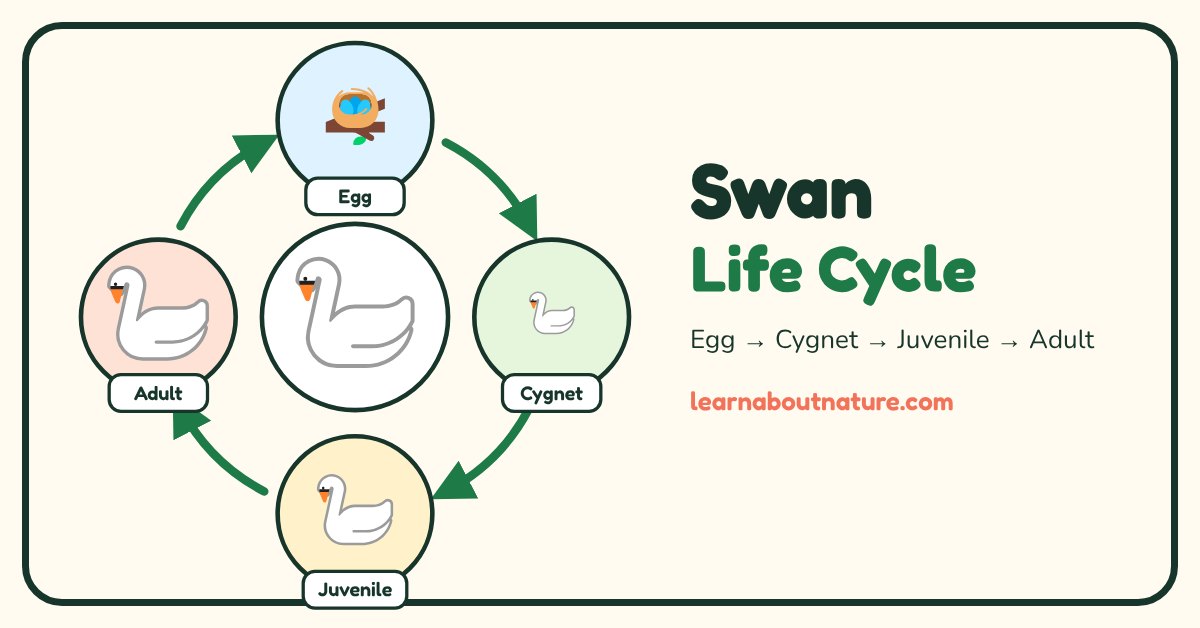
Quick answer: A swan’s life cycle has four stages: egg, cygnet, juvenile and adult. Mute swans lay about 4 to 7 eggs in a big nest of plants, and the female keeps them warm for about 5 weeks. Fluffy gray cygnets swim within a day, fly at about 4 to 5 months, and usually start breeding at 3 to 4 years.
Swans are large water birds with long, graceful necks. They belong to the same bird family as ducks and geese. There are several kinds of swans around the world, including the black swan of Australia and the trumpeter swan of North America.
This page follows the mute swan, the big white swan with an orange bill that lives on lakes, rivers and parks across Britain and Europe and has also been introduced to North America. Mute swans are among the heaviest flying birds, and their life cycle includes some of the most devoted parenting in the bird world.
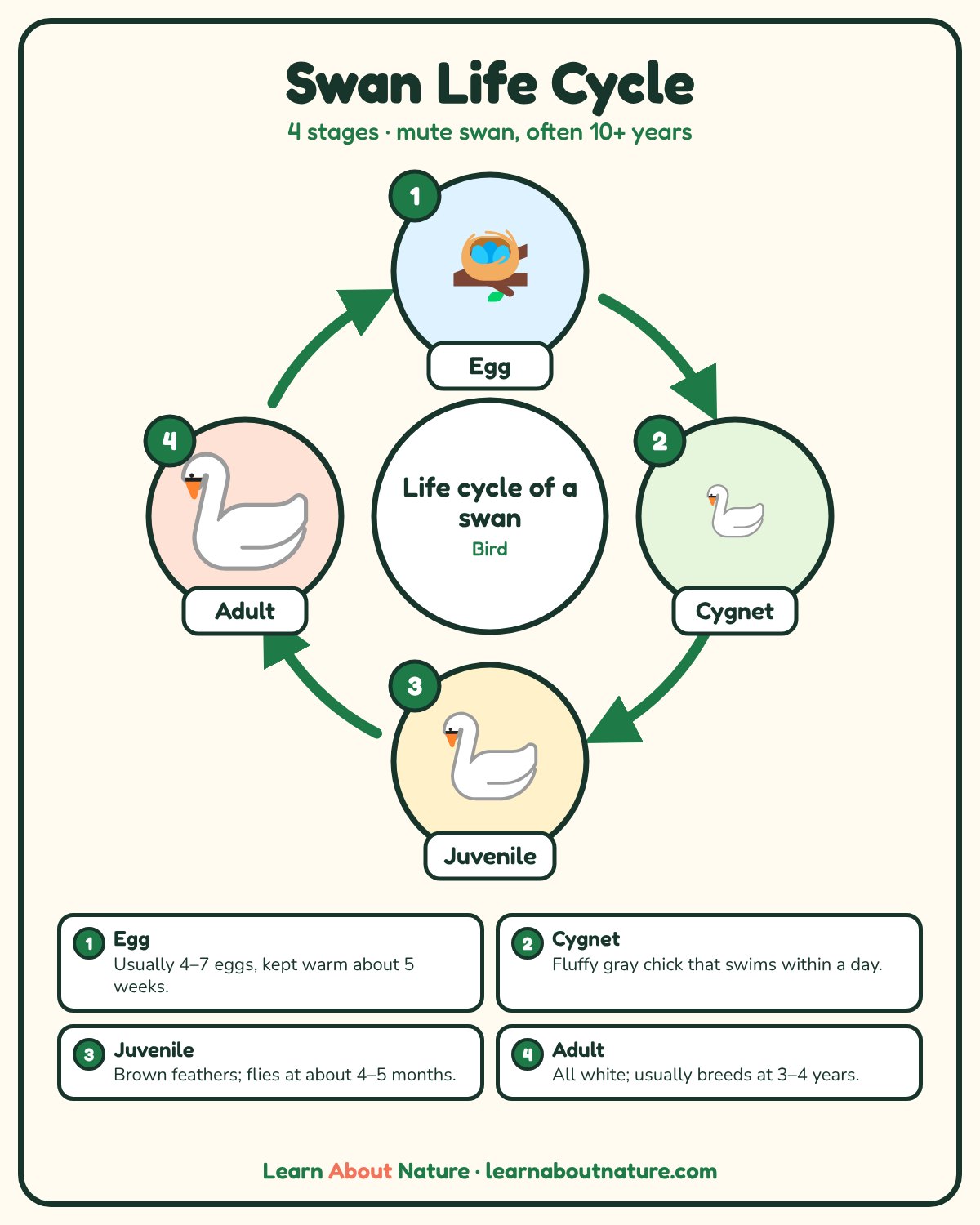
Teachers and students: you’re welcome to use this diagram in lessons and projects with credit to Learn About Nature.
Free printable: Download the Swan life cycle worksheet (PDF) – label the diagram, cut and sequence the stages, and match key words. Answer key included.
Swan Life Cycle Quick Facts
| Main example | Mute swan (Cygnus olor) |
| Eggs per clutch | usually 4–7 (range 2–12) |
| Incubation | about 35–41 days, mostly by the pen |
| Leaves nest | about 1 day after hatching |
| First flight | about 4–5 months |
| Mostly white | by about 1 year old |
| Breeding age | usually 3–4 years |
| Adult weight | about 19–24 lb (8.5–11 kg) |
| Lifespan | about 10 years for breeders; record 29+ |
Pairing and Courtship
An adult male swan is called a cob, and an adult female is called a pen. Young swans often begin forming pairs at around two years old, a year or two before they start breeding.
Swans are famous for staying with one partner, and many pairs do stay together for years. Established pairs tend to raise more young than new pairs. Even so, swans do not always mate for life. If a partner dies, or if a pair fails to breed, a swan may find a new mate.
During courtship, a pair may face each other and dip their heads and necks in the water at the same time, sometimes curving their necks so they form a heart shape.
Building the Nest
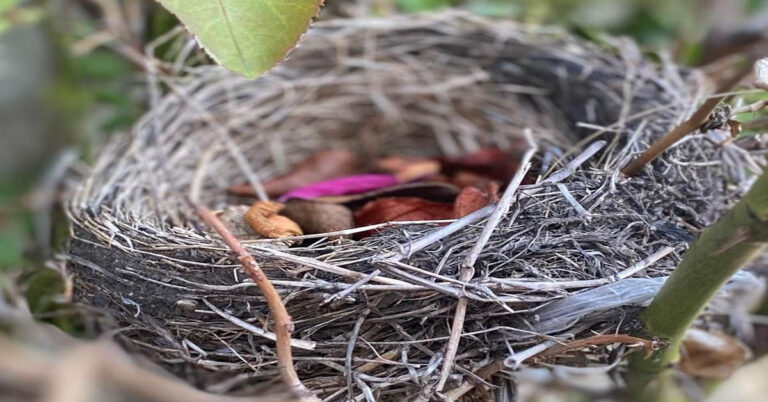
In early spring, the pair chooses a nest site near water, such as a small island, a reed bed or a quiet bank. The cob picks the spot and does most of the gathering, pulling up reeds, grasses and sticks. The pen arranges the material and shapes a cup in the middle with her body and feet.
The result is a huge mound of plants, often about 5 ft (1.5 m) across at the base. Building usually takes about 10 days, and pairs often reuse and repair the same nest year after year.
Stage 1: Egg
The pen lays one egg about every other day until the clutch is complete. A typical clutch has about 4 to 7 eggs, though some have as few as 2 or as many as 12. Each egg is large, about 3.5 to 4.5 inches (9 to 11.5 cm) long, and pale blue-green or gray when laid, becoming whiter over time.
The pen does nearly all of the incubation, keeping the eggs warm for about 35 to 41 days. She turns the eggs with her bill and lines the nest with soft feathers from her body.
Meanwhile, the cob stands guard. Mute swans are fiercely protective of their nests and will hiss, spread their wings and chase off geese, dogs and even people who come too close. Always keep a safe distance from a nesting swan.
Stage 2: Cygnet
Baby swans are called cygnets. The whole clutch usually hatches within about a day. Newly hatched cygnets are covered in soft gray or grayish-brown down, and their eyes are open. A few mute swan cygnets hatch with white down instead.
Cygnets are precocial, meaning they can walk, swim and feed themselves very soon after hatching. They usually stay on the nest for about a day while their down dries, then follow their parents onto the water.
The parents do not feed the cygnets the way songbirds feed their chicks. Instead, they lead the family to good feeding spots and pull up underwater plants for the little ones to nibble. Cygnets also pick at insects and small water creatures.
- Young cygnets often ride on a parent’s back, tucked between its wings.
- This keeps them warm, lets them rest and keeps them safer from predators such as large fish and snapping turtles.
- Families stay close together, with the cob usually keeping watch while the cygnets feed.
Stage 3: Juvenile
As the summer goes on, the cygnets grow quickly. Their fluffy down is replaced by grayish-brown feathers, and their bills are dark gray. Young mute swans can fly at about 4 to 5 months old, usually in late summer or fall.
Over their first winter and spring, the brown feathers slowly give way to white. By about one year old, a young mute swan is mostly white, but its bill is still a dull grayish pink rather than bright orange.
Before the next breeding season, the parents drive their grown-up youngsters away from the territory to make room for a new brood. The young swans then join flocks of other young and non-breeding swans, where they feed, rest and later begin to choose partners.
Stage 4: Adult
A mute swan’s adult look is complete when it has pure white feathers and a bright orange bill with a black knob at the base. The knob is larger on males, especially during the breeding season.
Most mute swans start breeding at about 3 to 4 years old, once they have a partner and can claim a territory. Adults are very heavy for flying birds. Males average about 24 lb (11 kg), and females about 19 lb (8.5 kg).
Each summer, adult swans molt, shedding their old flight feathers and growing new ones. For several weeks during the molt, they cannot fly at all, so they stay on open water where they can swim away from danger. Breeding pairs usually molt one at a time, so one parent can still guard the cygnets.
A breeding pair raises one brood a year. When spring comes, they return to their nest site, rebuild the mound, and the life cycle starts again.
A Year in the Life of a Cygnet
Here is roughly how a mute swan grows up during its first year, based on swans in Britain and Europe. Exact timing depends on the weather and where the swans live.
- Spring: eggs are laid and kept warm for about five weeks.
- Late spring to early summer: cygnets hatch, leave the nest within about a day and start swimming.
- Summer: gray down is replaced by grayish-brown feathers.
- Late summer to fall: cygnets make their first flights at about 4 to 5 months old.
- Winter: the young swans still travel with their parents, slowly turning whiter.
- Next spring: parents chase the yearlings away, and they join flocks of other young swans.
How Long Do Swans Live?
Many cygnets do not survive their first year, but mute swans that reach breeding age typically live about 10 years. Some live much longer. One wild mute swan in Britain, tracked using a numbered leg ring, lived for more than 29 years.
Mute swans face dangers such as collisions with power lines, lead poisoning from old fishing weights and shotgun pellets, getting tangled in fishing line, and bird flu outbreaks. As a species, the mute swan is listed as Least Concern by the IUCN. In parts of North America, where it is not native, it is managed because it can crowd out native birds and eat large amounts of water plants.
Interesting Swan Facts
- Despite the name, mute swans are not silent. They hiss, grunt and snort.
- The wings of a flying mute swan make a loud, rhythmic throbbing sound.
- Cygnets can swim within about a day of hatching.
- Young swans are brown and gray, and turn white as they grow up.
- Swans pull up underwater plants to help feed their cygnets.
Swan Life Cycle for Kids
Here is the swan life cycle in simple steps:
- Egg: Mom swan keeps her eggs warm on a big nest of plants.
- Cygnet: The fluffy gray baby swan can swim when it is one day old.
- Juvenile: The young swan has brown feathers and learns to fly.
- Adult: The grown-up swan is white and finds a partner.
Key words: cygnet – a baby swan; cob – an adult male swan; pen – an adult female swan; clutch – a group of eggs laid in one nest; incubate – to keep an egg warm so the baby inside can grow; precocial – able to walk, swim and feed soon after hatching.
Try this: Fold a white paper swan and a gray paper cygnet, then make a simple timeline showing how the cygnet’s feathers change from gray to brown to white as it grows up.
Related Life Cycles and Guides
- Ostrich life cycle
- Flamingo life cycle
- Bird life cycle
- Chicken life cycle
- Owl life cycle
- Bird anatomy
- All animal & plant life cycles
Swan Life Cycle FAQs
What is a baby swan called?
A baby swan is called a cygnet. Mute swan cygnets hatch covered in soft gray or grayish-brown down and can swim within about a day. An adult male swan is called a cob, and an adult female is called a pen.
How long do swans sit on their eggs?
Mute swans incubate their eggs for about 35 to 41 days, roughly five weeks. The female does almost all of the sitting, while the male guards the nest and chases away intruders. The eggs usually all hatch within about a day of each other.
Do swans mate for life?
Many swans stay with the same partner for years, and some for life, which is why swans are a symbol of loyalty. But it is not guaranteed. If a partner dies or a pair fails to raise young, a swan may pair up with a new mate.
When do baby swans learn to fly?
Mute swan cygnets usually learn to fly at about 4 to 5 months old, in late summer or fall. Until then, they stay close to their parents, swimming and feeding together, and sometimes riding on a parent’s back.
How long do swans live?
Mute swans that survive to breeding age typically live about 10 years in the wild. Some live much longer, and one ringed wild mute swan in Britain reached more than 29 years old. Many cygnets, though, do not survive their first year.
Sources: Mute Swan – BTO BirdFacts; Mute Swan Life History – All About Birds, Cornell Lab of Ornithology; Everything you need to know about mute swans – Scottish Wildlife Trust; Cygnus olor (mute swan) – BioKIDS, University of Michigan

Nato is a content writer and researcher with a background in psychology who’s eager to explore the wonders of nature. As a travel enthusiast and animal lover, she hopes to inspire others to discover and cherish the beauty and importance of the natural world. She also writes about the history of candy and snacks for Snack History and about food and healthy eating for The Fitchen.