Owl Life Cycle: Stages from Egg to Owlet to Adult (With Diagram)

Quick answer: The owl life cycle has four stages: egg, owlet (nestling), fledgling and adult. Eggs hatch after about a month, owlets are fed in the nest for several weeks, fledglings leave the nest and learn to fly and hunt, and most owls breed at one or two years old.
The owl life cycle has four main stages: egg, owlet (nestling), fledgling and adult. Owls hatch from eggs, spend their first weeks as fluffy, hungry owlets in the nest, leave the nest before they can fly well, and then learn to hunt before living on their own.
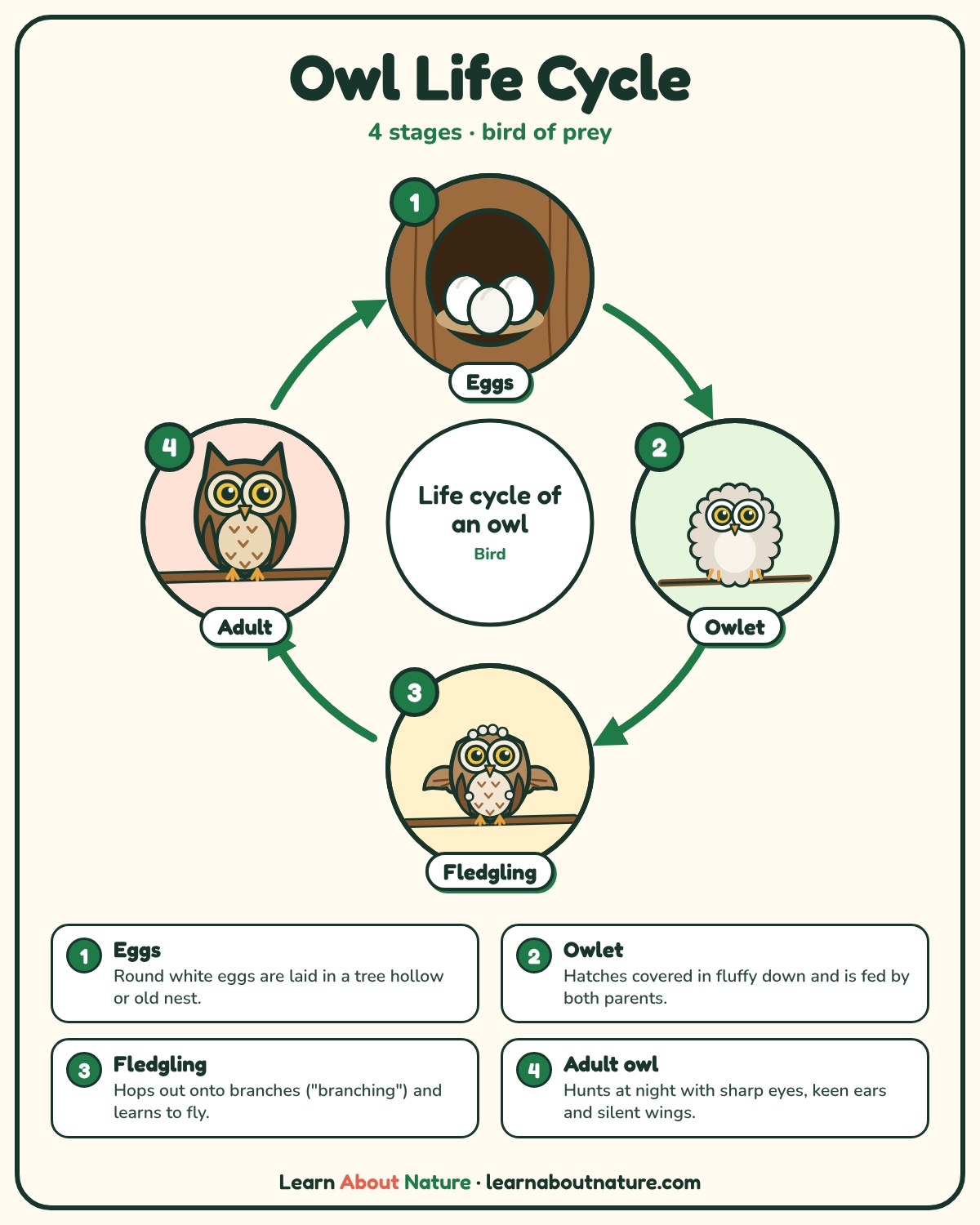
Owl Life Cycle Quick Facts
| Common name | Owl |
| Scientific name | Strigiformes |
| Kingdom | Animalia |
| Phylum | Chordata |
| Class | Aves |
| Life cycle stages | Egg, owlet (nestling), fledgling, adult |
| Type of development | Hatches from eggs; owlets are fed in the nest |
| Incubation | About 30–37 days (varies by species) |
| Time to adulthood | About 1–2 years (first breeding) |
| Lifespan | A few years to 20+ years in the wild, depending on species |
| Number of eggs | Barn owl usually 4–7; great horned owl usually 2–3 |
There are around 250 kinds of owls, and the details change from species to species. Big owls usually lay fewer eggs and take longer to grow up than small ones. In this guide we use two well-known North American owls as examples: the barn owl and the great horned owl.
Stage 1: Egg
Most owls do not build their own nests. Barn owls lay their eggs in sheltered hollows such as tree cavities, old barns, church towers and nest boxes, often on a soft bed of broken-up pellets. Great horned owls usually take over an old stick nest made by a hawk, crow or squirrel, or use a hollow tree or cliff ledge. Our guide to types of bird nests shows how different this is from birds that weave their own homes.
Owl eggs are white and almost round. A barn owl usually lays about 4 to 7 eggs, and sometimes more in years when mice and voles are plentiful. A great horned owl usually lays just 2 or 3, though clutches of 1 to 4 happen. Great horned owls are among the earliest birds to nest in North America, often laying eggs in the middle of winter, sometimes with snow on the ground.
The female does almost all of the sitting, keeping the eggs warm with a bare patch of skin on her belly called a brood patch. The male hunts and brings food to her. Eggs take about a month to hatch: roughly 30 days for barn owls, and about 30 to 37 days for great horned owls.
Staggered hatching
Owls usually lay their eggs a day or more apart and start sitting on them as soon as the first egg is laid. Because of this, the eggs hatch one at a time, in the order they were laid. In a large barn owl family, the oldest owlet may be about two weeks older and much bigger than the youngest.
This staggered hatching helps owl parents cope with changing food supplies. When food is plentiful, all the owlets can survive. When food is short, the biggest owlets get fed first, so at least some of the young make it, even if the smallest do not.
Stage 2: Owlet (Nestling)
A newly hatched owlet is tiny, weak and covered in thin, white down. Its eyes stay closed for about the first week or two, and it cannot keep itself warm, so the mother broods it under her body. Owlets like this, which depend completely on their parents, are called altricial (or semi-altricial) young.

At first the father brings prey to the nest and the mother tears it into small pieces for the owlets. As they grow, the owlets swallow mice and other prey whole, and they soon begin coughing up pellets of bones and fur, just like adults. Find out more about what owls eat.
Owlets grow very fast. Their first down is replaced by a thicker, fluffier coat of down, and then real feathers start to grow in. Hungry barn owlets make loud hissing and snoring sounds to beg for food, which can be heard from outside a barn at night.
Stage 3: Fledgling (Brancher)
Many young owls leave the nest before they can fly properly. Great horned owlets often climb out onto nearby branches at about six weeks old. Because of this habit, young owls at this stage are often called branchers. They hop, flap and climb from branch to branch, building up their strength. They can usually fly short distances a few weeks later, at roughly two to three months old. Young barn owls take their first flights when they are about two months old.

Fledglings still depend on their parents for food, and they call loudly so the adults can find them. Over the next weeks and months they practice pouncing on insects and other small animals. Young barn owls usually become independent within a couple of months of leaving the nest. Great horned owl parents may keep feeding their young into the fall.
Sometimes a brancher ends up on the ground. This is often normal, and the parents usually keep feeding it nearby. If you find a young owl that looks hurt or in danger, do not pick it up. Tell an adult, who can contact a local wildlife rehabilitator for advice.
Stage 4: Adult
Once a young owl can hunt well, it leaves its parents’ territory to find a home of its own. Many die in their first year, from starvation, cars, larger predators or bad weather. Those that survive soon become adults. Barn owls can breed when they are about a year old, while great horned owls usually start nesting when they are about two.
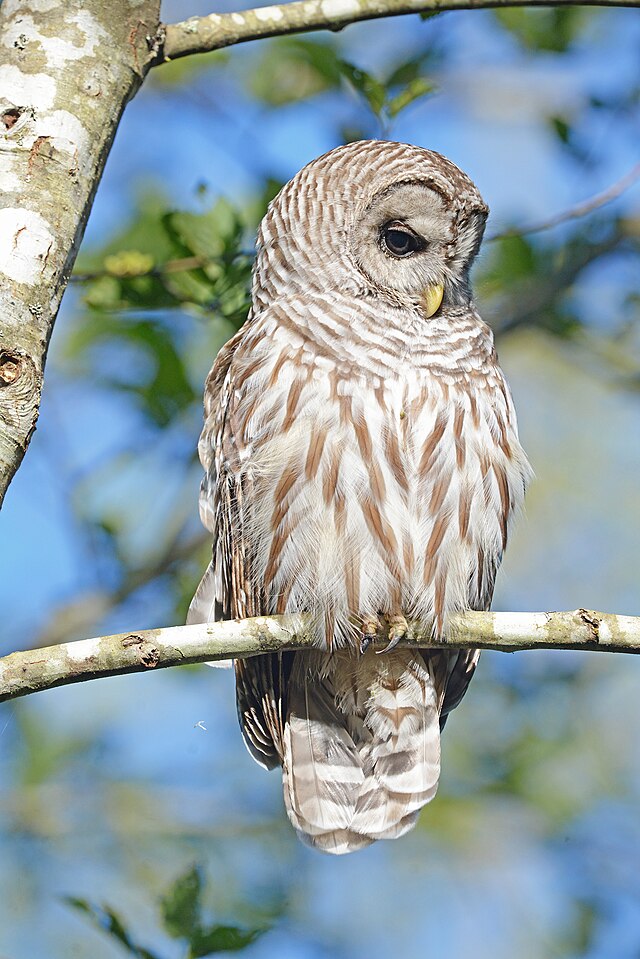
Adult owls are skilled night hunters. Soft-edged feathers let them fly almost silently, and their sharp hearing lets some species catch prey they cannot see. Their ears are hidden under feathers, as explained in our page on whether birds have ears. Many owl pairs stay together for years and defend the same territory. Learn more about owl courtship in how birds mate. When a pair lays a new clutch of eggs, the life cycle begins again.
How Long Does an Owl Live?
Owl lifespans vary a lot by size and species. Most wild barn owls live only a few years, although a few have lived well over 10 years. Larger owls tend to live longer: wild great horned owls have been recorded living more than 20 years. In zoos and sanctuaries, where they are safe from predators and always have food, owls often live longer than in the wild. Read the full story in how long do owls live.
Owl vs Chicken Life Cycle
Owls and chickens are both birds, so they share the same basic stages. Comparing them with the chicken life cycle shows how differently birds can start life:
- Hatching: A hen waits until all her eggs are laid before sitting on them, so the chicks hatch together. An owl starts sitting right away, so her owlets hatch days apart.
- Newborns: Chicks hatch with open eyes and can walk and peck for food within hours. Owlets hatch with closed eyes and must be fed for weeks.
- Incubation: Chicken eggs hatch in about 21 days. Owl eggs take about a month or a little longer.
- Diet: Chickens eat seeds, plants and insects. Owls are hunters that eat mostly small animals.
You can see all our animal and plant life cycles to compare owls with many other animals.
Fun Facts About the Owl Life Cycle
- Barn owls may raise more than one brood in a year when food is plentiful.
- Great horned owls can sit on their eggs during snowstorms, keeping them warm in freezing weather.
- Owlets often look bigger than their parents for a while, because their fluffy down makes them look puffed up.
- Owls cough up pellets of fur and bones, and owlets start doing this while they are still in the nest.
- Many owls, including the burrowing owl, live in the southern United States. See which ones in our guide to owls in Florida.
- People around the world have told stories about owls for thousands of years. Explore owl symbolism to learn more.
If you would like to help birds raise their young near your home, read these tips for hosting nesting birds safely, or learn how owls’ bodies work in our guide to bird anatomy.
More life cycles
- Bird Life CycleEgg → hatchling → nestling → fledgling → adult
- Chicken Life CycleEgg → chick → young bird → hen or rooster
- Bat Life CyclePup → juvenile → adult
- Fox Life CycleKit → juvenile → adult
- Frog Life CycleEgg → tadpole → froglet → frog
Owl Life Cycle FAQs
What are the stages of an owl’s life cycle?
An owl’s life cycle has four stages: egg, owlet (nestling), fledgling and adult. Young owls that climb onto branches before they can fly are often called branchers.
How long does it take for owl eggs to hatch?
Owl eggs usually hatch after about a month. Barn owl eggs take roughly 30 days, and great horned owl eggs take about 30 to 37 days.
Why do baby owls hatch at different times?
Owls start sitting on their eggs as soon as the first one is laid, so the eggs hatch in the order they were laid, often a day or more apart. This means owlets in one nest can be very different sizes.
What is a baby owl called?
A baby owl is called an owlet. Young owls that have left the nest but cannot fly well yet are called fledglings or branchers.
When do baby owls leave the nest?
Many owlets leave the nest at around six to eight weeks old, often before they can fly well. Their parents keep feeding them for weeks or months afterward.

Randi Jones is the owner and founder of the Nature Gift Store, an online retailer specializing in nature-themed gifts, educational science projects, live animal nature kits and real butterfly artwork. A biology graduate who fell in love with insects, she founded the company in 2001 to make active learning about nature fun, accessible and engaging for children and adults. Her store offers real butterfly frames, home and garden decor and educational live animal kits, including ant farms, worm farms, tadpoles, ladybugs and hermit crabs, and she runs a bug museum in Washington featuring live animals like Eddie the Iguana alongside other reptiles and insects.