Penguin Facts for Kids: Habitat, Diet and Fun Facts
Quick answer: A penguin is a flightless seabird that uses its wings as flippers to swim. There are about 18 species, and almost all live in the Southern Hemisphere, from icy Antarctica to the Galápagos Islands on the equator. Penguins eat fish, squid and krill. The emperor penguin, the largest, raises its chicks through the Antarctic winter.
Penguins waddle on land and then zoom through the water like torpedoes. They are birds that cannot fly in the air, but underwater they are some of the best swimmers on the planet.
Some penguins live on frozen Antarctic sea ice, while others live on warm beaches and rocky islands. On this page we look at penguins as a group, with the mighty emperor penguin as our main example.
Teachers and students: you’re welcome to use this fact sheet in lessons and projects with credit to Learn About Nature.
Free printable: Download the Penguin fact file worksheet (PDF) – draw the animal, fill in the facts and match key words. Answer key included.
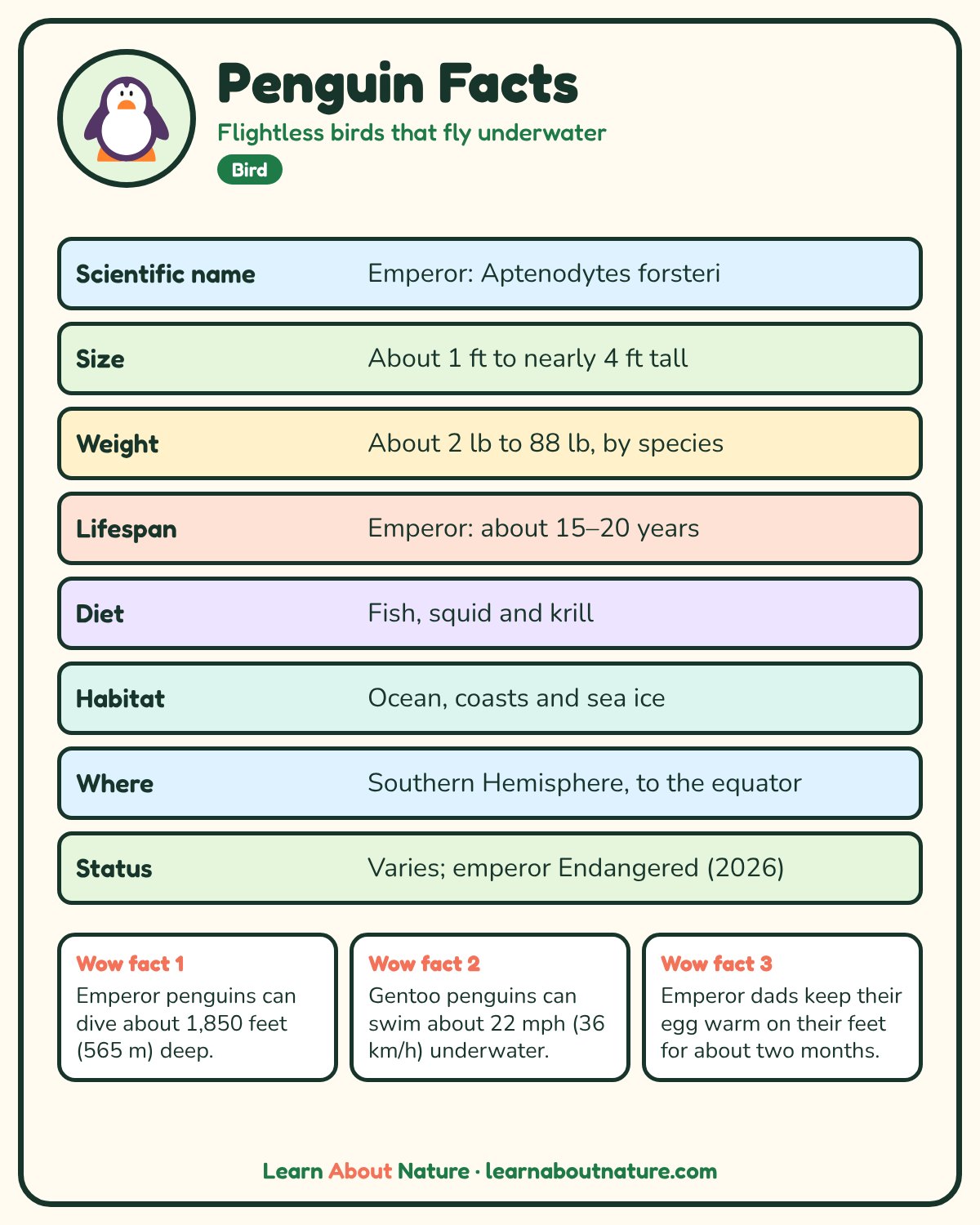
Penguin Quick Facts
| Class | Bird |
| Family | Penguins (Spheniscidae) |
| Number of species | About 18 |
| Largest | Emperor penguin, about 45 in tall |
| Smallest | Little penguin, about 12–14 in tall |
| Fastest swimmer | Gentoo penguin, about 22 mph (36 km/h) |
| Deepest dive (emperor) | About 1,850 ft (565 m) |
| Baby name | Chick |
| Group names | Colony on land; raft at sea |
| Conservation status | Varies; emperor Endangered, African Critically Endangered (IUCN) |
What Is a Penguin?
A penguin is a bird. Like all birds, it has feathers, lays eggs and is warm-blooded. But penguins cannot fly. Over millions of years their wings changed into stiff, narrow flippers that are perfect for swimming but useless for flying.
Scientists usually count about 18 species of penguin, though some list a few more or fewer. The biggest is the emperor penguin (Aptenodytes forsteri), which stands about 45 inches (1.1 m) tall. The smallest is the little penguin, also called the little blue or fairy penguin, which is only about 12 to 14 inches (30 to 35 cm) tall and weighs about 2 to 3.5 pounds (1 to 1.5 kg).
Where Do Penguins Live?
Penguins live almost entirely in the Southern Hemisphere, the southern half of the world. You will not find wild penguins at the North Pole. Many species live between Antarctica and the southern tips of South America, Africa, Australia and New Zealand.
Not all penguins live in the cold. The Galápagos penguin lives right at the equator, and a few even live slightly north of it. African penguins live on the coasts of South Africa and Namibia.
Emperor penguins live around Antarctica. They spend much of their lives at sea and breed on fast ice, which is sea ice that is attached to the coast. Scientists know of about 66 emperor penguin breeding colonies.
What Do Penguins Eat?
Penguins are carnivores. They catch fish, squid and krill, which are small shrimp-like animals. They catch their prey underwater, using their speed to chase it down.
Emperor penguins often eat a fish called the Antarctic silverfish, along with other fish, squid and krill. An adult usually eats about 4 to 7 pounds (2 to 3 kg) of food a day, and even more when it is building up fat before breeding.
To find food, emperor penguins are amazing divers. Most of their hunting dives reach about 500 to 800 feet (150 to 250 m) deep and last a few minutes. The deepest dive recorded was about 1,850 feet (565 m), and the longest lasted about 22 minutes. That is deeper than any other bird is known to dive.
Penguin Bodies: Built for the Water
A penguin’s body is shaped like a smooth torpedo, which helps it slip through the water. It “flies” underwater by flapping its flippers. Gentoo penguins are the fastest, reaching about 22 miles per hour (36 km/h). Emperor penguins usually cruise at about 4 to 6 miles per hour (6 to 9 km/h).
All penguins have dark backs and white bellies. This coloring is called countershading. From above, a penguin’s dark back blends in with the deep water. From below, its white belly blends in with the bright surface. This helps penguins hide from predators and sneak up on fish.
Penguins have thick layers of fat and tightly packed feathers to keep warm. The emperor penguin is the heaviest penguin. Adults can weigh up to about 88 pounds (40 kg) at the start of the breeding season.
Penguin Chicks: The Emperor Penguin’s Amazing Winter
A baby penguin is called a chick. Emperor penguins have one of the most unusual ways of raising a family of any animal. They are the only animals that breed during the dark, freezing Antarctic winter.
In May or early June, the female lays a single egg. She carefully passes it to the male, then heads to the sea to feed. The male balances the egg on his feet and covers it with a warm fold of skin called a brood pouch. He keeps it warm for about two months (roughly 65 to 75 days) without eating at all.
By the time the chick hatches, the male may have gone about four months without food and lost close to half his body weight. The mother returns with food, and the parents take turns feeding the chick. Older chicks gather in groups called crèches while both parents fish. By December and January, the chicks are ready to head to the sea.
- Eggs per season: 1 (emperor penguin)
- Egg kept warm by: the father
- Time to hatch: about 65–75 days
- Chicks join a crèche: about 45–50 days after hatching
How Penguins Live Together
Penguins are social birds. On land, many species gather in large breeding groups called colonies. Emperor penguin colonies can have from a few hundred to more than 20,000 pairs. A group of penguins swimming together at sea is sometimes called a raft.
To survive the Antarctic winter, emperor penguins form tight huddles. Up to 10 penguins can squeeze into one square meter (about 11 square feet). Huddling can cut heat loss by as much as half, and the middle of a huddle can warm up to about 75°F (24°C).
Emperor penguins can stand up to winds of more than 60 knots, or about 70 miles per hour.
Emperor Penguin vs Little Penguin
The emperor penguin and the little penguin show just how different penguins can be. The emperor stands about 45 inches (1.1 m) tall and can weigh up to about 88 pounds. The little penguin is only about 12 to 14 inches tall and weighs about 2 to 3.5 pounds, so an emperor can be many times heavier.
They live in very different places, too. Emperors live around icy Antarctica and raise their chicks on frozen sea ice in winter. Little penguins live along the milder coasts of southern Australia and New Zealand. They usually nest in sandy burrows near the sea, or in caves and rock crevices.
Their colors are different as well. Emperors have black backs, while little penguins have slate-blue heads, backs and flippers. The little penguin is listed as Least Concern by the IUCN, although many of its colonies are getting smaller.
Threats and Conservation Status
In the ocean, adult penguins are hunted by animals such as leopard seals and orcas. On land, birds such as giant petrels sometimes take chicks. These are natural parts of the Antarctic food web.
The biggest new danger for emperor penguins is climate change. Emperors need sea ice that stays frozen long enough for their chicks to grow waterproof feathers. In recent years, Antarctic sea ice has reached record lows, and early ice break-up has caused breeding failures. Satellite images show the population fell by about 10 percent between 2009 and 2018, a loss of more than 20,000 adults.
Conservation status varies by species. In April 2026, the IUCN Red List moved the emperor penguin from Near Threatened to Endangered. The African penguin was listed as Critically Endangered in 2024, after its breeding pairs fell below 10,000. Other penguins are less at risk, but penguins as a group are among the most threatened birds on Earth.
Fun Facts About Penguins
Here are a few more penguin surprises:
- Penguins cannot fly in the air, but they “fly” underwater with their flippers.
- Wild penguins live almost only in the Southern Hemisphere.
- An emperor penguin huddle can slowly drift about 650 feet (200 m) during a long blizzard.
- Giant penguins that lived millions of years ago stood nearly 6 feet (1.8 m) tall.
- Emperor penguin chicks need about 90 pounds (42 kg) of food from each parent to grow up.
Fast Facts for Young Readers
- Penguins are birds that cannot fly.
- Their wings are flippers for swimming.
- Almost all penguins live in the southern half of the world.
- Penguins eat fish, squid and krill.
- A baby penguin is called a chick.
- Emperor penguin dads keep the egg warm on their feet.
- Penguins huddle together to stay warm.
Key words: flipper – a flat, stiff wing that a penguin uses to swim; countershading – dark on top and light underneath, which helps an animal hide; brood pouch – a warm fold of skin that covers a penguin’s egg or chick; crèche – a group of penguin chicks that gather together while their parents find food; colony – a large group of penguins that nest in the same place; krill – small shrimp-like animals that many sea creatures eat.
Try this: Try the emperor penguin challenge: balance a beanbag “egg” on your feet and walk across the room without letting it touch the floor, then talk about how penguin dads do this for about two months.
Related Guides
- Penguin life cycle
- Bald Eagle facts for kids
- Hummingbird facts for kids
- Owl facts for kids
- All animal facts for kids
Penguin FAQs
How many species of penguins are there?
Scientists usually recognize about 18 penguin species, although some lists include a few more or fewer depending on how closely related groups are split. They range from the little penguin, about 12 to 14 inches tall, to the emperor penguin, about 45 inches tall.
Why can’t penguins fly?
Over millions of years, penguins’ wings changed into stiff, narrow flippers that work very well for swimming. This makes penguins excellent swimmers and divers, but they cannot lift off into the air like most other birds.
Do penguins live at the North Pole?
No. Wild penguins live almost only in the Southern Hemisphere, from Antarctica to the coasts of South America, Africa, Australia and New Zealand. The Galápagos penguin lives at the equator, and a few live slightly north of it, but none live in the Arctic.
How do emperor penguins stay warm?
Emperor penguins have thick fat and tightly packed feathers. In winter they gather in tight huddles, which can cut heat loss by as much as half. The middle of a huddle can warm up to about 75°F (24°C), even when it is bitterly cold outside.
Are penguins endangered?
It depends on the species. In April 2026 the IUCN Red List moved the emperor penguin to Endangered because of climate change and sea-ice loss. The African penguin was listed as Critically Endangered in 2024. Some other species are not currently threatened.
Sources: IUCN: Emperor penguin and Antarctic fur seal now Endangered due to climate change (April 2026); Australian Antarctic Program: Emperor penguin; National Geographic: Emperor Penguin; Britannica: Penguin; SANCCOB: African Penguin newly classified as Critically Endangered (2024); Wikipedia: Emperor penguin

Nato is a content writer and researcher with a background in psychology who’s eager to explore the wonders of nature. As a travel enthusiast and animal lover, she hopes to inspire others to discover and cherish the beauty and importance of the natural world. She also writes about the history of candy and snacks for Snack History and about food and healthy eating for The Fitchen.