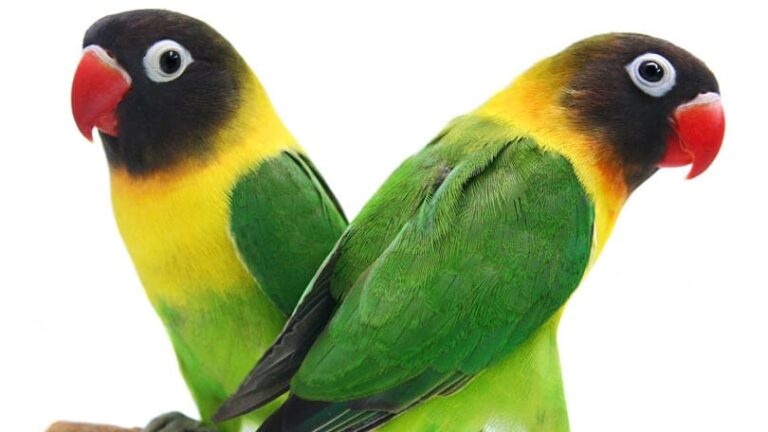
Cockatiel

The Cockatiel species of birds belong to the Cockatoo family and originated from Australia. It is the second most popular pet bird, the first being Budgerigar. They are much sought after because of their mingling and social character; hence, they are relatively easy to breed. These species of birds are the only ones belonging to the Genus Nymphicus. It is the smallest type of bird in the Cacatuidae which is the Cockatoo family.
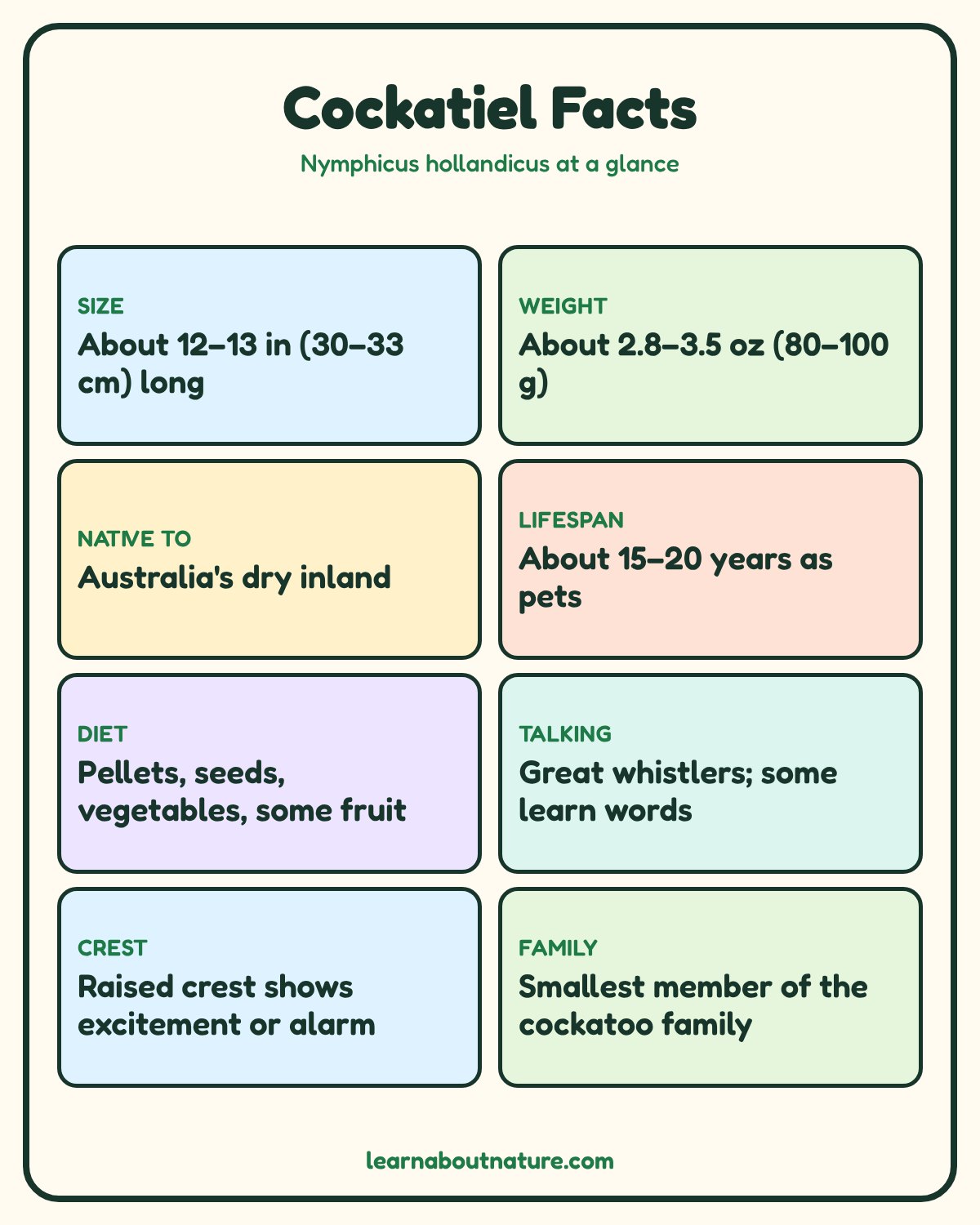
Cockatiel Quick Facts
| Common name | Cockatiel |
| Scientific name | Nymphicus hollandicus |
| Kingdom | Animalia |
| Phylum | Chordata |
| Class | Aves |
| Order | Psittaciformes |
| Family | Psittacidae |
| Genus | Nymphicus |
| Conservation status | Least Concern |
| Type | Bird |
| Diet | Seeds, fruit, vegetables and pellets |
| Habitat | Dry and semi-dry land near water |
| Native range | Mainland Australia |
| Size | 30–33 cm long |
| Colours | Gray with orange cheeks; males have yellow faces |
| Special feature | Pointed crest; smallest of the cockatoo family |

Description
These species of birds are very small structured that have a length of 30 to 33 cm. They have a slim body with pointed tails. The plumage is predominantly gray in color, which fades towards the end portion. Their distinctive feature is the orange shade over the cheeks and a crest in a pointed structure. The wings also have a splash of white color that adds to the overall beauty of this bird. The appearance of the male is different from the female bird, as it has a bright yellow shade over the forehead, crest and face. The young ones look similar to the female bird, but the young male bird has the distinctive yellow face.
Habitat
Cockatiel is a bird that lives in the wild almost only in mainland Australia, where it is abundant and widespread. Their main habitat is in the arid and semi-arid areas, near water bodies. They are mostly found in groups or pairs, sometimes hundreds of a flock can be seen nearby the water bodies. They are also found near the farms, and sometimes, they even destroy the cultivation in the farms. They are usually nomadic in nature, searching for food and water. They are very rarely found in the Tasmanian Island and the nearby coastal regions of Australia.
Reproduction
The male Cockatiels sexually mature by the age of 12 to 14 months, and the female from 8 to 10 months. In the wild, their breeding period is between the spring and the beginning of autumn. But in captivity, they can breed the whole year. They must be provided with a nest to lay eggs that should be at least 9 x 11 x 12 inch. Do not forget to leave a 2.25 inch opening in the nest. The female bird lays eggs after 7 to 10 days of mating. They lay an egg every 48 hours, until they complete the clutch of eggs ranging from 2 to 8. The eggs will hatch in 18 to 21 days after the period of nesting.
How to Grow At Home
Food
Cockatiels require a balanced and healthy food including fruits and vegetables. There is a misconception that the birds should be only provided with seed diet. Though, seeds play a vital role in a healthy diet, this alone is not sufficient for the pet’s good health. The diet should include fresh fruits and vegetables. Other than that, you can also provide pellets to balance any inadequacy in nutrition. A good and balanced diet will improve the health and lifespan of these birds.
Cage
Though the birds are small and compact, they should be provided with a medium sized cage, enough for them to move around. The preferable cage size is 24 x 24 x 24 inch and the spaces between the bars should not be more than 5/8 inch. Provide enough toys and perches to keep the birds busy.
Care
Spend some time with your Cockatiel pet, as they require attention and care, regularly. Keep the cage and food vessels clean, and wash them with disinfectant. Regularly take your pet to a veterinary doctor to update its health.
Cockatiel FAQs
Where do cockatiels come from?
Cockatiels come from mainland Australia. In the wild they live in dry and semi-dry areas near water and are often in flocks, sometimes of hundreds.
How big is a cockatiel?
A cockatiel is a small parrot about 30 to 33 cm long, with a slim body and a long pointed tail.
What do cockatiels eat?
Cockatiels need a balanced diet. Seeds are important but not enough, so they also need fresh fruit and vegetables, and pellets help fill any gaps.
How can you tell a male from a female cockatiel?
Males have a bright yellow face, forehead and crest. Females and young birds are duller. Young males also have the yellow face.
How many eggs do cockatiels lay?
A cockatiel lays 2 to 8 eggs, one every 48 hours. They hatch about 18 to 21 days after the nesting begins.

Randi Jones is the owner and founder of the Nature Gift Store, an online retailer specializing in nature-themed gifts, educational science projects, live animal nature kits and real butterfly artwork. A biology graduate who fell in love with insects, she founded the company in 2001 to make active learning about nature fun, accessible and engaging for children and adults. Her store offers real butterfly frames, home and garden decor and educational live animal kits, including ant farms, worm farms, tadpoles, ladybugs and hermit crabs, and she runs a bug museum in Washington featuring live animals like Eddie the Iguana alongside other reptiles and insects. Randi wrote most of the guides on this site. They first appeared on her long-running nature sites, including Monarch-Butterfly.com, Ladybug-Life-Cycle.com, Frog-Life-Cycle.com, Dragonfly-Site.com and Butterfly Pictures, which have now been brought together here at Learn About Nature.