Hummingbird Facts for Kids: Habitat, Diet and Fun Facts
Quick answer: A hummingbird is a very small, fast-flying bird found only in the Americas. There are about 360 species, living from Alaska to the tip of South America. Hummingbirds drink flower nectar and eat tiny insects. They are the only birds that can hover for long periods and fly backward with ease.
If you hear a soft buzz near a flower bed, look closely. You might see a hummingbird hanging in midair, its wings a blur, as it sips from a flower. A moment later it zips sideways, backs up and is gone.
Hummingbirds are some of the smallest and busiest animals on Earth. Their hearts race, their wings hum and they must eat almost all day long to stay alive. Here is how they live, what they eat and how they raise their tiny chicks.
Teachers and students: you’re welcome to use this fact sheet in lessons and projects with credit to Learn About Nature.
Free printable: Download the Hummingbird fact file worksheet (PDF) – draw the animal, fill in the facts and match key words. Answer key included.
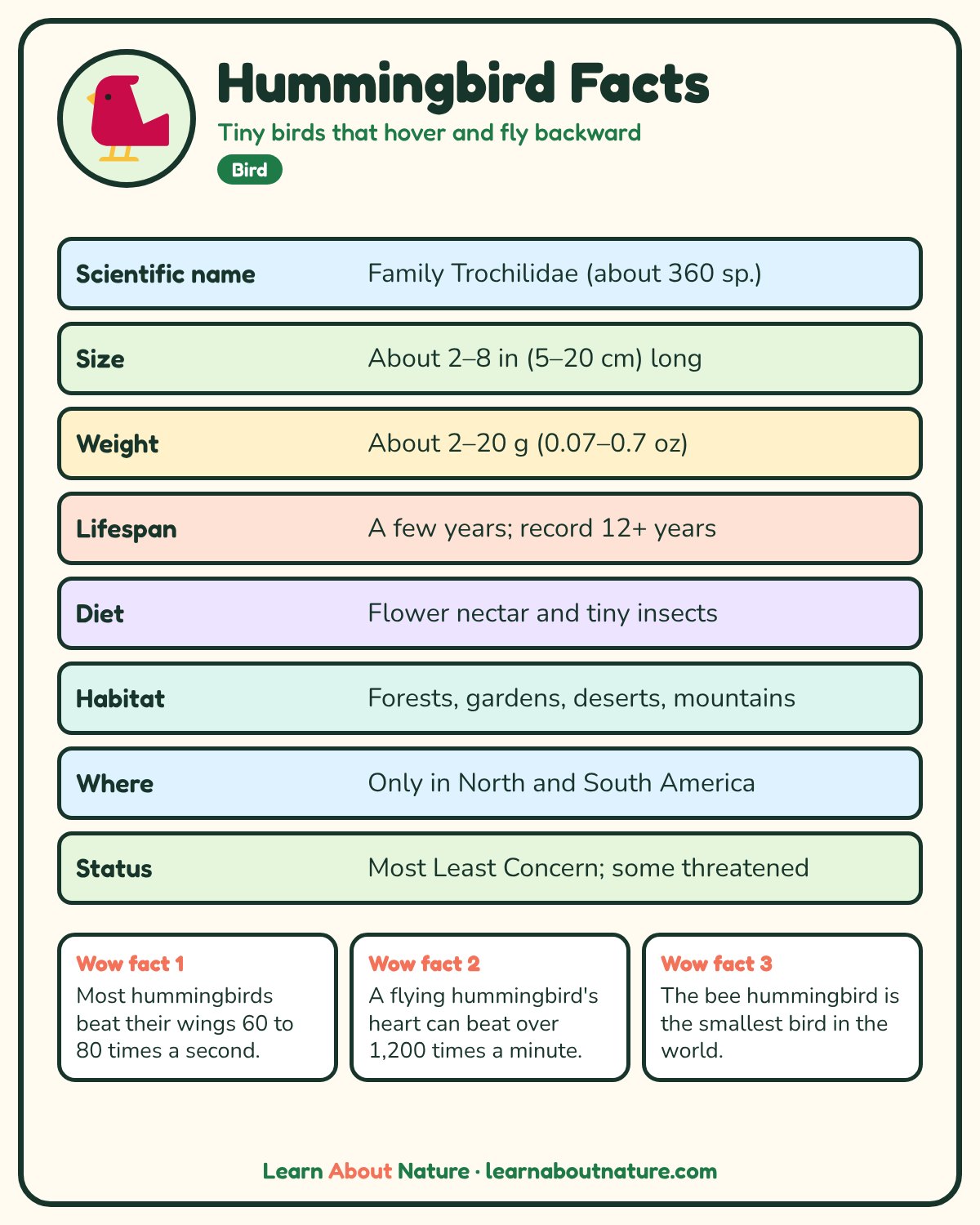
Hummingbird Quick Facts
| Class | Bird (Aves) |
| Family | Trochilidae |
| Number of species | About 360 |
| Size | About 2–8 in (5–20 cm) long |
| Wingbeats | About 60–80 per second (most species) |
| Top speed | About 30 mph in level flight; over 45 mph in dives |
| Diet | Flower nectar, small insects and spiders |
| Eggs | Usually 2 (ruby-throated); hatch in 12–14 days |
| Baby name | Chick or nestling |
| Conservation | Varies by species; most Least Concern, about 10 Critically Endangered (IUCN) |
What Is a Hummingbird?
A hummingbird is a bird in the family Trochilidae. There are about 360 species, and scientists still sometimes split or add species as they learn more. The name comes from the humming sound their fast-beating wings make.
Hummingbirds have long, thin bills, tiny feet and shiny feathers. Many males have a patch of bright throat feathers called a gorget that flashes red, purple, pink or green when sunlight hits it. These colors come from the structure of the feathers, not from colored pigment, so they can look dark from one angle and glowing from another.
Where Do Hummingbirds Live?
Hummingbirds live only in the Americas, from southern Alaska and Canada all the way to Tierra del Fuego at the tip of South America. They are not found in the wild in Europe, Africa, Asia or Australia.
Most species live in the tropics, and the greatest variety is found in the northern Andes Mountains. Ecuador alone has about 130 species. The United States has around 15 to 17 species that nest regularly, but east of the Mississippi River only the ruby-throated hummingbird nests.
Hummingbirds live in rainforests, cloud forests, deserts, meadows, backyards and even high mountain grasslands above 10,000 feet (3,000 meters).
What Do Hummingbirds Eat?
Hummingbirds mostly drink nectar, the sugary liquid made by flowers. A ruby-throated hummingbird may visit more than 1,000 flowers in a day. They are attracted to bright flowers, especially red or orange ones with long, tube-shaped petals.
Nectar gives quick energy, but it is not enough to build muscles and feathers. Hummingbirds also catch small insects and spiders, such as gnats, mosquitoes and fruit flies, for protein. Mothers feed insects to their chicks.
A hummingbird does not suck nectar through its bill like a straw. Its long tongue is split at the tip into two grooved halves. When the tongue touches nectar, the grooves spring open and fill up. Scientists filming hummingbirds have counted about 20 licks every second.
While feeding, hummingbirds pick up pollen on their heads and bills and carry it to the next flower. This makes them important pollinators for many plants.
Body, Wings and Amazing Flight
Hummingbird wings can rotate at the shoulder, so the bird gets lift on both the forward stroke and the back stroke. This lets them hover in one spot, fly backward, sideways and even upside down for a moment. They are the only birds that can hover for long periods.
Most hummingbirds beat their wings about 60 to 80 times a second. During courtship dives, a male’s wings may beat even faster. Ruby-throated hummingbirds fly about 30 miles (48 km) per hour in normal flight and more than 45 miles (72 km) per hour in dives.
All that flying takes huge amounts of energy. A ruby-throated hummingbird’s heart beats about 225 times a minute at rest and more than 1,200 times a minute in flight. Their normal body temperature is about 105°F (40.5°C).
Hummingbird feet are tiny and weak. They are good for perching and scratching, but hummingbirds cannot really walk or hop. To move along a branch, they fly.
Nests, Eggs and Baby Hummingbirds
Male and female hummingbirds do not stay together as pairs. After mating, the female does all the work. She builds a tiny cup-shaped nest about the size of a walnut shell, made from plant fluff and bound with spider silk, which lets it stretch as the chicks grow. Many females decorate the outside with bits of lichen and moss for camouflage.
A ruby-throated hummingbird usually lays two white eggs, each about the size of a jelly bean or a pea. She keeps them warm for about 12 to 14 days. The chicks hatch with closed eyes and almost no feathers.
The mother feeds her chicks a mix of nectar and insects. They leave the nest after about 18 to 22 days. Some species raise two broods in one summer.
Behavior: Torpor, Territories and Migration
Because they burn energy so fast, hummingbirds would quickly run out of fuel on cold nights. To save energy, they can enter torpor, a deep, sleep-like state. Their body temperature drops and their heart rate can slow to as few as about 50 beats a minute. In the morning, they warm up and get back to feeding.
Most hummingbirds live alone and can be fierce. Many defend a patch of flowers or a feeder, chasing away other hummingbirds and even larger birds and insects.
Some species migrate long distances. Many ruby-throated hummingbirds fly nonstop across the Gulf of Mexico, a trip of about 500 miles (800 km) that can take 18 to 20 hours. Rufous hummingbirds travel about 3,900 miles (6,300 km) one way between Alaska and Mexico, one of the longest migrations for a bird its size. Hummingbirds have very good memories and can return to the same feeders year after year.
Predators, Threats and Conservation Status
Hummingbirds are so small that many animals can catch them, including hawks, roadrunners, snakes, frogs, large fish and even praying mantises and spiders. Cats are a danger to hummingbirds in gardens. Jays, squirrels and snakes may raid their nests.
Each species has its own status on the IUCN Red List. Many common species, such as the ruby-throated hummingbird, are listed as Least Concern. But some species with very small ranges are in serious trouble. About ten species are listed as Critically Endangered, including the Chilean woodstar and the Juan Fernández firecrown. Habitat loss, especially the clearing of forests, is the biggest threat.
Planting native flowers and avoiding pesticides helps hummingbirds find food and insects in gardens.
Fun Facts About Hummingbirds
- The bee hummingbird of Cuba is the world’s smallest bird, about 2 inches (5–6 cm) long and lighter than a dime.
- The giant hummingbird of the Andes is the largest, at about 8 inches (20 cm) long.
- A group of hummingbirds is sometimes called a charm.
- The calliope hummingbird is the smallest long-distance migrant bird.
- A female broad-tailed hummingbird banded in Colorado lived at least 12 years, one of the oldest hummingbirds on record.
- Hummingbirds are found only in the Americas.
Fast Facts for Young Readers
- Hummingbirds are tiny birds that live only in the Americas.
- They can hover in one place and fly backward.
- Their wings beat so fast they make a humming sound.
- Hummingbirds drink sweet nectar from flowers.
- They also eat tiny bugs.
- A hummingbird nest is about the size of a walnut shell.
- The smallest bird in the world is a hummingbird.
Key words: nectar – a sweet liquid made by flowers; hover – to stay in one place in the air; torpor – a deep, sleep-like state that saves energy; pollinator – an animal that carries pollen from flower to flower so plants can make seeds; migration – a long journey animals make each year between places; gorget – a patch of shiny, colorful throat feathers on many male hummingbirds.
Try this: Count how many times you can flap your arms in 10 seconds, then multiply by 6 for one minute. Compare your number with a hummingbird’s 60 to 80 wingbeats every single second.
Related Guides
Hummingbird FAQs
How fast do hummingbird wings beat?
Most hummingbirds beat their wings about 60 to 80 times per second, which is why they look like a blur and make a humming sound. During steep courtship dives, some males beat their wings even faster. Larger species, such as the giant hummingbird, beat their wings more slowly.
Can hummingbirds fly backward?
Yes. A hummingbird’s wings can rotate at the shoulder, so it gets lift on both the forward and back strokes. This lets it hover in place, fly backward and sideways, and even flip upside down briefly. They are the only birds that can hover for long periods.
What do hummingbirds eat?
Hummingbirds drink flower nectar for quick energy and catch small insects and spiders for protein. A ruby-throated hummingbird may visit more than 1,000 flowers a day. Mothers feed their chicks both nectar and insects until they leave the nest.
How long do hummingbirds live?
Most hummingbirds live only a few years, and many do not survive their first year. Banding records show some can live much longer. A broad-tailed hummingbird lived at least 12 years, and a ruby-throated hummingbird lived more than 9 years.
Where do hummingbirds sleep at night?
Hummingbirds sleep perched on a twig, often in a sheltered spot. On cold nights, many enter torpor, a deep sleep-like state in which their body temperature and heart rate drop sharply to save energy. In the morning, they warm up and start feeding again.
Sources: Hummingbirds – Smithsonian’s National Zoo & Conservation Biology Institute; Ten Fascinating Facts About Hummingbirds – American Bird Conservancy; How Long Do Hummingbirds Live? – American Bird Conservancy; Ruby-throated Hummingbird Life History – Cornell Lab of Ornithology, All About Birds; Hummingbird tongues may be tiny pumps – Science News Explores

Nato is a content writer and researcher with a background in psychology who’s eager to explore the wonders of nature. As a travel enthusiast and animal lover, she hopes to inspire others to discover and cherish the beauty and importance of the natural world. She also writes about the history of candy and snacks for Snack History and about food and healthy eating for The Fitchen.