Eagle Life Cycle: Stages From Egg to Adult Bald Eagle
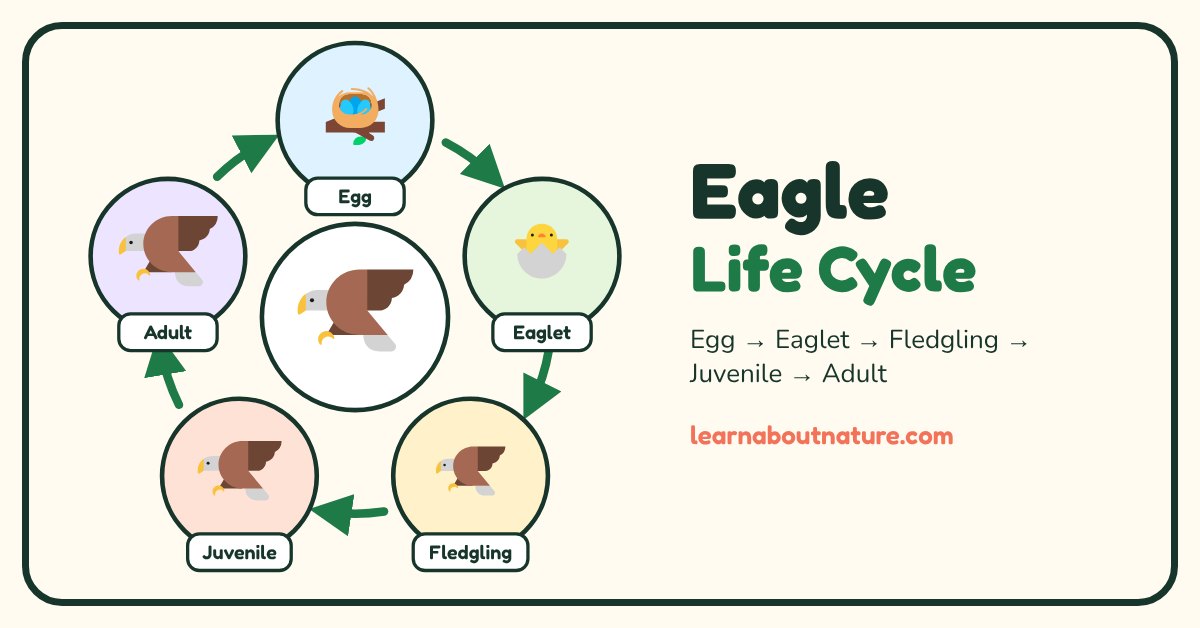
Quick answer: The eagle life cycle has five stages: egg, eaglet, fledgling, juvenile and adult. A bald eagle lays 1 to 3 eggs that hatch after about 35 days. The eaglets grow in the nest and make their first flight at about 10 to 12 weeks. Young eagles stay brown and mottled for years and get adult white heads at about 5.
A bald eagle chick hatches weighing only about 2 ounces, inside a nest that can be as wide as a kitchen table. In just a few months, it will be nearly as big as its parents and ready to fly. But it will not look like an adult, with a snowy white head and tail, for about five years.
This page follows the eagle life cycle using the bald eagle, the national bird of the United States, as the main example. Other eagles, such as golden eagles, have similar stages, though the details and timing differ.
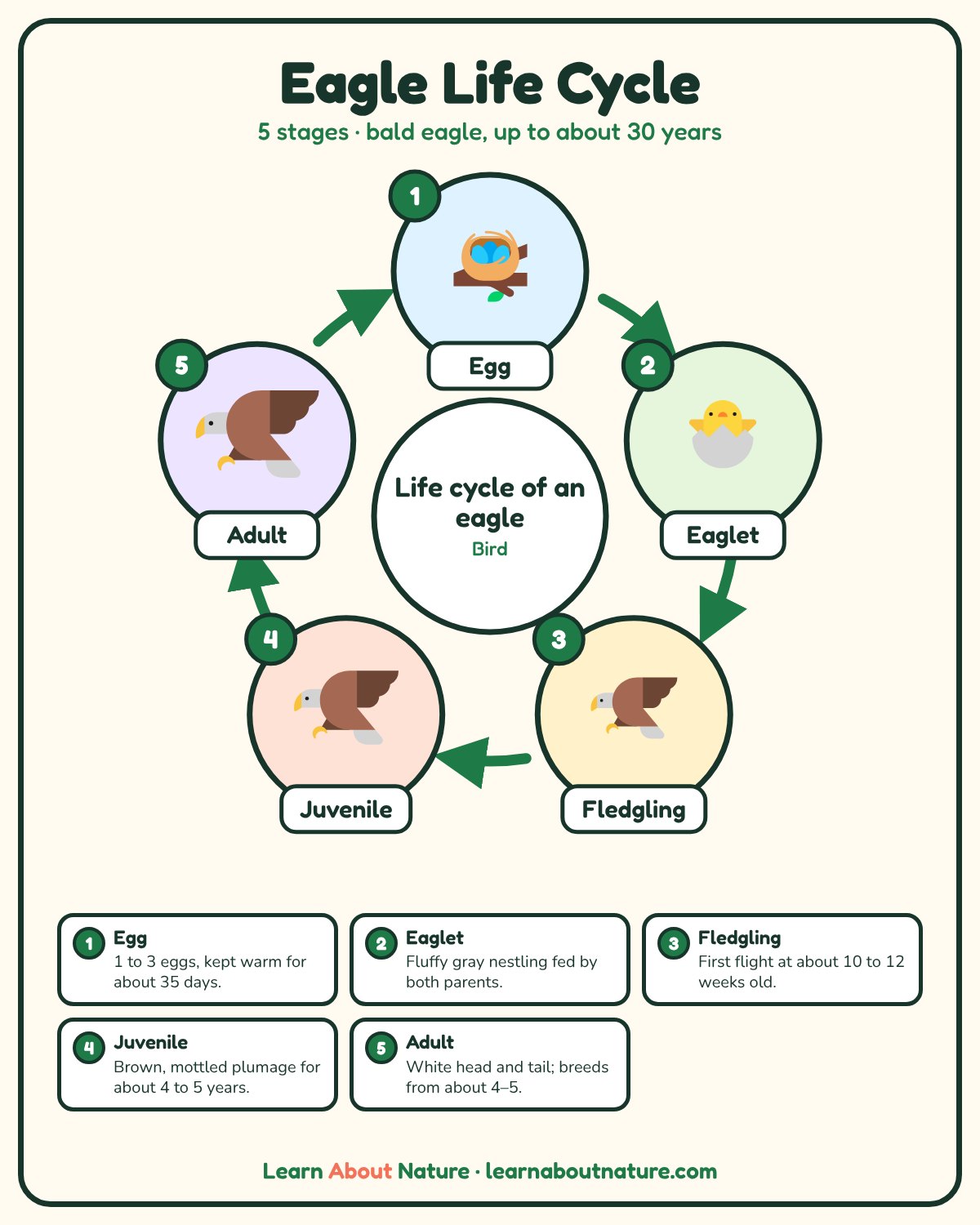
Teachers and students: you’re welcome to use this diagram in lessons and projects with credit to Learn About Nature.
Free printable: Download the Eagle life cycle worksheet (PDF) – label the diagram, cut and sequence the stages, and match key words. Answer key included.
Eagle Life Cycle Quick Facts
| Main example | Bald eagle (Haliaeetus leucocephalus) |
| Eggs per clutch | 1–3, most often 2 |
| Incubation | about 35 days |
| Weight at hatching | about 2 oz (60 g) |
| First flight | about 10–12 weeks (range 8–14) |
| Adult colors | at about 5 years |
| First breeding | about 4–5 years |
| Wingspan | about 70–90 in (1.8–2.3 m) |
| Lifespan | up to about 30 years in the wild |
Courtship and Nest Building
Bald eagles are believed to mate for life. A pair usually stays together until one of them dies, and then the survivor finds a new mate. Pairs perform amazing courtship flights, chasing each other through the sky and sometimes locking talons and tumbling downward together before letting go.
Bald eagles build some of the biggest nests of any bird. A typical nest is about 4 to 6 feet across and 2 to 4 feet deep, made of sticks and lined with soft grass, moss and feathers. It is usually high in a tall tree near water. Both the male and the female bring sticks, but the female usually decides where each one goes. A new nest can take weeks or even months to build.
Pairs often reuse the same nest year after year, adding more sticks each season. The largest bald eagle nest on record, in St. Petersburg, Florida, was about 9.5 feet wide, 20 feet deep and weighed nearly 6,000 pounds.
Stage 1: The Egg
Bald eagles lay 1 to 3 eggs, most often 2. The eggs are dull white with no markings and are about 2.3 to 3.3 inches (6 to 8 cm) long. Nesting starts earlier in the south than in the north, so eggs may be laid anywhere from late fall in Florida to spring in Alaska and Canada.
Both parents take turns keeping the eggs warm, but the female does most of the sitting. The parent on the nest turns the eggs now and then so they warm evenly. The eggs hatch after about 35 days.
Because the parents start incubating as soon as the first egg is laid, the chicks often hatch a day or more apart. The first chick to hatch is usually larger and stronger than its younger siblings.
Stage 2: The Eaglet
A baby eagle is called an eaglet. At hatching, it weighs only about 2 ounces (60 grams). It is covered in light gray down, with dark eyes and pink skin, and it cannot see well or hold its head up for long.
For the first weeks, a parent stays on the nest almost all the time, keeping the eaglets warm and shading them from sun and rain. The other parent hunts. Bald eagles eat mainly fish, but they also catch or scavenge birds, small mammals and dead animals.
Parents tear food into tiny pieces and feed the eaglets bite by bite. The chicks grow amazingly fast. After a few weeks they grow a second, darker, woolly down, and soon dark brown feathers start to push through.
The older, bigger eaglet can grab more food at feeding time. When food is scarce, the youngest chick may not get enough to survive. When there is plenty of food, two or even three eaglets can grow up together.
Stage 3: The Fledgling
As they grow, eaglets exercise their wings by flapping hard in the nest. Older chicks walk or hop out onto nearby branches, a stage people call branching.
Young bald eagles make their first flight, or fledge, at about 10 to 12 weeks old, though it can range from about 8 to 14 weeks. At this point they are almost as large as their parents, but their feathers are mostly dark brown.
Fledglings are not independent yet. Their parents keep feeding them for about another 4 to 6 weeks while they practice flying, landing and catching food. Then the young eagles leave the area where they were raised.
Stage 4: The Juvenile and Immature Eagle
Many people do not realize that young bald eagles look very different from adults. For their first years, they are brown and blotchy, and they are often mistaken for golden eagles. Their plumage changes a little with each yearly molt:
Immature eagles do not hold territories or nest. Instead, they wander, sometimes traveling hundreds of miles. They often scavenge dead fish and animals while they improve their hunting skills. Life is hard at this stage, and many young eagles do not survive their first year.
- Year 1: dark brown body, dark beak and eyes, with some white under the wings.
- Year 2: lots of white mottling on the body and wings, and the eyes begin to lighten.
- Year 3: the beak and eyes start turning yellow; the body is still mixed brown and white.
- Year 4: the head and tail are mostly white, with some dark streaks left.
- Year 5: full adult colors, with a white head and tail and a bright yellow beak.
Stage 5: The Adult Eagle
Bald eagles usually start breeding at about 4 to 5 years old, around the time they get adult colors. In places with many eagles, some wait longer because good nesting territories are hard to find.
Adult females are larger than males, which is common in birds of prey. Bald eagles have a wingspan of about 70 to 90 inches (1.8 to 2.3 m), and adults commonly weigh around 7 to 14 pounds, with females heaviest.
In winter, bald eagles from colder places often move to areas with open water, such as rivers below dams and coastlines, where they can still catch fish. Hundreds may gather in a single area, and these winter gatherings are popular with eagle watchers.
In the wild, bald eagles can live up to about 30 years. A pair may return to the same territory and nest for many years, raising one family after another.
The Bald Eagle’s Comeback
In the middle of the 1900s, bald eagles almost disappeared from the lower 48 United States. A pesticide called DDT washed into rivers and lakes and built up in the fish that eagles ate. It made eagle eggshells so thin that they broke or failed to hatch. By 1963, only about 417 nesting pairs were known in the lower 48 states.
DDT was banned in the United States in 1972, and bald eagles were given strong legal protection. Their numbers slowly climbed back. In 2007, the bald eagle was removed from the list of threatened and endangered species.
Today, the U.S. Fish and Wildlife Service estimates there are about 316,700 bald eagles in the lower 48 states, including more than 71,400 nesting pairs. Bald eagles are still protected by federal law. Their recovery is one of the best-known wildlife success stories in the country.
Fun Facts About Bald Eagles
Bald eagles are not actually bald. The name comes from an old meaning of the word bald, which described something with a white patch, like the eagle’s white head.
- Bald eagles live only in North America.
- An eaglet grows from about 2 ounces to nearly adult size in around three months.
- Young bald eagles have longer wing and tail feathers than adults, which may help them while they learn to fly.
- Bald eagles often steal fish from other birds, especially ospreys.
- A bald eagle nest can be used and added to for decades.
Eagle Life Cycle for Kids
Here is the eagle life cycle in simple steps:
- Egg: Mom and dad take turns keeping the eggs warm in a giant stick nest.
- Eaglet: The fluffy gray baby eats bits of fish from its parents.
- Fledgling: The young eagle flaps its wings and takes its first flight.
- Juvenile: The young eagle is brown and spotty while it grows up.
- Adult: The eagle gets a white head and tail and can raise its own babies.
Key words: eaglet – a baby eagle; incubate – to keep eggs warm so they can hatch; fledge – to grow flight feathers and leave the nest; plumage – a bird’s feathers; immature – not yet grown up; bird of prey – a bird that hunts animals using sharp talons and a hooked beak.
Try this: Watch a live bald eagle nest camera with your class over several weeks and keep a log of what the eaglets look like and do each time.
Related Life Cycles and Guides
- Duck life cycle
- Penguin life cycle
- Bird life cycle
- Chicken life cycle
- Owl life cycle
- Bird anatomy
- All animal & plant life cycles
See also: Bald Eagle Facts for Kids
Eagle Life Cycle FAQs
How long does it take for an eagle egg to hatch?
Bald eagle eggs hatch after about 35 days of incubation. Both parents take turns sitting on the eggs, though the female does most of the work. Because incubation starts with the first egg, chicks in the same nest often hatch a day or more apart.
What is a baby eagle called?
A baby eagle is called an eaglet. Bald eaglets hatch covered in light gray down and weigh about 2 ounces. They stay in the nest for roughly 10 to 12 weeks before making their first flight.
When do baby eagles leave the nest?
Young bald eagles usually fledge, or make their first flight, at about 10 to 12 weeks old. Their parents keep feeding them for about another 4 to 6 weeks while they learn to fly and find food, and then they leave the area.
At what age do bald eagles get their white heads?
Bald eagles get their full white head and tail at about 5 years old. Before that, they are mostly brown with white mottling, and their beaks and eyes slowly change from dark to yellow over several years.
How long do bald eagles live?
Bald eagles can live up to about 30 years in the wild, and longer in captivity. Many young eagles die in their first year while they are learning to hunt, but adults that survive often live for decades.
Sources: Bald Eagle Life History – All About Birds, Cornell Lab of Ornithology; Bald Eagle – U.S. Fish and Wildlife Service; Bald Eagle (Haliaeetus leucocephalus) – Animal Diversity Web; America’s Bald Eagle Population Continues to Soar – U.S. Fish and Wildlife Service

Nato is a content writer and researcher with a background in psychology who’s eager to explore the wonders of nature. As a travel enthusiast and animal lover, she hopes to inspire others to discover and cherish the beauty and importance of the natural world. She also writes about the history of candy and snacks for Snack History and about food and healthy eating for The Fitchen.