Penguin Life Cycle: Stages From Egg to Adult
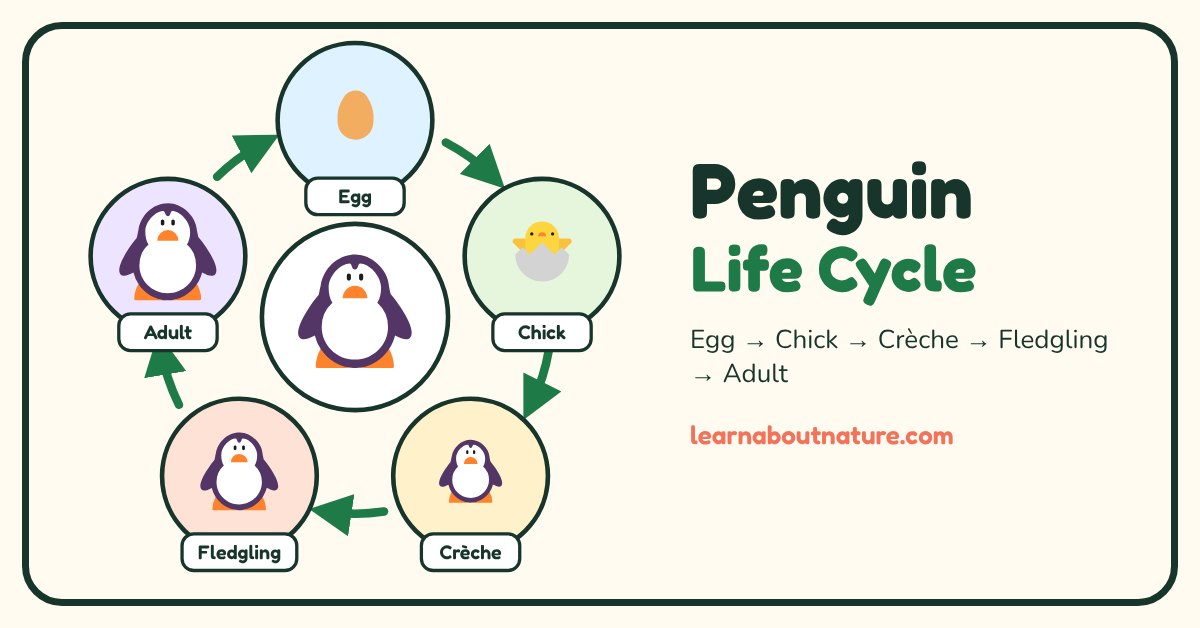
Quick answer: The penguin life cycle has five stages: egg, chick, crèche, fledgling and adult. In emperor penguins, the father keeps the single egg warm on his feet for about 65 days. The chick hatches in midwinter, joins a crèche at about 6 to 7 weeks, goes to sea at about 5 months and breeds at 4 to 6 years.
In the middle of the Antarctic winter, in total darkness and temperatures that can fall below minus 30 degrees, thousands of male emperor penguins stand huddled together on the sea ice. Each one is balancing a single egg on his feet. They will not eat for months.
This page explains the penguin life cycle using the emperor penguin, the largest penguin, as the main example. Emperor penguins breed in winter, which makes their life cycle one of the toughest of any bird. We also show how smaller penguins, such as the Adélie penguin, raise their chicks in a very different way.
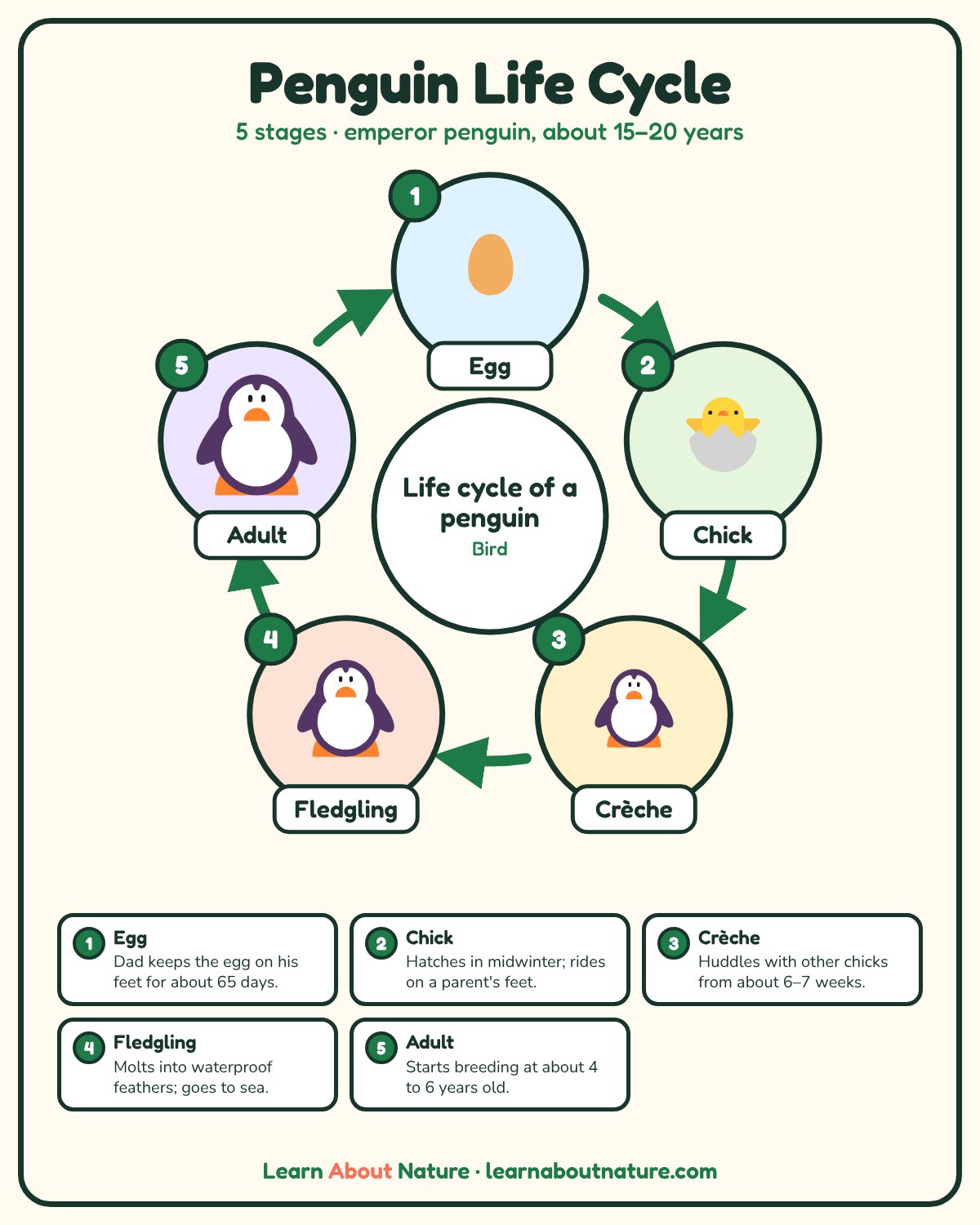
Teachers and students: you’re welcome to use this diagram in lessons and projects with credit to Learn About Nature.
Free printable: Download the Penguin life cycle worksheet (PDF) – label the diagram, cut and sequence the stages, and match key words. Answer key included.
Penguin Life Cycle Quick Facts
| Main example | Emperor penguin (Aptenodytes forsteri) |
| Eggs per season | 1 (emperor); usually 2 in Adélies |
| Egg weight | about 1 lb (450 g) |
| Incubation | about 65 days, by the father |
| Crèche starts | about 6–7 weeks old |
| Goes to sea | about 5 months old |
| First breeding | about 4–6 years |
| Adult height | up to about 4 ft (1.3 m) |
| Lifespan | about 15–20 years in the wild |
Courtship: Finding a Mate on the Ice
Emperor penguins spend the summer at sea, feeding and storing fat. Around March and April, as the Antarctic autumn begins and the sea ice thickens, adults walk to their breeding colony, which sits on stable sea ice called fast ice. Some walk a long way across the ice to get there.
Once at the colony, penguins pair up. They sing loud, trumpeting calls and bow their heads to each other. Each penguin’s call is different, and partners learn each other’s voice so they can find one another later in a crowd of thousands.
Emperor penguins usually stay with one partner for a breeding season. Many pick a new mate the next year.
Stage 1: The Egg
In late May or early June, the female lays one egg. It weighs about 1 pound (450 g). Emperor penguins do not build nests, because there is nothing on the ice to build them with.
Almost straight away, the female carefully passes the egg to the male. If the egg touches the ice for long, it will freeze. The male rolls it onto the tops of his feet and covers it with a warm fold of feathered skin called a brood pouch, which keeps the egg at about 100°F (38°C).
The female, now very hungry, walks back to the sea to feed. The male stays behind and keeps the egg warm for about 65 days, through the darkest, coldest part of winter.
Passing the egg is a risky moment. The pair stands close together while the female rolls the egg gently across to the male’s feet. An egg lost on the ice cannot be replaced that season.
How Fathers Survive the Winter
During incubation, male emperor penguins eat nothing except a little snow. By the time the chick hatches, a male may have gone without food for about four months, counting the time since he arrived at the colony.
To survive, the males crowd together in huge huddles. Birds on the outside slowly shuffle inward while those in the middle move out, so each penguin takes turns in the warmest spot.
By the end of this fast, a male has lost 40 percent or more of his body weight. He lives off the fat he stored the summer before.
Stage 2: The Chick
The chick hatches in July or August. It is covered in soft gray down and is very small, weighing only a few hundred grams. It cannot keep itself warm, so it stays on its parent’s feet, tucked under the brood pouch.
If the mother has not returned yet, the father can feed the chick a milky, protein-rich substance made in his throat. When the mother arrives, she finds her partner by his call and takes over, feeding the chick fish, krill and squid that she brings back up from her stomach. The thin, hungry father then heads to the sea to feed.
After that, the parents take turns. One guards and feeds the chick while the other goes fishing. A chick needs about 50 days before it can keep itself warm on its own.
Stage 3: The Crèche
When chicks are around 6 to 7 weeks old, they are big enough to leave their parent’s feet. Both parents now go to sea at the same time to bring back enough food for their growing chick.
While the parents are away, the chicks gather in groups called crèches. Huddling together keeps them warmer and gives some protection from predators such as giant petrels and skuas.
When a parent returns, it calls out, and its own chick answers. The parent feeds only its own chick, even in a crowd of hundreds of almost identical fluffy youngsters.
Feeding a fast-growing chick is hard work. As the Antarctic spring arrives, the sea ice starts to shrink, so the walk between the colony and open water gets shorter. That makes it easier for parents to bring back food more often, just when their chicks need it most.
Stage 4: Fledging and Molting
By early December, chicks are close to adult size. They molt, replacing their fluffy down with sleek, waterproof feathers. Down is warm on land but soaks up water, so a chick cannot swim until this molt is finished.
In December and January, at about 5 months old, young emperor penguins leave the colony and go to sea for the first time. This is called fledging. Its timing matches the summer breakup of the sea ice, when food is plentiful.
Young emperors spend their first years at sea, learning to hunt. Many do not survive this stage, but those that do grow into adults.
Fledglings look different from adults. They are smaller, with a whitish or grayish chin and only a hint of the bright yellow-orange ear patches. They gain full adult colors over the next few years.
Stage 5: The Adult Penguin
Emperor penguins first breed when they are about 4 to 6 years old, often around 5. Adults stand up to about 4 feet (1.3 m) tall and weigh about 50 to 100 pounds (22 to 45 kg), depending on the time of year.
Every summer, after breeding, adults go through their own molt. They first feed heavily at sea, then stand on the ice for about a month while their old feathers are replaced. During this time they cannot swim or eat.
Emperor penguins usually live about 15 to 20 years in the wild. They can dive deeper than about 1,600 feet (500 m) when hunting.
How Smaller Penguins Are Different
Most of the world’s penguins breed in spring and summer, not winter. The Adélie penguin of Antarctica is a good example. Adélies breed on rocky land between about October and February.
An Adélie pair builds a nest of small stones, and the female lays two eggs. Both parents take turns keeping the eggs warm. Chicks hatch in December, join a crèche at about 3 weeks old, and go to sea at about 7 to 9 weeks old, much sooner than emperor chicks.
- Emperor penguin: one egg, no nest, father incubates alone, breeds in winter.
- Adélie penguin: usually two eggs, stone nest, both parents share incubation, breeds in summer.
Threats to Emperor Penguins
Emperor penguins depend on sea ice that stays solid until their chicks have grown waterproof feathers. In recent years, sea ice around Antarctica has broken up earlier and fallen to record lows. When the ice breaks too soon, chicks without waterproof feathers can drown or freeze.
In April 2026, the IUCN changed the emperor penguin’s status from Near Threatened to Endangered. Scientists project that, with current climate trends, the population could fall by about half by the 2080s.
Scientists watch emperor colonies using satellite images, because the birds’ dark bodies and droppings show up against the white ice. This lets them count colonies in remote places and spot breeding failures when the ice breaks up too early.
Penguin Life Cycle for Kids
Here is the penguin life cycle in simple steps:
- Egg: Dad keeps the egg warm on his feet all winter long.
- Chick: The fluffy gray chick hatches and sits on a parent’s feet.
- Crèche: Chicks huddle together while mom and dad go fishing.
- Fledgling: The chick gets new waterproof feathers and swims in the sea.
- Adult: The grown-up penguin finds a mate and lays an egg.
Key words: incubate – to keep an egg warm so the baby inside can grow; brood pouch – a warm fold of skin that covers the egg or chick; crèche – a group of penguin chicks huddled together; molt – when a bird loses old feathers and grows new ones; fledge – when a young bird is ready to leave and live on its own; colony – a large group of penguins that breed in the same place.
Try this: Try the penguin egg challenge: balance a beanbag or plastic egg on your feet and shuffle across the room without letting it touch the floor, just like a father emperor penguin.
Related Life Cycles and Guides
- Eagle life cycle
- Duck life cycle
- Bird life cycle
- Chicken life cycle
- Owl life cycle
- Bird anatomy
- All animal & plant life cycles
See also: Penguin Facts for Kids
Penguin Life Cycle FAQs
How long do penguins sit on their eggs?
Male emperor penguins keep their single egg warm on their feet for about 65 days while the female feeds at sea. Smaller penguins incubate for a shorter time, and in species such as the Adélie penguin both parents take turns sitting on the eggs.
What is a group of penguin chicks called?
A group of penguin chicks huddled together is called a crèche. Emperor penguin chicks start gathering in crèches at about 6 to 7 weeks old, when both parents need to go to sea at the same time to find food.
How many eggs does a penguin lay?
Emperor and king penguins lay just one egg at a time and carry it on their feet. Most other penguins, including Adélie, chinstrap and gentoo penguins, usually lay two eggs in a nest made of stones, grass or burrows, depending on the species.
When do baby penguins learn to swim?
Penguin chicks cannot swim until they have molted their fluffy down and grown waterproof feathers. Emperor penguin chicks reach this stage at about 5 months old and head to sea in December or January.
How long do emperor penguins live?
Emperor penguins usually live about 15 to 20 years in the wild. They start breeding at around 4 to 6 years old and may raise many chicks over their lives, if the sea ice stays stable long enough each season.
Sources: Emperor penguin breeding cycle – Australian Antarctic Program; Emperor Penguin (Aptenodytes forsteri) – Animal Diversity Web; Emperor penguin – New Zealand Birds Online; Adélie penguin – Australian Antarctic Program; Emperor penguin and Antarctic fur seal now Endangered due to climate change – IUCN; Emperor penguin – Britannica

Nato is a content writer and researcher with a background in psychology who’s eager to explore the wonders of nature. As a travel enthusiast and animal lover, she hopes to inspire others to discover and cherish the beauty and importance of the natural world. She also writes about the history of candy and snacks for Snack History and about food and healthy eating for The Fitchen.