Parts of a Feather: Labeled Diagram and Feather Types
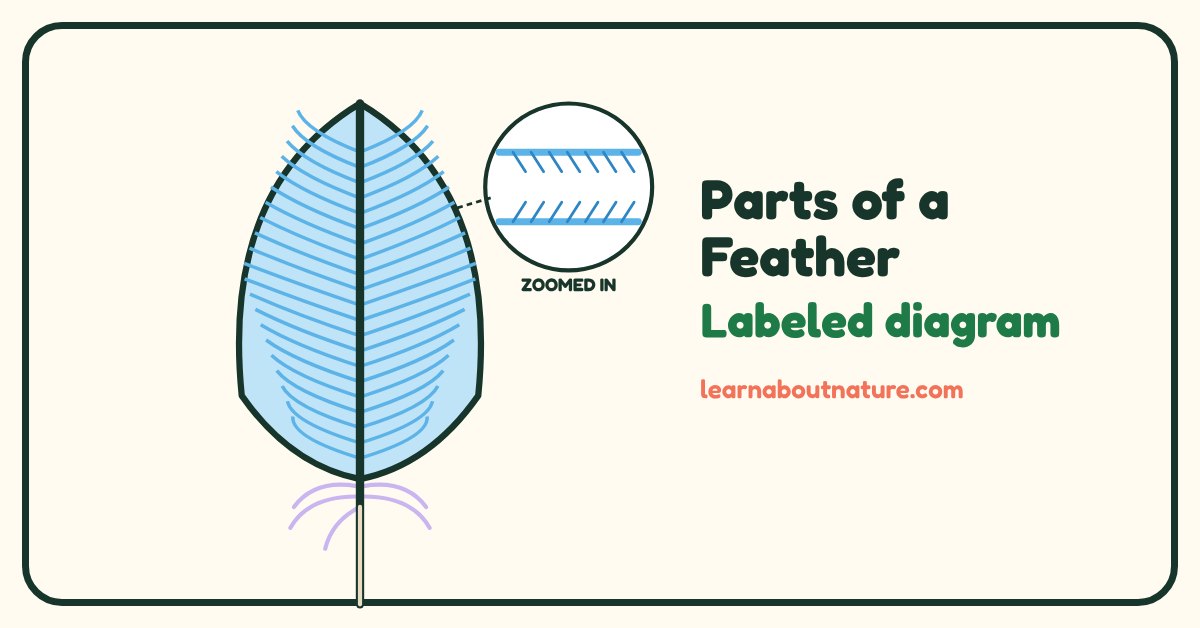
Quick answer: A feather has a hollow base called the calamus, or quill, and a stiff central shaft called the rachis. Thin branches called barbs grow from both sides of the rachis to form the flat vanes. Each barb carries tiny barbules with hooklets that zip the barbs together. Many also have fluffy downy barbs and a small afterfeather near the base.
Only birds have feathers today, and every bird has them. Feathers keep birds warm and dry, let them fly, hide them from predators and help them show off to mates. A feather is light enough to float on the air, yet strong enough to hold a bird up in flight.
This guide explains the parts of a feather using a typical body feather as the example, then looks at the different types of feathers a bird grows and what each one is for.
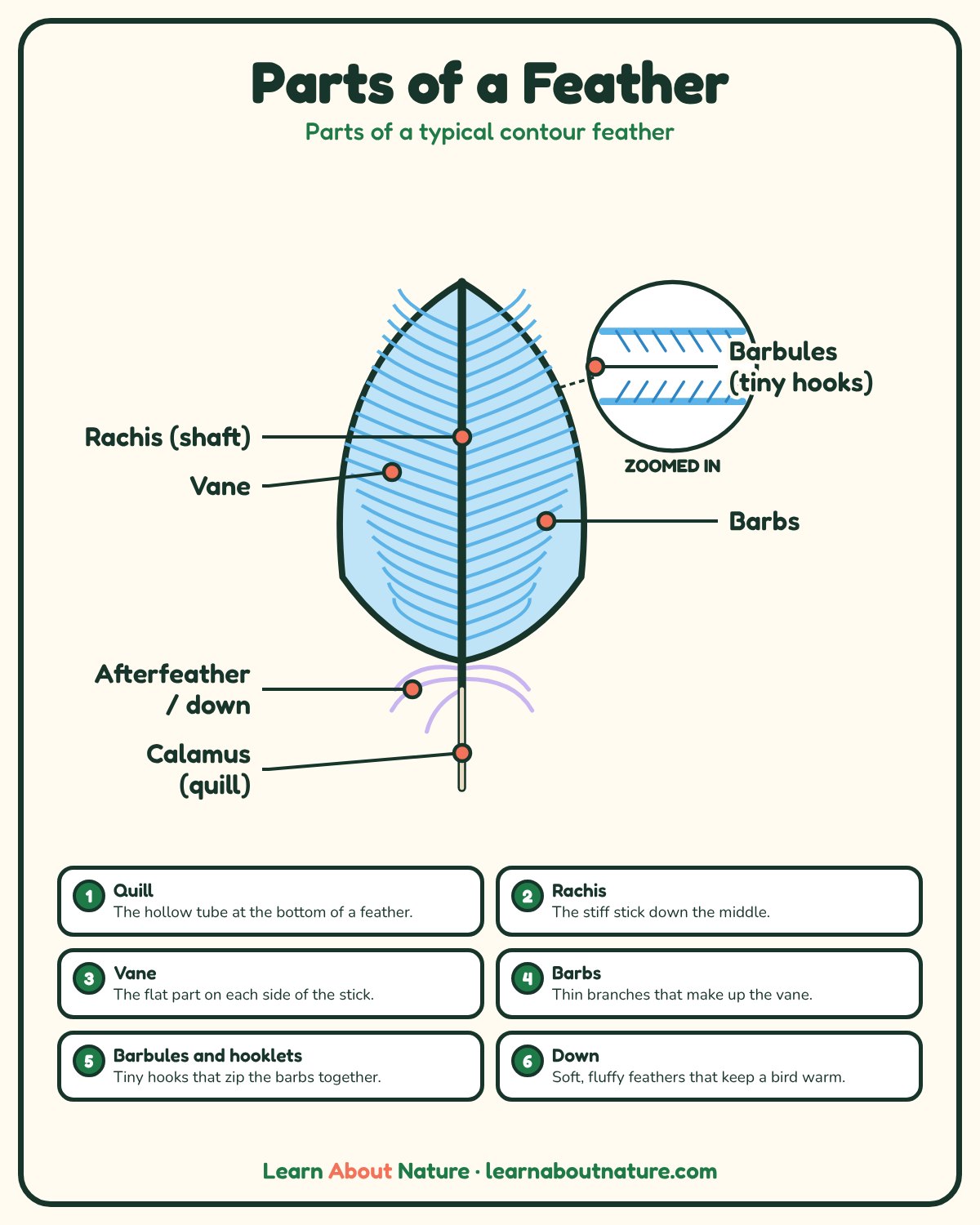
Teachers and students: you’re welcome to use this diagram in lessons and projects with credit to Learn About Nature.
Free printable: Download the Parts of a Feather labeling worksheet (PDF) – label the parts using the word bank. Answer key included.
Parts of a Feather and What They Do
| Part | What it does |
|---|---|
| Calamus (quill) | Hollow base that anchors the feather in the skin |
| Rachis | Stiff central shaft that holds up the barbs |
| Shaft | Calamus and rachis together |
| Vane (outer and inner) | Flat surfaces on each side of the rachis that catch air and shed water |
| Barbs | Thin branches from the rachis that make up the vane |
| Barbules | Tiny branches on the barbs |
| Hooklets | Microscopic hooks that zip neighboring barbs together |
| Downy barbs | Loose, fluffy barbs near the base that trap warm air |
| Afterfeather | Small extra feather at the base that adds warmth |
| Follicle | Pit in the skin where the feather grows |
| Tip | Top end of the feather; often wears down before molt |
What Is a Feather Made Of?
Feathers are made of a tough protein called beta-keratin. Keratins also make up your hair and fingernails and a bird’s beak and claws, although feather keratin is a special form found only in birds and their reptile relatives. Each feather grows out of a small pit in the skin called a follicle, much as a hair does.
A fully grown feather is dead tissue, like the tip of a fingernail. It cannot heal if it gets damaged. Instead, birds replace their feathers by molting: old feathers fall out and new ones grow in their place. Most birds molt at least once a year.
The Shaft: Calamus and Rachis
The central stem of a feather is called the shaft. It has two parts.
The calamus, or quill, is the bare, hollow tube at the bottom. It has no barbs. The calamus sits inside the follicle and anchors the feather in the skin. Long ago, people cut the calamus of large flight feathers into a point to make quill pens.
Above the calamus is the rachis, the stiff, solid-feeling part of the shaft that carries the barbs. The rachis is light but strong, with a spongy core inside. In flight feathers it is thick and curved; in small body feathers it is thin and bendy.
The Vane: Barbs, Barbules and Hooklets
The flat, blade-like part on each side of the rachis is called a vane. A feather has an outer vane and an inner vane. In wing feathers, the outer vane is usually narrower than the inner vane, which helps the feather work like a tiny airplane wing.
Each vane is made of hundreds of thin branches called barbs. Every barb has even smaller branches called barbules. On one side of a barb, the barbules carry microscopic hooklets. These hooks catch on the barbules of the next barb, locking the barbs together like the two sides of a zipper. This makes the vane smooth, firm and nearly windproof.
If you pull the barbs apart, the vane splits. Stroke the feather gently from base to tip and the hooklets catch again, closing the gap. Birds do this all the time when they preen, running their feathers through their beaks to zip them back together and clean them.
Downy Barbs and the Afterfeather
Look closely at the bottom of a body feather and you will often see a fluffy section just above the quill. These downy barbs have long, soft barbules with no hooklets, so they stay loose and puffy. They sit close to the bird’s skin, where they trap warm air.
Some feathers also have an afterfeather, a small second feather that grows from the base of the vane. It is usually soft and downy and adds extra warmth. Afterfeathers are well developed in many birds of cold places, such as grouse.
Types of Feathers
A single bird grows several kinds of feathers, each built for a different job. Ornithologists usually recognize these main types:
- Contour feathers: the visible outer feathers that cover the body and give a bird its shape and color. They overlap like roof shingles and shed water.
- Flight feathers: large, stiff contour feathers on the wings (called remiges) and tail (called rectrices). Wing flight feathers are attached to bone by strong ligaments. They lift, push and steer the bird in the air.
- Down feathers: short, fluffy feathers with a tiny rachis or none at all. They lie closest to the skin and keep the bird warm. Ducks and geese are famous for their down.
- Semiplumes: in-between feathers with a clear rachis but fluffy, unhooked barbs. They are hidden under contour feathers and add insulation.
- Filoplumes: thin, hair-like feathers with just a few barbs at the tip. Nerve endings around their base let a bird sense whether its other feathers are in place.
- Bristles: the simplest feathers, with a stiff rachis and few or no barbs. They are found mostly on the head, such as around the beaks of nightjars and nighthawks, and near the eyes.
How a New Feather Grows
A new feather starts growing inside its follicle as a soft, rolled-up tube wrapped in a thin, waxy sheath. At this stage it is called a pin feather, because it looks like a spiky pin poking out of the skin. While it grows, it has a blood supply running up the inside of the shaft to feed it.
When the feather is fully formed, the blood supply dries up and the sheath flakes away, often helped by the bird’s preening. The barbs then unroll and spread out into a flat vane. You can sometimes see little white flakes of old sheath on birds during a molt.
Feathers do not grow evenly all over a bird’s body. Most birds have their contour feathers arranged in tracts, with patches of bare skin in between that are hidden when the feathers lie flat. Many birds also have a preen gland near the base of the tail. It makes an oil that the bird spreads over its feathers to keep them flexible and in good condition.
What Feathers Do
- Flight: wing and tail feathers create lift and help the bird steer and brake.
- Warmth: down, semiplumes and downy barbs trap a layer of warm air next to the skin.
- Waterproofing: overlapping contour feathers shed rain, and preening keeps them in good order.
- Color and display: feathers can carry bright pigments, or have tiny structures that make shimmering colors, used to attract mates.
- Camouflage: patterned feathers help many birds blend into their surroundings.
- Sensing: filoplumes and bristles act a little like whiskers.
How Many Feathers Does a Bird Have?
It depends on the bird. Bigger birds generally have more feathers than smaller ones. In one well-known set of counts from North American birds, a ruby-throated hummingbird had about 940 feathers, many small songbirds had roughly 1,100 to 4,600, and a tundra swan had more than 25,000.
Some birds in cold places grow more feathers for winter. When birds molt, most replace their feathers a few at a time so they can still fly. Ducks and geese are different: they drop all their flight feathers at once and cannot fly for several weeks.
Feathers Compared With Hair and Scales
Feathers, mammal hair and reptile scales are all made from keratin and grow from the skin. But a feather is far more complex than a hair, with its branching barbs, barbules and hooklets. Scientists now know that many dinosaurs had feathers too, and birds are the living descendants of one group of feathered dinosaurs.
Parts of a Feather for Kids
- Quill: the hollow tube at the bottom of a feather.
- Rachis: the stiff stick down the middle.
- Vane: the flat part on each side of the stick.
- Barbs: thin branches that make up the vane.
- Barbules and hooklets: tiny hooks that zip the barbs together.
- Down: soft, fluffy feathers that keep a bird warm.
- Preening: when a bird uses its beak to clean and zip up its feathers.
Key words: rachis – the stiff central shaft of a feather; calamus – the hollow base of a feather, also called the quill; barb – one of the thin branches that grow from the rachis; barbule – a tiny branch on a barb; many carry hooklets; molting – shedding old feathers and growing new ones; preening – cleaning and arranging feathers with the beak.
Try this: Look at a clean craft feather or a found feather with a magnifying glass. Gently pull two barbs apart to make a gap, then stroke the vane from base to tip to zip it closed again, just as a bird does when it preens.
Related Guides
- Parts of an Egg
- Bird life cycle
- Chicken life cycle
- Owl life cycle
- Bird anatomy
- All labeled anatomy diagrams
Parts of a Feather FAQs
What are the parts of a feather?
A feather has a hollow base called the calamus or quill, and a central shaft called the rachis. Barbs branch off the rachis to form the flat vanes. Barbules on the barbs carry tiny hooklets that lock the barbs together. Many feathers also have fluffy downy barbs and a small afterfeather near the base.
What is the middle of a feather called?
The stiff stem running up the middle of a feather is the shaft. The lower, bare, hollow part of the shaft is the calamus, or quill, and the upper part that carries the barbs is the rachis.
What are the 6 types of feathers?
The six main feather types are contour feathers, which cover the body; flight feathers on the wings and tail; down feathers for warmth; semiplumes, which add insulation; filoplumes, hair-like feathers that sense the position of other feathers; and bristles, simple stiff feathers found mostly on the head.
What are feathers made of?
Feathers are made of beta-keratin, a tough, lightweight protein. Related keratin proteins make up hair, fingernails, and bird beaks and claws. A grown feather is no longer alive, so a damaged feather cannot repair itself and is replaced when the bird molts.
Why do feathers stick together?
The barbs of a feather are held together by barbules carrying microscopic hooklets. The hooks grab the barbules of the next barb, like a zipper, making the vane smooth and firm. When barbs are pulled apart, a bird preens with its beak to hook them back together.
Sources: Everything You Need to Know About Feathers – Cornell Lab of Ornithology (Bird Academy); Bird Feathers – The Canadian Encyclopedia; Lecture Notes: Feathers – Rubega Lab, University of Connecticut

Nato is a content writer and researcher with a background in psychology who’s eager to explore the wonders of nature. As a travel enthusiast and animal lover, she hopes to inspire others to discover and cherish the beauty and importance of the natural world. She also writes about the history of candy and snacks for Snack History and about food and healthy eating for The Fitchen.