Mealworm Life Cycle – Transformation From Egg To Darkling Beetle
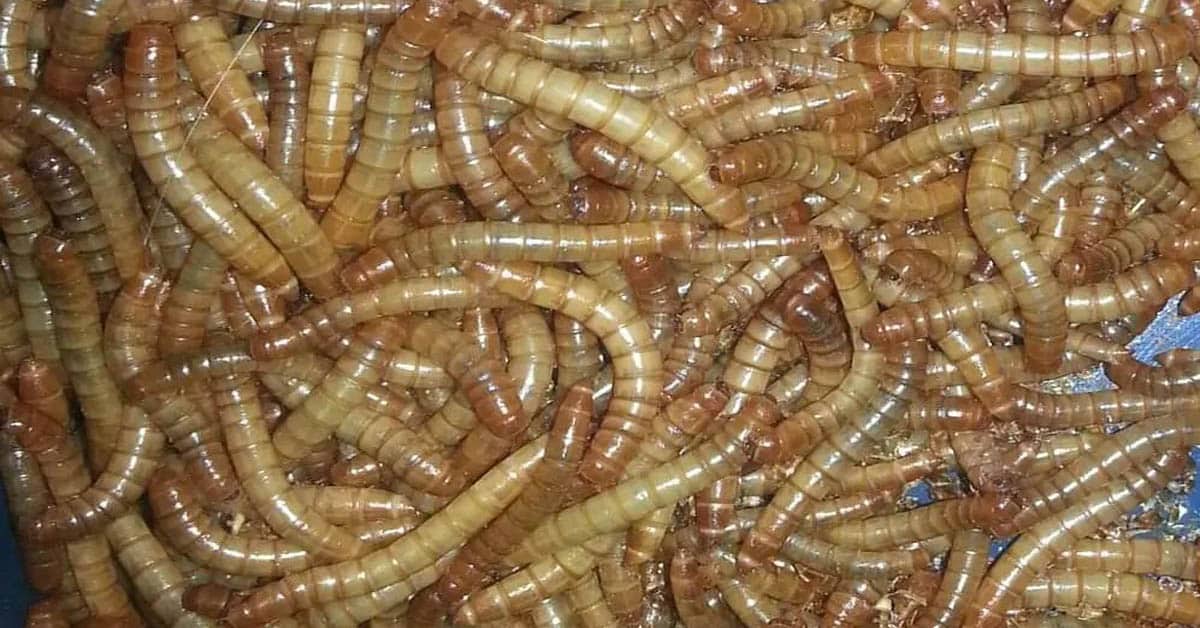
Mealworms are the larvae of the yellow mealworm beetle, Tenebrio molitor, a kind of darkling beetle. Despite their name, mealworms are not worms at all. They are young beetles that will go through an amazing change before they become adults.
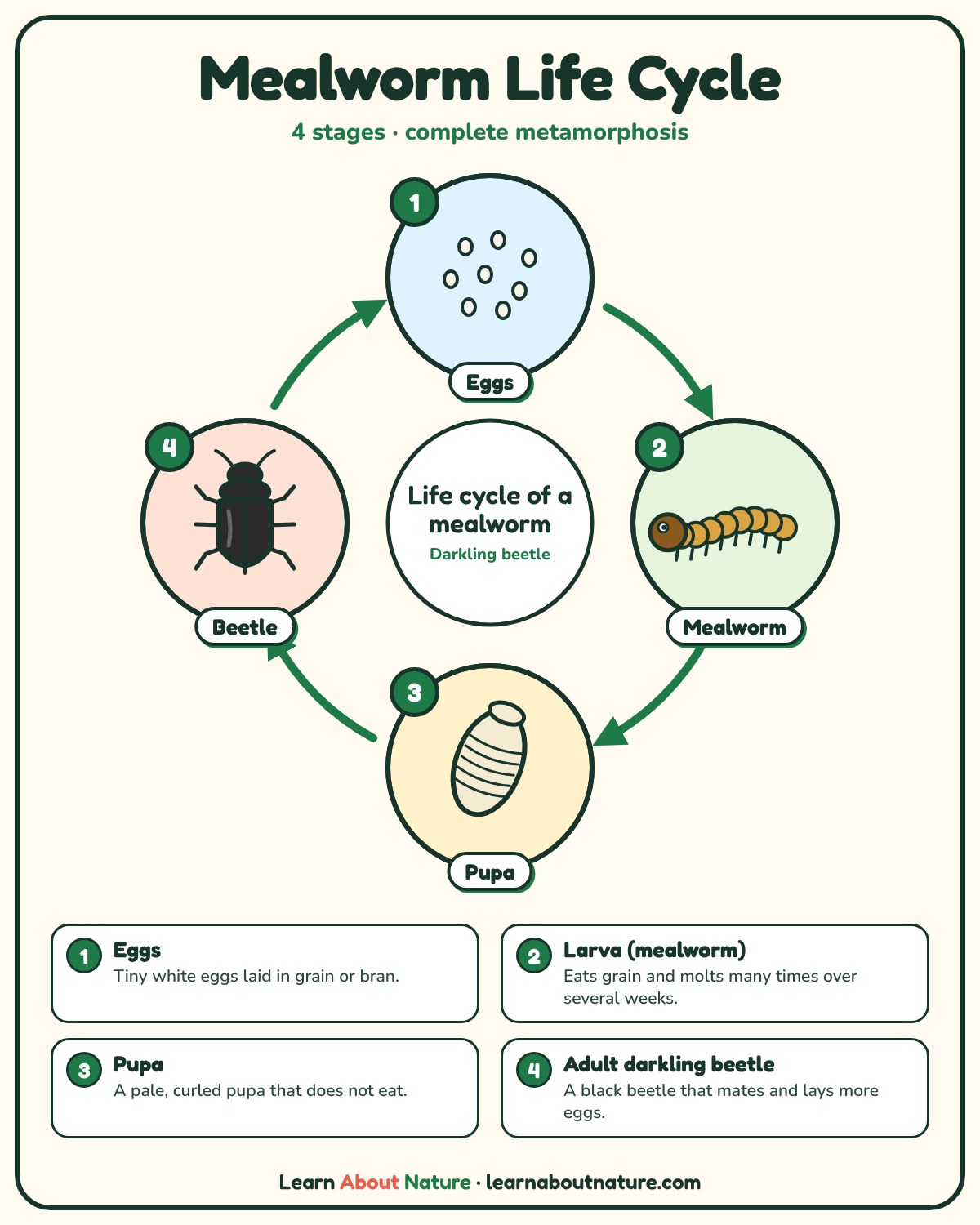
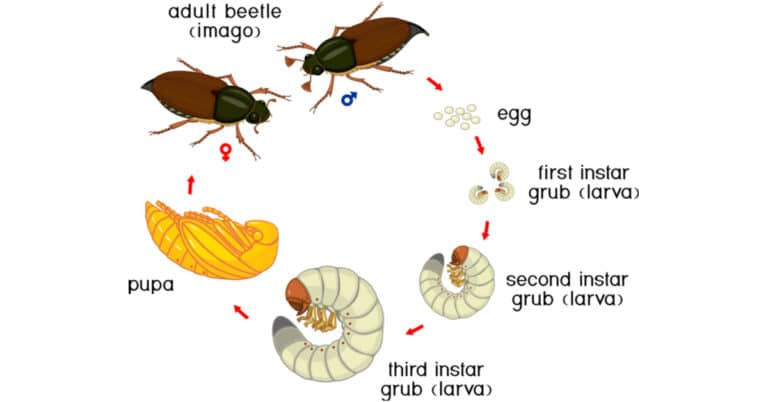
Teachers and students: you’re welcome to use this diagram in lessons and projects with credit to Learn About Nature.
Yellow mealworm beetle Quick Facts
| Common name | Yellow mealworm beetle |
| Scientific name | Tenebrio molitor |
| Kingdom | Animalia |
| Phylum | Arthropoda |
| Class | Insecta |
| Order | Coleoptera |
| Family | Tenebrionidae |
| Genus | Tenebrio |
| Type | Insect (darkling beetle) |
| Diet | Grains, bran, rotting plants and dead insects |
| Habitat | Grain stores, barns, rotting wood and leaf litter |
| Native range | Probably Europe; now worldwide |
| Size | Larvae about 2.5 cm; adults 1.25 to 1.8 cm |
| Lifespan | Adults usually live a few months |
| Colours | Larvae golden-brown; adults reddish-brown to black |
Mealworms are easy to raise, which makes them popular as classroom pets, pet food and even human food. Watching their life cycle up close is a great way to see metamorphosis in action.
Meet the Darkling Beetles
The yellow mealworm beetle belongs to the darkling beetle family, Tenebrionidae, which has around 20,000 species. Scientists study Tenebrio molitor a lot because it is easy to keep and grows quickly.
Like all beetles, it goes through complete metamorphosis, with four stages: egg, larva, pupa and adult. How long each stage takes depends a lot on temperature, food and moisture. Warm conditions speed things up, and cool conditions slow them down.
Stage 1: Egg
After mating, a female beetle lays her eggs one at a time or in small groups. She often hides them in flour, bran or soil. Each egg is tiny, white and bean-shaped, only about 1 to 2 mm long. The eggs are sticky, so bits of food and dust cling to them and help hide them.
A female can lay several hundred eggs during her life. In warm conditions, the egg stage usually lasts about one to two weeks. In cooler places it can take longer.
Stage 2: Larva (the Mealworm)
The tiny larva that hatches is pale and only about 3 mm long. It has six legs near its head and a long, segmented body. As it grows, its color turns golden yellow to light brown.
Mealworms spend almost all their time eating. In the wild they eat grain, flour, rotting plants and dead insects. Because their hard outer skin cannot grow with them, they shed their exoskeleton many times, often 10 to 20 times. Right after a molt, a mealworm is soft and white, but its new skin soon hardens and darkens.
A full-grown mealworm is about 2.5 cm long. In warm conditions, the larval stage usually lasts a few months, but it can last much longer when it is cool.
Stage 3: Pupa
When a mealworm is fully grown, it stops eating, curls up and molts one last time into a pupa. The pupa is creamy white at first and slowly turns brown. You can already see the outline of legs, wings and antennae, folded against its body.
The pupa does not eat and cannot walk, but it can wiggle when touched. This makes it vulnerable to attack, and mealworms and adult beetles will sometimes eat pupae. Inside, the body is being rebuilt into a beetle. In warm conditions, the pupa stage usually lasts about one to three weeks.
Stage 4: Adult Beetle
The adult beetle that comes out of the pupa is about 1.25 to 1.8 cm long. At first it is soft and white or pale tan. Over a few days its body hardens and darkens to reddish-brown and then shiny black.
Adult mealworm beetles have wings under their wing covers and can fly, though they rarely do. They usually live for a few months, during which they eat, mate and lay eggs.
Reproduction
Adult beetles are ready to reproduce within a couple of weeks of becoming adults. Males find females by scent, and after mating the female starts laying eggs within a few days. She keeps laying eggs for weeks, so one pair can produce a large colony.
Because adults and larvae may eat eggs and pupae, people who raise mealworms often keep the different stages in separate containers.
Where Do Mealworms Live?
The yellow mealworm beetle probably came from Europe, especially the Mediterranean region. Traveling with people and stored grain, it has spread around the world, from Africa to North America, where it is now well established.
Mealworms like dark, sheltered places with plenty of food, such as grain stores, barns, bird nests, rotting logs and leaf litter. In nature they are useful recyclers that break down dead plants and other organic matter.
Mealworms and People
Pets and Pet Food
Mealworms are a favorite food for many animals. People feed them to pet birds, fish and reptiles such as lizards, and farmers give them to poultry like chickens and turkeys. Anglers use them as fishing bait. They are rich in protein and fat, which makes them a nourishing treat.
Mealworms are also easy to raise yourself. Keep them in a container with oats or wheat bran, and add slices of carrot or potato for moisture. Kept at room temperature, they will go through their whole life cycle in a few months.
Human Food
In many parts of the world, including Southeast Asia, people eat insects as snacks, and mealworms are becoming popular too. In 2021, the European Union approved dried yellow mealworms as the first insect allowed as a food for humans after a safety review. People with shellfish or dust mite allergies may react to them, though.
Mealworms are nutritious. Fresh larvae contain roughly 14 to 25 grams of protein per 100 grams, along with healthy fats and minerals such as iron and zinc.
Plastic Eaters
Scientists have discovered that mealworms can eat Styrofoam, a type of plastic foam. Bacteria in their guts help break it down. In one study, a group of about 100 mealworms ate roughly 34 to 39 milligrams of Styrofoam a day. Researchers hope this may one day help us deal with plastic waste.
A Small Beetle With a Big Story
From tiny egg to wiggling larva, still pupa and shiny black beetle, the mealworm life cycle shows how much an insect can change. These hardy little insects help recycle nature’s leftovers, feed many animals and might even help clean up plastic.
More life cycles
- Bee Life CycleEgg → larva → pupa → adult
- Praying Mantis Life CycleEgg case → nymph → adult
- Cicada Life CycleEgg → underground nymph → adult
- Caterpillar Life CycleEgg → caterpillar → pupa → butterfly or moth
- Lizard Life CycleEgg → hatchling → adult
Yellow mealworm beetle FAQs
Are mealworms worms?
No. Mealworms are the larvae of the yellow mealworm beetle, a darkling beetle. They have six legs and a hard outer skin, and they grow into beetles.
How long does the mealworm life cycle take?
In warm conditions it usually takes a few months to go from egg to adult. Cool temperatures can make it take much longer.
What do mealworms eat?
Mealworms eat grains, oats, bran, rotting plants and dead insects. People who raise them often add carrot or potato slices for moisture.
Can mealworm beetles fly?
Yes, adult mealworm beetles have working wings and can fly, but they rarely do. Most of the time they walk around looking for food.
Is it safe to eat mealworms?
Yes. The European Union approved dried mealworms as food in 2021. People allergic to shellfish or dust mites should be careful, as mealworms may cause a reaction.

Nato is a content writer and researcher with a background in psychology who’s eager to explore the wonders of nature. As a travel enthusiast and animal lover, she hopes to inspire others to discover and cherish the beauty and importance of the natural world.