Bee Anatomy: Parts of a Honey Bee and What They Do
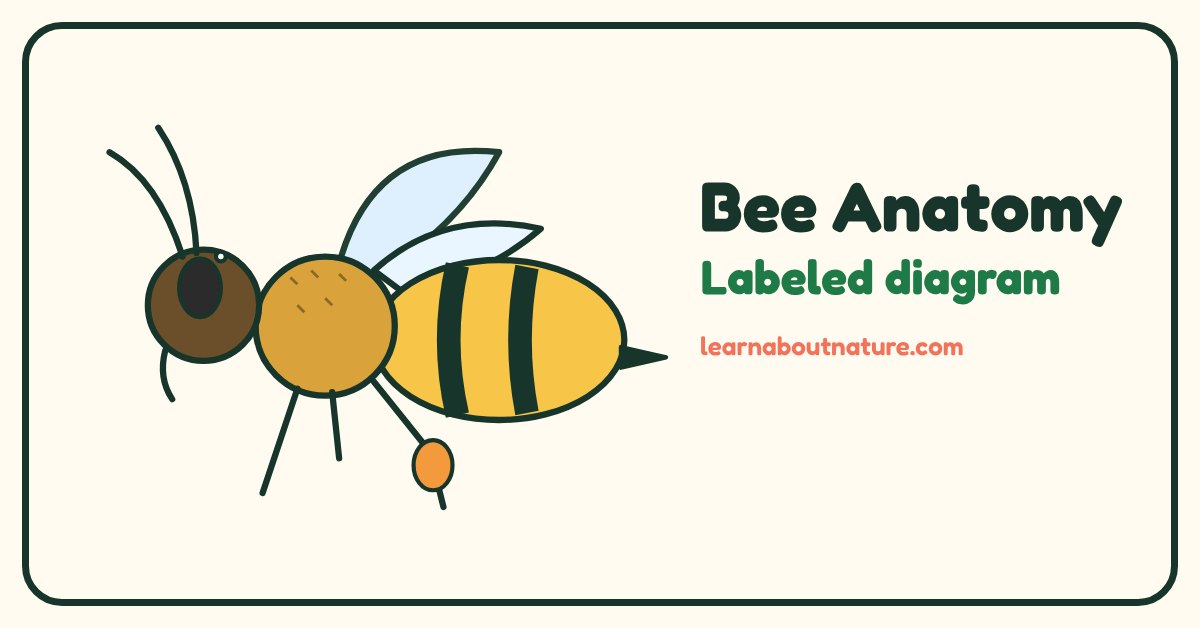
Quick answer: A honey bee has three body parts. The head carries two antennae, two large compound eyes, three small ocelli and mouthparts with a tongue. The thorax carries four wings and six legs, including hind legs with pollen baskets. The abdomen holds the honey stomach, wax glands and, in females, a stinger at the tip.
A honey bee may be small, but its body is packed with tools. It has a tongue for drinking nectar, baskets on its legs for carrying pollen, glands that make wax and a stomach for carrying nectar home to the hive.
This guide focuses on the worker honey bee (Apis mellifera), the female bee you see visiting flowers. A colony also has one queen and, in spring and summer, male bees called drones. Their bodies differ in a few important ways, which we explain along the way.
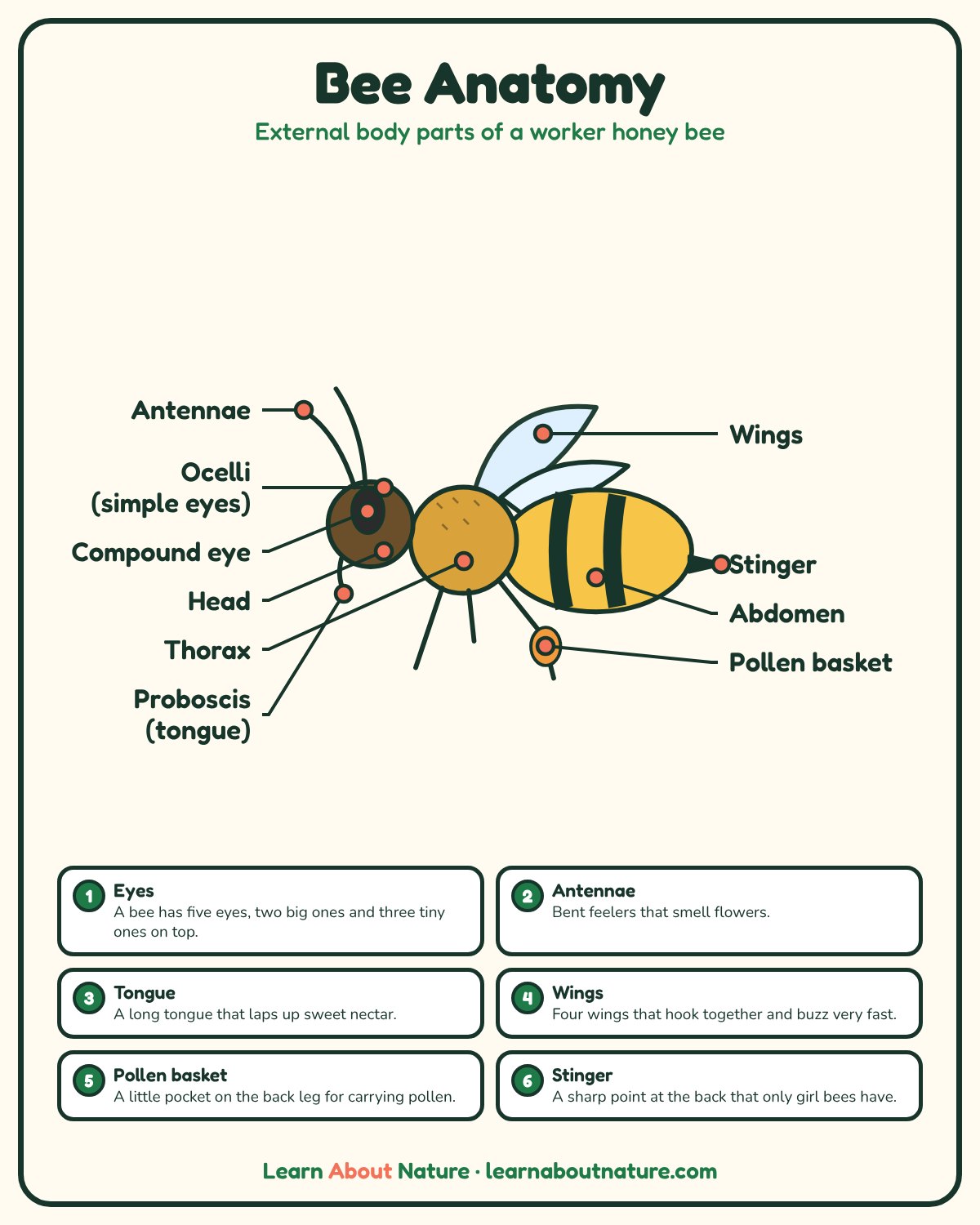
Teachers and students: you’re welcome to use this diagram in lessons and projects with credit to Learn About Nature.
Free printable: Download the Bee Anatomy labeling worksheet (PDF) – label the parts using the word bank. Answer key included.
Parts of a Bee and What They Do
| Part | What it does |
|---|---|
| Head | Holds the brain, eyes, antennae and mouthparts |
| Compound eyes | See colors, ultraviolet light and movement |
| Ocelli | Three simple eyes that sense light levels |
| Antennae | Smell, touch and taste |
| Mandibles | Jaws for shaping wax and carrying things |
| Proboscis (tongue) | Laps up nectar and water |
| Thorax | Holds the flight muscles; wings and legs attach here |
| Wings (4) | Hooked together in pairs for flight |
| Pollen basket (corbicula) | Carries pollen home on the hind legs |
| Abdomen | Holds the honey stomach, gut, wax glands and stinger |
| Honey stomach | Stores nectar to carry back to the hive |
| Wax glands | Make wax flakes for building honeycomb |
| Stinger | Defends the bee and colony; only females have one |
The Bee Body Plan
Like all insects, a bee has three main body parts: the head, the thorax and the abdomen. It has six legs and four wings, all attached to the thorax.
A bee’s body is covered in branched, feathery hairs. These hairs trap pollen grains as the bee moves around inside a flower. Bees are wasp relatives, and like wasps and ants they have a narrow waist between the thorax and abdomen.
The Head: Five Eyes, Antennae and a Tongue
- Compound eyes: two large eyes on the sides of the head, each made of thousands of tiny units. A worker has roughly 4,000 to 6,000 in each eye, and drones have even more.
- Ocelli: three small simple eyes on top of the head that sense light levels. Together with the compound eyes, that makes five eyes in total.
- Antennae: two jointed feelers, bent like an elbow, covered in thousands of sensors for smell, touch and taste.
- Mandibles: a pair of jaws used to shape wax, carry things and clean the hive.
- Proboscis: a long, hairy tongue that the bee extends to lap up nectar and water, then folds away under the head.
The Thorax: Wings and Legs
The thorax is filled with powerful flight muscles. Honey bees have four wings. The front wings are larger than the back wings. In flight, a row of tiny hooks on the front edge of each hindwing catches onto the forewing, so the two wings on each side work as one.
Honey bee wings beat about 230 times a second. That fast beating is what makes the familiar buzzing sound.
Each leg is a multi-tool. The front legs have a notch lined with stiff hairs for cleaning the antennae. On the outside of each hind leg is a smooth, slightly hollow patch fringed with long hairs called the corbicula, or pollen basket. The bee packs pollen into it, mixed with a little nectar, and flies home with two colorful pellets. Foot claws grip rough surfaces, and a sticky pad between them lets the bee walk on smooth ones.
The Abdomen and Stinger
The striped abdomen holds most of the bee’s organs. On the underside, young workers have four pairs of wax glands that make thin flakes of wax, which they chew and shape to build honeycomb.
At the tip of the abdomen is the stinger. Only female bees can sting, because the stinger is a changed egg-laying tube. A worker’s stinger has tiny backward-pointing barbs. When she stings a mammal with thick, elastic skin, the barbs hold fast, and the stinger and venom sac tear away from her body. She dies soon after. A queen’s stinger has much smaller barbs, so she can sting more than once. Drones have no stinger at all.
Bees sting to defend themselves and their colony, not to attack. Moving slowly and calmly near bees and staying back from hive entrances is the best way to avoid stings.
Internal Anatomy: Inside a Honey Bee
When a worker drinks nectar, it goes first into her honey stomach, or crop. This is a stretchy storage bag separate from the part of the gut that digests food. A full honey stomach can swell to fill much of the abdomen. Back at the hive, she brings the nectar back up and passes it to other bees, who turn it into honey.
A bee breathes through small holes called spiracles on the sides of the thorax and abdomen. Air travels through tubes and air sacs straight to the muscles. A long tube-shaped heart along the back pumps the bee’s blood, called hemolymph, around the body.
Glands in the worker’s head make royal jelly, a rich food fed to young larvae and to the queen. Other glands make scents, called pheromones, that bees use to send messages to each other.
Bee Senses
Honey bees see colors differently from us. They can see ultraviolet light, which reveals patterns on flowers that are invisible to people, but they cannot see red. Their antennae smell flowers, detect pheromones and feel their way around the dark hive.
Bees also sense vibrations through their legs and use them, along with touch, to follow the waggle dance that tells other workers where to find food.
Workers, Queens and Drones
- Worker: the smallest bee, female, with pollen baskets, wax glands and a barbed stinger. Workers do almost all the jobs in the hive.
- Queen: female, with a longer abdomen for laying eggs. She has no pollen baskets and does not collect food.
- Drone: male, with a stout body and very large eyes that meet at the top of the head, which help it spot a queen in flight. It has no stinger and no pollen baskets.
Honey Bees vs Wasps
Honey bees and wasps are close relatives with the same basic body plan. The easy differences are the hair and the diet. Honey bees are fuzzy and feed their young on pollen and nectar. Most wasps are smooth and shiny, with a slimmer, more obviously pinched waist, and many hunt insects to feed their young.
Most wasps also have stingers without large barbs, so they can sting more than once.
Bee Anatomy for Kids
- Eyes: a bee has five eyes, two big ones and three tiny ones on top.
- Antennae: bent feelers that smell flowers.
- Tongue: a long tongue that laps up sweet nectar.
- Wings: four wings that hook together and buzz very fast.
- Pollen basket: a little pocket on the back leg for carrying pollen.
- Stinger: a sharp point at the back that only girl bees have.
- Honey stomach: a special stomach for carrying nectar home.
Key words: corbicula – the pollen basket on a honey bee’s hind leg; ocelli – small simple eyes on top of an insect’s head; proboscis – a bee’s long tongue for drinking nectar; honey stomach – a stretchy bag where a bee stores nectar to carry home; drone – a male honey bee; pheromone – a scent an animal uses to send messages to others of its kind.
Try this: Watch bees on a flowering plant from a safe distance and look for the yellow or orange pollen balls on their back legs. Record which flower colors get the most visits.
Related Guides
- Bee life cycle
- Spider Anatomy
- Ant Anatomy
- Butterfly Anatomy
- Grasshopper life cycle
- Cockroach life cycle
- All animal & plant anatomy diagrams
- Animal & plant life cycles
See also: Bee Facts for Kids
Bee Anatomy FAQs
How many eyes does a bee have?
A honey bee has five eyes. Two large compound eyes on the sides of the head are made of thousands of tiny units and see color and movement. Three small simple eyes, called ocelli, sit on top of the head and sense light levels.
Where is the pollen basket on a bee?
The pollen basket, or corbicula, is on the outside of each hind leg. It is a smooth, slightly hollow area fringed with long hairs. The bee brushes pollen into it and presses it into a pellet to carry home. Only workers have pollen baskets.
Why do honey bees die after stinging?
A worker honey bee’s stinger has backward-facing barbs. When it stings a mammal with thick skin, the barbs catch and the stinger, venom sac and part of the gut tear away as the bee pulls free. This injury kills the bee. Queens and most other bees and wasps can sting more than once.
How many wings does a bee have?
Bees have four wings, two on each side. The front wings are larger. In flight, tiny hooks on the hindwing lock onto the forewing so they move together, which is why a bee can look as if it has only two wings.
Do male bees have stingers?
No. Male honey bees, called drones, have no stinger. The stinger is a changed egg-laying tube, so only females, the workers and the queen, have one. Drones also lack pollen baskets and do not collect food.
Sources: Honey Bee Anatomy – Michigan State University Pollinators and Pollination; Chapter 3: Anatomy of the Honeybee – FAO; Thorax of the Honey Bee – Bee Health, Extension Foundation; Short-amplitude high-frequency wing strokes determine the aerodynamics of honeybee flight – PNAS (Altshuler et al., 2005)

Nato is a content writer and researcher with a background in psychology who’s eager to explore the wonders of nature. As a travel enthusiast and animal lover, she hopes to inspire others to discover and cherish the beauty and importance of the natural world. She also writes about the history of candy and snacks for Snack History and about food and healthy eating for The Fitchen.