Rhino Facts for Kids: Species, Habitat, Diet and Fun Facts
Quick answer: A rhino, or rhinoceros, is a large, thick-skinned plant-eating mammal with one or two horns on its snout. There are five species: two live in Africa and three in southern Asia. Rhinos eat grass, leaves and twigs. Their horns are made of keratin, the same material as your fingernails, and poaching for these horns is their biggest threat.
With its tough gray skin, heavy body and horn on its nose, a rhino looks a bit like a living dinosaur. In fact, rhinos are mammals, and some kinds are among the biggest animals that walk on land today.
There are five different rhino species, and each one has its own story. Some are slowly coming back from the edge of extinction, while others are among the rarest large animals on Earth. Here are the rhino facts every young explorer should know.
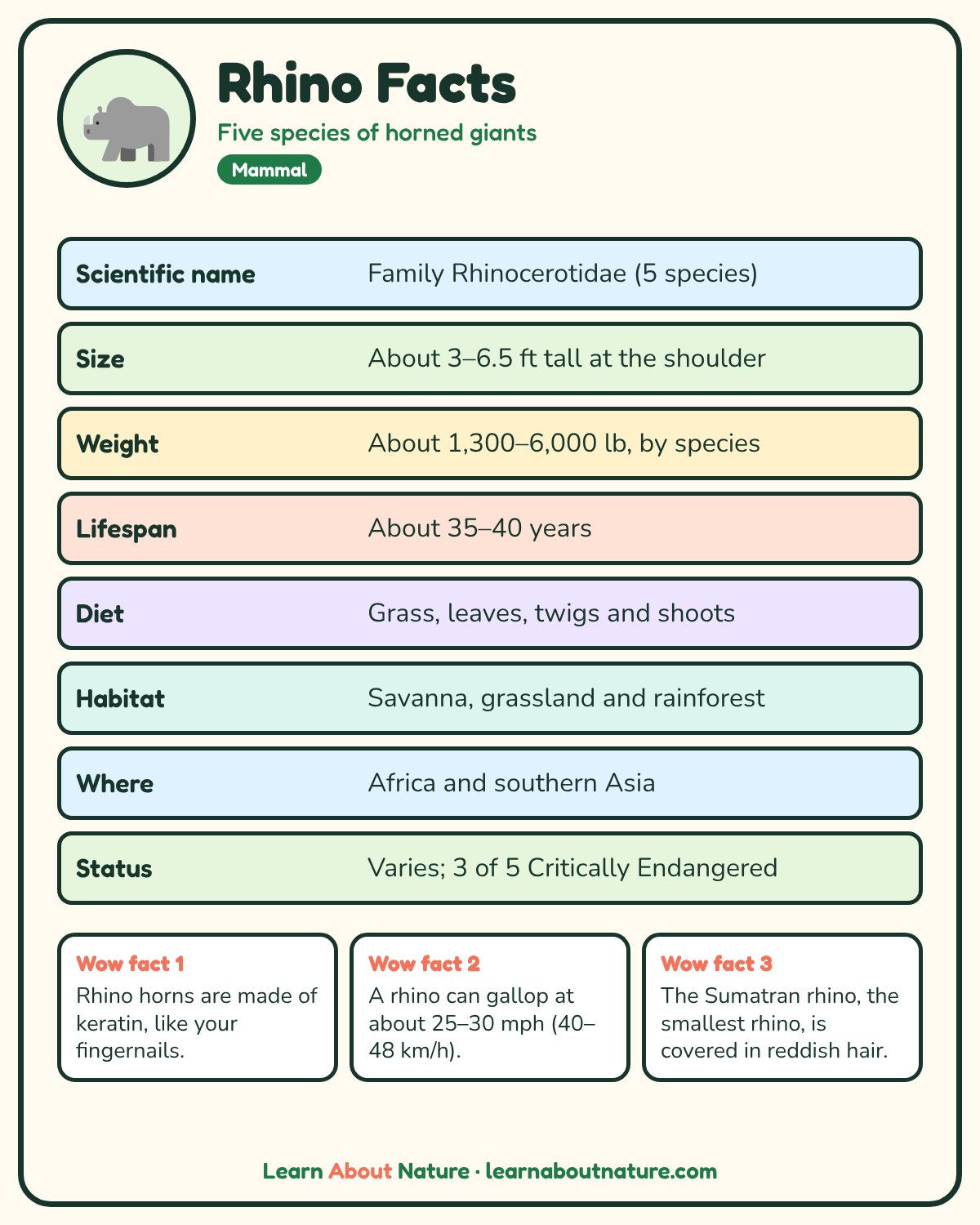
Teachers and students: you’re welcome to use this fact sheet in lessons and projects with credit to Learn About Nature.
Free printable: Download the Rhino fact file worksheet (PDF) – draw the animal, fill in the facts and match key words. Answer key included.
Rhino Quick Facts
| Class | Mammal |
| Family | Rhinocerotidae |
| Number of species | 5 (2 in Africa, 3 in Asia) |
| Largest species | White rhino and greater one-horned rhino |
| Smallest species | Sumatran rhino |
| Weight | About 1,300–6,000 lb, depending on species |
| Top speed | About 25–30 mph (40–48 km/h) |
| Pregnancy | About 15–17 months |
| Baby name | Calf |
| Conservation status | Near Threatened to Critically Endangered (IUCN) |
What Is a Rhino?
A rhino is a large, plant-eating mammal with thick skin and one or two horns on the front of its face. Its full name, rhinoceros, comes from Greek words meaning “nose horn.” Rhinos belong to a family of mammals called Rhinocerotidae.
Today there are five living species of rhino, and only about 27,000 rhinos are left in the wild altogether. Two species live in Africa and three live in Asia. Here is a quick guide, with the status each one has on the IUCN Red List:
- White rhino (Ceratotherium simum): Africa’s biggest rhino, with two horns and a wide, square mouth. About 15,752 at the end of 2024. Near Threatened.
- Black rhino (Diceros bicornis): two horns and a pointed, hooked upper lip. About 6,788 at the end of 2024. Critically Endangered.
- Greater one-horned rhino (Rhinoceros unicornis): one horn and skin folds that look like armor plates. Lives in India and Nepal. About 4,075. Vulnerable.
- Javan rhino (Rhinoceros sondaicus): one small horn, found in just one national park in Java, Indonesia. About 50. Critically Endangered.
- Sumatran rhino (Dicerorhinus sumatrensis): the smallest and hairiest rhino, with two horns. An estimated 34 to 47 left. Critically Endangered.
Where Do Rhinos Live?
African rhinos live in the grasslands, savannas and bushlands of eastern and southern Africa. Today, most are found in protected parks and reserves, especially in South Africa, Kenya, Namibia and Zimbabwe.
The greater one-horned rhino lives in the tall floodplain grasslands and nearby woodlands of northern India and southern Nepal. It often stands in rivers and pools. The Javan rhino survives only in the tropical rainforest of Ujung Kulon National Park on the western tip of Java. Sumatran rhinos live in dense, hilly rainforests in a few places on the island of Sumatra, and a tiny group was recently found on Borneo.
What Do Rhinos Eat?
All rhinos are herbivores. Some are grazers, which means they eat mainly grass. Others are browsers, which means they eat leaves, twigs and shoots from bushes and trees.
The white rhino is a grazer. Its wide, flat lips work like a lawnmower on short grass. The black rhino is a browser. It uses its pointed, flexible upper lip almost like a finger to grab leaves and branches. The greater one-horned rhino mostly grazes but also eats water plants. Javan and Sumatran rhinos browse in the forest, and scientists have recorded hundreds of different plants in their diets.
Rhino Bodies, Horns and Senses
Rhinos come in different sizes. The white rhino and the greater one-horned rhino are the biggest, weighing about 4,000 to 6,000 pounds (1,800 to 2,700 kg) and standing up to about 6 feet (1.8 m) or more at the shoulder. The Sumatran rhino is the smallest, at about 1,300 to 2,000 pounds (600 to 950 kg) and 3 to 5 feet (1 to 1.5 m) tall.
A rhino’s horn is not bone. It is made of keratin, the same tough material that makes up your hair and fingernails. African rhinos and Sumatran rhinos have two horns, one behind the other. Greater one-horned and Javan rhinos have one.
Rhinos have poor eyesight, but their hearing and sense of smell are very good. They follow scent trails with their heads held low. Even though they are heavy, rhinos can gallop at about 25 to 30 miles per hour (40 to 48 km/h).
Rhinos love a good mud bath. Rolling in mud or lying in shallow water helps them cool off and probably helps protect their skin from biting insects.
Rhino Babies
A baby rhino is called a calf. Rhino mothers are pregnant for a very long time: about 16 months for white rhinos and about 15 to 17 months for black rhinos. A mother almost always has one calf at a time.
A white rhino calf is up and walking around within about three days. It starts nibbling plants within a few weeks but keeps drinking milk for a year or more. Calves usually stay with their mothers for two to three years, often until a new brother or sister is born.
- Pregnancy: about 15–17 months
- Babies per birth: 1
- Walking: within about 3 days (white rhino)
- Time with mother: about 2–3 years
How Rhinos Live
Most adult rhinos spend much of their time alone. Adult males usually live by themselves and guard their own areas. Females often travel with their calves, and young rhinos sometimes form small groups.
Rhinos “talk” with snorts, squeals and pants, and they leave messages with smell. Many rhinos use shared dung piles called middens, and males scrape their feet through the dung to spread their scent.
Small birds called oxpeckers often ride on rhinos and pick off ticks and insects. When danger comes near, the birds give a loud, high-pitched alarm call that can warn the rhino.
White Rhino vs Black Rhino
Here is a surprise: white rhinos are not white, and black rhinos are not black. Both are gray. The name “white” probably comes from a word in Afrikaans meaning “wide,” describing the animal’s broad mouth.
The easiest way to tell them apart is to look at the mouth. A white rhino has a wide, square lip for grazing grass. A black rhino has a pointed, hooked lip for grabbing leaves, so it is also called the hook-lipped rhino. White rhinos are bigger, weighing about 4,000 to 6,000 pounds, while black rhinos weigh about 1,750 to 3,000 pounds (800 to 1,350 kg).
Their homes differ, too. White rhinos prefer open grassland, while black rhinos usually live in areas with more bushes and shrubs.
Threats and Conservation Status
The biggest threat to rhinos is poaching, which is illegal hunting. Poachers kill rhinos for their horns, which are sold illegally even though they are only keratin. Rhinos also lose habitat to farms and towns, and drought can hurt populations.
IUCN figures released in 2025 show mixed news. Poaching in Africa has dropped, and black rhino numbers have been slowly rising since the 1990s, when they fell to about 2,300. White rhino numbers, though, fell to about 15,752 by the end of 2024. The northern white rhino subspecies has only two animals left, both females. In Asia, the greater one-horned rhino has grown from fewer than 100 animals to more than 4,000 thanks to strong protection, but the Javan and Sumatran rhinos are among the rarest large mammals on Earth.
On the IUCN Red List, the black, Javan and Sumatran rhinos are Critically Endangered, the greater one-horned rhino is Vulnerable and the white rhino is Near Threatened. The black and white rhino listings were confirmed in a 2020 assessment.
Fun Facts About Rhinos
Here are a few more rhino surprises:
- Rhinoceros means “nose horn.”
- The greater one-horned rhino has bounced back from fewer than 100 animals to more than 4,000.
- The greater one-horned rhino often stands in water to cool off and feed on water plants.
- Male Javan rhinos have the smallest horn of any rhino, only about 10 inches (25 cm) long.
- Rhinos use shared dung piles called middens, a bit like a smelly message board.
Fast Facts for Young Readers
- Rhinoceros means “nose horn.”
- There are five kinds of rhinos.
- Two kinds live in Africa and three live in Asia.
- Rhino horns are made of the same stuff as your fingernails.
- Rhinos eat only plants.
- A baby rhino is called a calf.
- Rhinos roll in mud to stay cool.
Key words: herbivore – an animal that eats only plants; grazer – a plant eater that mostly eats grass; browser – a plant eater that mostly eats leaves, twigs and shoots; keratin – the tough material that makes hair, nails and rhino horns; poaching – hunting animals illegally.
Try this: Feel your fingernails and hair, then talk about how rhino horns are made of the same material, keratin. Make a chart comparing the five rhino species by number of horns, home continent and status.
Related Guides
- Rhino life cycle
- Tiger facts for kids
- Wolf facts for kids
- Kangaroo facts for kids
- Meerkat facts for kids
- All animal facts for kids
Rhino FAQs
How many types of rhinos are there?
There are five living rhino species. The white rhino and black rhino live in Africa. The greater one-horned rhino, Javan rhino and Sumatran rhino live in Asia. Together there are only about 27,000 rhinos left in the wild.
What is a rhino horn made of?
A rhino horn is made of keratin, the same material found in human hair and fingernails. It has no bone inside. Sadly, people still kill rhinos for their horns, which are sold illegally. Protecting rhinos from poachers is one of the most important parts of rhino conservation.
Why is it called a white rhino if it is gray?
White rhinos and black rhinos are both gray. The name “white” probably comes from an Afrikaans word meaning “wide,” which described the white rhino’s broad, square mouth. The easiest way to tell the two apart is to look at the shape of the mouth, not the color.
Are rhinos endangered?
Yes, most of them. On the IUCN Red List, the black, Javan and Sumatran rhinos are Critically Endangered, the greater one-horned rhino is Vulnerable and the white rhino is Near Threatened. Poaching for horns is the biggest threat, along with habitat loss.
What do rhinos eat?
Rhinos are herbivores. White rhinos and greater one-horned rhinos mostly eat grass. Black, Javan and Sumatran rhinos are browsers that eat leaves, twigs, shoots and other plant parts. The black rhino uses its hooked upper lip to grab leaves from bushes.
Sources: IUCN: Poaching of African rhinos down, but drought and other threats drive losses globally (2025); IUCN: Conservation efforts bring cautious hope for African rhinos (2020); International Rhino Foundation: Rhino Species; San Diego Zoo Wildlife Alliance Library: White Rhinoceros Fact Sheet; San Diego Zoo Wildlife Alliance Library: Black Rhinoceros Fact Sheet; African Wildlife Foundation: Rhinoceros

Nato is a content writer and researcher with a background in psychology who’s eager to explore the wonders of nature. As a travel enthusiast and animal lover, she hopes to inspire others to discover and cherish the beauty and importance of the natural world. She also writes about the history of candy and snacks for Snack History and about food and healthy eating for The Fitchen.