
Wolf Facts for Kids: Gray Wolf Habitat, Diet and Fun Facts
Quick answer: A wolf, or gray wolf, is the largest wild member of the dog family. Wolves live in forests, mountains, tundra and deserts across North America, Europe and Asia. They hunt large hoofed animals such as deer, elk and moose. Wolves live in family groups called packs and howl to keep in touch.
On a cold, still night, a long howl rises from the forest. Another wolf answers, then another, until the whole pack is singing together. Few sounds in nature are as famous as a wolf’s howl.
Wolves are smart, social animals that live in close family groups and work as a team. They once roamed more of the world than almost any other land mammal. Here is how wolves live, what they eat, how their pups grow up and why people are helping them return to places where they had disappeared.
Teachers and students: you’re welcome to use this fact sheet in lessons and projects with credit to Learn About Nature.
Free printable: Download the Wolf fact file worksheet (PDF) – draw the animal, fill in the facts and match key words. Answer key included.
Wolf Quick Facts
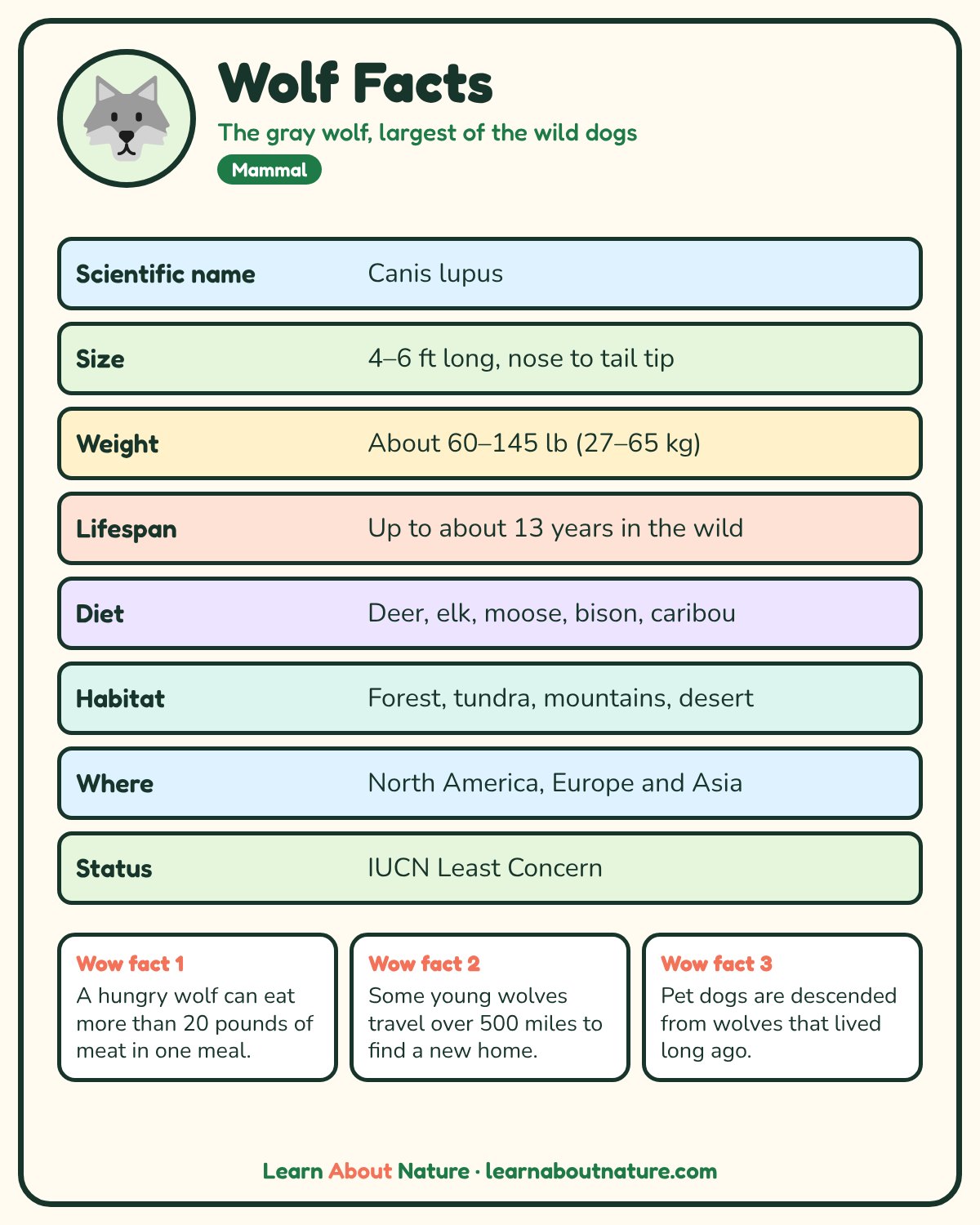
| Class | Mammal |
| Family | Dog family (Canidae) |
| Scientific name | Canis lupus |
| Length | About 4–6 ft (1.2–1.8 m), nose to tail tip |
| Height | About 26–33 in (66–84 cm) at the shoulder |
| Weight | Males about 70–145 lb; females about 60–100 lb |
| Top speed | About 35 mph (56 km/h) in short bursts |
| Pups per litter | Usually 4–7 |
| Group name | Pack |
| Conservation status | Least Concern (IUCN, assessed 2018) |
What Is a Wolf?
A wolf is a mammal and the largest wild member of the dog family, called Canidae. When people say “wolf,” they usually mean the gray wolf, whose scientific name is Canis lupus. Coyotes, foxes and jackals are its cousins.
There are several kinds, or subspecies, of gray wolf. The Arctic wolf lives in the far north and has thick white fur. The Mexican gray wolf of the southwestern United States and Mexico is the smallest. Pet dogs are descended from wolves that lived thousands of years ago, which is why many dogs still look and act a little like wolves.
Where Do Wolves Live?
Gray wolves live across the Northern Hemisphere, in nearly 70 countries in North America, Europe and Asia. Most live in the wild lands of northern Canada and Russia. They are very adaptable and can live in forests, mountains, grasslands, Arctic tundra and even deserts, as long as there is enough prey to eat.
Wolves once lived in more places than any other land mammal except humans. Over the last few hundred years they lost about one-third of their range because people hunted, trapped and poisoned them. In the United States, wolves now live in Alaska, the northern Rocky Mountains and the western Great Lakes, with smaller groups in states such as Washington, Oregon, California, Colorado, Arizona and New Mexico.
Each pack has its own territory. In Yellowstone National Park, a pack’s home range covers about 185 to 310 square miles (300 to 500 square kilometers).
What Do Wolves Eat?
Wolves are carnivores. They mostly hunt large hoofed animals such as deer, elk, moose, caribou and bison. In Yellowstone, elk make up about 90 percent of what wolves eat in winter. When big prey is hard to find, wolves also eat beavers, rabbits, birds, fish and even some fruit. They will eat carrion, too, which means animals that are already dead.
Hunting big animals is hard work, and most chases do not end in a catch. Wolves often go several days without food. When the pack does make a catch, a wolf may eat more than 20 pounds (9 kg) of meat at once. Over time, an adult eats about 10 pounds (4.5 kg) of food a day on average.
Wolves usually catch animals that are young, old, sick or weak. This helps keep herds of deer and elk healthy.
Body and Senses
Gray wolves measure about 4 to 6 feet (1.2 to 1.8 m) from nose to tail tip and stand about 26 to 33 inches (66 to 84 cm) tall at the shoulder. Males usually weigh about 70 to 145 pounds (32 to 65 kg), and females about 60 to 100 pounds (27 to 45 kg). Wolves in the far north are the biggest.
Despite the name, gray wolves are not always gray. Their thick fur can be grizzled gray, brown, black or almost white. In winter, a woolly undercoat keeps them warm in temperatures far below freezing.
Wolves are built for long-distance travel. They have long legs, big feet and a steady trot they can keep up for hours. In short bursts they can run about 35 miles per hour (56 km/h). Wolves have excellent senses of smell and hearing, which help them find prey and hear howls from far away.
Wolf Pups
Baby wolves are called pups. Wolves usually mate in late winter, and the mother is pregnant for about 9 weeks (around 63 days). In spring, she gives birth in a den, often a hole dug into the ground or a sheltered spot among rocks.
A litter usually has about 4 to 7 pups. Each newborn weighs about 1 pound (0.5 kg) and is born blind, deaf and helpless. Their eyes open at about two weeks old, and they are weaned off their mother’s milk at around 5 to 9 weeks. After that, other pack members bring them meat.
The whole pack helps raise the pups. Older brothers and sisters often babysit and play with them. Wolves are ready to breed at about two years old, and many young wolves leave home between one and two years of age to start families of their own.
- Pregnancy: about 9 weeks
- Pups per litter: usually 4–7
- Weight at birth: about 1 lb (0.5 kg)
- Eyes open: at about 2 weeks
Packs and Howling
A wolf pack is really a family. Most packs are made of a mother and father, called the breeding pair, and their pups from the last few years. In the Great Lakes area, winter packs usually have about 4 to 8 wolves. In parts of Canada and Alaska, packs can grow to 30 or more.
Pack members hunt together, share food, defend their territory and care for the young. They communicate with body language, scent marks and sounds such as barks, whines and growls.
The most famous sound is the howl. Wolves howl to find each other when they are spread out, to gather the pack before a hunt and to warn other packs to stay away. When a group howls together, each wolf uses a different note, which can make a small pack sound much bigger.
Threats and Conservation Status
The IUCN Red List lists the gray wolf as Least Concern, based on an assessment carried out in 2018. Scientists estimate there are roughly 200,000 to 250,000 wolves worldwide. Some local groups are much rarer, though. The Himalayan wolf and the Indian wolf are listed as Vulnerable.
The biggest threat to wolves has always been conflict with people, especially when wolves kill livestock. Habitat loss and too few prey animals are also problems. In the United States, wolves’ legal protection varies from place to place and has changed several times.
Wolves have made a comeback in some areas. From 1995 to 1997, 41 wolves from Canada and Montana were released in Yellowstone National Park, where wolves had been wiped out. Today, about 500 wolves live in the Greater Yellowstone area.
Wolf vs Coyote
Wolves and coyotes are close relatives, and people sometimes mix them up. The easiest difference is size. A coyote weighs about 25 to 35 pounds (11 to 16 kg) and is only about one-third the size of a wolf. Wolves are taller, heavier and have broader heads and bigger feet.
Their food is different, too. Wolves work as a pack to hunt large animals such as elk and moose. Coyotes mostly hunt alone or in pairs and catch smaller prey such as mice, voles and rabbits.
Coyotes have spread across most of North America, including cities and suburbs. Wolves need much more space and usually stay in wilder places with plenty of large prey.
Fun Facts About Wolves
Here are a few more wolf surprises:
- Young wolves may travel up to 550 miles (885 km) from where they were born to find a new territory.
- Wolf pups are born with blue eyes that later change color.
- Wolves walk on their toes, which helps them move quietly and quickly.
- Many wild wolves live only a few years, but some reach about 13 years old.
- The gray wolf once had the largest range of any wild land mammal on Earth.
Fast Facts for Young Readers
- The gray wolf is the biggest wild member of the dog family.
- Wolves live in family groups called packs.
- Wolves howl to talk to their pack.
- Baby wolves are called pups.
- Pups are born blind and deaf.
- Wolves eat big animals like deer and elk.
- Pet dogs are related to wolves.
Key words: pack – a family group of wolves that lives, travels and hunts together; territory – the area a pack lives in and protects from other wolves; den – a sheltered hole or hiding place where a mother wolf has her pups; carnivore – an animal that eats mainly meat; subspecies – a group within a species that looks a little different and lives in its own area; disperse – to leave the family group to find a new home.
Try this: Play a howling game: split into small “packs” spread around a room or playground, give each pack its own howl pattern, and see whether each pack can find its members by sound alone with their eyes closed.
Related Guides
- Orangutan facts for kids
- Meerkat facts for kids
- Gorilla facts for kids
- Kangaroo facts for kids
- All animal facts for kids
Wolf FAQs
How big is a wolf?
Gray wolves are about 4 to 6 feet long from nose to tail tip and stand about 26 to 33 inches tall at the shoulder. Males usually weigh 70 to 145 pounds and females 60 to 100 pounds. Wolves in the far north tend to be the largest.
Why do wolves howl?
Wolves howl to stay in touch with pack members that are far away, to bring the pack together before a hunt and to tell other packs to keep out of their territory. Wolves do not howl at the moon. They simply point their noses up so the sound carries farther.
How many wolves are in a pack?
Most packs are a family made of a breeding pair and their young. In the western Great Lakes region, winter packs usually have about 4 to 8 wolves. Some packs in Canada and Alaska grow to 30 or more.
What do wolves eat?
Wolves mainly eat large hoofed animals such as deer, elk, moose, caribou and bison. They also eat smaller animals like beavers and rabbits, and sometimes fish, birds or fruit. A wolf can eat more than 20 pounds of meat at once and then go days without food.
Are wolves endangered?
Not as a species. The IUCN Red List lists the gray wolf as Least Concern, with roughly 200,000 to 250,000 wolves worldwide. Some populations are much rarer, and wolves disappeared from large areas because of hunting and trapping. They have returned to places such as Yellowstone with help from people.
Sources: San Diego Zoo Wildlife Alliance Library: Gray Wolf fact sheet; San Diego Zoo Wildlife Alliance Library: Gray Wolf population and conservation; National Wildlife Federation: Gray Wolf; Yellowstone National Park (NPS): Wolves; International Wolf Center: Biology and Behavior; Yellowstone National Park (NPS): Coyote

Nato is a content writer and researcher with a background in psychology who’s eager to explore the wonders of nature. As a travel enthusiast and animal lover, she hopes to inspire others to discover and cherish the beauty and importance of the natural world. She also writes about the history of candy and snacks for Snack History and about food and healthy eating for The Fitchen.


