Gorilla Life Cycle: Stages From Infant to Silverback
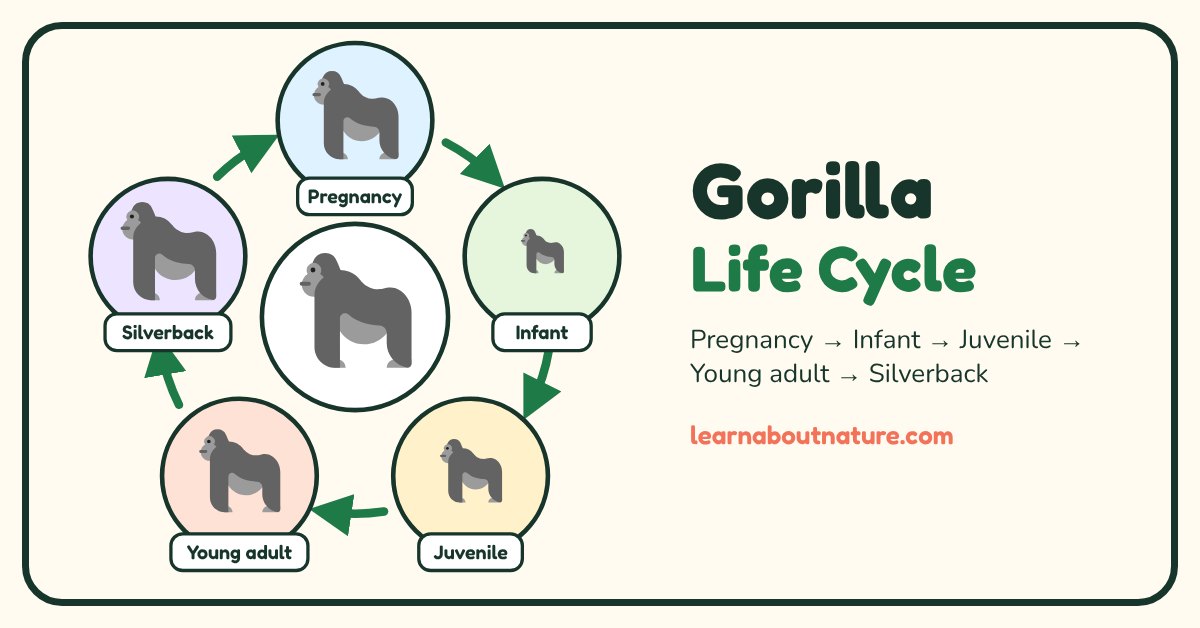
Quick answer: The gorilla life cycle has five stages: pregnancy, infant, juvenile, young adult and silverback. A mother is pregnant for about 8.5 months and has one tiny baby. Infants ride on her back, are weaned at about three to five years, and grow into adults that start families at around 10 to 15 years.
The largest primate on Earth starts life weighing about the same as a small human baby. A newborn gorilla weighs around 4 pounds, clings to its mother’s fur and depends on her for years.
This guide follows the gorilla life cycle from pregnancy to silverback. Most of the timings come from mountain gorillas, a kind of eastern gorilla that scientists have studied in the wild for decades. Western gorillas follow the same pattern, but they grow up a little more slowly, so we point out the differences where they matter.
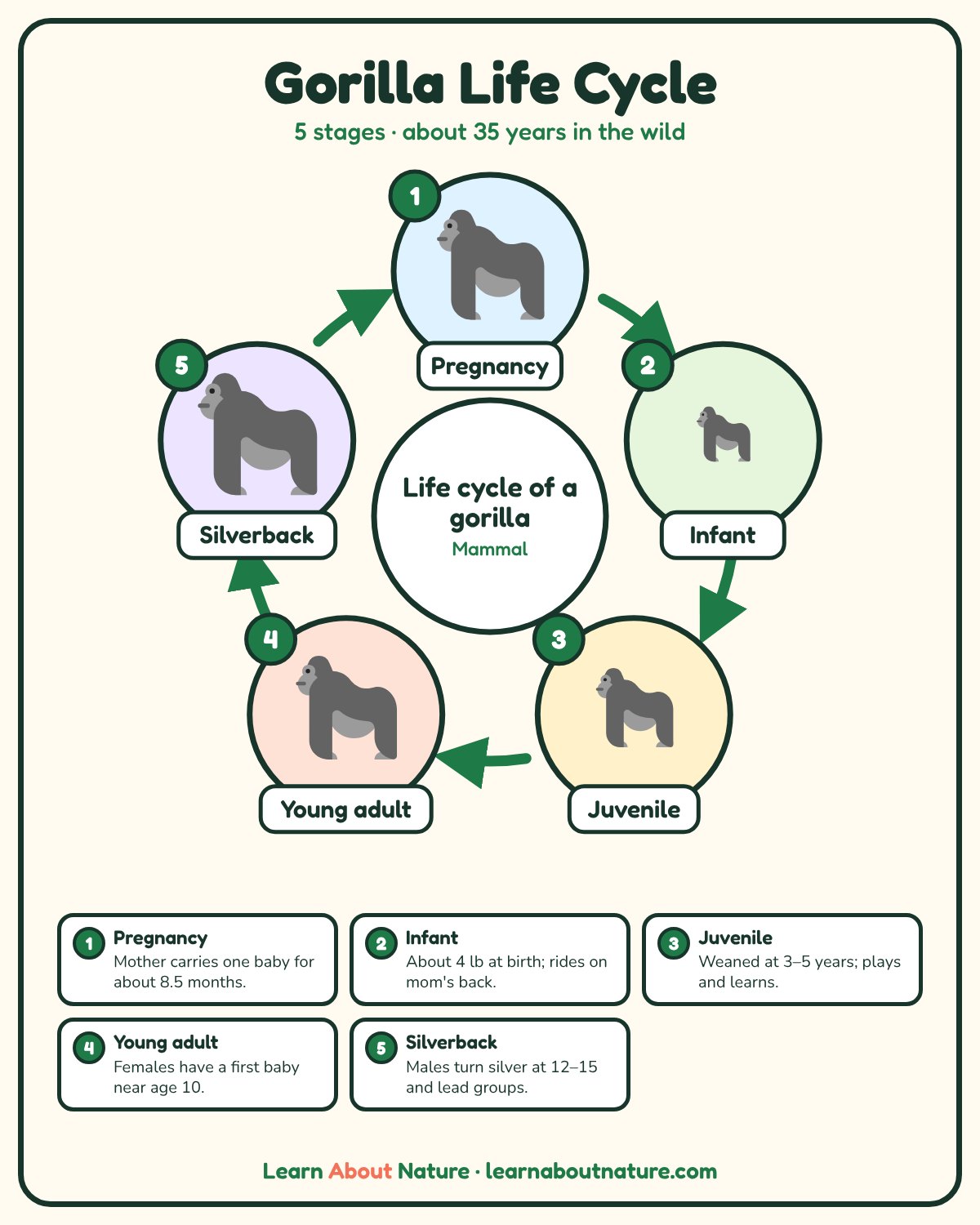
Teachers and students: you’re welcome to use this diagram in lessons and projects with credit to Learn About Nature.
Free printable: Download the Gorilla life cycle worksheet (PDF) – label the diagram, cut and sequence the stages, and match key words. Answer key included.
Gorilla Life Cycle Quick Facts
| Pregnancy | about 8.5 months |
| Babies per birth | almost always 1 |
| Weight at birth | about 3–4 lb (1.4–1.8 kg) |
| Rides on mother’s back | about 4 months to 2–3 years |
| Weaned | about 3 years (mountain); 4–5 years (western) |
| Time between babies | about 4 years |
| First baby (females) | about 10 years (mountain gorillas) |
| Becomes a silverback | about 12–15 years |
| Lifespan in the wild | about 35 years |
Gorilla Families
Gorillas live in family groups often called troops. A typical troop has one adult male, called a silverback, several adult females and their young. Some mountain gorilla groups have more than one silverback, and groups can have up to about 30 members.
The silverback decides where the group travels, feeds and rests, and he protects the family from danger. Gorillas have no fixed breeding season, so babies can be born in any month of the year.
Mountain gorillas live in cool, misty forests high on the slopes of volcanoes and mountains, at about 8,000 to 13,000 feet. Western gorillas live in lowland rainforests and swamps farther west in central Africa. A gorilla group moves around a home range, feeding on leaves, stems, shoots and fruit, and builds new nests to sleep in each night.
Stage 1: Pregnancy
A gorilla pregnancy lasts about 8.5 months, a little shorter than a human pregnancy. The mother almost always has a single baby. Twins are very rare.
Because a mother cares for each infant for years, she usually has a new baby only about once every four years. This slow pace of breeding is one reason gorilla populations take a long time to recover when numbers fall.
Stage 2: Infant
A newborn gorilla weighs only about 3 to 4 pounds (1.4 to 1.8 kg), roughly half the weight of an average human newborn. It is weak and helpless at first and clings to the fur on its mother’s chest.
For the first five or six months, the infant stays in almost constant contact with its mother. At around three months it starts grabbing and handling objects. From about four months, it begins riding on her back, and it keeps hitching rides until it is about two or three years old.
By around eight months, the infant can walk and explore a few feet away from its mother before hurrying back. At night it sleeps with her in a nest of leaves and branches that she builds.
Zoo records for western gorillas give a clear picture of how quickly infants learn. Babies start crawling at about three months old and taste their first plants at around two and a half months. By four to six months they can scamper along on all fours, and by six or seven months they are starting to climb.
- Weight at birth: about 3–4 lb (1.4–1.8 kg)
- Rides on mom’s back: from about 4 months
- Walks and explores nearby: about 8 months
- Babies per birth: almost always 1
Stage 3: Juvenile
Young gorillas drink their mother’s milk for several years, while slowly eating more leaves, stems and fruit. Mountain gorillas are usually weaned at about three years old. Western gorillas nurse longer, and one long-term study found they stopped suckling at around four to five years.
Gorillas between about three and six years old are called juveniles. They spend much of their day playing, chasing, wrestling and climbing. Play helps them build strength and learn how to get along with the rest of the group. Juveniles may also help carry and play with younger infants, and silverbacks often let youngsters play close to them.
Because young gorillas need so much care, the gap between babies is long. Mountain gorilla mothers usually have a baby about every four years, and one study of western gorillas found an average gap of nearly four years too.
Stage 4: Young Adult
As they grow up, young gorillas take different paths. Most young females leave the group they were born in when they are nearly grown and join another group or a lone silverback. This helps them avoid mating with close relatives.
Mountain gorilla females have their first baby at about 10 years old on average. Western gorilla females are often a bit older when they first give birth.
Young males around 8 to 12 years old are called blackbacks, because the hair on their backs is still dark. Many leave their birth group at around eight years old and live alone or in groups of males. They usually do not have females of their own until after about age 13.
A young female’s body is not ready for a baby straight away. In zoos, western gorilla females often begin mating at about seven and a half years old, but they usually do not become pregnant for another year or so. Most have their first baby between about 8.5 and 10 years old in zoos, and often later in the wild.
Stage 5: Silverback
At around 12 to 15 years old, a male’s back hair turns silvery gray, and he becomes a silverback. Mountain gorilla males are fully grown by about 15, while western gorilla males are thought to keep growing until about 18.
An adult male gorilla can weigh about 300 to 485 pounds (136 to 219 kg), much more than adult females at about 200 to 250 pounds. A silverback may beat his chest, roar and charge to scare off rivals, but gorillas are generally calm and peaceful unless they are disturbed.
How Long Do Gorillas Live?
Mountain gorillas live about 35 years in the wild, and some live longer. In zoos, western gorillas often live well into their thirties, and females tend to outlive males.
Threats and Conservation
All gorillas are in danger. On the IUCN Red List, both the western gorilla and the eastern gorilla are Critically Endangered. The mountain gorilla, which is one kind of eastern gorilla, was moved from Critically Endangered to Endangered in 2018 after its numbers rose above 1,000.
The main threats are illegal hunting, habitat loss from farming, mining and logging, and diseases such as Ebola, which can kill many gorillas at once. Gorillas can also catch some human illnesses. Ranger patrols, vet care in the wild and carefully managed tourism have helped mountain gorilla numbers grow.
About half of the world’s mountain gorillas live in the Virunga Mountains, which stretch across Rwanda, Uganda and the Democratic Republic of the Congo. The rest live in Uganda’s Bwindi Impenetrable National Park and nearby forest. Grauer’s gorillas, the other kind of eastern gorilla, have declined sharply in the Democratic Republic of the Congo over the last few decades.
Interesting Gorilla Life Cycle Facts
Here are a few surprising facts about how gorillas grow up.
- A newborn gorilla weighs only about half as much as a typical human baby.
- Infants ride on their mother’s back for up to two or three years.
- Gorillas build a fresh sleeping nest almost every night, and babies share their mother’s nest.
- A male’s back turns silver as he becomes an adult, just like some people’s hair turns gray.
- Mountain gorillas are the only wild great apes whose numbers have recently been going up.
Gorilla Life Cycle for Kids
Here is the gorilla life cycle in simple steps:
- Pregnancy: A mother gorilla carries her baby for about eight and a half months.
- Infant: The tiny baby holds on to its mom and later rides on her back.
- Juvenile: Young gorillas play, climb and learn which plants to eat.
- Young adult: Grown-up females join new groups and have babies of their own.
- Silverback: Adult males get silver hair on their backs and protect their families.
Key words: infant – a baby gorilla; juvenile – a young gorilla that no longer needs to be carried but is not grown up; blackback – a young male gorilla whose back hair is still dark; silverback – an adult male gorilla with silver-gray hair on his back; troop – a family group of gorillas; primate – the group of mammals that includes apes, monkeys and humans.
Try this: Make a timeline on a long strip of paper from birth to age 15, then mark when a gorilla rides on its mom, becomes a juvenile, has its first baby and turns into a silverback.
Related Life Cycles and Guides
- Sloth life cycle
- Otter life cycle
- Beaver life cycle
- Rabbit life cycle
- Wolf life cycle
- Fox life cycle
- All animal & plant life cycles
See also: Gorilla Facts for Kids
Gorilla Life Cycle FAQs
How long is a gorilla pregnant?
A gorilla is pregnant for about 8.5 months, a little less than a human. The mother usually has one baby at a time. Because she cares for each infant for years, she normally gives birth only about once every four years.
How big is a baby gorilla?
A newborn gorilla weighs about 3 to 4 pounds (1.4 to 1.8 kg), roughly half as much as an average human newborn. It clings to its mother’s chest at first and starts riding on her back when it is about four months old.
How long do baby gorillas stay with their mothers?
Baby gorillas ride on their mothers until about two or three years old. Mountain gorillas are weaned at around three years, and western gorillas at around four to five. Young gorillas stay in their birth group for years before many leave as they near adulthood.
At what age does a gorilla become a silverback?
A male gorilla becomes a silverback at about 12 to 15 years old, when the hair on his back turns silvery gray. Before that, young males around 8 to 12 years old are called blackbacks. Many do not lead a family until after age 13.
How long do gorillas live?
Mountain gorillas live about 35 years in the wild. In zoos, western gorillas often live well into their thirties, and female gorillas tend to live longer than males. Disease, poaching and habitat loss shorten many wild gorillas’ lives.
Sources: Dian Fossey Gorilla Fund: Gorilla Infancy; San Diego Zoo Wildlife Alliance Library: Western Lowland Gorilla Reproduction & Development; Berggorilla & Regenwald Direkthilfe: Western Gorilla Life History; National Geographic: Mountain Gorilla; Smithsonian’s National Zoo: Gorilla Group Social Structure; Mongabay: Mountain gorillas’ recovery prompts downlisting to Endangered status

Nato is a content writer and researcher with a background in psychology who’s eager to explore the wonders of nature. As a travel enthusiast and animal lover, she hopes to inspire others to discover and cherish the beauty and importance of the natural world. She also writes about the history of candy and snacks for Snack History and about food and healthy eating for The Fitchen.