Flamingo Life Cycle: From Egg to Pink Adult
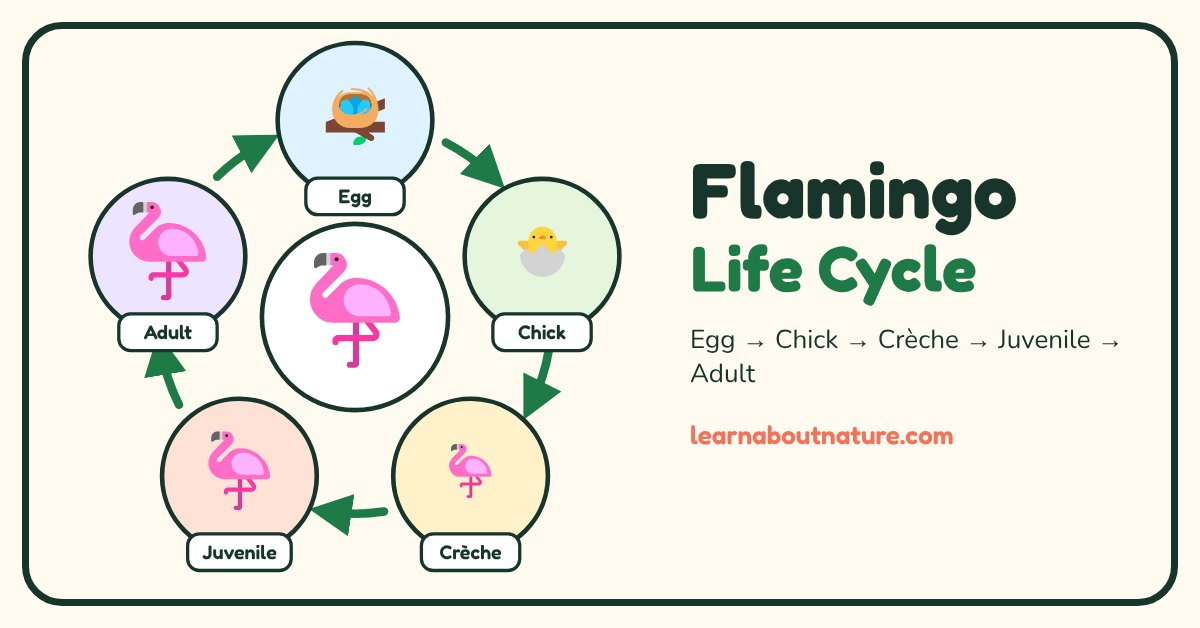
Quick answer: A flamingo’s life cycle has five stages: egg, chick, crèche, juvenile and adult. Parents lay one egg on a mud mound and take turns keeping it warm for about a month. The gray chick drinks crop milk, joins a crèche, flies at 9 to 13 weeks, and turns pink as an adult at 3 to 5 years.
Flamingos are wading birds known for their long legs, bent bills and bright pink feathers. There are six species, living in warm, shallow lakes, lagoons and salt flats in the Americas, Africa, Europe and Asia.
Here is a surprise: flamingos are not born pink. Their chicks are fluffy and gray, and it takes years of eating the right food for them to turn pink. This page follows the American flamingo of the Caribbean, with notes on its close relative, the greater flamingo. Both have very similar life cycles.
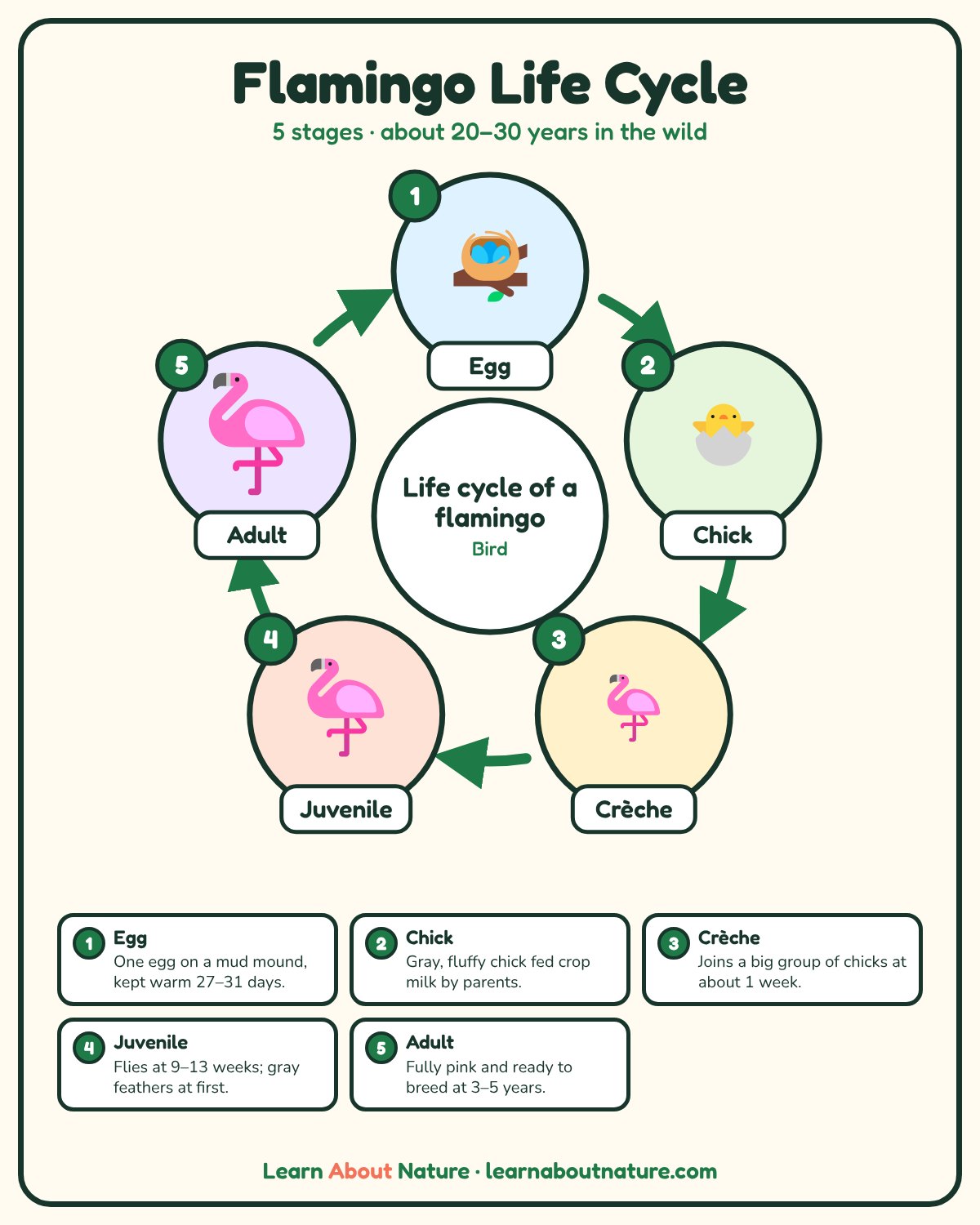
Teachers and students: you’re welcome to use this diagram in lessons and projects with credit to Learn About Nature.
Free printable: Download the Flamingo life cycle worksheet (PDF) – label the diagram, cut and sequence the stages, and match key words. Answer key included.
Flamingo Life Cycle Quick Facts
| Main example | American flamingo (Phoenicopterus ruber) |
| Eggs per clutch | usually 1 |
| Incubation | about 27–31 days, by both parents |
| Weight at hatching | about 3 oz (70–90 g) |
| Leaves nest | about 5–12 days old |
| First flight | about 9–13 weeks |
| Full pink color | about 3–5 years |
| Breeding age | about 3–6 years |
| Lifespan | about 20–30 years in the wild |
Courtship and Breeding
Flamingos live and breed in large groups called colonies, sometimes with thousands of birds. Before nesting, they perform group displays together, marching, flagging their heads from side to side and stretching their wings. These shows help many pairs get ready to breed at the same time.
Breeding often depends on rainfall and water levels rather than a fixed calendar, so a colony may skip a year when conditions are poor. Pairs usually stay together for several breeding seasons, and only birds with full adult color take part.
Within the crowd, the female chooses her mate. The male follows her closely through the shallow water, and once they pair up, the two leave the group to mate. Most flamingo colonies need many birds before they will nest at all, ideally hundreds or thousands.
Stage 1: Egg
Both parents build the nest. They scoop mud with their bills and pat it into shape with their feet, making a cone-shaped mound about 12 inches (30 cm) tall with a hollow on top. The raised nest keeps the egg above rising water and away from the hot ground.
Many pairs dig a small moat around the base of the mound. Flamingos often reuse old nests from earlier seasons, and on rocky islands without mud, they may build with stones instead. Twigs, roots and feathers are sometimes added when they are easy to find.
The female lays one egg, which is chalky white and quite large. Two eggs in one nest are rare. Both parents take turns sitting on the egg, called incubation, for about 27 to 31 days. While one sits, the other goes off to feed.
Flamingo nests are packed close together in the colony. Living in a crowd gives some protection from predators, because there are many eyes watching for danger.
Stage 2: Chick
A newly hatched flamingo chick is about the size of a tennis ball and weighs about 3 ounces (70 to 90 g). It is covered in soft white or gray down. Its bill is straight, not bent, and its legs are pink and puffy at first, turning dark within about a week.
For its first several days, the chick stays on the nest mound. Its parents feed it a special food called crop milk, which they make in their upper digestive tract and dribble into the chick’s mouth. Both the mother and the father make crop milk. It is rich in fat and protein and is colored red by pigments from the parents’ diet.
Making crop milk takes a lot out of the parents. As they pass their color to the chick, the parents’ feathers fade to pale pink or almost white. They regain their color once the chick can feed itself.
Stage 3: Crèche
At about 5 to 12 days old, chicks can walk and swim well. They leave the nest and join a crèche, a large group of chicks that can include hundreds or even thousands of young birds. A few adults stay with the crèche to watch over it while the other parents fly off to feed.
Even in such a crowd, parents find their own chick. They recognize its calls, sometimes from far away, and mainly feed their own young. The chicks keep drinking crop milk for about the first two months.
After about two weeks, the chick’s bill begins to bend into the adult shape and develop the comb-like edges flamingos use to filter food. At about 4 weeks, the down turns darker gray. Chicks start feeding themselves at roughly 4 to 6 weeks old, though their parents keep feeding them too.
Stage 4: Juvenile
Young flamingos fledge, or become able to fly, at about 9 to 13 weeks old. They are still mostly gray, white and brown, with a pinkish-gray bill and grayish legs.
The first year is risky. In American flamingos, about 30 percent of young birds die before their first birthday. Survivors join the adults in feeding flocks and travel with them between lakes and lagoons.
Juveniles must also master the flamingo’s unusual way of eating. Standing in shallow water, they tip their heads upside down, sweep their bills from side to side and use their tongues to pump water in and out. Practice makes them better at it, and their diet of colorful algae and tiny animals slowly begins to tint their feathers.
Over the next two to three years, the young birds slowly gain color. The pink often appears first at the base of the neck and then spreads. The wings are usually the last part to become fully colored.
Why Are Flamingos Pink?
Flamingos get their color from their food. They feed by holding their heads upside down in shallow water and pumping water through their bills, which strain out tiny algae, shrimp-like animals and other small creatures.
Many of these foods contain natural pigments called carotenoids, the same kind of pigment that makes carrots orange. As a flamingo digests its food, these pigments are deposited in its growing feathers, skin and bill. The more carotenoids a flamingo eats, the brighter its color. American flamingos are deep red-orange, while greater flamingos are paler pink.
Stage 5: Adult
Flamingos usually reach adulthood at about 3 to 5 years, when they have their full color. Some take up to six years before they start breeding. Adult American flamingos have pale yellow eyes and a bill that is yellowish at the base, red-orange in the middle and black at the tip.
Once an adult finds a mate and the colony is ready to breed, the pair builds a mud mound, lays a single egg, and the life cycle begins again. A flamingo can raise many chicks over its long life.
How Long Do Flamingos Live?
Flamingos are long-lived birds. In the wild, they often live about 20 to 30 years, and in zoos many live even longer. One flamingo at Adelaide Zoo in Australia lived to be more than 75 years old.
Flamingos depend on shallow wetlands, which can be harmed by drought, water pollution, mining and development. People walking or driving near colonies can also cause flamingos to abandon their nests. The American and greater flamingos are widespread, but some of their relatives, especially those of the high Andes and Africa’s soda lakes, are of more concern because they rely on just a few breeding sites.
Interesting Flamingo Facts
- Flamingo chicks are born gray, not pink.
- Both flamingo parents, male and female, make crop milk for their chick.
- A baby flamingo’s bill is straight and only starts to bend after about two weeks.
- Flamingos eat with their heads upside down.
- A crèche of flamingo chicks can include thousands of young birds.
Flamingo Life Cycle for Kids
Here is the flamingo life cycle in simple steps:
- Egg: Mom and dad take turns keeping one egg warm on a mud nest.
- Chick: The fluffy gray chick drinks red crop milk from its parents.
- Crèche: The chick joins a big group of baby flamingos.
- Juvenile: The young flamingo learns to fly, but it is still gray.
- Adult: The grown-up flamingo turns pink from the food it eats.
Key words: crop milk – a rich liquid food that some bird parents make in their throats for their chicks; crèche – a big group of young birds looked after together; down – soft, fluffy feathers on a baby bird; incubate – to keep an egg warm so the baby inside can grow; fledge – when a young bird grows flight feathers and learns to fly; carotenoids – natural colors in some foods that can turn feathers pink or orange.
Try this: Soak white paper towels in water with different amounts of beet juice or red food coloring to show how more pigment in a flamingo’s food makes deeper pink feathers.
Related Life Cycles and Guides
- Swan life cycle
- Ostrich life cycle
- Bird life cycle
- Chicken life cycle
- Owl life cycle
- Bird anatomy
- All animal & plant life cycles
Flamingo Life Cycle FAQs
Why are baby flamingos gray?
Flamingo chicks hatch with gray or white down because they have not yet eaten the foods that color adult feathers. Flamingos get their pink from natural pigments called carotenoids in algae and small animals. It takes about two to three years of eating these foods before a young flamingo turns fully pink.
How many eggs does a flamingo lay?
A flamingo usually lays just one egg each breeding season, on top of a cone-shaped mud mound built by both parents. Two eggs in one nest are rare. The mother and father take turns keeping the egg warm for about 27 to 31 days.
What do baby flamingos eat?
Baby flamingos drink crop milk, a red, fat-rich liquid that both parents make in their upper digestive tract and drip into the chick’s mouth. Chicks begin filter-feeding for themselves at around 4 to 6 weeks old, but their parents keep feeding them until they can fly.
What is a group of baby flamingos called?
A group of flamingo chicks is called a crèche. Chicks leave their nests at about 5 to 12 days old and gather in crèches that can hold hundreds or thousands of young birds, watched over by a few adults while the parents feed.
How long do flamingos live?
Flamingos often live about 20 to 30 years in the wild, and many live longer in zoos. One flamingo at Adelaide Zoo in Australia lived for more than 75 years. They grow slowly and usually do not start breeding until they are 3 to 6 years old.
Sources: American flamingo fact sheet: Reproduction & Development – San Diego Zoo Wildlife Alliance Library; Flamingo – San Diego Zoo Wildlife Alliance Animals and Plants; Phoenicopterus ruber (American flamingo) – Animal Diversity Web

Nato is a content writer and researcher with a background in psychology who’s eager to explore the wonders of nature. As a travel enthusiast and animal lover, she hopes to inspire others to discover and cherish the beauty and importance of the natural world. She also writes about the history of candy and snacks for Snack History and about food and healthy eating for The Fitchen.