Whale Life Cycle: Stages From Calf to Adult
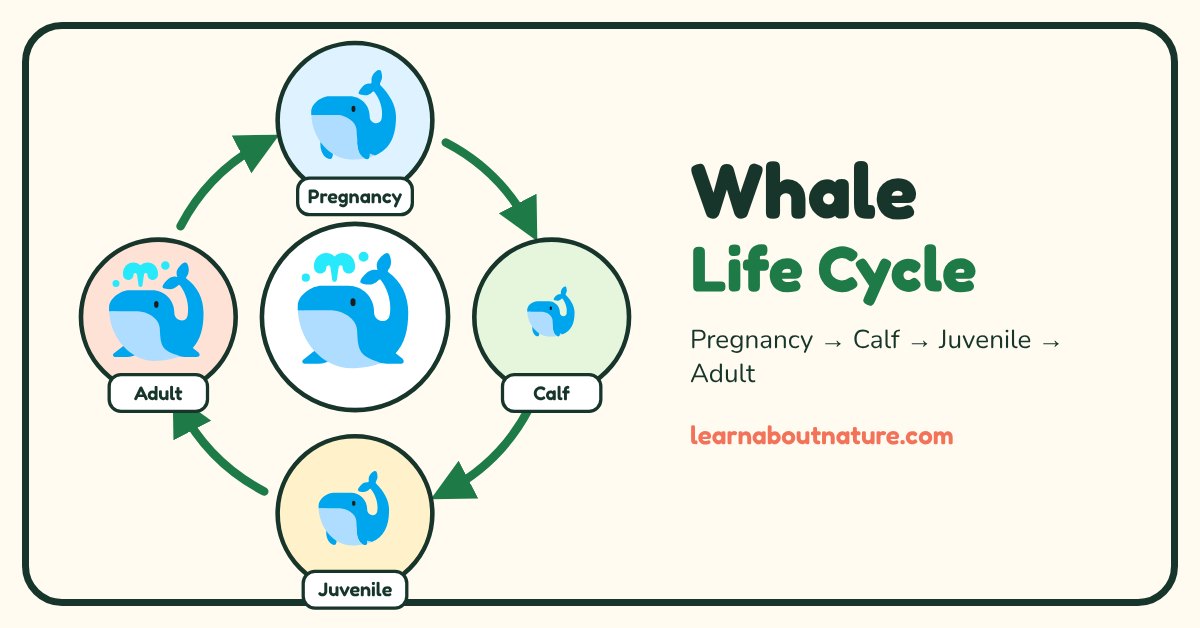
Quick answer: A whale’s life cycle has four stages: pregnancy, calf, juvenile and adult. In humpback whales, the mother is pregnant for about 11 months and gives birth to one calf in warm tropical water. The calf nurses for up to a year, grows into a juvenile, and becomes a breeding adult at about 4 to 10 years old.
Whales are mammals, just like us. They breathe air, give birth to live young, and feed their babies milk. Their whole life cycle happens in the ocean, from the moment a calf is born to the day an old whale dies.
On this page we follow the humpback whale, a baleen whale famous for its songs and long migrations. Along the way you will see how the life of a toothed whale, such as a dolphin or sperm whale, can be a little different.
Teachers and students: you’re welcome to use this diagram in lessons and projects with credit to Learn About Nature.
Free printable: Download the Whale life cycle worksheet (PDF) – label the diagram, cut and sequence the stages, and match key words. Answer key included.
Whale Life Cycle Quick Facts
| Example species | Humpback whale (Megaptera novaeangliae) |
| Pregnancy | about 11 months |
| Babies per birth | 1 calf |
| Calf length at birth | about 13–16 ft (4–5 m) |
| Weaning | about 6–12 months |
| Breeding age | about 4–10 years |
| Adult size | up to about 60 ft (18 m), about 40 tons |
| Migration | up to about 5,000 miles each way |
| Lifespan | about 80–90 years |
Stage 1: Pregnancy
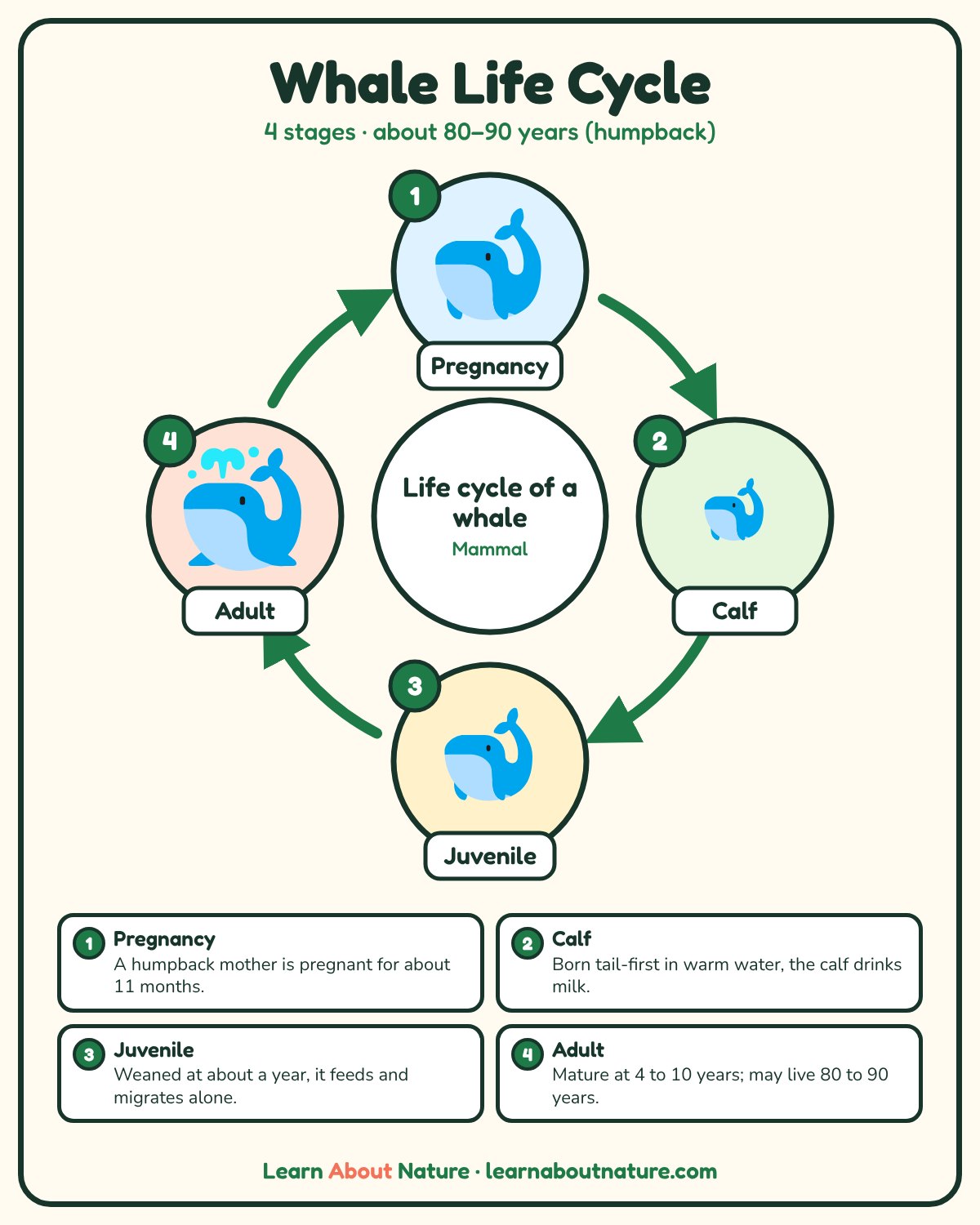
A humpback whale’s life begins inside its mother. Humpbacks mate in warm tropical waters during the winter breeding season. After mating, the female is pregnant for about 11 months.
During that time, the mother swims all the way to cold feeding grounds near the poles and back again. She eats huge amounts of krill and small fish in summer, building up blubber that will help her feed her baby later.
A female usually has one calf every 2 to 3 years. A few females have been seen calving in back-to-back years, but that is unusual because raising a calf takes so much energy.
Inside the mother, the baby grows quickly in the last months of pregnancy. By the time she reaches the warm breeding grounds again, the calf is ready to be born. The timing means calves arrive in the season when the water near the tropics is warm and calm.
Stage 2: Calf
The calf is born in warm, shallow tropical water, often near islands where there are fewer predators. A newborn humpback is about 13 to 16 feet (4 to 5 m) long and can weigh up to about 1.5 tons. That sounds huge, but it is tiny next to its mother.
Like all whales, the calf is usually born tail-first, so it does not try to breathe before it reaches the surface. The mother helps it up for its first breath of air.
Calves drink their mother’s milk, which is very rich and roughly half fat. With so much energy, a young calf can gain up to about 100 pounds (45 kg) a day. A newborn has only a thin layer of blubber, which is one reason humpbacks give birth in warm water.
For the first weeks, the mother stays mostly in the calm breeding grounds while her calf grows stronger. She eats little or nothing during this time, so all the milk she makes comes from the fat she stored the summer before. By the time they head north, she may have lost a lot of weight.
- The calf swims close beside its mother, often just above or below her.
- It practices breaching, tail slapping and flipper slapping, which build strength.
- When the calf is a few months old, it migrates with its mother to the cold feeding grounds.
Stage 3: Juvenile
A humpback calf stays near its mother for up to about one year. Somewhere between 6 and 12 months old, it is weaned. That means it stops drinking milk and starts catching its own krill and small fish.
Humpbacks are baleen whales. Instead of teeth, they have rows of baleen plates that act like a giant sieve. A young whale gulps a mouthful of seawater and prey, then pushes the water out through the baleen and swallows the food left behind.
Juveniles make the long migration on their own or with other whales. They keep growing for years and learn skills such as bubble-net feeding, where whales blow rings of bubbles to trap fish before lunging up through the middle.
Young humpbacks are still small compared with adults, so they are more at risk from predators such as orcas. Many humpbacks carry rake-like scars on their tails from orca attacks, and scientists think most of these attacks happen when the whales are young.
Stage 4: Adult
Humpbacks become sexually mature, or able to breed, at about 4 to 10 years old. An adult can grow up to about 60 feet (18 m) long and weigh around 40 tons. Females are usually a little bigger than males.
Adult humpbacks are known for their very long flippers, which can be up to about one-third of their body length. Their scientific name, Megaptera, means “big wing.” They use these flippers to steer, turn tightly while hunting, and slap the water’s surface.
Adults spend summer eating in cold, food-rich waters and winter breeding in the tropics. While they are on their breeding grounds, they eat very little and live off their fat stores. When the adults mate and a new calf is born, the life cycle starts again.
Migration, Mating and Whale Songs
Humpback whales make some of the longest migrations of any mammal. Some populations travel about 5,000 miles each way between polar feeding grounds and tropical breeding grounds. One group of North Pacific humpbacks swims about 3,000 miles from Alaska to Hawaii in as few as 28 days.
In the breeding grounds, males sing long, complex songs. Only males sing, and a single song can last 10 to 30 minutes before it is repeated, sometimes for hours. Males in the same population sing nearly the same song, and the song slowly changes over the months.
Scientists are still studying exactly why males sing. Most think the songs are linked to mating, perhaps to attract females or to compete with other males. Males also chase and push each other in noisy groups around a female.
Baleen Whales vs. Toothed Whales
There are two main groups of whales, and their life cycles follow the same basic pattern of pregnancy, calf, juvenile and adult. The differences are mostly in how they feed and how long the young stay with their mothers.
Baleen whales, such as humpbacks, blue whales and gray whales, filter small prey through baleen. Many of them make long seasonal migrations, and calves usually leave their mothers within about a year.
Toothed whales, such as dolphins, orcas and sperm whales, have teeth and use echolocation to find prey. Many live in close family groups, and their calves often stay with their mothers for several years. Some orca families in the Pacific Northwest stay together with their mothers for life.
- Baleen whales have two blowholes; toothed whales have one.
- Baleen whales filter food; toothed whales catch fish and squid one at a time.
- Toothed whale calves tend to depend on their mothers for longer.
How Long Do Whales Live?
Humpback whales can live for about 80 to 90 years, according to NOAA Fisheries. Scientists estimate the age of whales by studying layers in their earwax plugs and by following individual whales for decades using photos of their unique tail patterns.
Each humpback has black and white markings on the underside of its tail that are as unique as a fingerprint. Researchers use these photos to identify the same whale year after year, which helps them learn how often females have calves and how long whales survive.
Threats and Conservation
Commercial whaling cut most humpback populations by more than 95 percent. A worldwide pause on commercial whaling took effect in 1985, and since then many humpback populations have grown again. In the United States, 9 of the 14 humpback population groups have recovered enough to be removed from the endangered species list.
Humpbacks still face dangers. They can get tangled in fishing gear, be hit by ships, and be disturbed by underwater noise. Climate change can also affect the krill and fish they depend on. Protecting feeding and calving areas helps more calves survive to adulthood.
Whale Life Cycle for Kids
Here is the whale life cycle in simple steps:
- Pregnancy: The mother whale carries her baby inside her for almost a whole year.
- Calf: The baby whale is born in warm water and drinks lots of rich milk.
- Juvenile: The young whale stops drinking milk and learns to catch its own food.
- Adult: The grown-up whale swims to warm seas to find a mate and have babies.
Key words: calf – a baby whale; baleen – stiff, bristly plates in a whale’s mouth that strain food from water; migration – a long trip animals make each year between places; weaning – when a baby stops drinking milk and starts eating other food; blubber – a thick layer of fat that keeps whales warm and stores energy; echolocation – finding things by making sounds and listening for echoes.
Try this: Use a world map and string to trace a humpback migration from Alaska to Hawaii, then measure how far the whale travels and compare it with a trip you have taken.
Related Life Cycles and Guides
- Dolphin life cycle
- Octopus life cycle
- Coral life cycle
- Shark life cycle
- Fish life cycle
- Jellyfish life cycle
- All animal & plant life cycles
See also: Orca Facts for Kids · Blue Whale Facts for Kids
Whale Life Cycle FAQs
How long is a whale pregnant?
It depends on the species. A humpback whale is pregnant for about 11 months, and many large baleen whales have pregnancies of around a year. Some toothed whales are pregnant for longer: an orca (killer whale) pregnancy lasts about 15 to 18 months.
How are baby whales born?
Whale calves are born underwater, usually tail-first. This helps the calf avoid breathing in water before it is fully out. As soon as it is born, the mother helps the calf swim to the surface to take its first breath through its blowhole.
Do whales drink milk?
Yes. Whales are mammals, so mothers feed their calves milk. Humpback milk is very rich in fat, which helps calves grow fast and build blubber. A young humpback calf can gain up to about 100 pounds (45 kg) in a single day.
Why do humpback whales migrate?
Humpbacks feed in cold polar waters in summer, where krill and small fish are plentiful. In winter they travel to warm tropical waters to mate and give birth. Warm water is safer for newborn calves, which have only a thin layer of blubber.
How long do whales live?
Lifespans vary by species. Humpback whales can live about 80 to 90 years. Bowhead whales may live more than 200 years, making them among the longest-lived animals on Earth. Scientists estimate whale ages using earwax layers and long-term photo records of known individuals.
Sources: Humpback Whale – NOAA Fisheries; Humpback Whale Life Cycle and Role in Ocean Health – Oceanic Society; How long do bowhead whales live? – NOAA Ocean Service; Killer Whale Fact Sheet – PBS Nature

Nato is a content writer and researcher with a background in psychology who’s eager to explore the wonders of nature. As a travel enthusiast and animal lover, she hopes to inspire others to discover and cherish the beauty and importance of the natural world. She also writes about the history of candy and snacks for Snack History and about food and healthy eating for The Fitchen.