Coral Life Cycle: From Spawning to Polyp to Reef Colony
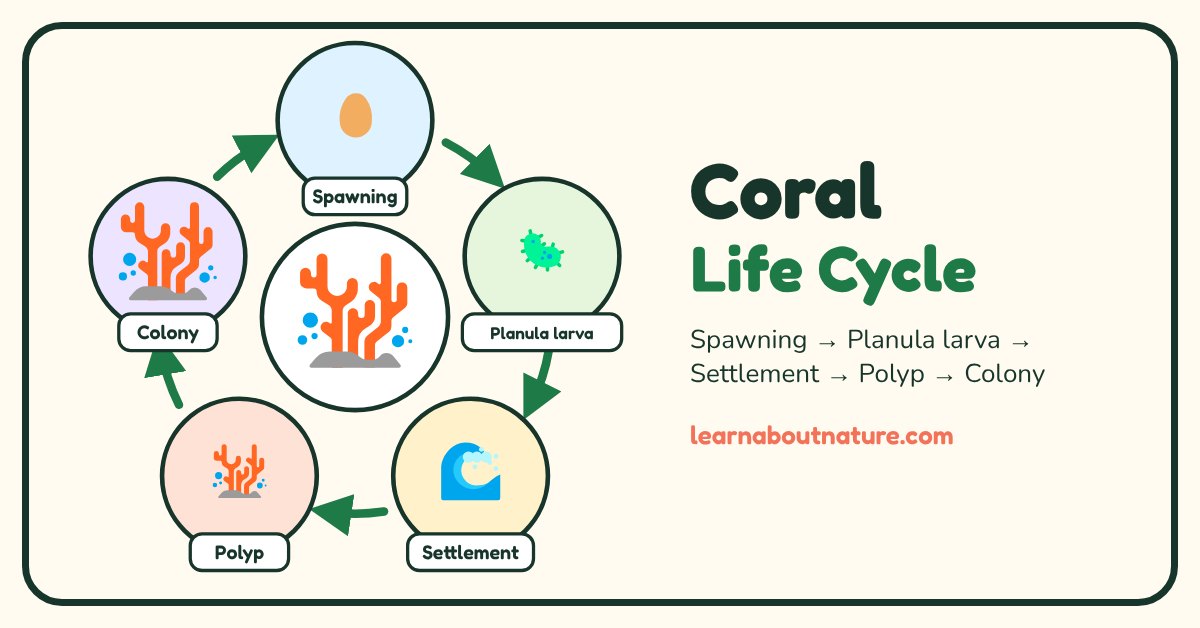
Quick answer: A coral’s life cycle has five main stages: spawning, planula larva, settlement, polyp and colony. Adult corals release eggs and sperm that join to form tiny swimming planula larvae. A larva settles on a hard surface, changes into a single polyp, and then copies itself again and again by budding to grow a coral colony.
Coral might look like colorful rock or a plant, but it is an animal. A coral reef is built by millions of tiny animals called polyps, each with a soft, tube-shaped body and a ring of stinging tentacles. Corals belong to the same animal group as jellyfish and sea anemones, called cnidarians.
This page explains the life cycle of reef-building stony corals, the kind that form tropical reefs such as the Great Barrier Reef. Their story mixes two ways of making new corals: a spectacular spawning event and a quiet, steady copying process called budding.
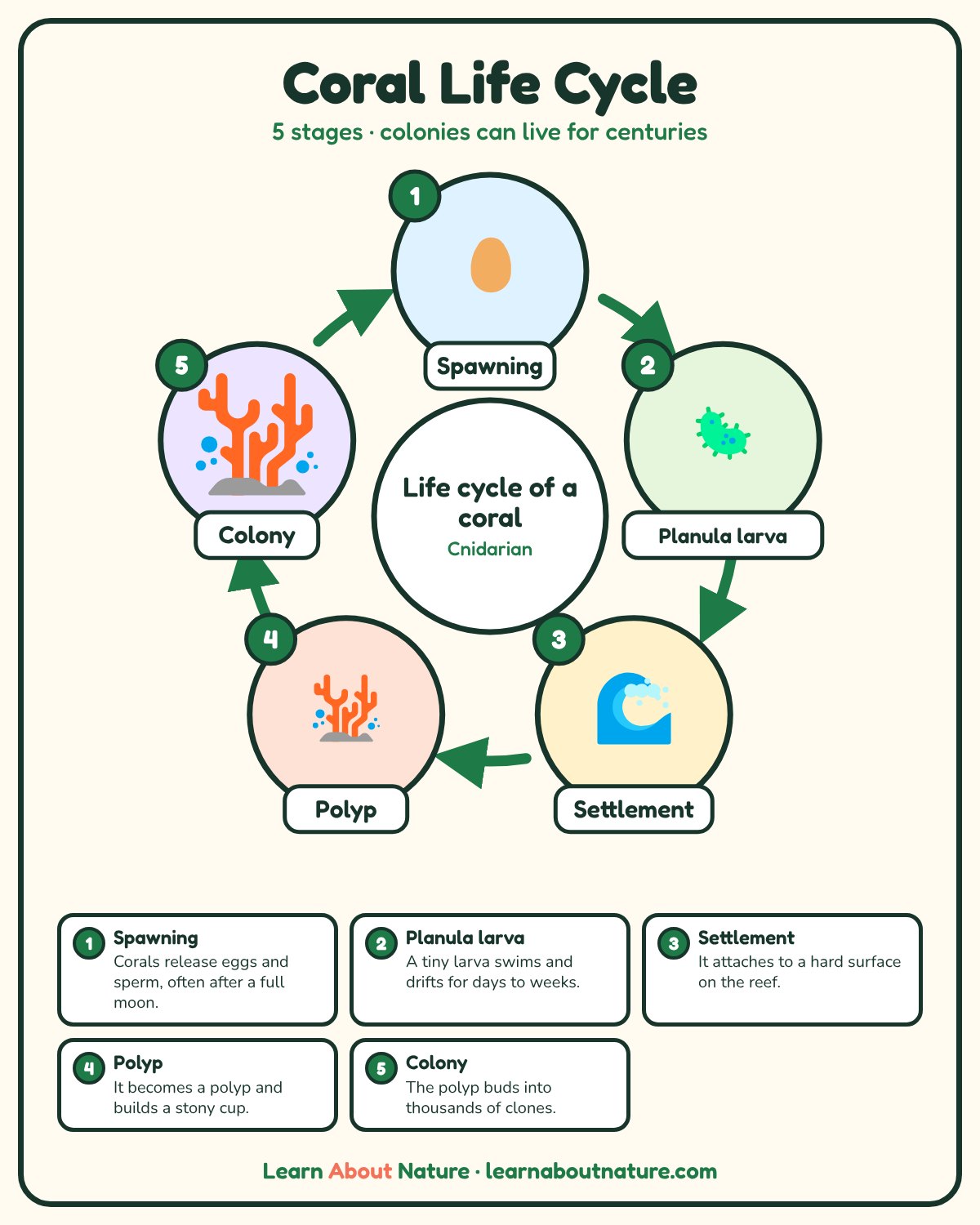
Teachers and students: you’re welcome to use this diagram in lessons and projects with credit to Learn About Nature.
Free printable: Download the Coral life cycle worksheet (PDF) – label the diagram, cut and sequence the stages, and match key words. Answer key included.
Coral Life Cycle Quick Facts
| Animal group | Cnidarian (related to jellyfish and sea anemones) |
| Ways to reproduce | spawning (eggs and sperm) and budding (cloning) |
| Spawning time (Great Barrier Reef) | 1–6 nights after full moons, Oct–Dec |
| Larva name | planula |
| Time as a larva | usually about 2 days; some up to 3 weeks or more |
| Growth (massive corals) | about 0.3–2 cm a year |
| Growth (branching corals) | up to about 10 cm a year |
| Food partner | zooxanthellae algae living in coral tissue |
Stage 1: Spawning
Most reef-building corals start new life through spawning, when they release eggs and sperm into the sea. About three-quarters of stony coral species produce eggs and sperm this way. Many corals are hermaphrodites, which means one colony makes both eggs and sperm, often packed together in small floating bundles.
On many reefs, lots of coral species spawn on the same few nights each year. This is called mass spawning. On the Great Barrier Reef, it usually happens one to six nights after the full moons in October, November or December, at night. Water temperature, day length and the cycle of the moon all help corals time it.
When spawning starts, pink, orange and yellow bundles float up from the colonies like an upside-down snowstorm. At the surface the bundles break apart, and eggs from one colony can meet sperm from another. Eggs and sperm only stay usable for a few hours, so the perfect timing matters.
Spawners and Brooders
Not all corals reproduce in the same way. Scientists sort them into two main groups.
Broadcast spawners release eggs and sperm into the water, and fertilization happens out in the open sea. Most reef-building corals are broadcast spawners. Their young may travel far from the parent reef.
Brooders keep their eggs inside the polyp. Sperm released by nearby colonies is taken in, and the eggs are fertilized and grow inside the parent. The larvae are released when they are already well developed. They spend less time drifting and usually settle close to home.
Stage 2: Planula Larva
A fertilized coral egg develops into a planula (plural: planulae). A planula is a tiny, oval larva covered in tiny hairs called cilia, which it beats to swim. It is far too small to see clearly without a magnifier.
Planulae at first swim up toward the light and drift with the currents near the surface. Later they swim back down toward the seafloor, searching for a place to live. Most coral species settle within about two days, but some planulae swim for up to three weeks, and a few have been known to drift for around two months.
This is the most dangerous stage of a coral’s life. Fish and other plankton eaters swallow huge numbers of larvae, and many others drift away from any reef. That is why corals release so many eggs at once: only a very small share will ever grow into a colony.
Stage 3: Settlement
When a planula finds the right spot, it settles. It needs a hard, clean surface, such as bare rock or dead coral skeleton. Some larvae seem to be guided by chemical signals from certain pink algae that grow as a crust on reef rocks.
Once it attaches, the larva changes shape. This change is called metamorphosis. It flattens out, grows a mouth surrounded by tentacles, and becomes the very first polyp of a new coral.
Choosing a good home matters, because once a coral settles it can never move again. A larva that lands in too much shade, mud or crashing surf may not survive, so planulae test surfaces before they commit.
Stage 4: Polyp
The new polyp is smaller than a grain of rice. It starts building a hard cup around its base using calcium carbonate, the same mineral found in limestone and seashells. This stony skeleton protects the polyp’s soft body and anchors it to the reef.
Reef corals have a partner living inside them: microscopic algae called zooxanthellae. The algae use sunlight to make food, and they share most of it with the coral. In return, the coral gives the algae a safe home. The algae also give many corals their colors.
At night, polyps stretch out their tentacles to catch tiny drifting animals. Each tentacle is armed with stinging cells that stun prey before the polyp pulls it into its mouth.
Stage 5: Colony
A single polyp does not stay alone for long. It makes copies of itself by budding: a new polyp grows from the side or top of the parent, or the parent splits in two. The new polyps are clones, which means they share exactly the same genes. Budding continues for the whole life of the colony.
Over time, one polyp becomes hundreds, then thousands. They stay connected by a thin sheet of living tissue on top of the shared skeleton. As each generation of polyps builds new skeleton on top of the old, the colony slowly grows into a branch, plate, fan or boulder.
Colonies can also spread when storms break off pieces. If a broken branch lands in a good spot, it can keep growing as a new colony. When a colony is big and healthy enough, it joins in the next spawning event, and the life cycle begins again.
How Fast Do Corals Grow?
Corals grow slowly. Massive boulder corals usually add about 0.3 to 2 cm (0.1 to 0.8 in) a year, while branching corals can grow up to about 10 cm (4 in) a year. A brand-new colony often grows only about 1 cm a year.
Because growth is so slow, reefs take a very long time to form. A reef can take up to about 10,000 years to build, and large barrier reefs and atolls can take from 100,000 to 30 million years. Some individual coral colonies are hundreds of years old.
Why Coral Reefs Matter
Only hard, stony corals build reefs, but those reefs become homes for an enormous variety of fish, crabs, shrimp, sea turtles, sponges and other ocean life. Soft corals, which do not build stony skeletons, often live on reefs too and add to their shape and color.
Reefs also matter to people. They break up waves before they reach the shore, which helps protect beaches and coastal towns during storms. Many communities rely on reef fish for food and on visitors who come to snorkel and dive.
Because each new colony starts from a single settled larva, the health of a reef depends on its life cycle working well. Scientists in places like Australia and Florida now collect spawn, raise baby corals in tanks and plant them back onto damaged reefs to help them recover.
Coral Bleaching and Threats
When corals are stressed, especially by water that stays too warm, they push out their zooxanthellae. Without the algae, the coral tissue turns see-through and the white skeleton shows. This is called coral bleaching.
A bleached coral is not dead yet, but it is starving and weak. If conditions return to normal quickly, the algae can move back in and the coral may recover. If the stress lasts too long, the coral can die. Rising ocean temperatures are the leading cause of bleaching, and pollution, runoff and very low tides can also stress corals.
Bleaching also affects the life cycle. Stressed corals may produce fewer eggs or skip spawning, so fewer new corals settle on the reef.
Coral Life Cycle for Kids
Here is the coral life cycle in simple steps:
- Spawning: On special nights, corals let out tiny eggs that float up like snow.
- Planula larva: A baby coral swims around in the sea looking for a home.
- Settlement: The baby coral sticks itself onto a hard rock.
- Polyp: It turns into a tiny tube-shaped animal and builds a stony cup.
- Colony: The polyp makes copies of itself until it becomes a big coral.
Key words: polyp – a small, soft coral animal with a mouth and tentacles; spawning – releasing eggs and sperm into the water; planula – a tiny swimming coral larva; budding – when a new polyp grows from a parent polyp as an exact copy; zooxanthellae – tiny algae that live inside corals and make food from sunlight; bleaching – when stressed corals lose their algae and turn white.
Try this: Make a coral colony from paper cups: start with one cup as the first polyp, then add one new cup beside each existing cup every round and count how fast the colony grows.
Related Life Cycles and Guides
- Dolphin life cycle
- Octopus life cycle
- Whale life cycle
- Shark life cycle
- Fish life cycle
- Jellyfish life cycle
- All animal & plant life cycles
Coral Life Cycle FAQs
Is coral a plant or an animal?
Coral is an animal. Each coral is made of tiny animals called polyps, which have mouths and stinging tentacles. Corals do partner with tiny algae that live inside them and make food from sunlight, which is one reason corals are often mistaken for plants.
How do corals reproduce?
Corals reproduce in two ways. They make new colonies by spawning, when eggs and sperm meet and form swimming larvae. They also grow by budding, when a polyp makes exact copies of itself. Broken pieces of coral can sometimes regrow into new colonies too.
When do corals spawn?
Many reef corals spawn once a year on just a few nights. On the Great Barrier Reef, mass spawning usually happens one to six nights after the full moons in October, November or December. Water temperature, day length and the moon help corals time it.
What is a baby coral called?
A baby coral is called a planula larva. It is a tiny swimming larva covered in hairs called cilia. After drifting for days or weeks, it settles on a hard surface and changes into the first polyp of a new coral colony.
Can bleached coral recover?
Sometimes. A bleached coral has lost the algae that feed it, but it is still alive. If the water cools and conditions improve fairly quickly, the algae can return and the coral may recover. If the stress goes on too long, the coral can die.
Sources: Corals Tutorial: Coral Reproduction – NOAA Ocean Service; How do corals reproduce? (Coral spawning) – NOAA Ocean Service; Corals Tutorial: Coral Reefs – NOAA Ocean Service; Coral Spawning 101 – Great Barrier Reef Marine Park Authority; What is coral bleaching? – NOAA Ocean Service

Nato is a content writer and researcher with a background in psychology who’s eager to explore the wonders of nature. As a travel enthusiast and animal lover, she hopes to inspire others to discover and cherish the beauty and importance of the natural world. She also writes about the history of candy and snacks for Snack History and about food and healthy eating for The Fitchen.