Duck Life Cycle: Stages From Egg to Duckling to Adult
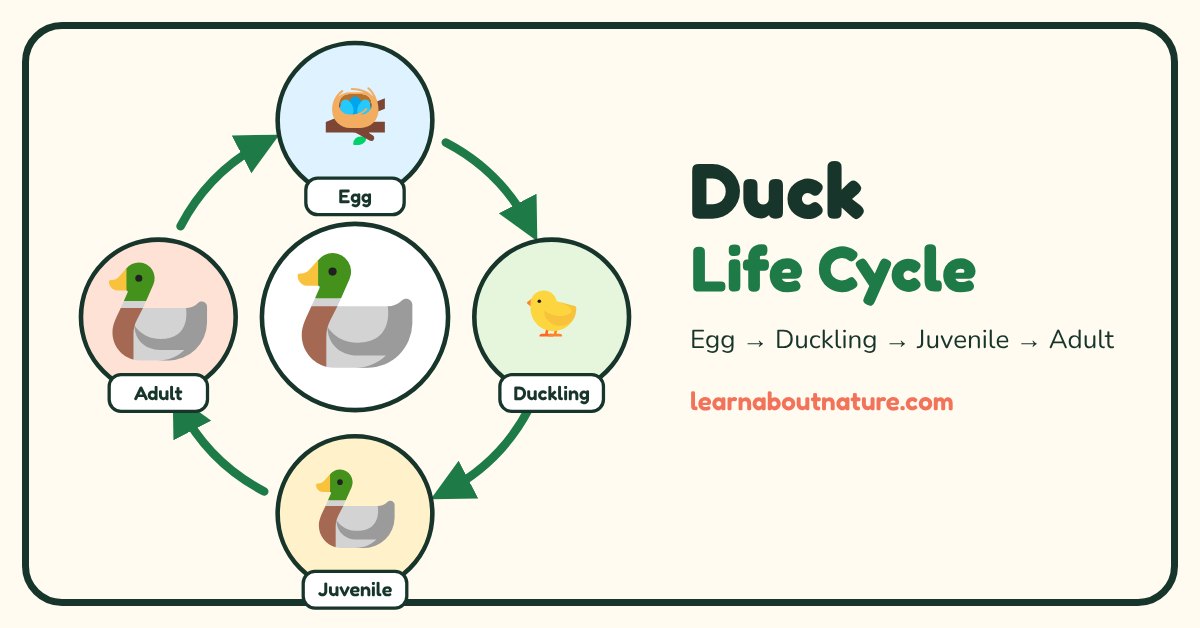
Quick answer: The duck life cycle has four stages: egg, duckling, juvenile and adult. A female mallard lays about 8 to 13 eggs and keeps them warm for about four weeks. The fluffy ducklings walk to water within a day of hatching, learn to fly at about 7 to 8 weeks, and breed when they are about one year old.
A mallard duckling can walk, swim and find its own food within a day of hatching. That is a huge head start compared with many baby birds, which stay in the nest, helpless, for weeks.
This page follows the duck life cycle of the mallard, the familiar duck of ponds, lakes and parks across North America, Europe and Asia. The male mallard, or drake, has a shiny green head. The female, or hen, is mottled brown. Many other ducks follow a similar pattern, though clutch sizes and timing vary.
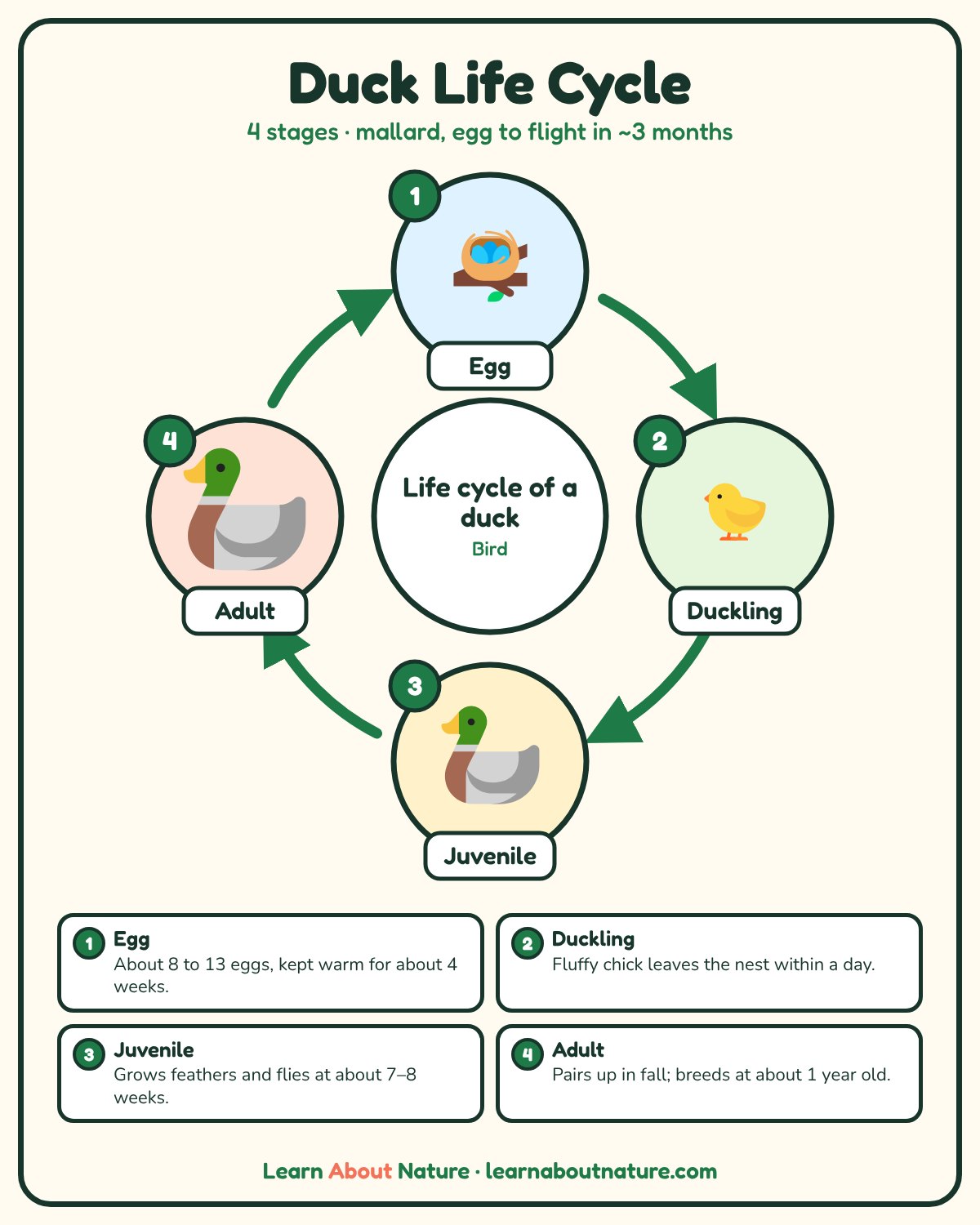
Teachers and students: you’re welcome to use this diagram in lessons and projects with credit to Learn About Nature.
Free printable: Download the Duck life cycle worksheet (PDF) – label the diagram, cut and sequence the stages, and match key words. Answer key included.
Duck Life Cycle Quick Facts
| Main example | Mallard (Anas platyrhynchos) |
| Eggs per clutch | usually about 8–13 |
| Egg laying | one egg a day |
| Incubation | about 23–30 days, by the hen only |
| Leaves nest | within about 12–24 hours of hatching |
| First flight | about 7–8 weeks old |
| First breeding | about 1 year old |
| Adult weight | about 2.5–2.75 lb (1.1–1.2 kg) |
| Lifespan | most under 2 years; record over 25 years |
Pairing Up and Building a Nest
Mallards choose their mates early. Pairs start forming as early as October and November, months before nesting begins. Drakes show off to hens by whistling, shaking their heads and splashing water. A pair usually stays together for about 6 to 8 months, through the winter and into spring.
In spring, the hen picks a nest site, usually on the ground and close to water, often hidden under tall grass, reeds or bushes. She scrapes a shallow bowl in the ground and pulls nearby plants around it. Mallards sometimes nest in surprising places, such as flower beds, planters and even on balconies.
The finished nest is about a foot across. Once she starts incubating, the hen plucks soft down feathers from her breast and adds them to the nest. The down keeps the eggs warm when she leaves to feed.
Stage 1: The Egg
A hen mallard lays one egg a day until her clutch is complete. A clutch usually has about 8 to 13 eggs, though it can be smaller or larger. The eggs are smooth and unmarked, creamy to greenish or grayish buff, and about 2 to 2.5 inches (5 to 6 cm) long.
The hen does not start sitting on the eggs until the last one is laid. This clever timing means all the eggs develop together and the ducklings hatch at about the same time.
Only the hen incubates the eggs, for about 23 to 30 days. She leaves the nest only for short breaks to feed. The drake usually leaves her around this time and joins other males.
If a predator such as a fox, raccoon or crow destroys the nest, the hen may try again and lay a smaller second clutch.
Stage 2: The Duckling
To hatch, a duckling uses a tiny hard tip on its bill, called an egg tooth, to break through the shell. Hatching can take many hours. Newborn ducklings are wet at first, but they dry quickly into fluffy yellow-and-brown balls of down.
Mallard ducklings are precocial, which means they are born with their eyes open, covered in down and able to move about. Within about 12 to 24 hours after hatching, the hen leads her whole brood out of the nest to water. She does not come back to the nest.
Ducklings find their own food from the start, snapping up insects, snails and seeds. Their mother does not feed them, but she protects them, leads them to good feeding spots and keeps them warm under her body on cold nights.
A newly hatched mallard brood moves together as a tight group, often in a line behind the hen. At first, ducklings get cold quickly, especially in rain, so they stop often to warm up under their mother.
Imprinting: Following Mom
Soon after hatching, ducklings learn to recognize their mother and follow her everywhere. This quick, early learning is called imprinting. It helps the brood stay together and close to the hen, who watches for danger.
When the hen senses a threat, she gives an alarm call, and the ducklings dive, hide in plants or scramble close to her. A hen may even pretend to be hurt, flapping on the water to draw a predator away from her young.
If you see a hen leading ducklings across a road or path, give them space and let them pass. Never try to catch or move ducklings, because they need their mother to survive.
Stage 3: The Juvenile
Ducklings grow very fast. After a few weeks, their fluffy down is replaced by real feathers, starting on their sides and tail. Young ducks at this stage look a lot like a brown female, whether they are male or female.
Young ducklings need lots of protein to grow, so they eat many insects and other small animals. As they get bigger, they eat more plant food, such as seeds and water plants, like adult mallards do.
Young mallards can fly at about 7 to 8 weeks old, or roughly 45 to 60 days. The hen stays with them until they are able to fly. Once they can fly, the young ducks become independent.
Many ducklings do not survive to this stage. Predators such as large fish, snapping turtles, gulls, herons, hawks, foxes and raccoons all take ducklings, which is one reason hens lay so many eggs.
Stage 4: The Adult Duck
By their first fall, young drakes start to grow their shiny green head feathers and other bright colors. Mallards are able to breed by the time they are about 1 year old, and most hens nest in their first spring.
Adult mallards are about 23 to 24.5 inches (58 to 62 cm) long and weigh about 2.5 to 2.75 pounds (1.1 to 1.2 kg), with drakes slightly larger than hens.
Adult mallards are dabbling ducks. They feed at the surface or tip forward to reach underwater plants, seeds, snails and insects, rather than diving deep. They also graze on land in fields and parks.
Many mallards in northern areas migrate south for the winter, while others, especially in cities and milder places, stay all year. In fall, adults pair up again, and the life cycle starts over.
Molting and Eclipse Plumage
In early summer, after breeding, drakes go through a big molt. They lose their bright feathers and grow a drab, brown plumage that looks a lot like the hen’s. This is called eclipse plumage.
During this molt, mallards lose all their flight feathers at once, so they cannot fly for a few weeks until new ones grow. The dull colors help them hide during this risky time. Hens molt later, after their ducklings are grown.
By fall, drakes have their bright breeding colors back, just in time to court hens for the next season.
How Long Do Ducks Live?
Life is risky for wild mallards. More than half die before they reach 2 years old, because of predators, hunting, disease, accidents and bad weather. Wild mallards that survive their early years can live several more years. Hens sitting on nests are especially at risk from predators.
A few live much longer. Banding records show some wild mallards have lived more than 25 years, but this is very unusual.
Fun Facts About Mallards
Mallards are one of the most widespread ducks in the world, and they are the ancestors of most farmyard ducks.
- Only female mallards make the classic loud quack; males make a quieter, raspy sound.
- Most mallard nests are within about 100 yards of water, so ducklings do not have far to walk.
- A hen leads her ducklings to water when they are less than a day old.
- Drakes have a curly black tail feather in breeding season.
- Plain bread fills ducks up without giving them the nutrients they need, so it is best not to feed it to them.
Duck Life Cycle for Kids
Here is the duck life cycle in simple steps:
- Egg: Mother duck sits on her eggs in a soft, feathery nest.
- Duckling: The fluffy baby hatches and follows mom to the water.
- Juvenile: The young duck grows real feathers and learns to fly.
- Adult: The grown-up duck finds a mate and lays eggs of its own.
Key words: duckling – a baby duck; clutch – a group of eggs laid by one bird in one nest; incubate – to keep eggs warm so they can hatch; precocial – born able to see, move and feed itself; imprinting – when a baby animal quickly learns who its mother is and follows her; eclipse plumage – the dull feathers a drake grows after breeding.
Try this: Visit a local pond in late spring and count the ducklings in each brood you see. Return a few weeks later to notice how they have grown and changed.
Related Life Cycles and Guides
- Ducks
- Eagle life cycle
- Penguin life cycle
- Bird life cycle
- Chicken life cycle
- Owl life cycle
- All animal & plant life cycles
Duck Life Cycle FAQs
How long does it take duck eggs to hatch?
Mallard eggs hatch after about 23 to 30 days of incubation, usually close to four weeks. The hen waits until all her eggs are laid before she starts sitting on them, so the ducklings hatch at about the same time.
How many eggs does a duck lay?
A mallard hen usually lays about 8 to 13 eggs in one clutch, laying one egg each day. If her first nest is destroyed, she may lay a second, smaller clutch. Most mallards raise only one brood a year.
When do ducklings leave the nest?
Mallard ducklings leave the nest within about 12 to 24 hours of hatching. Once they are dry and fluffy, the hen leads the whole brood to water, where the ducklings swim and find their own food. She does not return to the nest.
When can ducklings fly?
Young mallards can usually fly at about 7 to 8 weeks old, or roughly 45 to 60 days after hatching. Their mother stays with them until they can fly, and then they become independent.
How long do ducks live?
Many wild mallards live only a short time, and more than half die before they are 2 years old. Some survive many years, and banding records show a few wild mallards have lived more than 25 years.
Sources: Mallard Life History – All About Birds, Cornell Lab of Ornithology; Mallard Life Cycle – Ducks Unlimited; Mallard Ducks – Pennsylvania Game Commission; Mallard (Anas platyrhynchos) – Animal Diversity Web

Nato is a content writer and researcher with a background in psychology who’s eager to explore the wonders of nature. As a travel enthusiast and animal lover, she hopes to inspire others to discover and cherish the beauty and importance of the natural world. She also writes about the history of candy and snacks for Snack History and about food and healthy eating for The Fitchen.