Grain Beetles
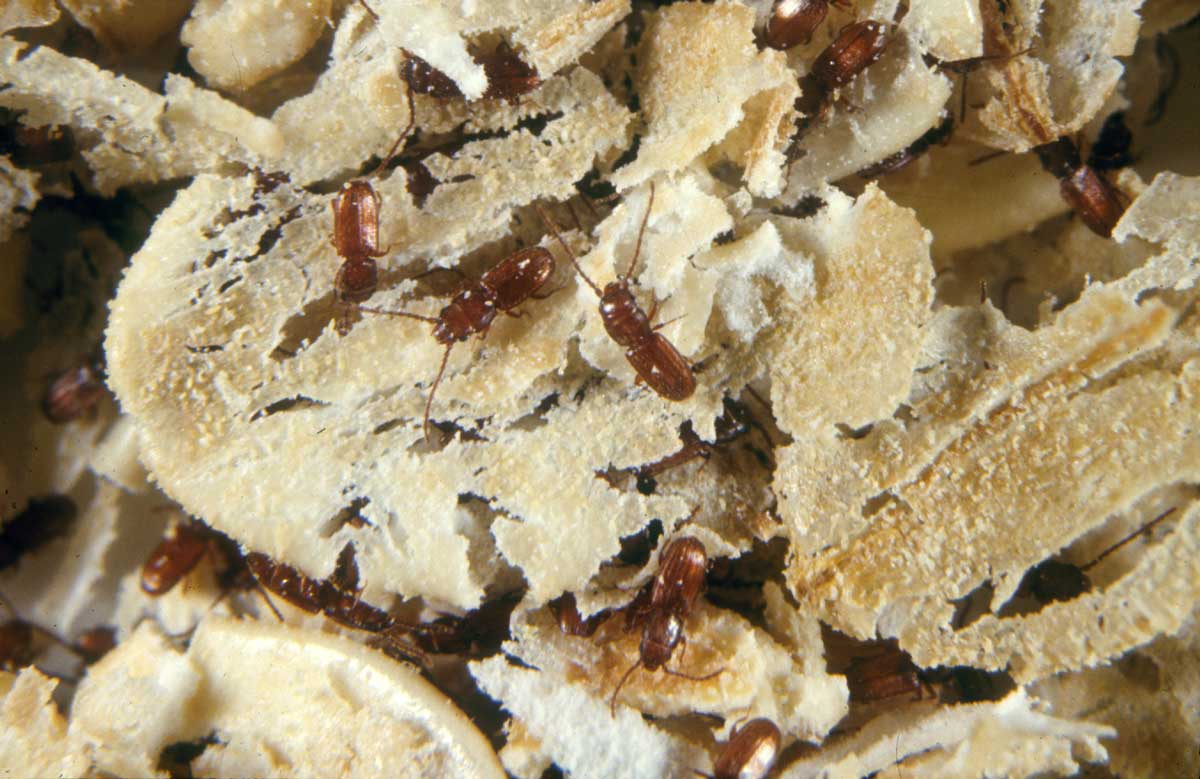
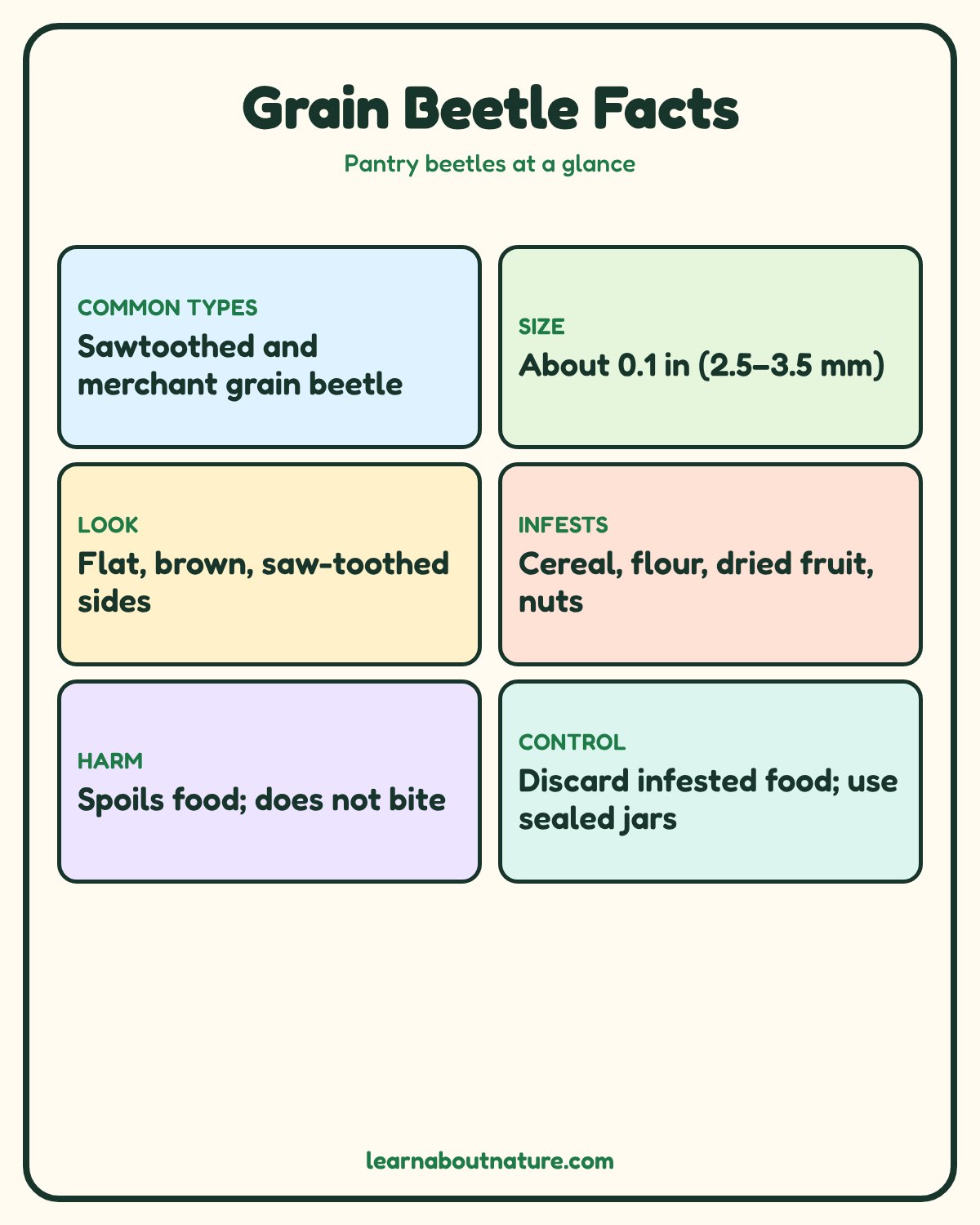
Grain beetles are tiny beetles that live in stored food such as grain, flour, cereal, rice, nuts and spices. They are among the most common pantry pests in homes, shops and warehouses around the world, including Canada and the United States. They do not bite or spread disease, but they can spoil a lot of food.
Grain beetles Quick Facts
| Common name | Grain beetles |
| Scientific name | Oryzaephilus |
| Kingdom | Animalia |
| Phylum | Arthropoda |
| Class | Insecta |
| Order | Coleoptera |
| Family | Silvanidae |
| Type | Insects (several kinds of small beetles) |
| Diet | Stored grain, flour, cereal, nuts, dried fruit and spices |
| Habitat | Grain stores, mills, warehouses and home pantries |
| Native range | Worldwide, spread by trade |
| Size | Mostly 2-3 mm long |
| Colours | Reddish-brown to dark brown |
What are grain beetles?
“Grain beetle” is not one single species. It is a name for several small beetles that feed on stored grain products. The best-known are the saw-toothed grain beetle and the merchant grain beetle, but flat and rusty grain beetles, foreign grain beetles, flour beetles, cigarette beetles, grain borers and weevils are all found in the same kinds of places.
Some of these insects can chew into whole, healthy grain kernels. Others can only feed on grain that is already broken, cracked or ground into flour, so they often move in after other pests have done the first damage.
What do grain beetles look like?
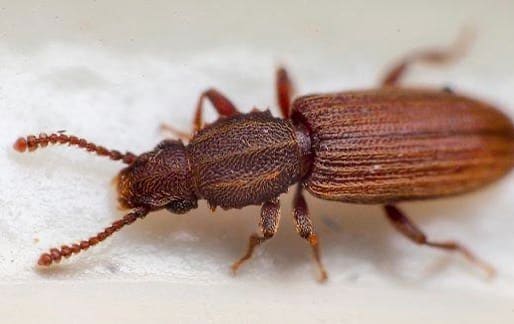
Most grain beetles are very small, about 2 to 3 mm long, which is smaller than a grain of rice. They are usually reddish-brown to dark brown, with slim, flattened bodies that let them squeeze into cracks, folds of packaging and the gaps around jar lids.
The saw-toothed grain beetle is easy to recognize under a magnifying glass. It has six tooth-like points along each side of its thorax, like the edge of a saw. The merchant grain beetle looks almost the same, but has larger eyes.
Where do they live?
Grain beetles live wherever dry food is stored: grain bins, grain elevators, flour mills, warehouses, railroad cars, cargo ships, grocery stores and kitchen cupboards. They have traveled around the world in shipments of grain and other foods, so most species are now found almost everywhere people store food.
They like warm conditions. In cold climates, some species survive only inside heated buildings, while others can cope with colder grain stores.
What do grain beetles eat?
Between them, grain beetles eat almost any dry food made from plants. That includes wheat, barley, oats, rice, corn, flour, breakfast cereal, pasta, crackers, dried fruit, nuts, seeds, chocolate, spices, dried pet food and birdseed.
Each species has its favorites. The saw-toothed grain beetle often feeds on cereals, flour, oatmeal and dried fruit. The merchant grain beetle prefers foods with more oil, such as nuts, seeds, brown rice and bran.
Life cycle
Grain beetles go through four stages: egg, larva, pupa and adult. The female lays her eggs in or near food, either loose among the grains or tucked into cracks. The eggs are so tiny that they are very hard to see.
The larvae hatch and feed on the food around them, then turn into pupae. In warm conditions, the whole cycle from egg to adult can take only about a month or two. Depending on the species, a female may lay from a few dozen to a few hundred eggs, and adults often live for many months. That is why a small problem can become a big one quickly.
Why are they a problem?
Grain beetles do not sting, bite people or carry diseases. The problem is that they spoil food. Infested food is full of beetles, larvae, shed skins and droppings, and it can smell musty. Nobody wants to eat that, so it usually ends up in the trash.
For farms, mills, warehouses and stores, grain beetles can cause large losses of food and money every year.
How to spot an infestation
- Small brown beetles crawling in food packages, on shelves or near the pantry.
- Tiny larvae, webbing, dust or clumps in flour and cereal.
- Small holes in packaging or in whole grains and beans.
- In large grain stores, patches of grain that feel warm, because many insects feeding together produce heat.
How to prevent grain beetles
- Buy dry foods in amounts you will use within a few weeks or months.
- Check packages for damage or insects before you buy them.
- Store flour, cereal, rice, nuts and pet food in airtight glass, metal or hard plastic containers.
- Wipe up spills and vacuum pantry shelves and corners regularly, so crumbs do not build up.
- Use older food first, and do not mix old and new food in the same container.
- Keeping flour or whole grains in the freezer, or freezing new packets for a few days, kills any hidden eggs or larvae.
How to get rid of grain beetles
Start by finding every infested food item and throwing it away in a sealed bag in an outdoor bin. Check everything in the cupboard, including spices, pet food and decorations made from dried plants.
Vacuum the shelves thoroughly, especially cracks and corners, then wash them with soap and water. Food you are unsure about can be frozen for about a week to kill any insects. Insect sprays are not needed in food cupboards, and they can contaminate food. If the problem keeps coming back, or you find beetles in a large storage area, ask a professional pest control service for help.
Types of grain beetles and other pantry pests
Saw-toothed grain beetle
Oryzaephilus surinamensis is about 2.5 to 3 mm long, slim and dark brown, with saw-like teeth on its thorax. It is one of the most common pantry beetles and feeds on many cereal products and dried fruits.
Merchant grain beetle
Oryzaephilus mercator is a close relative of the saw-toothed grain beetle and looks almost identical, but has bigger eyes. It prefers oily foods such as nuts, seeds and cereal products. Unlike its cousin, it can fly, though it rarely does.
Flat and rusty grain beetles
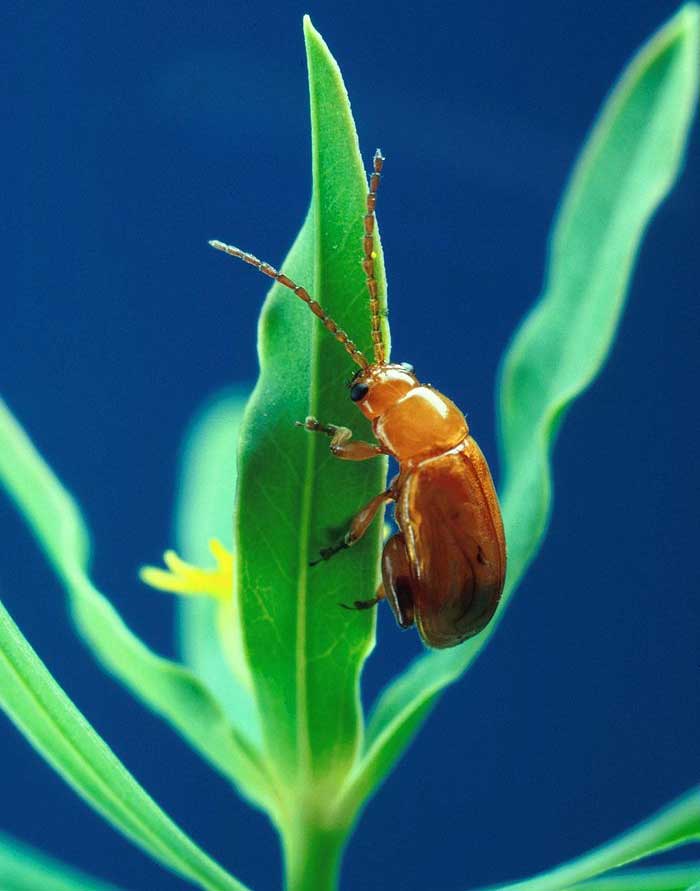
These are among the smallest grain beetles, only about 2 mm long, with flat, reddish-brown bodies and long antennae. Their larvae feed mainly on the germ (the nutritious inner part) of damaged grain kernels. The rusty grain beetle is a serious pest of stored wheat in Canada.
Foreign grain beetle
The foreign grain beetle is about 2 mm long and reddish-brown. It feeds mostly on mold and fungi, so it is a sign that grain or food is damp. It is also common in new buildings where plaster and wood are still drying out.
Flour beetles
Adult flour beetles are about 3 to 4 mm long and reddish-brown. The red flour beetle and the confused flour beetle are the most common. They cannot attack whole, healthy grain, but they thrive in flour, cereal, cake mix and broken grain.
Cigarette beetle
The cigarette beetle is about 2 to 3 mm long, oval and light brown, with its head tucked down so it looks hunched. It is a major pest of stored tobacco, and it also infests spices, dried herbs, rice, pet food, dried flowers and even books.
Grain weevils
Weevils are beetles with a long snout. The rice weevil, maize weevil and granary (wheat) weevil are about 2.5 to 5 mm long. The female chews a hole in a whole kernel of rice, wheat, corn or another grain, lays an egg inside, and the larva grows up hidden inside the grain.
Lesser grain borer
Rhyzopertha dominica, also called the Australian wheat weevil, is not actually a weevil but a small, cylindrical, dark brown beetle. It is found worldwide and is a serious pest of stored cereal grains, because both adults and larvae bore into whole kernels.
Warehouse pirate bug: a helper, not a pest
The warehouse pirate bug is often found in grain stores, but it is not a beetle and it does not eat grain. It is a tiny true bug, about 2.5 mm long, that hunts the eggs and larvae of grain beetles and moths. In a grain store, it is actually one of the good guys.
Grain beetles FAQs
Are grain beetles harmful to humans?
No. Grain beetles do not bite, sting or spread disease. They are a nuisance because they spoil stored food, which usually has to be thrown away.
What happens if you accidentally eat grain beetles?
Swallowing a few grain beetles or larvae by accident is not known to be harmful. Still, infested food tastes and smells bad, so it is best to throw it away.
How do grain beetles get into my kitchen?
They usually arrive inside food packages from the store, often as tiny eggs or larvae. They can also crawl in from nearby infested food or fly in, depending on the species.
How do I get rid of grain beetles?
Throw away infested food in a sealed bag, vacuum and wash the shelves, and store dry food in airtight containers. Freezing uncertain items for about a week kills any hidden insects.
How long do grain beetles live?
Many grain beetles live for several months as adults, and some can live for a year or more. In warm conditions, they can go from egg to adult in only a month or two.

Randi Jones is the owner and founder of the Nature Gift Store, an online retailer specializing in nature-themed gifts, educational science projects, live animal nature kits and real butterfly artwork. A biology graduate who fell in love with insects, she founded the company in 2001 to make active learning about nature fun, accessible and engaging for children and adults. Her store offers real butterfly frames, home and garden decor and educational live animal kits, including ant farms, worm farms, tadpoles, ladybugs and hermit crabs, and she runs a bug museum in Washington featuring live animals like Eddie the Iguana alongside other reptiles and insects. Randi wrote most of the guides on this site. They first appeared on her long-running nature sites, including Monarch-Butterfly.com, Ladybug-Life-Cycle.com, Frog-Life-Cycle.com, Dragonfly-Site.com and Butterfly Pictures, which have now been brought together here at Learn About Nature.