Plant Cell vs Animal Cell: Labeled Diagrams and Differences
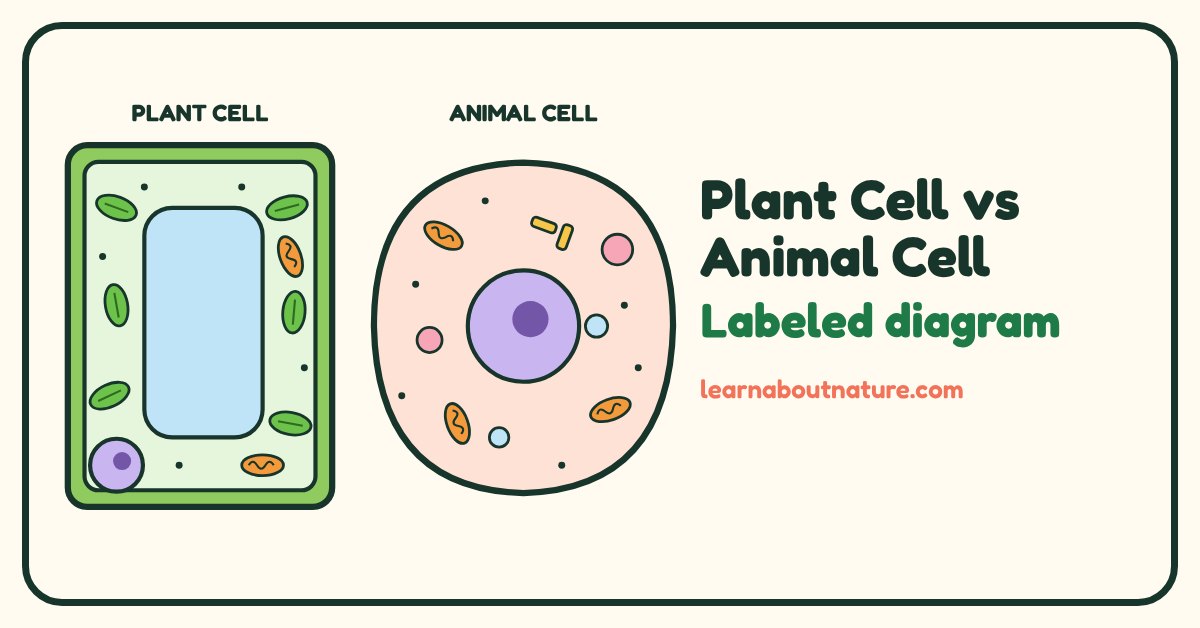
Quick answer: Plant and animal cells share a cell membrane, nucleus, cytoplasm, mitochondria and ribosomes. Plant cells also have a stiff cell wall, green chloroplasts for photosynthesis and one large central vacuole, which give them a boxy shape. Animal cells have no cell wall or chloroplasts, are rounder, and have centrioles, lysosomes and only small vacuoles.
Every plant and every animal is built from tiny units called cells. Most are far too small to see without a microscope, yet each one is a busy, living factory with its own set of working parts, called organelles.
Plant cells and animal cells are both eukaryotic cells, meaning they keep their DNA inside a nucleus. That is why they share many of the same parts. But plants make their own food and stand up without a skeleton, so their cells have a few extra tools. This guide labels both cells, explains what each part does and lists the key differences side by side.
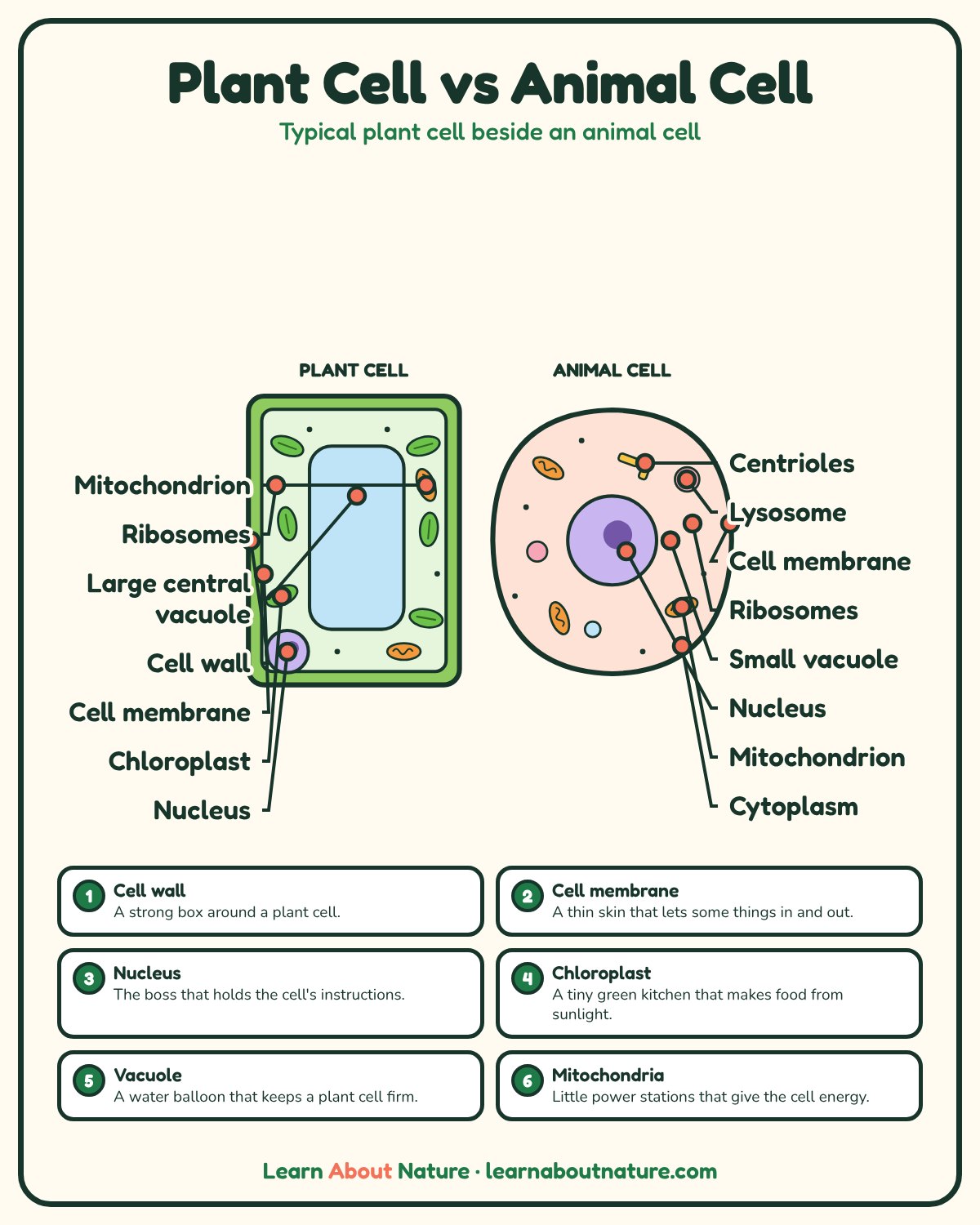
Teachers and students: you’re welcome to use this diagram in lessons and projects with credit to Learn About Nature.
Free printable: Download the Plant Cell vs Animal Cell labeling worksheet (PDF) – label the parts using the word bank. Answer key included.
Parts of a Cell and What They Do
| Part | What it does |
|---|---|
| Cell wall (plant only) | Stiff cellulose layer that supports and protects the cell and gives it shape |
| Cell membrane (both) | Thin skin that controls what enters and leaves the cell |
| Nucleus (both) | Holds DNA and controls the cell’s activities |
| Cytoplasm (both) | Jelly-like fluid that holds the organelles; many reactions happen here |
| Chloroplast (plant only) | Uses sunlight to make sugar by photosynthesis |
| Large central vacuole (plant only) | Stores water and sap and keeps the cell firm |
| Mitochondria (both) | Release energy from food by cellular respiration |
| Ribosomes (both) | Build proteins |
| Small vacuoles (mainly animal) | Store or carry small amounts of material |
| Centrioles (animal only) | Help organize cell division |
| Lysosomes (mainly animal) | Break down waste, worn-out parts and germs with enzymes |
| Plasmodesmata (plant only) | Channels linking neighboring plant cells |
What Plant and Animal Cells Have in Common
Both kinds of cell are wrapped in a thin cell membrane and filled with jelly-like cytoplasm. Both have a nucleus that holds the cell’s DNA, the instructions for building and running the cell.
Both also use mitochondria to release energy from food, and ribosomes to build proteins. Plants have mitochondria too, a fact that surprises many students: plant cells make sugar in their chloroplasts, then break it down in their mitochondria for energy, just as animal cells do.
- Cell membrane, cytoplasm and nucleus
- Mitochondria and ribosomes
- Endoplasmic reticulum, a folded network that helps make proteins and fats
- Golgi apparatus, which packages and ships materials around the cell
Parts Found in Both Cells
- Cell membrane: A thin, flexible skin made mostly of fats and proteins. It controls what enters and leaves the cell, such as water, food molecules and waste.
- Nucleus: The control center. It holds DNA and tells the cell which proteins to make. A dark spot inside, the nucleolus, makes ribosome parts.
- Cytoplasm: The watery gel that fills the cell and holds the organelles in place. Many chemical reactions happen here.
- Mitochondria: The powerhouses of the cell. They carry out cellular respiration, using oxygen to release energy from sugar.
- Ribosomes: Tiny protein builders, some floating free and some stuck to the endoplasmic reticulum.
Parts Found Only in Plant Cells
- Cell wall: A tough layer outside the cell membrane, made mainly of cellulose. It gives the cell a fixed, often box-like shape and stops it bursting when it fills with water.
- Chloroplasts: Green organelles that contain chlorophyll. They capture sunlight and use it to turn water and carbon dioxide into sugar in a process called photosynthesis. Root cells, which live in the dark, usually have none.
- Large central vacuole: A big sac of watery sap that can take up as much as 90 percent of a mature plant cell. It stores water, sugars and waste, and presses outward against the wall to keep the plant firm.
- Plasmodesmata: Tiny channels through the cell walls that link neighboring plant cells so materials can pass between them.
Parts Found Only (or Mainly) in Animal Cells
Instead of a cell wall, animal cells sit in a mesh of proteins such as collagen outside the membrane. This lets them bend, squeeze and change shape, which is useful for cells that move, like white blood cells.
- Centrioles: A pair of short tubes near the nucleus that help organize the cell’s skeleton and pull chromosomes apart when the cell divides. Most plant cells do not have them.
- Lysosomes: Small sacs of digestive enzymes that break down worn-out parts, food particles and germs. Plant cells generally lack typical lysosomes; their central vacuole does much of this recycling work instead.
- Small vacuoles: Animal cells may have a few small, often temporary vacuoles for storing or moving materials, but never one giant central vacuole.
Key Differences Between Plant and Animal Cells
Here are the main differences at a glance. Teachers often ask for these in a test, so they are worth learning as pairs.
- Cell wall: plant cells have one made of cellulose; animal cells do not.
- Shape: plant cells are usually fixed and rectangular; animal cells are rounder or irregular and can change shape.
- Chloroplasts: many plant cells have them and make their own food; animal cells never do and must get food by eating.
- Vacuoles: plant cells have one large central vacuole; animal cells have none or only small ones.
- Centrioles: found in animal cells; absent from most plant cells.
- Lysosomes: common in animal cells; plant cells rely mostly on the vacuole instead.
- Nucleus position: often pushed to the side by the vacuole in plant cells; usually near the center in animal cells.
- Food storage: plant cells store energy as starch; animal cells store it as glycogen and fat.
- Cell division: a plant cell builds a new wall, called a cell plate, across the middle; an animal cell pinches in two.
Why Plant Cells Need a Wall and a Big Vacuole
Plants have no bones. They stay upright partly because of water pressure inside their cells, called turgor pressure. The central vacuole swells with water and pushes against the stiff cell wall, a bit like air inflating a tire. Millions of firm cells together hold up stems and leaves.
When a plant runs short of water, its vacuoles shrink, the pressure drops and the plant wilts. Water it, and the cells refill and stand up again. Animal cells have no wall to push against, so if they take in too much water they can swell and burst.
How to See Real Cells
With a simple school microscope, a thin layer of onion skin stained with iodine shows neat, brick-like plant cells, each with a cell wall and a nucleus. Onion skin cells have no chloroplasts, but a leaf from pondweed such as Elodea shows bright green chloroplasts that can even be seen moving around the cell.
For animal cells, many classes look at cheek cells gently scraped with a clean cotton swab and stained. They appear as flat, rounded shapes with a dark nucleus and no wall. Always follow your teacher’s instructions when using stains and microscope slides.
Fun Facts About Cells
- The word “cell” comes from Robert Hooke, who in 1665 looked at cork through a microscope and thought the tiny boxes looked like small rooms.
- Chloroplasts and mitochondria have their own small loops of DNA, a clue that they came from bacteria that began living inside other cells long ago.
- Fungi have cell walls too, but theirs are made of chitin, the same tough material found in insect shells, not cellulose.
- Cotton and paper are made largely of cellulose from plant cell walls.
Plant Cell vs Animal Cell for Kids
- Cell wall: a strong box around a plant cell.
- Cell membrane: a thin skin that lets some things in and out.
- Nucleus: the boss that holds the cell’s instructions.
- Chloroplast: a tiny green kitchen that makes food from sunlight.
- Vacuole: a water balloon that keeps a plant cell firm.
- Mitochondria: little power stations that give the cell energy.
- Animal cells have no wall, so they can be round and squishy.
Key words: cell – the smallest living unit that makes up all living things; organelle – a tiny part inside a cell that has a special job; photosynthesis – how plants use sunlight, water and carbon dioxide to make sugar; cellulose – the tough material that plant cell walls are made of; turgor pressure – water pressure inside a plant cell that keeps it firm; eukaryotic – describes cells that keep their DNA inside a nucleus.
Try this: Build a model of each cell in a zip-top bag: clear gelatin or hair gel for cytoplasm, a plum or ball for the nucleus and beans for mitochondria; put the plant cell bag inside a small box for the cell wall, then add green peas for chloroplasts and a water balloon for the vacuole.
Related Guides
- Parts of a Plant
- Parts of a Mushroom
- Parts of a Tree
- Plant life cycle
- Angiosperm life cycle
- Sunflower life cycle
- All labeled anatomy diagrams
Plant Cell vs Animal Cell FAQs
What are 3 differences between plant and animal cells?
Plant cells have a stiff cell wall made of cellulose, chloroplasts for making food from sunlight, and one large central vacuole. Animal cells have none of these. Animal cells instead have centrioles and lysosomes and can change shape because they have no wall.
Do plant cells have mitochondria?
Yes. Plant cells have both chloroplasts and mitochondria. Chloroplasts use sunlight to make sugar, and mitochondria then break that sugar down to release energy the cell can use. Plant cells in roots, which get no light, rely on mitochondria using sugar sent down from the leaves.
Why do animal cells not have a cell wall?
Animals get support from skeletons, shells or muscles rather than from stiff cells. Without a wall, animal cells can bend, move and change shape, which lets muscles contract, white blood cells crawl and many cells take in food by wrapping around it.
Why is the vacuole bigger in plant cells?
The large central vacuole stores water and dissolved materials and pushes against the cell wall to keep the cell firm. This water pressure helps hold the whole plant upright. It can fill up to about 90 percent of a mature plant cell, which saves the plant from building lots of costly cytoplasm.
Which parts are found in both plant and animal cells?
Both have a cell membrane, cytoplasm, a nucleus, mitochondria, ribosomes, endoplasmic reticulum and a Golgi apparatus. These shared parts handle basic jobs every living cell needs, such as controlling what enters, storing DNA, making proteins and releasing energy.
Sources: Animal Cells versus Plant Cells | Biology for Majors I (Lumen Learning / OpenStax); Percent of a mature plant cell occupied by the central vacuole | BioNumbers, Harvard Medical School; Plant cell | Britannica; Characteristics of Fungi | OpenStax Biology 2e (Lumen Learning)

Nato is a content writer and researcher with a background in psychology who’s eager to explore the wonders of nature. As a travel enthusiast and animal lover, she hopes to inspire others to discover and cherish the beauty and importance of the natural world. She also writes about the history of candy and snacks for Snack History and about food and healthy eating for The Fitchen.