Parts of a Plant: Labeled Diagram and What Each Part Does
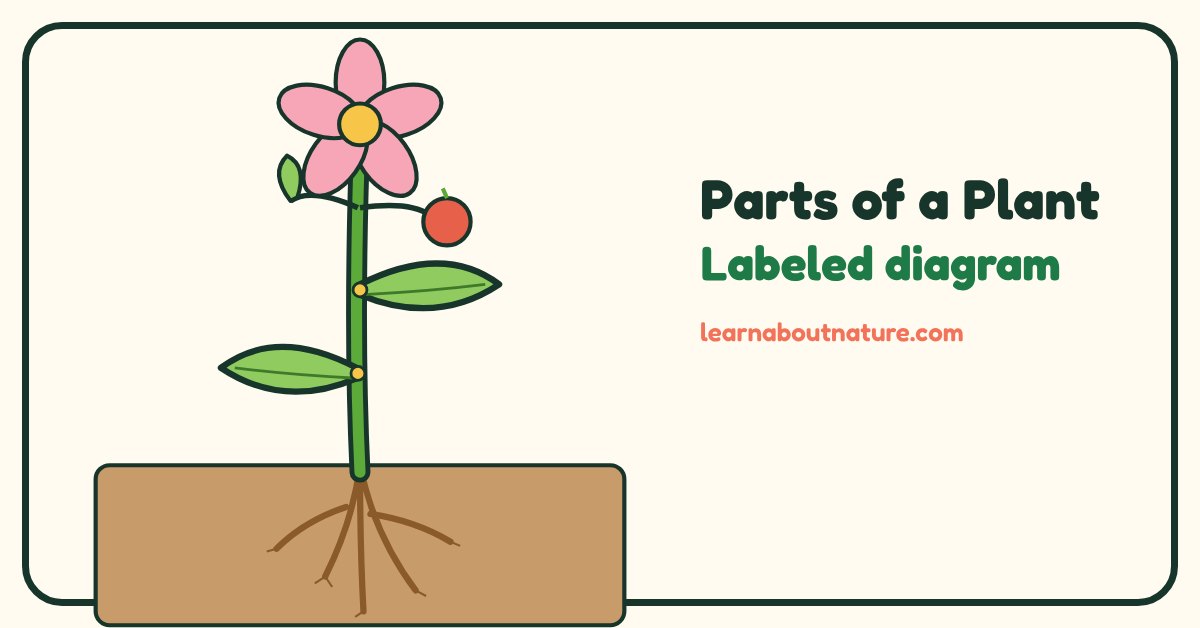
Quick answer: The main parts of a flowering plant are the roots, which anchor it and take in water; the stem, which holds it up and carries water and food; the leaves, which make food from sunlight; and the flowers, which make seeds. Buds grow at nodes on the stem, and fruits protect and spread the seeds.
A sunflower, an apple tree and a blade of grass look very different, but most flowering plants are built from the same basic parts. Each part has a job, and together they let a plant feed itself, grow toward the light and make new plants.
Botanists split these parts into two groups. The vegetative parts, roots, stems and leaves, keep the plant alive and growing. The reproductive parts, flowers, fruits and seeds, make the next generation. This guide labels each one and explains how they work together.
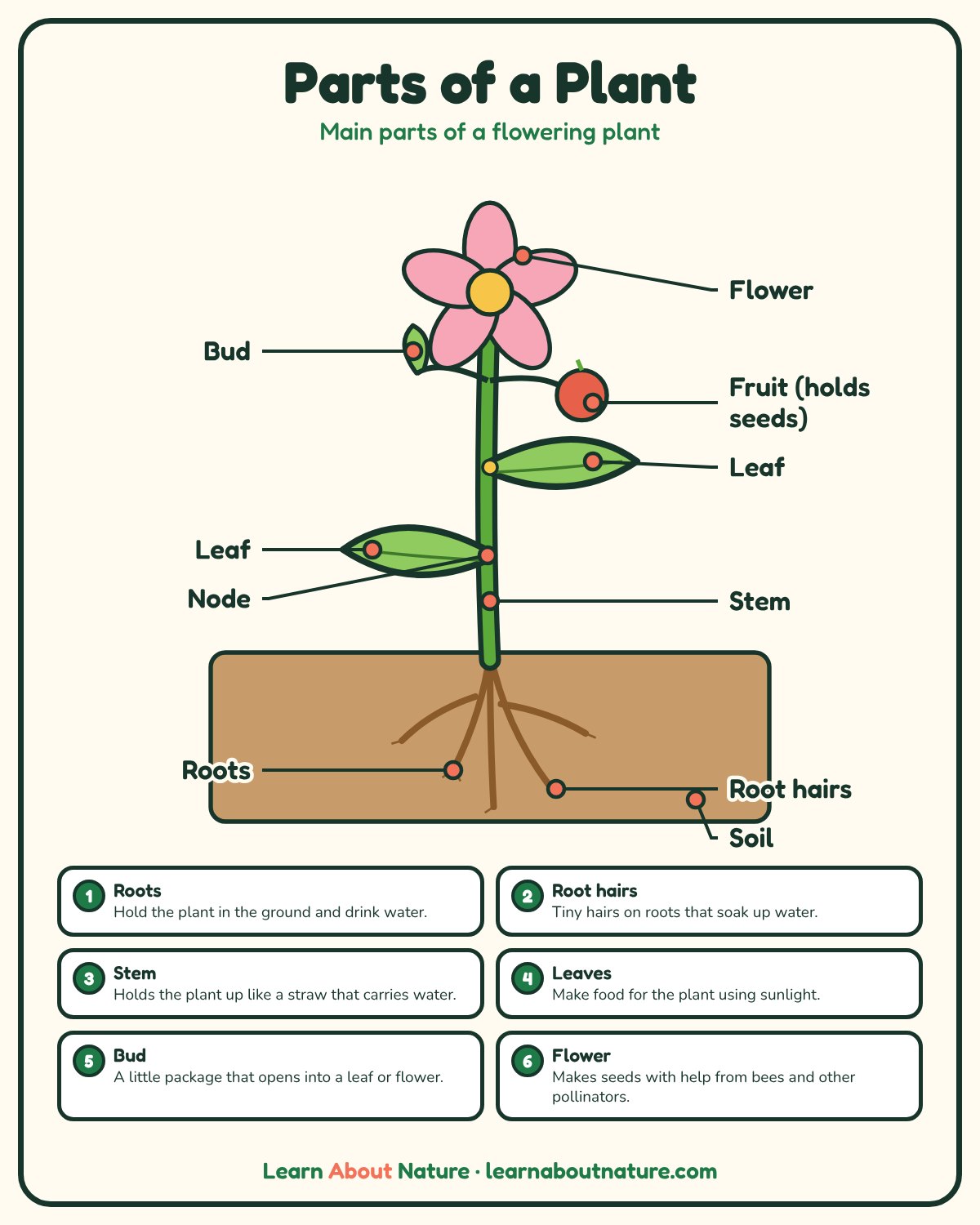
Teachers and students: you’re welcome to use this diagram in lessons and projects with credit to Learn About Nature.
Free printable: Download the Parts of a Plant labeling worksheet (PDF) – label the parts using the word bank. Answer key included.
Parts of a Plant and What They Do
| Part | What it does |
|---|---|
| Roots | Anchor the plant, absorb water and minerals, and store food |
| Root hairs | Tiny outgrowths that greatly increase the surface for absorbing water |
| Stem | Supports the plant and carries water and food between roots and leaves |
| Node | Point on the stem where leaves, buds or branches grow |
| Internode | Section of stem between two nodes |
| Terminal bud | Bud at the stem tip that makes the stem grow longer |
| Axillary bud | Side bud that can become a branch, leaves or a flower |
| Leaves | Make food by photosynthesis and exchange gases |
| Flower | Reproductive part that makes pollen and ovules |
| Fruit | Develops from the flower’s ovary; protects and spreads seeds |
| Seed | Contains a baby plant and its food supply |
| Xylem and phloem | Tubes that carry water up and sugar around the plant |
The Basic Plan of a Plant
Think of a plant as having two systems. The root system lives below ground and is usually hidden in the soil. The shoot system lives above ground and includes the stem, leaves, buds, flowers and fruits.
The two systems depend on each other. Roots send water and minerals up to the leaves. Leaves make sugar and send it down to feed the roots. Tubes inside the plant called xylem carry water upward, and tubes called phloem carry sugar to wherever it is needed.
Roots and Root Hairs
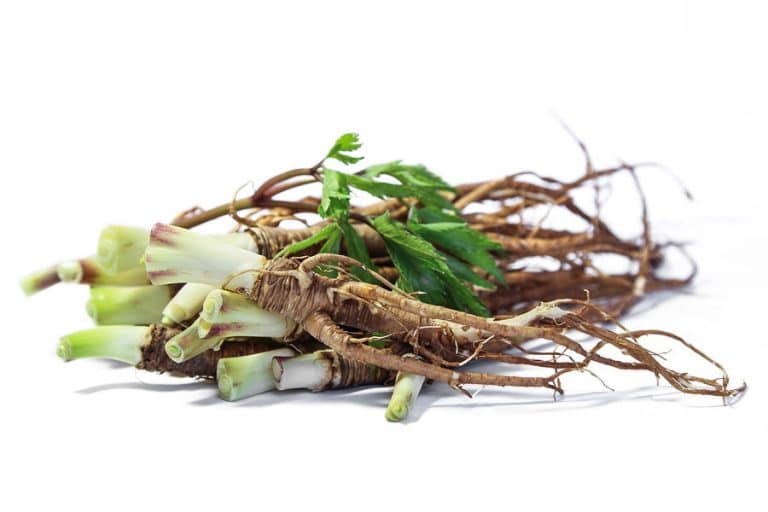
Roots anchor the plant in the ground, soak up water and minerals and often store food. Carrots, beets and sweet potatoes are swollen roots full of stored sugar and starch.
Some plants, such as carrots and dandelions, have one thick main taproot that grows deep. Others, such as grasses, have a mat of many thin fibrous roots that spread near the surface and help hold soil in place.
Just behind each growing root tip are thousands of tiny root hairs. Each is a thin outgrowth of a single skin cell. Root hairs greatly increase the surface area touching the soil, so they do most of the work of absorbing water. They are delicate and short-lived, which is one reason plants often droop after being moved to a new pot.
The Stem, Nodes and Buds
Some stems look nothing like stalks. A potato is a swollen underground stem, and its “eyes” are buds at its nodes, which is why a piece of potato with an eye can grow into a new plant.
- Stem: The main support of the shoot. It holds leaves up toward the light and flowers up where pollinators can find them. Inside, bundles of xylem and phloem run like pipes between the roots and the leaves.
- Node: A point on the stem where a leaf, bud or side branch grows out. Nodes are busy growth areas.
- Internode: The stretch of stem between two nodes. Plants grown in dim light often have long, spindly internodes as they stretch toward the light.
- Terminal bud: The bud at the tip of a stem. It makes the stem grow longer.
- Axillary (side) bud: A bud in the angle where a leaf joins the stem. It can grow into a new branch, leaves or a flower.
Leaves: The Food Factories
Leaves are where most photosynthesis happens. Green chlorophyll inside the leaf cells captures sunlight and uses its energy to turn water and carbon dioxide into sugar, giving off oxygen.
A typical leaf has a flat blade to catch light and a stalk called the petiole that joins it to the stem. Tiny pores called stomata, mostly on the underside, let carbon dioxide in and oxygen and water vapor out. As water evaporates from the leaves, it helps pull more water up from the roots.
Flowers, Fruits and Seeds
Fruits spread seeds in clever ways. Animals eat juicy berries and drop the seeds elsewhere, maple fruits spin on the wind and burrs hitch a ride on fur.
- Flower: The reproductive part. Colorful petals attract pollinators such as bees. Stamens make pollen, and the pistil holds the ovules that can become seeds once pollen reaches them.
- Fruit: After pollination, the ovary at the base of the flower swells into a fruit that protects the seeds and helps spread them. Apples, tomatoes, pea pods and acorns are all fruits.
- Seed: A baby plant packed with a food supply inside a protective coat. When it lands in a good spot with water, air and the right temperature, it germinates and grows into a new plant.
How the Parts Work Together
Follow a drop of water through a plant. It enters a root hair, moves into the root’s xylem, rises up the stem and reaches a leaf. There it may be used in photosynthesis or escape as vapor through a stoma.
The sugar made in the leaf travels through the phloem to growing buds, opening flowers, ripening fruits and the roots below. Stored food in roots and stems keeps the plant alive through winter or a dry season, ready to grow again.
Plants Without Flowers
Not every plant has all these parts. Ferns have roots, stems and leaves, but no flowers or seeds; they spread by tiny spores instead. Mosses have no true roots at all and hold on with thin threads. Pine trees and other conifers make seeds inside cones rather than fruits.
The diagram on this page shows a flowering plant, the largest group of plants on Earth, which includes most crops, garden flowers and broadleaf trees.
What Plants Need, and Which Part Gets It
Plants need five main things to grow: sunlight, water, air, nutrients and space. Each part of the plant is shaped to collect one or more of them.
Leaves are broad and flat to soak up sunlight, and their stomata take in carbon dioxide from the air. Roots and root hairs collect water and minerals such as nitrogen and potassium from the soil, and they also need oxygen, which is why plants can drown in waterlogged soil. Stems grow toward the light, a response called phototropism, so leaves are not left in the shade. Spreading seeds far away, through fruits, gives each new plant its own space.
Fun Facts About Plant Parts
- When you eat celery, you are eating mostly leaf stalks; broccoli is mostly flower buds.
- Cactus spines are modified leaves, and the green cactus body is a swollen stem that does the photosynthesis.
- Strawberry “seeds” on the outside are actually tiny fruits, each holding one seed.
- Some roots grow in the air: many orchids and mangroves have aerial roots.
Parts of a Plant for Kids
- Roots: hold the plant in the ground and drink water.
- Root hairs: tiny hairs on roots that soak up water.
- Stem: holds the plant up like a straw that carries water.
- Leaves: make food for the plant using sunlight.
- Bud: a little package that opens into a leaf or flower.
- Flower: makes seeds with help from bees and other pollinators.
- Fruit: keeps the seeds safe and helps them travel.
- Seed: a baby plant waiting to grow.
Key words: photosynthesis – how plants use sunlight, water and air to make their own food; node – the place on a stem where a leaf or bud grows; xylem – tubes that carry water up from the roots; phloem – tubes that carry sugar from the leaves to the rest of the plant; pollination – moving pollen to a flower’s pistil so seeds can form; germinate – when a seed starts to grow into a new plant.
Try this: Put a stalk of celery in a glass of water with a few drops of food coloring and check it after a day; the colored lines and leaf tips show how the stem carries water up to the leaves.
Related Guides
- Parts of a flower
- Parts of a leaf
- Food Chain and Food Web
- Plant Cell vs Animal Cell
- Parts of a Mushroom
- Plant life cycle
- Angiosperm life cycle
- All labeled anatomy diagrams
Parts of a Plant FAQs
What are the 6 main parts of a plant?
The six parts most often taught are roots, stem, leaves, flowers, fruits and seeds. Roots, stems and leaves keep the plant alive and growing. Flowers, fruits and seeds help the plant reproduce and spread to new places.
What is the function of the stem?
The stem holds the plant upright and lifts leaves toward sunlight and flowers toward pollinators. Inside, xylem tubes carry water and minerals up from the roots, and phloem tubes carry sugar from the leaves to other parts. Some stems, such as potatoes, also store food.
What do root hairs do?
Root hairs are tiny extensions of skin cells near the root tip. They give the root a much larger surface touching the soil, so the plant can absorb more water and minerals. They are fragile and short-lived, and new ones keep forming as the root grows.
What is a node on a plant?
A node is a point on a stem where a leaf, bud or side branch grows out. The bare stretch between two nodes is called an internode. Gardeners look for nodes when taking cuttings, because new roots and shoots usually grow from them.
Is a fruit part of a plant?
Yes. In botany, a fruit is the part that grows from a flower’s ovary after pollination, and it holds the seeds. That means many foods called vegetables, such as tomatoes, cucumbers, peppers and pea pods, are fruits to a botanist.
Sources: Vegetative Plant Parts | Oregon State University Extension; Chapter 1: Botany | Virginia Cooperative Extension Master Gardener Handbook; Parts of a Plant | Let’s Talk Science

Nato is a content writer and researcher with a background in psychology who’s eager to explore the wonders of nature. As a travel enthusiast and animal lover, she hopes to inspire others to discover and cherish the beauty and importance of the natural world. She also writes about the history of candy and snacks for Snack History and about food and healthy eating for The Fitchen.