
Parts of a Mushroom: Labeled Diagram and What Each Part Does
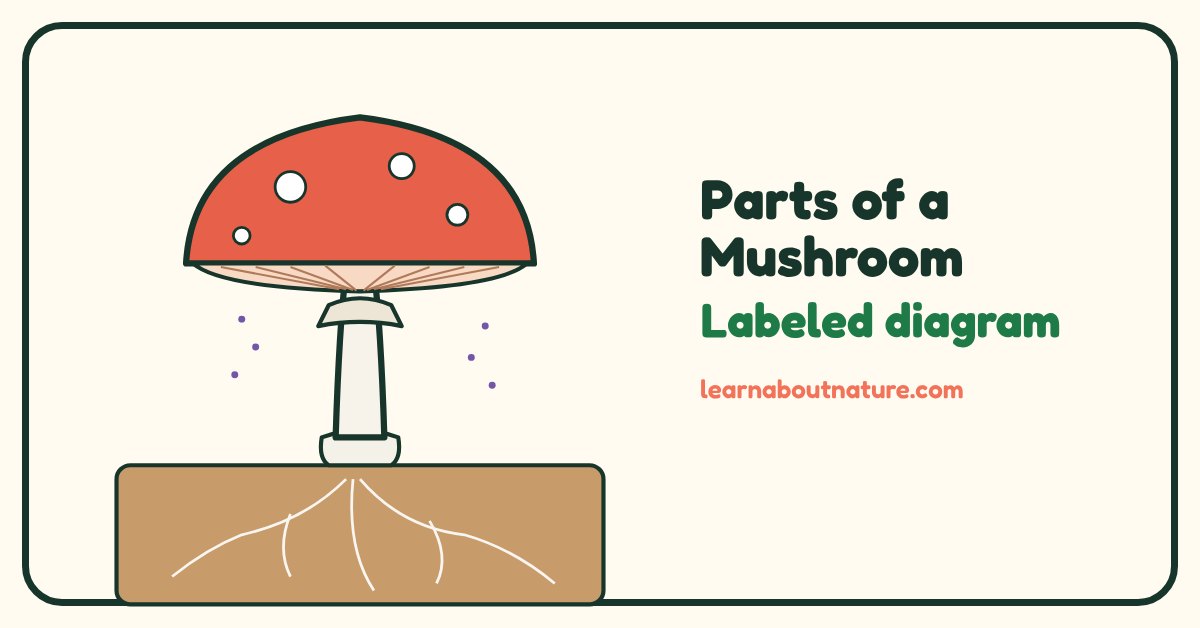
Quick answer: The main parts of a mushroom are the cap; the gills under the cap, which make and release spores; the stem, or stipe, which holds the cap up; and, in some species, a ring on the stem and a cup-like volva at the base. Below ground, a web of threads called mycelium is the main body of the fungus.
A mushroom popping up after rain looks like a whole living thing, but it is only a small part of one. Most of the organism lives hidden in soil, wood or leaf litter as a web of fine threads. The mushroom is its fruiting body, a short-lived structure built to spread spores, a bit like an apple on an apple tree.
This guide labels the parts of a typical gilled mushroom, explains what each part does and shows why fungi belong in a kingdom of their own. It also explains why you should never eat a mushroom you find growing wild.
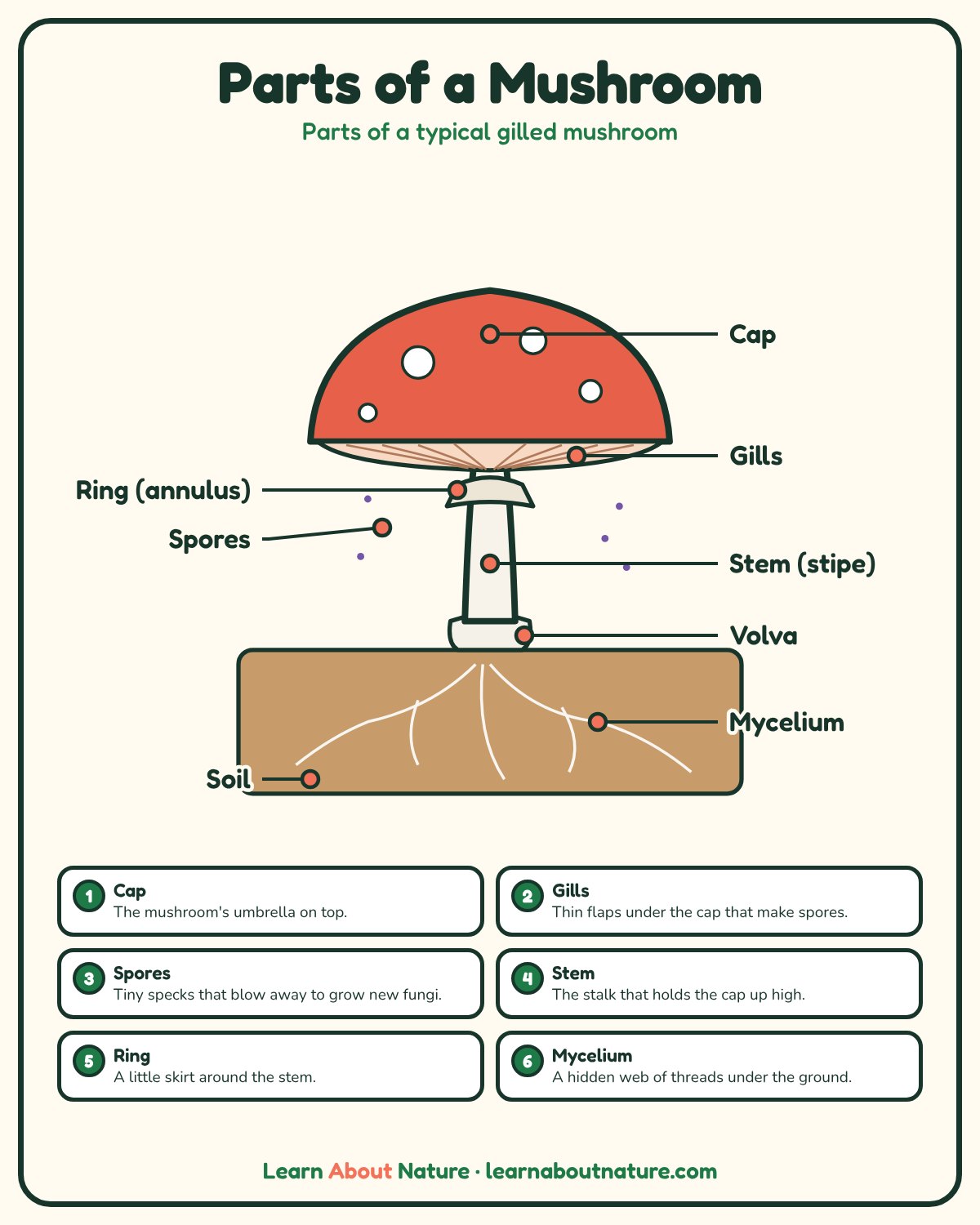
Teachers and students: you’re welcome to use this diagram in lessons and projects with credit to Learn About Nature.
Free printable: Download the Parts of a Mushroom labeling worksheet (PDF) – label the parts using the word bank. Answer key included.
Parts of a Mushroom and What They Do
| Part | What it does |
|---|---|
| Cap (pileus) | Umbrella-like top that shelters the gills |
| Gills (lamellae) | Thin blades under the cap where spores are made |
| Pores | Tiny tubes that replace gills in some mushrooms, such as boletes |
| Spores | Microscopic cells that spread on the air and grow into new fungi |
| Stem (stipe) | Lifts the cap so spores can catch the wind |
| Ring (annulus) | Leftover piece of the veil that covered young gills |
| Volva | Cup at the stem base left from the veil around a young mushroom |
| Partial veil | Thin sheet protecting the gills of a young mushroom |
| Mycelium | Underground network that is the main body of the fungus |
| Hyphae | Microscopic threads that make up the mycelium and the mushroom |
Safety First: Never Eat Wild Mushrooms
Some of the world’s most poisonous mushrooms, such as the death cap (Amanita phalloides) and destroying angels, look and even taste like harmless ones. Even experienced foragers sometimes get them wrong. Cooking, boiling, freezing or drying does not make a poisonous mushroom safe.
Never eat a wild mushroom, and never let young children or pets pick or taste them. Enjoy mushrooms by looking at them and taking photos. Wash your hands after touching any wild fungus. If someone may have eaten a wild mushroom, get medical help straight away, even if they feel fine, because symptoms can take many hours to appear. In the United States, Poison Control can be reached at 1-800-222-1222.
Fungi Are Not Plants
Mushrooms were once grouped with plants, but scientists now place them in their own kingdom, Fungi, along with molds and yeasts. Fungi are actually more closely related to animals than to plants.
Here is why fungi are different from plants:
- They have no chlorophyll and cannot make food from sunlight.
- They feed by releasing digestive enzymes into their surroundings and absorbing the broken-down food.
- Their cell walls are made of chitin, the same tough material found in insect shells, not cellulose.
- Like animals, they store energy as glycogen rather than starch.
- They reproduce with spores, not seeds.
The Cap and Gills
Not all mushrooms have gills. Boletes have a spongy layer of tiny pores under the cap, and some fungi have teeth or spines instead. Puffballs make their spores inside a round sac and puff them out when raindrops hit.
- Cap (pileus): The top of the mushroom. It shelters the gills from rain and sun. Caps can be domed, flat, cone-shaped or funnel-shaped, and smooth, scaly, slimy or warty.
- Gills (lamellae): Thin, papery blades under the cap. Their surfaces are covered in microscopic spore-making cells. Packing many gills under one cap gives a huge surface area for making spores.
- Spores: Microscopic reproductive cells, so small that a single mushroom can release millions or even billions of them. They drift on air currents, and the few that land in a good spot can grow into new fungi.
The Stem, Ring and Volva
Many mushrooms have no ring or volva. The deadly Amanita group often has both, which is one reason mushroom experts dig up the whole base when identifying a specimen.
- Stem (stipe): The stalk that lifts the cap up so spores can catch the breeze. It may be thick or thin, solid or hollow, and some mushrooms have no stem at all.
- Ring (annulus): A skirt of tissue on the stem. In a young mushroom, a thin sheet called the partial veil covers the gills. As the cap opens, the veil tears and the leftover piece hangs on the stem as a ring.
- Volva: A cup or sac at the base of the stem. Some young mushrooms start out wrapped in a thin skin called the universal veil, like an egg. When the mushroom pushes up, the veil breaks and its bottom part stays behind as the volva. It is often hidden below the soil.
Underground: Mycelium and Hyphae
The real body of the fungus is the mycelium, a tangled network of microscopic threads called hyphae. Each hypha is a thin tube that grows at its tip, branching through soil, rotting wood or leaf litter to find food.
When the mycelium has enough food and conditions are right, often after rain, it builds mushrooms by packing hyphae tightly together. In fact, the cap, gills and stem are all made of hyphae. A mycelium can live for many years, producing new mushrooms season after season.
How Mushrooms Feed and Help Forests
Many fungi are decomposers. They break down dead leaves, logs and animal remains, returning nutrients to the soil. Without them, forests would be buried in fallen wood.
Other fungi form partnerships with tree roots called mycorrhizae. The fungus helps the tree take in water and nutrients such as phosphorus, and the tree feeds the fungus sugar. A few fungi are parasites that attack living plants or insects.
How a Mushroom Grows
A mushroom’s story starts with a single spore. If it lands somewhere damp with food, such as a rotting log, it sprouts a thin thread, a hypha. The hypha grows and branches, and when it meets a compatible hypha from another spore of the same species, the two can join and build a new mycelium.
The mycelium may spread for months or years before it fruits. When the weather turns cool and wet, it forms tiny knots of hyphae that swell into buttons, small rounded baby mushrooms. A button can expand into a full mushroom within a day or two, mostly by taking up water, which is why mushrooms seem to appear overnight after rain. Once it has shed its spores, the mushroom rots away, but the mycelium lives on underground.
Fun Facts About Mushrooms
- One of the largest living things on Earth is a honey fungus in Oregon’s Blue Mountains whose mycelium spreads under nearly 4 square miles of forest.
- Mushroom experts identify species by making a spore print: they rest a cap gills-down on paper overnight to see the color of the spores.
- Some mushrooms glow faintly in the dark, a kind of bioluminescence sometimes called foxfire.
- Penicillin, the first widely used antibiotic, came from a mold, which is also a fungus.
Parts of a Mushroom for Kids
- Cap: the mushroom’s umbrella on top.
- Gills: thin flaps under the cap that make spores.
- Spores: tiny specks that blow away to grow new fungi.
- Stem: the stalk that holds the cap up high.
- Ring: a little skirt around the stem.
- Mycelium: a hidden web of threads under the ground.
- Never eat a mushroom you find outside.
Key words: fungus – a living thing, like a mushroom, mold or yeast, that is not a plant or an animal; fruiting body – the part of a fungus, such as a mushroom, that makes spores; spore – a tiny cell that can grow into a new fungus; mycelium – the web of threads that forms the main body of a fungus; hyphae – the thin threads that make up a fungus; decomposer – a living thing that breaks down dead material and returns nutrients to the soil.
Try this: With an adult, buy a few white button mushrooms from a store, use a magnifying glass to find the cap, gills and stem, then set one cap gills-down on paper under a bowl overnight to make a spore print.
Related Guides
- Food Chain and Food Web
- Plant Cell vs Animal Cell
- Parts of a Plant
- Plant life cycle
- Angiosperm life cycle
- Sunflower life cycle
- All labeled anatomy diagrams
Parts of a Mushroom FAQs
What are the main parts of a mushroom?
A typical mushroom has a cap on top, gills underneath that make spores, and a stem, or stipe, that holds the cap up. Some species also have a ring on the stem and a cup-like volva at the base. Underground, the mycelium is the main body of the fungus.
Is a mushroom a plant?
No. Mushrooms are fungi, which form their own kingdom. Unlike plants, fungi have no chlorophyll and cannot make food from sunlight. They absorb food from their surroundings, have cell walls of chitin and store energy as glycogen, which makes them more closely related to animals than to plants.
What do the gills of a mushroom do?
The gills are thin blades under the cap that are covered in microscopic spore-making cells. Their many folds give a large surface area, so one mushroom can release huge numbers of spores. The spores drop from the gills and drift away on the air to start new fungi.
What is mycelium?
Mycelium is the main body of a fungus: a network of very thin threads called hyphae that spreads through soil, wood or leaf litter. It digests and absorbs food and can live for years. Mushrooms are just its temporary fruiting bodies, made to spread spores.
Is it safe to eat mushrooms you find in the wild?
No. Some deadly mushrooms look very similar to edible ones, and even experts can make mistakes. Cooking does not destroy their toxins. Never eat wild mushrooms. If someone may have eaten one, seek medical help right away; in the US, call Poison Control at 1-800-222-1222.
Sources: Macroscopic features of fungi | Australian National Botanic Gardens; Characteristics of Fungi | OpenStax Biology 2e (Lumen Learning); Poisonous Mushrooms | California Department of Public Health; Humongous Fungus (Armillaria ostoyae) | Oregon Encyclopedia

Nato is a content writer and researcher with a background in psychology who’s eager to explore the wonders of nature. As a travel enthusiast and animal lover, she hopes to inspire others to discover and cherish the beauty and importance of the natural world. She also writes about the history of candy and snacks for Snack History and about food and healthy eating for The Fitchen.


