Parts of a Leaf: Labeled Diagram and What Each Part Does
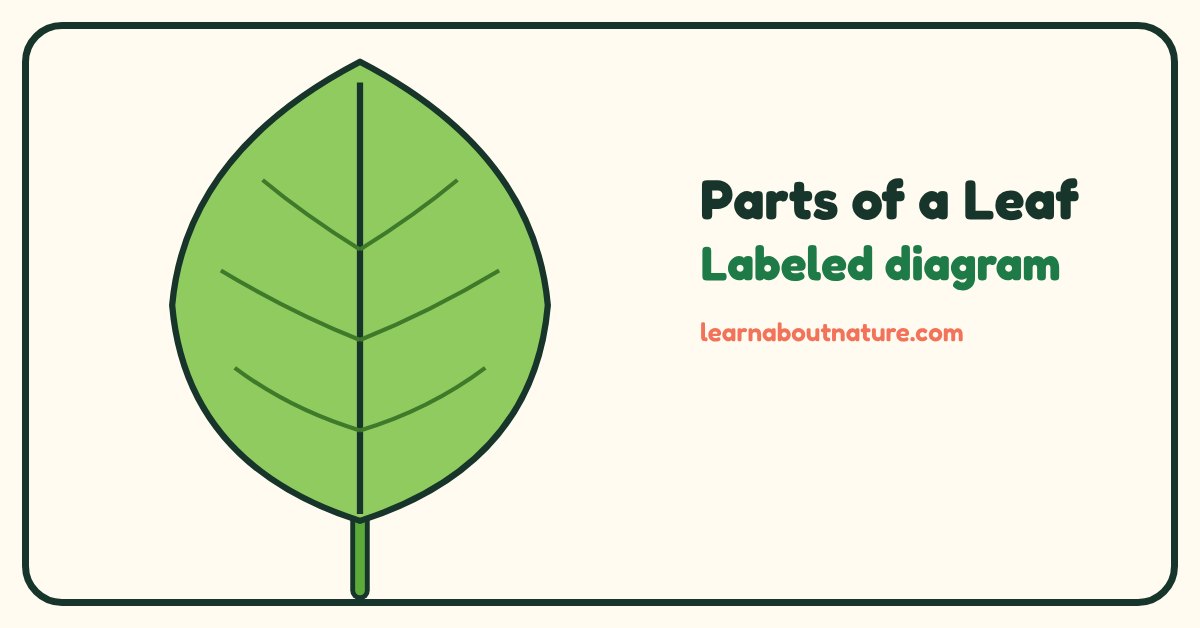
Quick answer: The main parts of a leaf are the blade, or lamina, the flat green surface that makes food; the midrib and veins that carry water and sugar; the margin, or edge; the apex, or tip; the base; and the petiole, the stalk that joins the leaf to the stem. Tiny pores called stomata let gases in and out.
Leaves are a plant’s food factories. Using sunlight, water and air, they make the sugar that feeds the whole plant, and they release the oxygen we breathe.
This guide labels the parts of a simple leaf, explains what each part does and then zooms in on the tiny structures inside. It also shows how botanists use leaf edges, tips and vein patterns to identify plants.
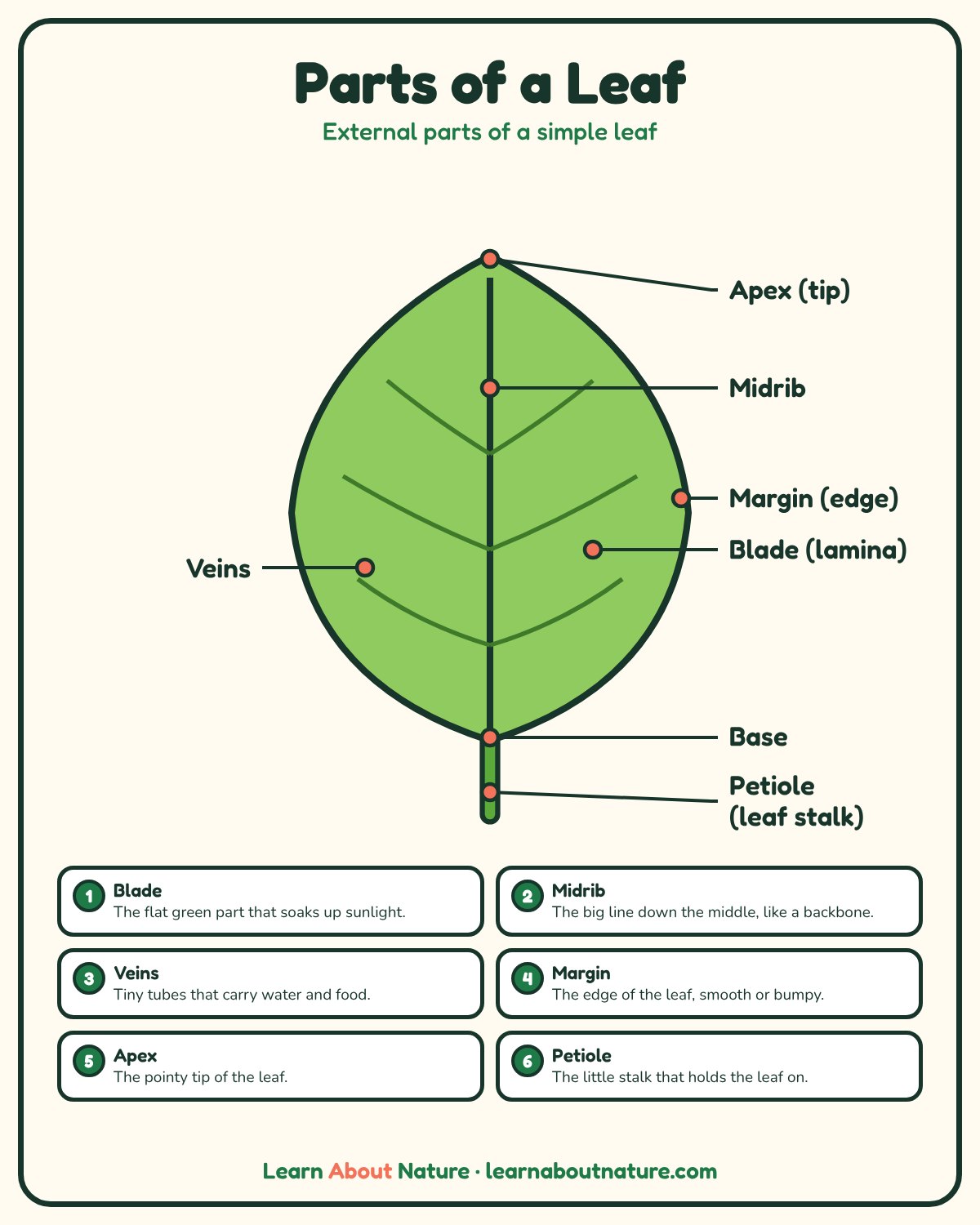
Teachers and students: you’re welcome to use this diagram in lessons and projects with credit to Learn About Nature.
Free printable: Download the Parts of a Leaf labeling worksheet (PDF) – label the parts using the word bank. Answer key included.
Parts of a Leaf and What They Do
| Part | What it does |
|---|---|
| Blade (lamina) | Main flat surface that captures sunlight for photosynthesis |
| Midrib | Central vein that carries water and sugar and supports the blade |
| Veins | Carry water in and sugar out across the blade |
| Margin | Leaf edge; its shape helps identify the plant |
| Apex | Leaf tip; some tips help rain drip off |
| Base | Lower end of the blade where it meets the petiole |
| Petiole | Stalk that joins the leaf to the stem and holds it toward light |
| Stipules | Small flaps at the base of the petiole in some plants |
| Epidermis and cuticle | Protective skin with a waxy coat that saves water |
| Mesophyll | Inner cells packed with chloroplasts where food is made |
| Stomata | Tiny pores that let gases in and out |
| Guard cells | Open and close each stoma |
The Basic Plan of a Leaf
A typical leaf has two main sections. The blade, also called the lamina, is the broad, flat part. The petiole is the stalk that attaches the blade to the stem. Some leaves, such as many grasses, have no petiole and grow straight from the stem; these are called sessile leaves.
Running through the blade is a network of veins, with a large central vein called the midrib. The edge of the blade is the margin, the tip is the apex and the end nearest the petiole is the base.
External Parts: Blade, Margin, Apex and Base
- Blade (lamina): The main surface where most photosynthesis happens. Its broad, flat shape catches as much sunlight as possible.
- Margin: The edge of the leaf. It can be smooth (entire), saw-toothed (serrate), rounded-toothed (crenate) or deeply lobed, as in oak leaves.
- Apex: The tip of the leaf. It may be sharply pointed (acute), long and tapering (acuminate) or rounded (obtuse). Long, pointed tips may help rain drip off quickly.
- Base: The lower end of the blade. Botanists describe its shape too, for example heart-shaped (cordate) or wedge-shaped (cuneate).
External Parts: Midrib, Veins and Petiole
Where the petiole meets the stem, there is usually a small axillary bud. It can grow into a new shoot or a flower.
- Midrib: The thick main vein down the center of many leaves. It carries water in and sugar out and stiffens the blade.
- Veins: Smaller branches that spread through the blade. Each holds two kinds of tubes: xylem, which brings water and minerals from the roots, and phloem, which carries sugar from the leaf to the rest of the plant.
- Petiole: The leaf stalk. It holds the blade out toward the light, lets the leaf bend in the wind and carries the veins into the stem.
- Stipules: Small leaf-like flaps found at the base of the petiole in some plants, such as roses and peas. In some species they are shaped into spines.
Inside a Leaf: Cells and Stomata
A leaf is only a few cells thick. The top and bottom are covered by a thin skin called the epidermis, which is coated with a waxy layer, the cuticle, that slows water loss.
Between the two skins is the mesophyll. Its upper layer, the palisade layer, is made of tall, tightly packed cells full of chloroplasts, the green parts where photosynthesis happens. Below is the spongy layer, with loose cells and air spaces so gases can move around.
The epidermis is dotted with tiny pores called stomata. Each one is surrounded by two bean-shaped guard cells that open the pore to let carbon dioxide in and oxygen and water vapor out, and close it to save water. In many plants most stomata are on the underside of the leaf.
How a Leaf Makes Food
Photosynthesis is how a leaf turns light into food. Water travels up from the roots through the xylem in the veins. Carbon dioxide enters through the stomata. Inside the chloroplasts, green chlorophyll captures energy from sunlight and uses it to combine water and carbon dioxide into sugar, releasing oxygen as a by-product.
The sugar then moves out through the phloem to feed the stems, roots, flowers and fruits. Water that escapes through the stomata as vapor, called transpiration, helps pull more water up from the roots.
Simple and Compound Leaves, and Vein Patterns
A simple leaf has one undivided blade, like a maple or oak leaf. A compound leaf has a blade divided into separate leaflets. In pinnate compound leaves, such as ash, leaflets line up along a central stalk; in palmate compound leaves, such as horse chestnut, they spread from one point like fingers.
A quick test: there is a bud at the base of a whole leaf, but not at the base of each leaflet.
Vein patterns help sort plants too. Monocots such as grasses, lilies and corn usually have parallel veins. Eudicots such as roses, beans and maples usually have a branching net of veins.
Leaves Compared: Broad Leaves and Needles
Pine needles and spruce needles are leaves too. They are narrow, thick and waxy, with stomata sunk into grooves. This shape loses less water and survives freezing winters, which is why many conifers can keep their leaves all year.
Broad, thin leaves catch more light but lose more water, so many broad-leaved trees in cold climates drop their leaves in autumn.
Fun Facts About Leaves
- Autumn colors appear when leaves stop making green chlorophyll, revealing yellow and orange pigments that were there all along.
- Cactus spines are modified leaves that protect the plant and reduce water loss.
- Pea tendrils, which curl around supports, are modified leaflets.
- Some leaves, like those of the Venus flytrap, have become traps for catching insects.
Parts of a Leaf for Kids
- Blade: the flat green part that soaks up sunlight.
- Midrib: the big line down the middle, like a backbone.
- Veins: tiny tubes that carry water and food.
- Margin: the edge of the leaf, smooth or bumpy.
- Apex: the pointy tip of the leaf.
- Petiole: the little stalk that holds the leaf on.
- Stomata: tiny holes that let the leaf breathe.
Key words: photosynthesis – how plants use sunlight, water and air to make their own food; chlorophyll – the green substance in leaves that captures sunlight; stomata – tiny pores on a leaf that let gases in and out; petiole – the stalk that connects a leaf to the stem; lamina – another name for the flat blade of a leaf; transpiration – the loss of water vapor from leaves.
Try this: Collect five different leaves, make crayon rubbings of them to show the veins, then label the blade, midrib, margin, apex and petiole on each rubbing and sort them by edge shape.
Related Guides
- Parts of a Flower
- Plant life cycle
- Angiosperm life cycle
- Sunflower life cycle
- Tree life cycle
- Bean plant life cycle
- All animal & plant anatomy diagrams
- Animal & plant life cycles
Parts of a Leaf FAQs
What are the main parts of a leaf?
A typical leaf has a flat blade, or lamina, and a stalk called the petiole. The blade has a central midrib, smaller veins, an edge called the margin, a tip called the apex and a base where it meets the petiole. Tiny pores called stomata dot its surface.
What is the function of the petiole?
The petiole attaches the leaf blade to the stem. It holds the blade out toward the light, lets the leaf move in the wind without tearing, and carries the veins that bring water into the leaf and take sugar out to the rest of the plant.
What do the veins in a leaf do?
Veins are the leaf’s plumbing. Xylem tubes inside them carry water and minerals up from the roots, and phloem tubes carry sugar made in the leaf to the rest of the plant. Veins also stiffen the blade and help hold it flat.
What are stomata and where are they found?
Stomata are tiny pores in the leaf’s skin. Each is controlled by two guard cells that open it to let carbon dioxide in and oxygen and water vapor out. In many plants, most stomata are on the underside of the leaf, where they lose less water.
What is the difference between a simple and a compound leaf?
A simple leaf has a single blade, even if it is deeply lobed, like an oak leaf. A compound leaf is split into several separate leaflets on one stalk. A bud sits at the base of the whole leaf, but not at the base of each leaflet.
Sources: Leaves | OpenStax Biology 2e (Lumen Learning); Plant Morphology: Leaves | Plant Identification, Kwantlen Polytechnic University; Leaf Characteristics | University of Vermont Plant ID

Nato is a content writer and researcher with a background in psychology who’s eager to explore the wonders of nature. As a travel enthusiast and animal lover, she hopes to inspire others to discover and cherish the beauty and importance of the natural world. She also writes about the history of candy and snacks for Snack History and about food and healthy eating for The Fitchen.