Tree Life Cycle: Stages From Seed to Old Tree (With Diagram)

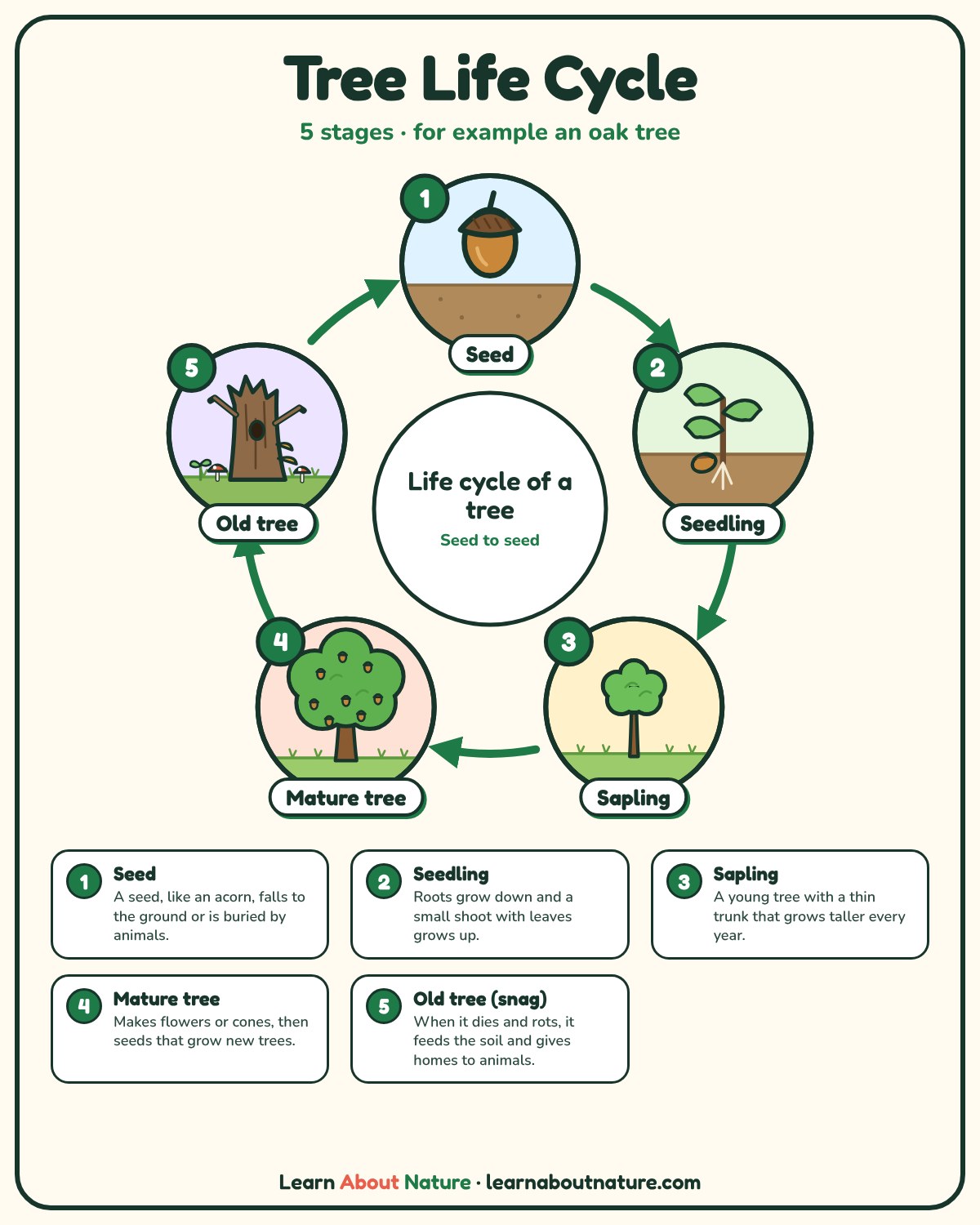
Quick answer: The tree life cycle has five main stages: seed, sprout or seedling, sapling, mature tree and old tree. A seed sprouts, grows into a young sapling, becomes an adult that makes flowers or cones and seeds, then grows old, dies and decays, returning nutrients to the soil.
The tree life cycle has five main stages: seed, sprout (seedling), sapling, mature tree and old tree. A tiny seed sprouts, grows into a thin young sapling, becomes a full-grown tree that makes its own flowers or cones and seeds, and finally grows old, dies and returns its nutrients to the soil so new plants can grow.
Tree Life Cycle Quick Facts
| Life cycle stages | Seed, sprout (seedling), sapling, mature tree, old tree |
| Type of development | Grows from seed |
| Time to adulthood | About 5 to 20+ years, depending on the kind of tree |
| Lifespan | Under 100 years for some kinds; thousands of years for a few |
| Seeds | Inside fruits (flowering trees) or cones (conifers); often thousands per year |
Trees follow the same basic pattern as every other plant life cycle, but they do it slowly. A bean plant can go from seed to seed in a few months, while a tree may need many years just to make its first seeds, and it can keep growing for centuries. Want to compare? See all our animal and plant life cycles.
Stage 1: Seed
Every tree starts as a seed. Inside the seed is a tiny baby plant called an embryo, plus a store of food to keep it alive until it can make its own. A tough seed coat protects it from drying out and from being crushed.
Trees make seeds in two main ways. Flowering trees, such as oaks, maples and apples, grow their seeds inside fruits. An acorn is the fruit of an oak tree, and the winged “helicopters” that spin down from a maple tree each carry a seed. Conifers, such as pines and firs, make their seeds in cones instead of flowers.
Seeds need to travel away from the parent tree, where there is more light and space. They get around in different ways:
- Wind carries light, winged seeds such as maple and pine seeds.
- Animals move heavy seeds. Squirrels and jays bury acorns and nuts to eat later and forget some of them. Nuts and seeds are a big part of what squirrels eat, so they plant a lot of trees by accident.
- Birds eat berries and drop the seeds somewhere else in their droppings.
- Water floats some seeds, like coconuts, to new shores.
Many tree seeds wait before they sprout. Some need a cold winter first, so they do not start growing in fall and then freeze. Most seeds never become trees at all, because they are eaten, rot or land in the wrong place.
Stage 2: Sprout and Seedling
When a seed has enough water, oxygen and warmth, it germinates, or sprouts. The seed swells with water, the seed coat splits, and a root pushes down into the soil first. Then a small shoot grows up toward the light.
The first leaves to appear are often seed leaves, called cotyledons, which look different from the tree’s real leaves. Soon the true leaves open and the seedling starts making its own food from sunlight, water and air through photosynthesis.
The seedling stage is the most dangerous part of a tree’s life. A seedling may be only a few inches tall, and it can be eaten by deer, rabbits, insects or slugs, dried out by drought, or shaded by bigger plants. Out of thousands of seedlings on a forest floor, only a few will survive to grow tall.

Stage 3: Sapling
A sapling is a young tree. It has a thin, flexible trunk, a few branches and is usually taller than a person’s knee but still much smaller than the trees around it. Foresters often call a young tree a sapling once it is about 3 feet (1 meter) tall, while its trunk is still only a few inches wide.
During this stage, the tree puts most of its energy into growing taller and spreading its roots. Its bark starts to thicken, and each year it adds a new layer of wood under the bark. In places with warm summers and cold winters, these layers show up as growth rings, one for each year, which is how people can tell the age of a cut tree.
Saplings are still not old enough to make seeds. Depending on the kind of tree, this stage can last a few years for fast-growing trees or many years for slow growers that live in the shade of older trees, waiting for a gap in the forest to open up.
Stage 4: Mature Tree
A tree becomes mature when it is old enough to reproduce. Flowering trees grow flowers, and conifers grow cones. This can happen after about 5 to 10 years for some smaller or faster trees, but many large forest trees, such as oaks, take 20 years or more before they make a good crop of seeds.
To make seeds, pollen has to move from one flower or cone to another. Many trees, including oaks, birches and pine trees, let the wind carry their pollen. Others, such as apple and cherry trees, have colorful, sweet-smelling flowers that attract bees and other insects to carry pollen for them. You can read about these blooming kinds in our guide to flowering trees.
After pollination, seeds grow inside fruits or cones, ripen and fall, and the life cycle starts all over again. A mature tree can make seeds year after year for a very long time. Some trees, like oaks, have “mast years” when they produce a huge crop of acorns, followed by years when they make very few.

Stage 5: Old Tree, Snag and Decay
Eventually a tree slows down. Old trees grow more slowly, lose branches and become hollow inside. Disease, insects, storms, fire or drought may finally kill them. You can learn about some of these problems in our guide to tree diseases.
A dead tree that is still standing is called a snag. Snags may look lifeless, but they are full of life. Woodpeckers dig holes in them, and owls, bats, squirrels and many insects use those holes as homes.
When the tree finally falls, it becomes a log on the forest floor. Fungi, bacteria, beetles, termites and worms slowly break the wood down. This can take many years, and as it happens the tree’s nutrients go back into the soil. Moss, ferns and new seedlings often grow right on top of the rotting log, which is why fallen logs are sometimes called “nurse logs.” In this way, the end of one tree helps the next generation begin.
How Long Does a Tree Live?
It depends on the kind of tree. Some fast-growing trees, such as many birches and poplars, often live less than 100 years. Oaks commonly live for several hundred years. A few trees live far longer: giant sequoias can live over 3,000 years, and Great Basin bristlecone pines are among the oldest living things on Earth, with some more than 4,500 years old. Coast redwoods, the tallest trees in the world, can also live for well over 1,000 years.
Trees in cities and gardens often have shorter lives because of pollution, poor soil and damage to their roots. Good care, like watering young trees in dry weather and protecting their roots, can help them stay healthy for longer.

Tree Life Cycle vs Other Plant Life Cycles
All seed plants follow the same seed, sprout, grow, reproduce pattern. The big difference is time. Annual plants, like the ones in the pumpkin life cycle or the dandelion life cycle, can finish everything in one growing season or less. Trees are perennials, so they live for many years and reproduce again and again.
Flowering trees follow the angiosperm life cycle, with seeds inside fruits. Conifers are gymnosperms, which means “naked seeds,” because their seeds sit on the scales of cones instead of inside a fruit. Some plants, like those in the fern life cycle, do not make seeds at all and use tiny spores instead.
Fun Facts About the Tree Life Cycle
- A tree’s rings can show good and bad years: wide rings usually mean a good growing year, and narrow rings can mean drought.
- One big oak can drop thousands of acorns in a good year, but only a tiny number will ever grow into trees.
- Some pines have cones that stay shut until a forest fire heats them, then release their seeds onto the cleared ground.
- Dead trees can provide homes and food for wildlife for many years after they die.
- Not sure what kind of tree you are looking at? Try our tree identification tips or browse the main types of trees.
More life cycles
- Apple Tree Life CycleSeed → seedling → tree → blossoms → apples
- Plant Life CycleSeed → seedling → adult plant → flower → seed
- Sunflower Life CycleSeed → sprout → bud → flower → seeds
- Bean Plant Life CycleSeed → germination → seedling → flowers → pods
- Butterfly Life CycleEgg → caterpillar → chrysalis → butterfly
Tree Life Cycle FAQs
What are the stages of a tree’s life cycle?
A tree grows from a seed into a sprout, or seedling, then a young sapling, then a mature tree that makes flowers or cones and seeds. Finally it grows old, dies and decays, returning nutrients to the soil.
How long does it take a tree to grow from a seed?
It depends on the kind of tree. Some small or fast-growing trees can make seeds within about 5 to 10 years, but many large forest trees, such as oaks, take 20 years or more.
What is a sapling?
A sapling is a young tree with a thin, flexible trunk. It is bigger than a seedling but not yet old enough to make flowers, cones or seeds.
What happens to a tree when it dies?
A dead standing tree, called a snag, becomes a home for woodpeckers, owls, bats and insects. When it falls, fungi, bacteria and insects break it down and its nutrients return to the soil.
Do all trees have flowers?
No. Flowering trees such as oaks, maples and apples make seeds inside fruits. Conifers such as pines and firs make their seeds in cones instead.

Randi Jones is the owner and founder of the Nature Gift Store, an online retailer specializing in nature-themed gifts, educational science projects, live animal nature kits and real butterfly artwork. A biology graduate who fell in love with insects, she founded the company in 2001 to make active learning about nature fun, accessible and engaging for children and adults. Her store offers real butterfly frames, home and garden decor and educational live animal kits, including ant farms, worm farms, tadpoles, ladybugs and hermit crabs, and she runs a bug museum in Washington featuring live animals like Eddie the Iguana alongside other reptiles and insects.