
Parts of a Flower: Labeled Diagram and What Each Part Does
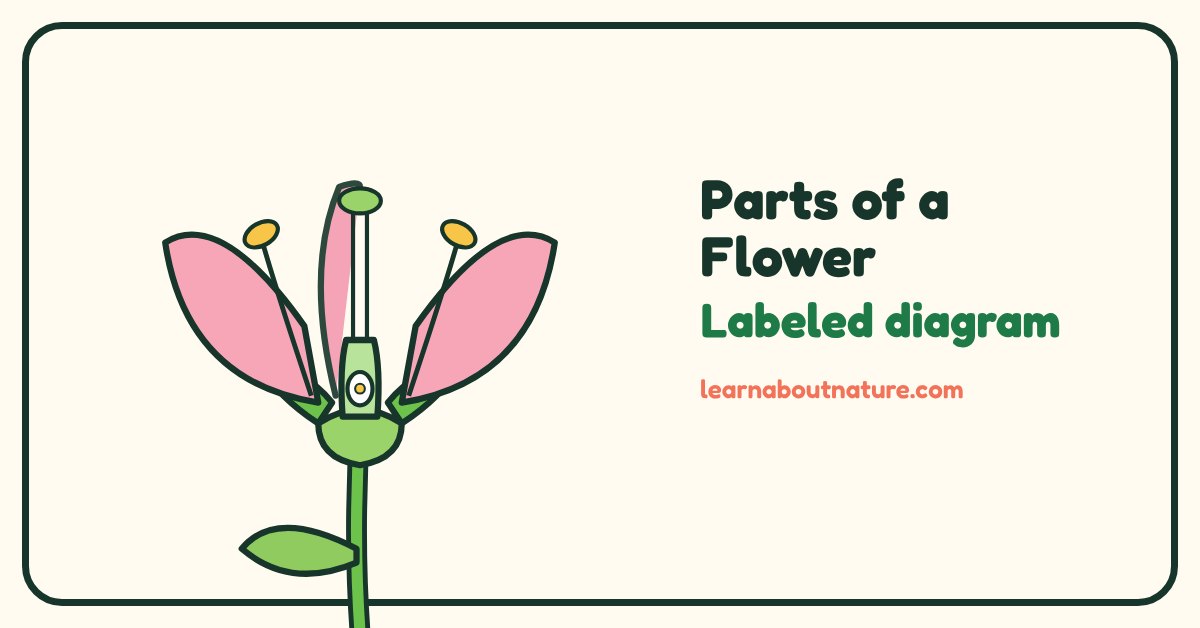
Quick answer: The main parts of a flower are the sepals, which protect the bud; the petals, which attract pollinators; the stamens, made of an anther and a filament, which make pollen; and the pistil, made of a stigma, style and ovary, which makes seeds. All of these sit on the receptacle at the top of the stem.
A flower is not just decoration. It is the part of a plant that makes seeds, and every piece of it has a job in that process, from the colorful petals that call in bees to the hidden ovary where seeds form.
This guide labels the parts of a typical flower, explains what each part does and shows how they work together during pollination. Our diagram uses a hibiscus, which has a few special features we point out along the way.
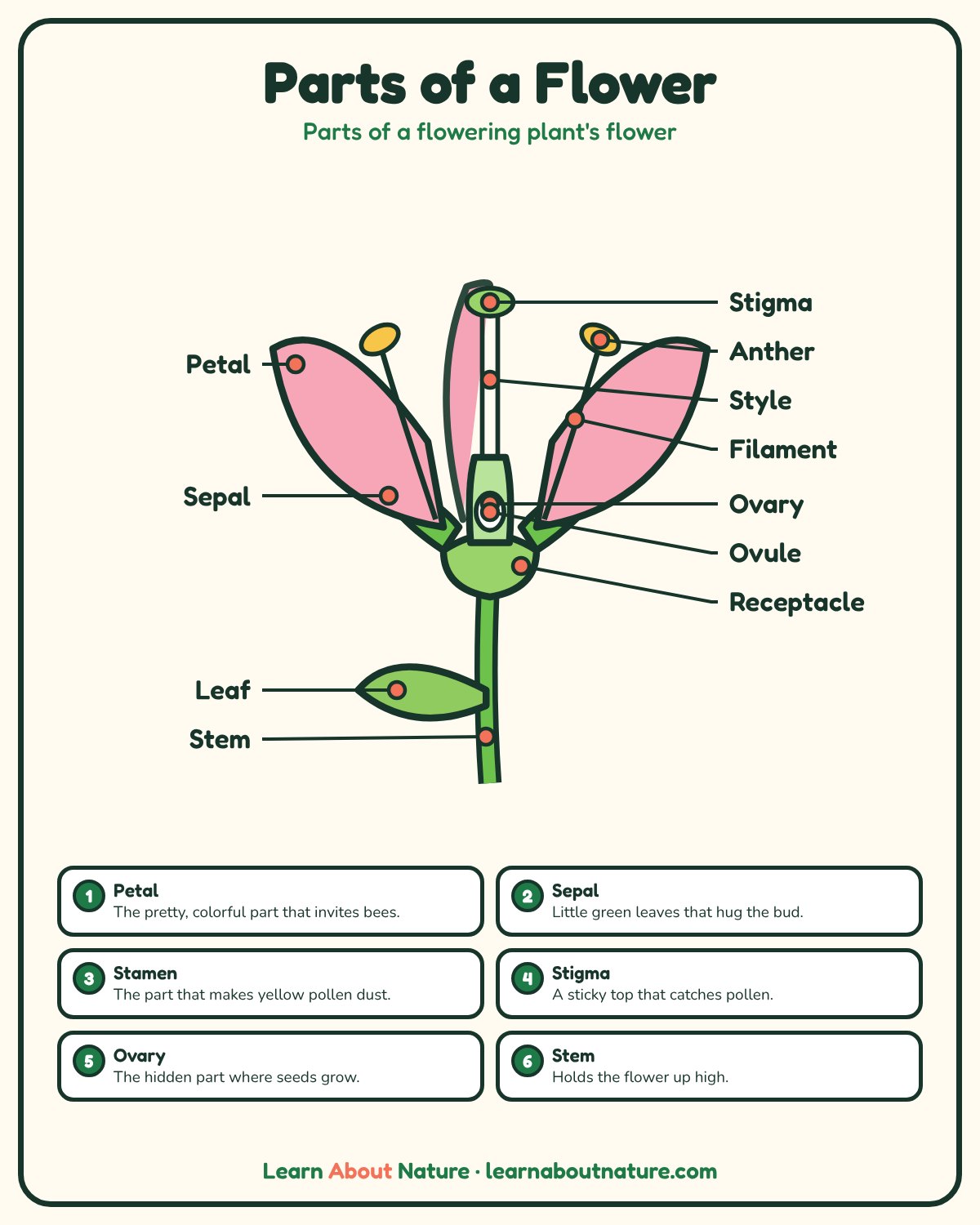
Teachers and students: you’re welcome to use this diagram in lessons and projects with credit to Learn About Nature.
Free printable: Download the Parts of a Flower labeling worksheet (PDF) – label the parts using the word bank. Answer key included.
Parts of a Flower and What They Do
| Part | What it does |
|---|---|
| Petal | Attracts pollinators with color and scent |
| Sepal | Protects the flower bud before it opens |
| Stamen | The pollen-making part, made of anther and filament |
| Anther | Makes and holds pollen |
| Filament | Holds the anther up |
| Pistil (carpel) | The seed-making part, made of stigma, style and ovary |
| Stigma | Sticky tip that catches pollen |
| Style | Stalk that joins the stigma to the ovary |
| Ovary | Holds the ovules and becomes the fruit |
| Ovule | Becomes a seed after fertilization |
| Receptacle | Where all the flower parts attach to the stalk |
| Stem (peduncle) | Holds the flower up |
| Nectar | Sweet liquid that rewards pollinators |
How a Flower Is Arranged
Most flowers are built in rings, one inside the next. From the outside in, the four rings are the sepals, the petals, the stamens and, in the very center, the pistil. All four rings grow from the receptacle, the slightly widened tip of the flower stalk.
The sepals and petals protect the flower and attract animals but do not make seeds themselves. The stamens and pistil are the reproductive parts. A flower that has all four rings is called a complete flower.
Outer Parts: Sepals, Petals and Receptacle
- Sepals: Small, usually green, leaf-like parts that wrap around and protect the bud before it opens. Together they are called the calyx. In some flowers, such as lilies and tulips, the sepals are colorful and look like petals.
- Petals: The often colorful, scented parts that attract pollinators such as bees, butterflies and birds. Together they are called the corolla. Some petals have ultraviolet patterns that insects can see and people cannot, guiding them to the nectar.
- Receptacle: The top of the flower stalk where all the flower parts attach.
- Stem (peduncle): The stalk that holds the flower up toward light and visitors.
The Male Part: Stamen, Anther and Filament
The stamen is the pollen-making part of a flower. Each stamen has two pieces. The anther is a small sac at the top that makes pollen, the dusty grains that carry the plant’s male sex cells. The filament is the thin stalk that holds the anther up where visitors will brush against it.
Most flowers have several stamens standing in a ring. In a hibiscus, the filaments are joined into a long tube, called the staminal column, that sticks out from the center of the flower with the anthers dotted along its upper part.
The Female Part: Pistil, Stigma, Style and Ovary
The pistil sits in the very center and is the seed-making part of the flower. It is built from one or more units called carpels. Each pistil has three parts.
- Stigma: The sticky tip that catches pollen.
- Style: The stalk that raises the stigma and connects it to the ovary. In a hibiscus, the style runs up inside the staminal column and splits into five branches, each with a small round stigma.
- Ovary: The swollen base of the pistil. It contains one or more ovules, which become seeds once fertilized. The ovary itself grows into the fruit.
How Pollination and Seed Making Work
Pollination happens when pollen moves from an anther to a stigma. Bees, butterflies, hummingbirds, bats and even wind or water can carry it. Many animals visit for nectar, a sweet liquid usually made near the base of the petals, and pick up pollen on their bodies as they feed.
Once a pollen grain lands on a stigma, it grows a tiny tube down through the style into the ovary. The male cell travels down this tube and joins with an egg cell inside an ovule. This is fertilization. The ovule then develops into a seed, and the ovary swells into a fruit that protects the seeds and helps spread them.
Perfect and Imperfect Flowers
A flower with both stamens and a pistil, like a hibiscus or a lily, is called a perfect flower. An imperfect flower has only one kind: stamens in a male flower or a pistil in a female flower.
The University of Florida explains that some plants, such as corn and squash, carry male and female flowers on the same plant. Others, such as holly and asparagus, have male and female flowers on separate plants, so only the female plants make berries or seeds.
Wind Flowers Compared With Insect Flowers
Flowers pollinated by animals tend to be large, colorful and scented, with nectar as a reward. Flowers pollinated by wind, such as grasses and oaks, usually have small, plain petals or none at all.
Wind flowers often have long filaments that dangle anthers in the breeze and feathery stigmas that catch drifting pollen, and they make huge amounts of light, dusty pollen.
Fun Facts About Flower Parts
- Apples, tomatoes, cucumbers and peas are all fruits that grew from flower ovaries.
- A sunflower head is not one flower but hundreds of tiny flowers packed together.
- Bees cannot see red well, so many red flowers are pollinated by birds instead.
- Some flowers, such as dogwoods, have showy leaf-like parts called bracts that look like petals but are not.
Parts of a Flower for Kids
- Petal: the pretty, colorful part that invites bees.
- Sepal: little green leaves that hug the bud.
- Stamen: the part that makes yellow pollen dust.
- Stigma: a sticky top that catches pollen.
- Ovary: the hidden part where seeds grow.
- Stem: holds the flower up high.
Key words: pollen – tiny grains made by the anther that carry a plant’s male cells; pollination – moving pollen from an anther to a stigma; ovule – a tiny part inside the ovary that becomes a seed; nectar – a sweet liquid flowers make to attract animals; pistil – the female, seed-making part in the middle of a flower; stamen – the male, pollen-making part of a flower.
Try this: Gently take apart a large flower such as a lily or tulip on white paper, sort the pieces into sepals, petals, stamens and pistil, and tape each group next to its label.
Related Guides
- Dandelion life cycle
- Parts of a Leaf
- Plant life cycle
- Angiosperm life cycle
- Sunflower life cycle
- Tree life cycle
- All animal & plant anatomy diagrams
- Animal & plant life cycles
Parts of a Flower FAQs
What are the male and female parts of a flower?
The stamen is the male part. It has an anther that makes pollen and a filament that holds the anther up. The pistil is the female part. It has a sticky stigma, a stalk-like style and an ovary that holds ovules, which become seeds.
What is the difference between a pistil and a carpel?
A carpel is a single seed-making unit with its own stigma, style and ovary. A pistil is the whole female structure in the center of the flower. Some pistils are one carpel; others are several carpels joined together, as in a hibiscus or a tomato.
What does the sepal do?
Sepals protect the flower while it is still a bud. They are usually green and leaf-like and wrap around the developing petals. Once the flower opens, they often stay underneath the petals, and in some plants they are colorful and help attract pollinators.
Why do flowers have petals?
Petals help attract pollinators. Their colors, patterns and scents draw in bees, butterflies, birds and other animals, which carry pollen from flower to flower. Some petals have ultraviolet markings that guide insects to the nectar.
Which part of the flower becomes the fruit?
The ovary becomes the fruit. After pollination and fertilization, the ovules inside the ovary develop into seeds, and the ovary wall swells to form the fruit around them. In apples and some other fruits, nearby flower parts also help form the fleshy part.
Sources: Parts of a Flower | University of Florida IFAS Gardening Solutions; Parts of a Flower | American Museum of Natural History; Hibiscus Flowers | Backyard Nature

Nato is a content writer and researcher with a background in psychology who’s eager to explore the wonders of nature. As a travel enthusiast and animal lover, she hopes to inspire others to discover and cherish the beauty and importance of the natural world. She also writes about the history of candy and snacks for Snack History and about food and healthy eating for The Fitchen.

