Parts of a Tree: Labeled Diagram, Trunk Layers and Rings
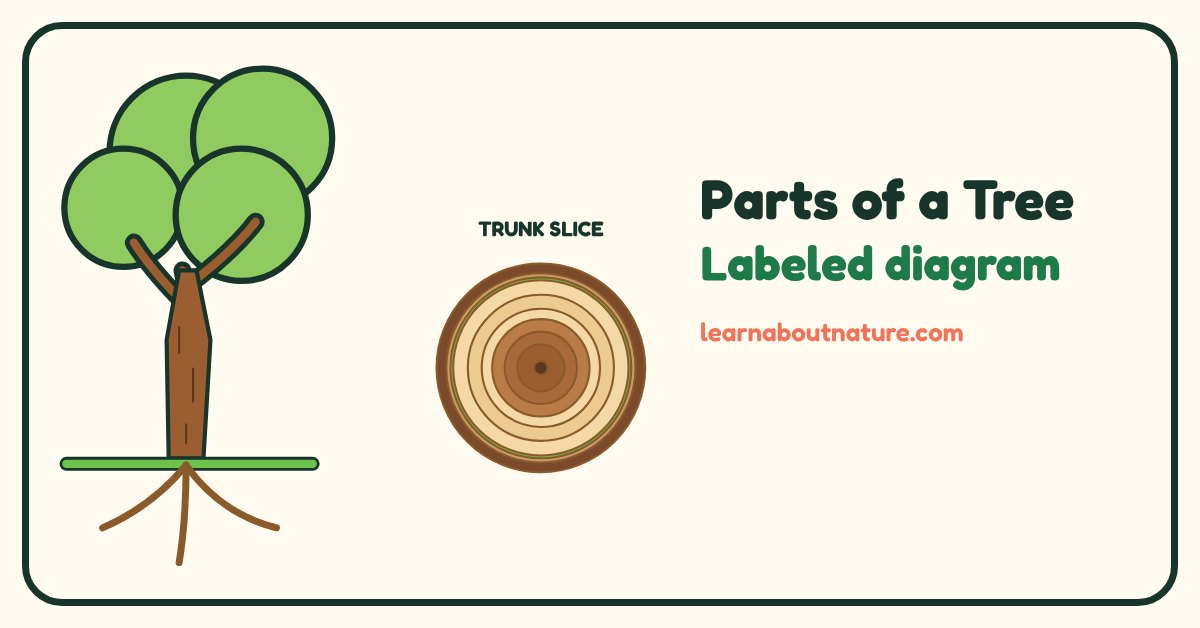
Quick answer: The main parts of a tree are the roots, which anchor it and take in water; the trunk, which holds it up and carries water and food; the branches; the leaves, which make food from sunlight; and the crown, the leafy top. Inside the trunk are bark, phloem, cambium, sapwood, heartwood and pith.
Trees are the largest plants on Earth, and some are among the oldest living things on the planet. A tree is still a plant with roots, a stem and leaves, but its stem has become a thick, woody trunk that can stand for hundreds of years.
This guide labels the main parts of a tree, then slices through the trunk to show the layers inside, from the rough outer bark to the tiny pith at the center. It also explains how tree rings form and how to count them to find a tree’s age.
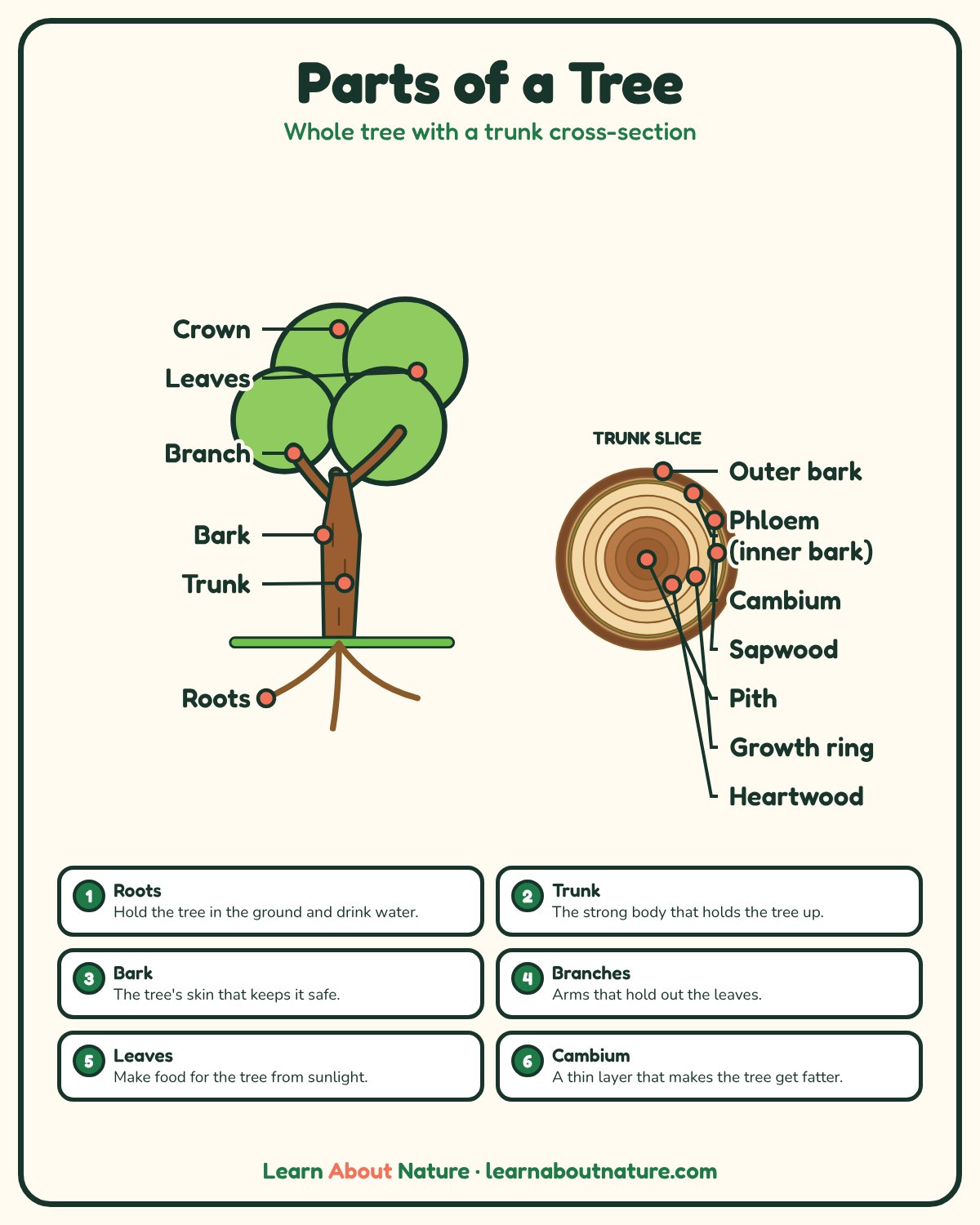
Teachers and students: you’re welcome to use this diagram in lessons and projects with credit to Learn About Nature.
Free printable: Download the Parts of a Tree labeling worksheet (PDF) – label the parts using the word bank. Answer key included.
Parts of a Tree and What They Do
| Part | What it does |
|---|---|
| Crown | Leafy top of the tree that catches sunlight |
| Leaves | Make food by photosynthesis and release oxygen |
| Branches | Hold leaves out to the light and carry water and food |
| Trunk | Supports the tree and links roots and crown |
| Roots | Anchor the tree, absorb water and minerals, store food |
| Outer bark | Protects the trunk from insects, weather, fire and drying out |
| Inner bark (phloem) | Carries sugar from the leaves to the rest of the tree |
| Cambium | Growing layer that makes new bark and new wood each year |
| Sapwood | Living wood that carries water up from the roots |
| Heartwood | Dead central wood that gives strength and support |
| Pith | Soft center left from the young stem |
| Growth rings | Yearly layers of wood that show age and growing conditions |
The Basic Plan of a Tree
A tree has three main sections. The roots grow underground. The trunk is the single woody stem that rises from the ground. The crown is everything above the trunk: the branches, twigs, leaves and, in many trees, flowers, fruits or cones.
What makes a tree different from a sunflower is wood. Each year a thin growing layer inside the trunk adds new wood, so the trunk, branches and roots keep getting thicker for the whole life of the tree.
Crown, Branches and Leaves
- Crown: The leafy top of the tree. Its shape, whether round, cone-shaped or spreading, helps people identify trees from a distance.
- Branches and twigs: Woody arms that hold the leaves out to catch sunlight and carry water out to them and food back to the trunk. New growth happens at buds on the twig tips.
- Leaves: The tree’s food factories. They use sunlight, water and carbon dioxide to make sugar by photosynthesis and release oxygen. Broadleaf trees such as oaks and maples have flat leaves; conifers such as pines have needles or scales.
Trunk and Roots
The trunk supports the weight of the crown and acts as the tree’s highway. Water and minerals travel up from the roots through the wood, while sugar made in the leaves travels down through the inner bark.
Roots anchor the tree, absorb water and minerals and store food for winter. Many people picture tree roots as a deep mirror image of the crown, but most roots grow in the top few feet of soil, where water and oxygen are easiest to reach. They often spread two to four times wider than the crown. Some trees, such as many oaks, also start with a deep taproot.
Inside the Trunk: The Layers From Outside In
Cut across a log and you will see a set of rings and bands. Each layer has a job.
- Outer bark: The tree’s armor. This layer of dead cork cells protects against insects, disease, fire, heat, cold and drying out. It keeps cracking and peeling as the trunk grows wider, which is why bark is often rough.
- Inner bark (phloem): A thin living layer that carries sugar from the leaves down to the trunk and roots. Its cells live only a short time, then become part of the outer bark.
- Cambium: A layer only a few cells thick and the part that makes the trunk grow wider. Each year it makes new phloem on its outside and new wood on its inside.
- Sapwood: Young, living wood (xylem) that carries water and minerals up from the roots to the leaves. It is usually paler in color.
- Heartwood: Older wood at the center that no longer carries water. Its cells are dead, and in many trees it is darker because it fills with natural chemicals that resist decay. It works like a strong backbone.
- Pith: A small spot of soft tissue at the very center, left over from the young twig the trunk once was.
Growth Rings and How to Count Them
In places with clear seasons, the cambium makes wood at different speeds through the year. In spring it makes large, thin-walled cells that look pale, called earlywood. Later in summer it makes smaller, thicker-walled cells that look darker, called latewood. One pale band plus one dark band makes one growth ring, usually equal to one year.
To estimate a tree’s age from a stump or log slice, start at the pith in the center and count outward, counting only the dark latewood bands, until you reach the bark. Scientists can also drill out a pencil-thin core from a living tree with a tool called an increment borer, without cutting it down.
- Wide rings usually mean a good growing year with plenty of water and warmth.
- Narrow rings can mean drought, cold, crowding or insect attack.
- Dark scars in the rings can show old fires or injuries.
- Counts are not always exact: a tree may skip a ring in a very bad year or form an extra false ring, so scientists check by matching patterns between many trees.
- Many tropical trees grow all year and show faint or no yearly rings.
How a Tree Moves Water and Food
Water enters through tiny root hairs and climbs through the sapwood, sometimes more than 300 feet in the tallest trees. It is pulled up mainly by water evaporating from the leaves, which tugs on the whole column of water below.
Sugar takes the opposite path, flowing down through the phloem in the inner bark. That is why removing a strip of bark all the way around a trunk, called girdling, can kill a tree: the roots are cut off from their food supply.
Broadleaf Trees and Conifers Compared
Broadleaf trees, also called hardwoods, include oaks, maples and cherries. Most have flat leaves and flowers that turn into fruits or nuts, and in cold climates many drop their leaves in autumn.
Conifers, also called softwoods, include pines, spruces and firs. They have needles or scales and make seeds in cones. Most keep their leaves all year, though larches drop their needles each fall. Both groups have the same trunk layers, but their wood cells are arranged differently.
Fun Facts About Trees
- Hyperion, a coast redwood in California, is the tallest known living tree at about 380 feet (116 meters).
- Some Great Basin bristlecone pines are more than 4,800 years old.
- Cork for bottle stoppers is the outer bark of the cork oak, which regrows after it is carefully stripped.
- Maple syrup is made by boiling down sugary sap collected from maple trees in early spring.
Parts of a Tree for Kids
- Roots: hold the tree in the ground and drink water.
- Trunk: the strong body that holds the tree up.
- Bark: the tree’s skin that keeps it safe.
- Branches: arms that hold out the leaves.
- Leaves: make food for the tree from sunlight.
- Cambium: a thin layer that makes the tree get fatter.
- Rings: each ring is usually one year of growing.
Key words: cambium – the thin growing layer under the bark that makes new wood and bark; phloem – tissue in the inner bark that carries sugar; xylem – wood tissue that carries water up from the roots; heartwood – the old, dead wood at the center of a trunk; growth ring – one year’s layer of wood seen in a cut trunk; dendrochronology – the science of dating events using tree rings.
Try this: Find a tree stump or a log slice, start at the center and count the dark rings outward to estimate its age, then look for wide and narrow rings and talk about which years might have been wet or dry.
Related Guides
- Tree life cycle
- Plant Cell vs Animal Cell
- Food Chain and Food Web
- Parts of a Seed
- Plant life cycle
- Angiosperm life cycle
- All labeled anatomy diagrams
Parts of a Tree FAQs
What are the main parts of a tree?
The main parts are the roots, trunk, branches, leaves and crown. Roots anchor the tree and take in water, the trunk supports it and carries water and food, branches hold out the leaves, and leaves make food from sunlight. The crown is the leafy top made of branches and leaves.
What are the layers of a tree trunk?
From outside to inside, a trunk has outer bark, inner bark (phloem), cambium, sapwood, heartwood and pith. The bark protects, the phloem carries sugar, the cambium makes new growth, the sapwood carries water, the heartwood gives support and the pith is the tiny center.
How do you count tree rings?
Start at the pith in the center of a cut stump or log and count outward to the bark. Count only the darker latewood bands, since one pale band plus one dark band usually equals one year. Rings can be hard to see, so a light sanding or a little water helps.
What is the difference between sapwood and heartwood?
Sapwood is the younger, outer wood that is still alive and carries water from the roots to the leaves. Heartwood is older wood at the center that no longer carries water. In many trees heartwood is darker and more resistant to decay, and it helps hold the tree up.
What does the cambium do in a tree?
The cambium is a very thin growing layer between the bark and the wood. Each year it makes new wood on its inner side and new inner bark on its outer side, which is how a trunk gets wider. Damage to the cambium all the way around a trunk can kill a tree.
Sources: Anatomy of a Tree | USDA Forest Service; Anatomy of a Tree | Arbor Day Foundation; About Tree Rings | Laboratory of Tree-Ring Research, University of Arizona

Nato is a content writer and researcher with a background in psychology who’s eager to explore the wonders of nature. As a travel enthusiast and animal lover, she hopes to inspire others to discover and cherish the beauty and importance of the natural world. She also writes about the history of candy and snacks for Snack History and about food and healthy eating for The Fitchen.