Parts of a Seed: Labeled Bean Seed Diagram and Functions
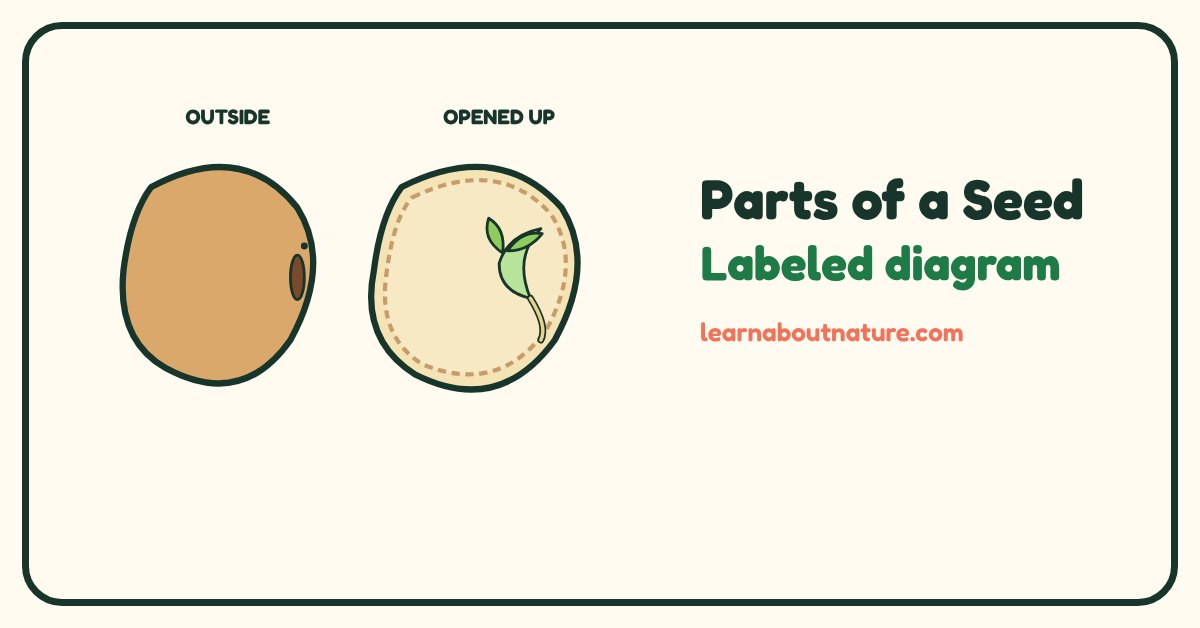
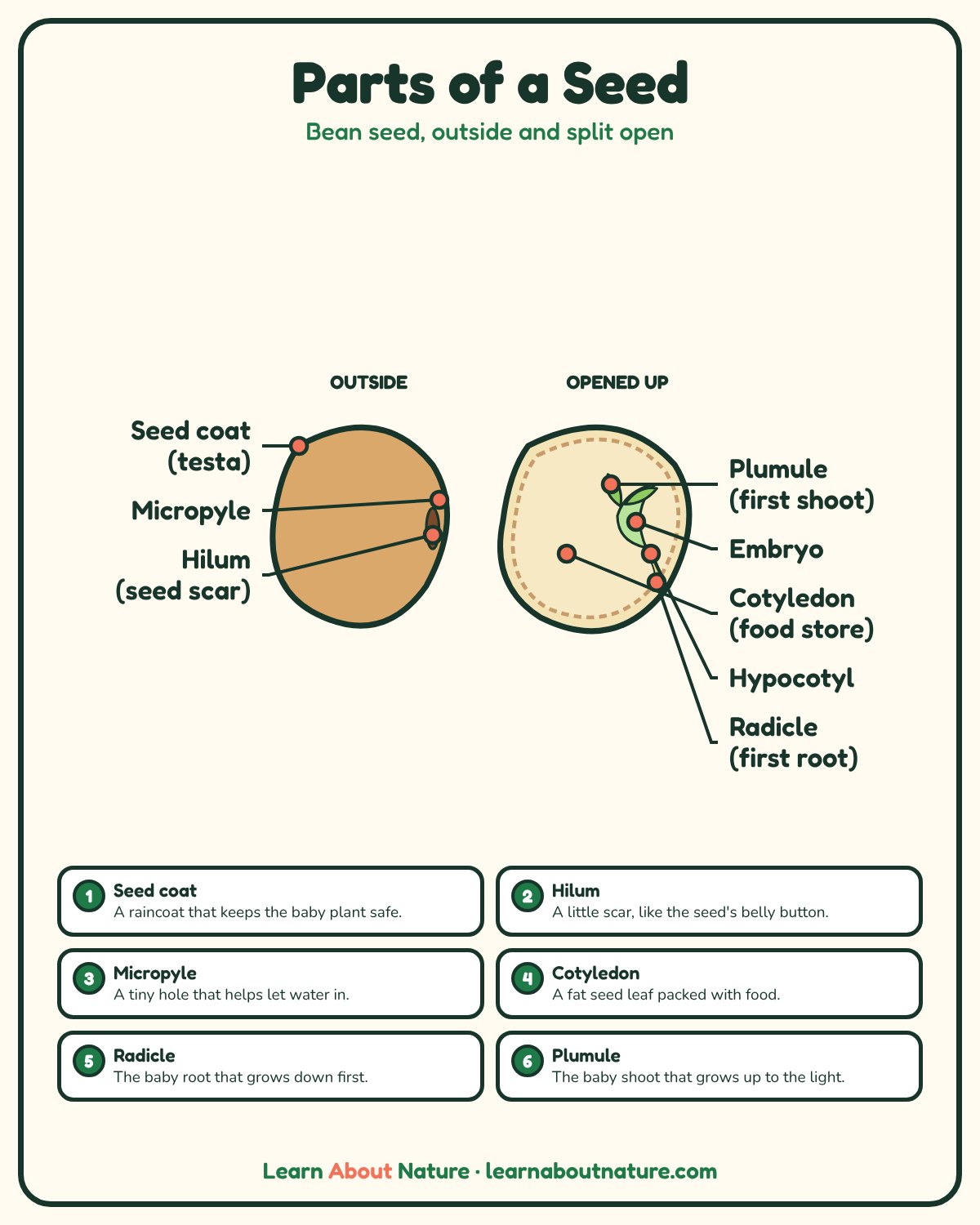
Quick answer: The main parts of a seed are the seed coat, or testa, which protects it; the embryo, the baby plant, made of the radicle (first root), plumule (first shoot) and hypocotyl; and the food store, held in the cotyledons or the endosperm. On the outside, the hilum is a scar and the micropyle is a tiny pore.
A seed is a baby plant in a lunchbox. Inside a tough coat, it carries a tiny living plant, called the embryo, plus enough stored food to get it started. Some seeds can wait months or even years for the right moment to grow.
The easiest seed to study is a large bean, such as a kidney or lima bean. Soak one overnight and its coat slips off, its two halves fall open and the baby plant is plain to see. This guide labels each part, explains what it does and compares a bean with a corn kernel.
Teachers and students: you’re welcome to use this diagram in lessons and projects with credit to Learn About Nature.
Free printable: Download the Parts of a Seed labeling worksheet (PDF) – label the parts using the word bank. Answer key included.
Parts of a Seed and What They Do
| Part | What it does |
|---|---|
| Seed coat (testa) | Protects the embryo from drying out, injury and decay |
| Hilum | Scar where the seed was attached to the fruit |
| Micropyle | Tiny pore where the pollen tube entered; water often enters near here |
| Embryo | The baby plant that will grow into a seedling |
| Radicle | Embryonic root; first part to emerge, becomes the main root |
| Plumule | Embryonic shoot with the first tiny leaves |
| Hypocotyl | Stem section between the radicle and the cotyledons |
| Epicotyl | Stem section above the cotyledons, below the plumule |
| Cotyledon | Seed leaf; stores food in beans or absorbs it in corn |
| Endosperm | Food-storage tissue; large in corn and wheat, used up in beans |
The Basic Plan of a Seed
Every seed has three main jobs: protect the embryo, feed it and help it start growing at the right time. To do this, a seed has three main parts. The seed coat is the protective outer layer. The embryo is the young plant. The food store is packed either into thick seed leaves called cotyledons or into a separate tissue called the endosperm.
A seed forms inside a flower after pollination. The ovule becomes the seed and its outer layers harden into the seed coat. The ovary around it ripens into the fruit.
Outside the Seed: Seed Coat, Hilum and Micropyle
- Seed coat (testa): The outer skin. It shields the embryo from drying out, injury, insects and decay. In some seeds it is thin and papery; in others, such as many wild beans, it is hard and can stop water getting in until it is scratched or worn.
- Hilum: A scar on the seed coat where the seed was attached by a little stalk to the inside of the fruit, like a belly button. On a bean it is the pale or dark oval mark on the inner curve.
- Micropyle: A tiny pore next to the hilum. It is where the pollen tube entered the ovule before the seed formed. In many seeds, water soaks in through this area when germination begins.
Inside the Seed: The Embryo
The embryo is a complete miniature plant with its parts already in place. In a bean it lies curled along one edge, between the two cotyledons.
- Radicle: The embryonic root. It is usually the first part to break out of the seed, and it grows downward to become the main root.
- Plumule: The embryonic shoot, with the first tiny leaves folded at its tip. It grows upward toward the light.
- Hypocotyl: The short section of stem between the radicle and the point where the cotyledons attach.
- Epicotyl: The section of stem above the cotyledons, leading up to the plumule.
Food Stores: Cotyledons and Endosperm
Cotyledons are seed leaves, the first leaves of the embryo. In a bean they are huge and fleshy and make up most of the seed. They hold the stored starch and protein that feed the seedling until it can make its own food by photosynthesis.
Endosperm is a separate food-storage tissue around or beside the embryo. In beans and peas the endosperm is used up as the seed develops, and its food is moved into the cotyledons. In corn, wheat and rice the endosperm stays and fills most of the grain. White flour is made mostly from wheat endosperm.
Monocot vs Dicot Seeds
Flowering plants are often sorted by how many cotyledons their seeds have. Dicots have two, and monocots have one. A bean is a dicot; a corn kernel is a monocot.
Strictly, a corn kernel is a tiny fruit with the seed coat fused to the fruit wall, but it is usually studied as a seed.
- Number of cotyledons: bean has two; corn has one, called the scutellum.
- Where food is stored: bean stores food in its cotyledons; corn stores it in a large endosperm.
- Job of the cotyledon: bean cotyledons store food; the corn scutellum absorbs food from the endosperm and passes it to the embryo.
- Protective sheaths: corn has a sheath over the young shoot (coleoptile) and another over the young root (coleorhiza); a bean does not.
- Seedling leaves: dicot seedlings usually have net-veined leaves; monocot seedlings, like grasses, have long leaves with parallel veins.
How a Seed Germinates
Germination is when the embryo wakes up and starts to grow. Most seeds need water, oxygen and a suitable temperature. Some also need light, darkness or a cold spell first. Until then, a seed rests in a state called dormancy.
First the seed soaks up water and swells, splitting its coat. The radicle pushes out and grows down. In a common bean, the hypocotyl then forms a hook, pulls the cotyledons above the ground and straightens, and the plumule opens into the first true leaves. The cotyledons shrink as their food is used up, then fall off. In peas and corn, the cotyledons stay underground and only the shoot comes up.
How Seeds Travel
A seedling that sprouts right under its parent has to compete for light and water, so many plants have ways to send their seeds farther away. The shape of a seed or its fruit often gives away how it travels.
- Wind: Dandelion seeds float on fluffy parachutes, and maple seeds spin like tiny helicopters.
- Water: Coconuts can float across the sea and still sprout on a distant beach.
- Animals: Birds and mammals eat berries and drop the seeds in their droppings, often with a little fertilizer. Burrs hook onto fur and socks, and squirrels bury acorns and forget some of them.
- Bursting pods: Some plants, such as touch-me-nots and many beans and violets, fling their seeds out when the dry pod splits open.
Fun Facts About Seeds
- A date palm seed about 2,000 years old, found at Masada in Israel, was sprouted in 2005 and grew into a healthy plant.
- Coconuts are seeds inside a fruit; the coconut water and white flesh are endosperm.
- Orchid seeds are as fine as dust and carry almost no stored food, so they need help from fungi to grow.
- Popcorn pops because water inside the starchy endosperm turns to steam and bursts the hard hull.
Parts of a Seed for Kids
- Seed coat: a raincoat that keeps the baby plant safe.
- Hilum: a little scar, like the seed’s belly button.
- Micropyle: a tiny hole that helps let water in.
- Cotyledon: a fat seed leaf packed with food.
- Radicle: the baby root that grows down first.
- Plumule: the baby shoot that grows up to the light.
- Endosperm: a food store that feeds the baby plant.
Key words: embryo – the tiny young plant inside a seed; cotyledon – a seed leaf that stores or absorbs food for the young plant; germination – when a seed starts to grow into a seedling; dormancy – a resting stage when a seed waits for good conditions; monocot – a flowering plant whose seeds have one cotyledon; dicot – a flowering plant whose seeds have two cotyledons.
Try this: Soak a few dried lima or kidney beans in water overnight, peel off the seed coat, gently split each bean in half and use a magnifying glass to find and draw the cotyledons, radicle and plumule.
Related Guides
- Bean plant life cycle
- Parts of a Mushroom
- Food Chain and Food Web
- Plant Cell vs Animal Cell
- Plant life cycle
- Angiosperm life cycle
- All labeled anatomy diagrams
Parts of a Seed FAQs
What are the 3 main parts of a seed?
The three main parts are the seed coat, which protects the seed; the embryo, which is the baby plant; and the stored food, found in the cotyledons or the endosperm. Together they protect the young plant, feed it and let it start growing when conditions are right.
What is the difference between the radicle and the plumule?
The radicle is the embryonic root. It usually comes out of the seed first and grows downward to become the main root. The plumule is the embryonic shoot, with the first tiny leaves, and it grows upward to become the stem and leaves.
What is the function of the cotyledon?
Cotyledons are seed leaves. In beans and peas they store the food the seedling uses until it can make its own by photosynthesis. In corn and other grasses, the single cotyledon absorbs food from the endosperm and passes it to the growing embryo.
What is the hilum of a seed?
The hilum is a scar on the seed coat marking where the seed was attached by a short stalk to the fruit wall. On a bean it is easy to see as an oval mark on the inner curve. A tiny pore called the micropyle lies right next to it.
What do seeds need to germinate?
Most seeds need water, oxygen and a suitable temperature. Water makes the seed swell and wakes up its stored food, oxygen lets the cells release energy, and warmth lets growth happen. Some seeds also need light, darkness or a period of cold before they will sprout.
Sources: Mature Embryos and Seed Structure | Botany (Ha, Morrow and Algiers), LibreTexts; Part 5: Plant reproduction | OpenLearn Create, The Open University; Chapter 1: Botany | Virginia Cooperative Extension Master Gardener Handbook; 2,000-Year-Old Seed Sprouts, Sapling Is Thriving | National Geographic

Nato is a content writer and researcher with a background in psychology who’s eager to explore the wonders of nature. As a travel enthusiast and animal lover, she hopes to inspire others to discover and cherish the beauty and importance of the natural world. She also writes about the history of candy and snacks for Snack History and about food and healthy eating for The Fitchen.