Octopus Facts for Kids: Habitat, Diet, Body and Fun Facts
Quick answer: An octopus is a soft-bodied ocean animal with eight arms and no bones. It is a mollusk, related to squid and snails. About 300 kinds of octopus live in oceans around the world, mostly on the seafloor. Octopuses eat crabs, clams and fish, and they can change color in a flash to hide.
Even a large octopus can squeeze through a gap about 1 inch (2.5 cm) wide. It can change color in a flash and squirt a cloud of ink to escape. It can also open jars and solve puzzles. No wonder many people think the octopus is one of the cleverest animals in the sea.
Octopuses have three hearts, blue blood and eight arms that can almost think for themselves. Here is how these amazing invertebrates live, hunt, hide and raise their young.
Teachers and students: you’re welcome to use this fact sheet in lessons and projects with credit to Learn About Nature.
Free printable: Download the Octopus fact file worksheet (PDF) – draw the animal, fill in the facts and match key words. Answer key included.
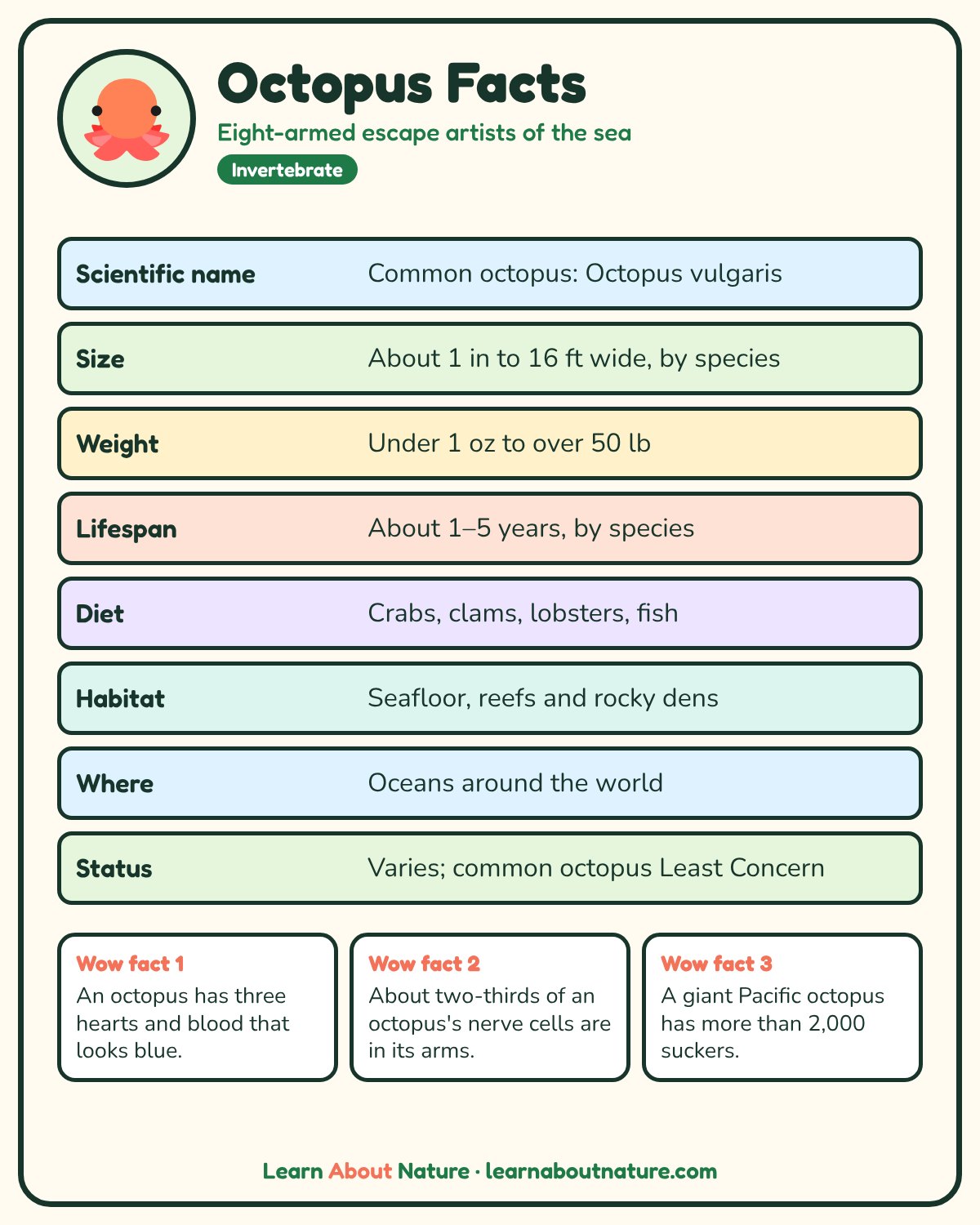
Octopus Quick Facts
| Phylum | Mollusk (Mollusca) |
| Class | Cephalopod (Cephalopoda) |
| Number of species | About 300 |
| Example species | Common octopus (Octopus vulgaris) |
| Largest | Giant Pacific octopus, arm span up to about 16 ft |
| Hearts | 3 |
| Lifespan | About 1–2 years for most; giant Pacific 3–5 years |
| Baby name | Paralarva (plural: paralarvae) |
| Conservation status | Varies; common octopus and giant Pacific octopus Least Concern (IUCN) |
What Is an Octopus?
An octopus is an invertebrate, an animal with no backbone. In fact, it has no bones at all. It belongs to the mollusks, the same big group as snails and clams. More exactly, it is a cephalopod, a group that also includes squid, cuttlefish and the nautilus.
There are about 300 known species of octopus. Two well-known ones are the common octopus, found in warm and mild seas such as the Mediterranean and the Atlantic, and the giant Pacific octopus, the largest octopus in the world.
Where Do Octopuses Live?
Octopuses live in oceans all over the world, from warm coral reefs to cold, deep waters. Most live on or near the seafloor, where they hide in cracks, under rocks or inside empty shells. An octopus’s home is called a den.
The common octopus lives in tropical and temperate waters, including the eastern Atlantic from southern England to South Africa. The giant Pacific octopus lives in the cool North Pacific, from Japan and Korea across to Alaska, Canada and the west coast of the United States and Mexico.
What Do Octopuses Eat?
Octopuses are carnivores. They mostly eat crabs, clams, lobsters and other shellfish, plus fish and snails. The giant Pacific octopus has even been known to catch seabirds and other octopuses.
An octopus often hunts by feeling around in cracks with its arms, grabs prey with its suckers and pulls it toward its mouth. In the center of its arms is a hard, sharp beak, a bit like a parrot’s, which can crack open shells. All octopuses have venom in their bite, which helps them quiet their prey.
Body and Senses
An octopus has a soft, rounded body called a mantle and eight arms lined with suckers. The suckers can grip, taste and feel. A giant Pacific octopus has more than 2,000 of them.
Sizes vary a lot. A common octopus has a body up to about 10 inches (25 cm) long, arms up to about 3 feet (1 m), and weighs up to about 20 pounds (9 kg). A full-grown giant Pacific octopus often weighs more than 50 pounds, with a body about 2 feet (60 cm) long and an arm span that can stretch more than 13 feet (4 m).
Octopuses have three hearts. Two pump blood through the gills, and one pumps it to the rest of the body. Their blood uses a copper-based substance called hemocyanin to carry oxygen, which gives it a bluish color.
The octopus has over 500 million nerve cells, about as many as a dog. Around two-thirds of them are in its arms, so each arm can sense and react on its own.
Octopuses are masters of disguise. Special skin cells called chromatophores hold colored pigments that let them change color in a flash. They can even change the texture of their skin to look bumpy like a rock or smooth like sand.
Octopus Babies
Octopus mothers are devoted parents. A female lays her eggs inside a den and stays to guard them, gently blowing fresh water over them to keep them clean. A giant Pacific octopus lays about 18,000 to 74,000 eggs in long strings and may guard them for up to six months.
During this time the mother stops eating. She usually dies soon after the eggs hatch. Males also die not long after mating. This short life is a normal part of the octopus life cycle.
In many species, the tiny babies, called paralarvae, drift in the ocean as plankton for weeks or months before settling to the seafloor. Most octopuses live only one to two years, but the giant Pacific octopus lives about three to five years.
How Octopuses Stay Safe
Many animals, including fish, seabirds, seals, sea otters and dolphins, like to eat octopuses. So octopuses have lots of tricks for staying safe.
Most of the time, an octopus hides by blending in with its surroundings. If a predator spots it, the octopus can shoot out a dark cloud of ink to block the predator’s view, then zoom away. For a fast escape, it pushes water out through a tube called a siphon, which works like jet propulsion. Swimming this way is tiring, though. The main heart slows down while an octopus swims, so most of the time it prefers to crawl along the bottom on its arms.
Because it has no bones, an octopus can squeeze through tiny openings. Some octopuses also use tools. The veined octopus collects empty coconut shells and carries them around to use as a shelter.
Octopus vs Squid
Octopuses and squid are close cousins, but they are easy to tell apart once you know what to look for:
- Arms: an octopus has eight arms with suckers all along them. A squid has eight arms plus two longer tentacles with suckers mostly near the tips.
- Body: an octopus has a soft, round body. A squid has a long, torpedo-shaped body with fins.
- Lifestyle: most octopuses live alone on the seafloor and hide in dens. Many squid swim in open water, often in groups.
- Inside: squid have a stiff, feather-shaped support inside the body called a pen. Most octopuses have no stiff support like this, and their hardest body part is the beak.
Threats and Conservation Status
Conservation status varies by species. On the IUCN Red List, the common octopus is Least Concern (assessed in 2018), and the giant Pacific octopus is also listed as Least Concern (assessed in 2018). Many octopus species have not been studied enough for scientists to judge how they are doing.
Octopuses are caught for food and bait in many parts of the world. In North America alone, up to about 3,500 tons of giant Pacific octopus are caught each year. Because they live short lives and lay many eggs, some populations can recover quickly, but overfishing, pollution and damage to reefs and coasts can still harm them.
Fun Facts About Octopuses
Here are a few more octopus surprises:
- The plural of octopus is octopuses.
- The smallest octopus is about 1 inch (2.5 cm) long and weighs less than a paper clip.
- An octopus arm can keep moving and reacting for a while even after it is cut off.
- Blue-ringed octopuses are small but have venom that is dangerous to people, so they should never be touched.
- Giant Pacific octopuses in aquariums have learned to open jars to get food inside.
Fast Facts for Young Readers
- An octopus has eight arms and no bones.
- It has three hearts and blue blood.
- Octopuses can change color to hide.
- They squirt ink to escape from danger.
- An octopus home is called a den.
- Mother octopuses guard their eggs.
- Octopuses are very good at solving puzzles.
Key words: invertebrate – an animal without a backbone; cephalopod – a group of sea animals with arms around the head, like octopuses and squid; chromatophore – a skin cell filled with color that helps an octopus change color; paralarva – a tiny baby octopus that drifts in the ocean; siphon – a tube an octopus uses to squirt water and move fast.
Try this: Play octopus camouflage: give students paper octopus cut-outs to color so they blend into a patterned background somewhere in the classroom, then see which ones classmates find last.
Related Guides
- Octopus Anatomy
- Octopus life cycle
- Blue Whale facts for kids
- Shark facts for kids
- Orca facts for kids
- Starfish facts for kids
- All animal facts for kids
Octopus FAQs
Does an octopus really have three hearts?
Yes. An octopus has three hearts. Two small hearts pump blood through the gills, where it picks up oxygen, and one main heart pumps it around the rest of the body. Their blood uses copper to carry oxygen, which makes it look blue.
Are octopus legs arms or tentacles?
An octopus has eight arms, not tentacles. Arms have suckers along their whole length. Tentacles are longer and usually have suckers only near the tip. Squid and cuttlefish have both arms and tentacles, but octopuses have only arms.
How smart are octopuses?
Octopuses are very intelligent for invertebrates. They have about 500 million nerve cells, around as many as a dog. In aquariums they can learn to open jars and solve puzzles, and in the wild some even carry coconut shells to use as shelters.
How long do octopuses live?
Most octopuses live only about one to two years. The giant Pacific octopus lives longer, about three to five years. Females usually die soon after their eggs hatch, after spending weeks or months guarding them without eating.
Are octopuses endangered?
Most well-known octopuses are not. On the IUCN Red List, the common octopus and the giant Pacific octopus are both listed as Least Concern. Many of the roughly 300 octopus species, though, have not been studied enough for scientists to know how they are doing.
Sources: Monterey Bay Aquarium: Giant Pacific Octopus; Wikipedia: Octopus; Wikipedia: Common octopus; Wikipedia: Giant Pacific octopus

Nato is a content writer and researcher with a background in psychology who’s eager to explore the wonders of nature. As a travel enthusiast and animal lover, she hopes to inspire others to discover and cherish the beauty and importance of the natural world. She also writes about the history of candy and snacks for Snack History and about food and healthy eating for The Fitchen.