Ostrich Life Cycle: From Giant Egg to Adult
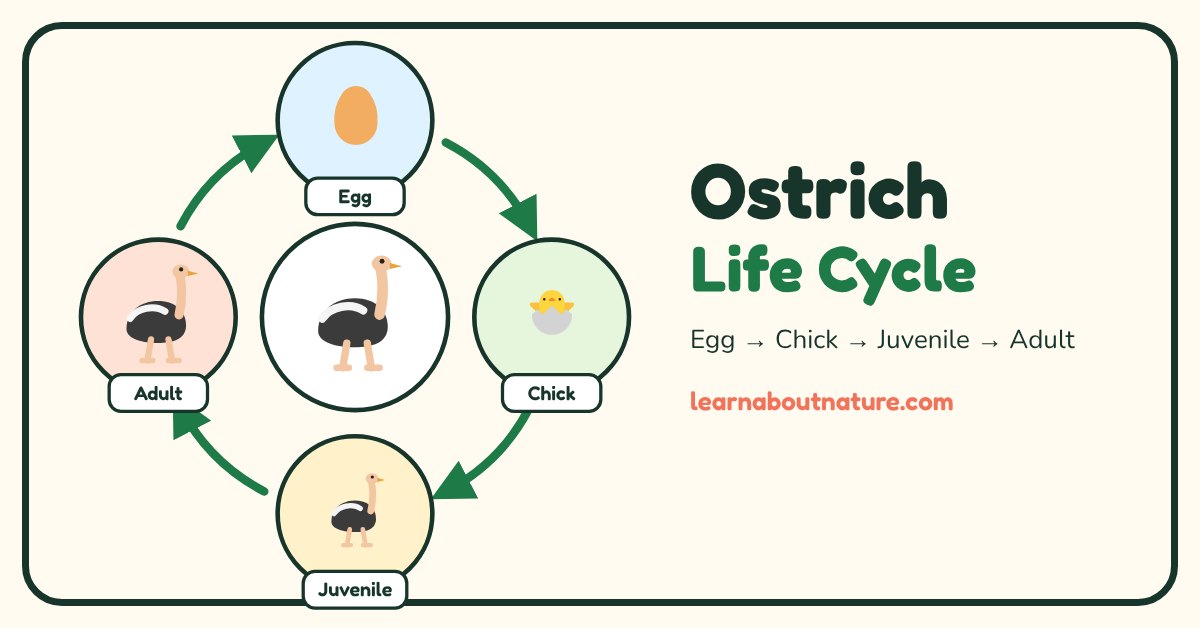
Quick answer: An ostrich’s life cycle has four stages: egg, chick, juvenile and adult. Ostriches lay the largest eggs of any living bird, and parents take turns keeping them warm for about six weeks. Chicks hatch chicken-sized, grow about a foot a month, reach nearly full size by six months, and can breed at about 3 to 4 years.
The ostrich is the largest living bird. A grown male can stand about 9 ft (2.75 m) tall and outweigh most people. Ostriches cannot fly, but they are the fastest runners of any bird, sprinting at up to about 43 mph (70 km/h).
Ostriches live in the open savannas and dry plains of Africa. This page follows the common ostrich through its four life stages, from an egg the size of a small melon to a towering adult. Along the way, you will learn about shared nests, night-shift fathers and huge groups of chicks.
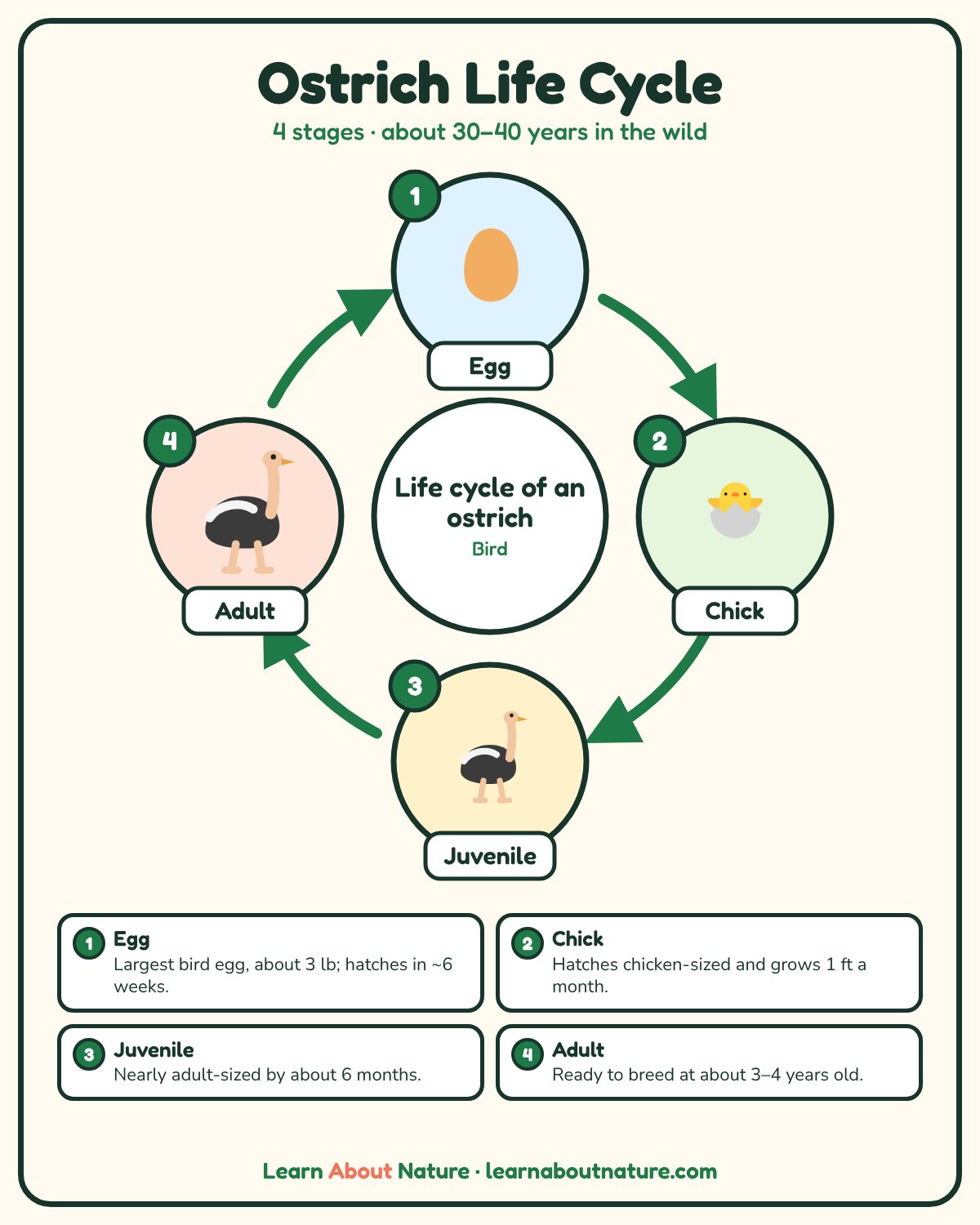
Teachers and students: you’re welcome to use this diagram in lessons and projects with credit to Learn About Nature.
Free printable: Download the Ostrich life cycle worksheet (PDF) – label the diagram, cut and sequence the stages, and match key words. Answer key included.
Ostrich Life Cycle Quick Facts
| Main example | Common ostrich (Struthio camelus) |
| Eggs per hen | about 7–10 per nesting |
| Egg size | about 6 in (15 cm), 3 lb (1.4 kg) |
| Incubation | about 42–46 days |
| Chick growth | about 1 ft (30 cm) a month |
| Near adult height | about 6 months |
| Breeding age | about 3–4 years |
| Adult height | up to about 9 ft (2.75 m) |
| Lifespan | about 30–40 years in the wild |
Courtship and Mating
Breeding usually happens just before or during the rainy season, so the chicks hatch when plenty of food is around. An adult male, called a cock, claims a territory and tries to attract females, called hens.
To show off, the male performs a dance. He drops to the ground, sways his head and neck, and flaps his big white wing feathers one side at a time. During the breeding season, the bare skin on a male’s neck and legs often turns brighter pink or red.
Ostriches have an unusual family setup. The male mates with one main hen, often called the major hen, but several other hens may mate with him too and lay their eggs in the same nest.
Stage 1: Egg
The male digs the nest, a simple shallow scrape in the sand or bare ground, using his strong legs. The major hen lays her eggs first, then other hens add theirs. Each hen lays about 7 to 10 eggs, so a shared nest can end up with dozens of eggs, sometimes as many as 50 or 60.
Ostrich eggs are the largest eggs of any living bird. Each one is about 6 inches (15 cm) long and weighs about 3 lb (1.4 kg), as much as roughly two dozen chicken eggs. The shell is shiny, cream-white and very thick.
There are often more eggs than the parents can cover. The major hen can recognize her own eggs and keeps them in the middle of the nest, where they are best protected. Eggs laid by other hens may be pushed to the edges, and some are left out entirely.
Incubation: Day and Night Shifts
The eggs need about 6 weeks of warmth, roughly 42 to 46 days, before they hatch. The major hen and the male share the job of incubation, and their colors help them hide while they work.
During the day, the hen sits on the nest. Her soft brown-gray feathers blend in with the dry grass and sand. At night, the male takes over. His black feathers are hard to see in the dark.
An ostrich sitting on a nest may lie flat with its long neck stretched along the ground to avoid being noticed. This might be where the old myth comes from that ostriches bury their heads in the sand. They do not really do that.
Stage 2: Chick
When it is time to hatch, the chick breaks through the thick shell using its bill, neck and legs. This can be hard work. A newly hatched ostrich chick is about the size of a farm chicken. It is covered in stiff, spiky, tan down with dark spots and stripes on its head and neck that help it blend in.
Chicks are precocial, meaning they can walk and feed themselves soon after hatching. They follow their parents across the savanna, pecking at plants, seeds and insects.
Ostrich chicks grow incredibly fast, gaining about 1 ft (30 cm) in height every month. By one month old, they can keep up with running adults, reaching speeds of about 35 mph (56 km/h). When danger comes, chicks may flatten themselves on the ground and freeze while the parents try to distract or chase off the predator.
Crèches: Ostrich Nurseries
When two ostrich families meet, the adults sometimes face off. The winning pair takes charge of all the chicks, adding the other family’s young to its own group.
Over time, these groups can grow into huge nurseries, or crèches. Some hold up to about 300 chicks looked after by just a couple of adults. Being part of a large group helps protect each chick, because predators such as lions, hyenas, jackals and birds of prey have a harder time singling one out.
Stage 3: Juvenile
By about 4 months old, the chick’s fuzzy down has been replaced by real feathers. Young ostriches of both sexes look similar, with dull brown-gray feathers, so it is hard to tell males from females.
Young ostriches eat mostly plants, such as leaves, roots, flowers and seeds, along with the occasional insect or small animal. Like many birds, they swallow small stones and grit. The stones stay in a muscular part of the stomach called the gizzard, where they help grind up tough food. Ostriches can also get much of the water they need from the plants they eat, which helps them live in dry places.
Thanks to their rapid growth, juveniles are nearly as tall as their parents by about 6 months old. They keep filling out and getting stronger over the next couple of years, while they learn to find food and avoid predators. Many chicks do not survive this far, but those that do have few enemies once they reach full size.
Stage 4: Adult
Ostriches become mature at about 3 to 4 years old. At this age, males grow their striking black-and-white feathers, while females keep their brown-gray coloring.
Adult females usually stand about 5.7 to 6.2 ft (1.7 to 1.9 m) tall and weigh about 200 to 240 lb (90 to 110 kg). Males are taller and heavier, often weighing 220 to 290 lb (100 to 130 kg) or more. Each foot has just two toes, one much larger than the other, which helps them run fast. A strong forward kick from an adult ostrich can be dangerous to predators.
Outside the breeding season, adult ostriches often live in small groups. They are sometimes seen feeding near zebras and antelopes, where many watchful eyes and the ostrich’s height and sharp eyesight help everyone spot predators sooner.
When a mature male wins a territory and a hen joins him, he digs a new nest scrape, and the life cycle starts again.
How Long Do Ostriches Live?
Ostriches live about 30 to 40 years in the wild. In zoos and on farms, they can live to about 50 years, and a few have lived even longer.
The common ostrich is listed as Least Concern by the IUCN, but it has disappeared from much of North Africa and the Middle East because of hunting and habitat loss. The Arabian ostrich became extinct in the 20th century, and the North African population is now very small. A separate species, the blue-necked Somali ostrich of the Horn of Africa, is considered threatened.
Interesting Ostrich Facts
- One ostrich egg weighs about as much as two dozen chicken eggs.
- Ostriches have only two toes on each foot.
- Ostrich chicks grow about 1 ft (30 cm) taller every month at first.
- Hens sit on the nest by day, and males take the night shift.
- Ostriches do not bury their heads in the sand; they may lie flat to hide.
Ostrich Life Cycle for Kids
Here is the ostrich life cycle in simple steps:
- Egg: The ostrich egg is the biggest bird egg in the world.
- Chick: The spiky, fluffy chick hatches and soon runs after its parents.
- Juvenile: The young ostrich grows super fast and gets real feathers.
- Adult: The grown-up ostrich is the biggest bird on Earth.
Key words: hen – an adult female ostrich; cock – an adult male ostrich; incubate – to keep an egg warm so the baby inside can grow; precocial – able to walk and feed soon after hatching; crèche – a big group of young animals looked after together; flightless – not able to fly.
Try this: Measure and cut a paper ostrich egg about 6 inches (15 cm) long, then line up real or paper chicken eggs next to it to compare their sizes.
Related Life Cycles and Guides
- Flamingo life cycle
- Swan life cycle
- Bird life cycle
- Chicken life cycle
- Owl life cycle
- Bird anatomy
- All animal & plant life cycles
Ostrich Life Cycle FAQs
How big is an ostrich egg?
An ostrich egg is about 6 inches (15 cm) long and weighs about 3 lb (1.4 kg). It is the largest egg laid by any living bird and is roughly equal to two dozen chicken eggs. The shiny, cream-colored shell is very thick and strong.
How long does it take an ostrich egg to hatch?
Ostrich eggs hatch after about six weeks of incubation, usually 42 to 46 days. The main hen sits on the eggs during the day, and the male takes over at night, when his black feathers help hide the nest in the dark.
How many eggs does an ostrich lay?
Each ostrich hen lays about 7 to 10 eggs per nesting. Because several hens may lay in the same nest, a shared nest can hold dozens of eggs, sometimes 50 or more. That is often more than the parents can cover, so some eggs at the edges never hatch.
How fast do baby ostriches grow?
Ostrich chicks grow about 1 foot (30 cm) taller every month at first. They can keep up with running adults by one month old, and by about six months they are almost as tall as their parents.
How long do ostriches live?
Ostriches live about 30 to 40 years in the wild. In zoos and on farms they can reach about 50 years. They grow up quickly but do not become fully mature and ready to breed until they are about 3 to 4 years old.
Sources: Ostrich – San Diego Zoo Wildlife Alliance Animals and Plants; Ostrich – Smithsonian’s National Zoo; Ostrich – Los Angeles Zoo; Struthio camelus (ostrich) – Animal Diversity Web; Ostrich – Britannica

Nato is a content writer and researcher with a background in psychology who’s eager to explore the wonders of nature. As a travel enthusiast and animal lover, she hopes to inspire others to discover and cherish the beauty and importance of the natural world. She also writes about the history of candy and snacks for Snack History and about food and healthy eating for The Fitchen.