Camel Life Cycle: Stages From Calf to Adult
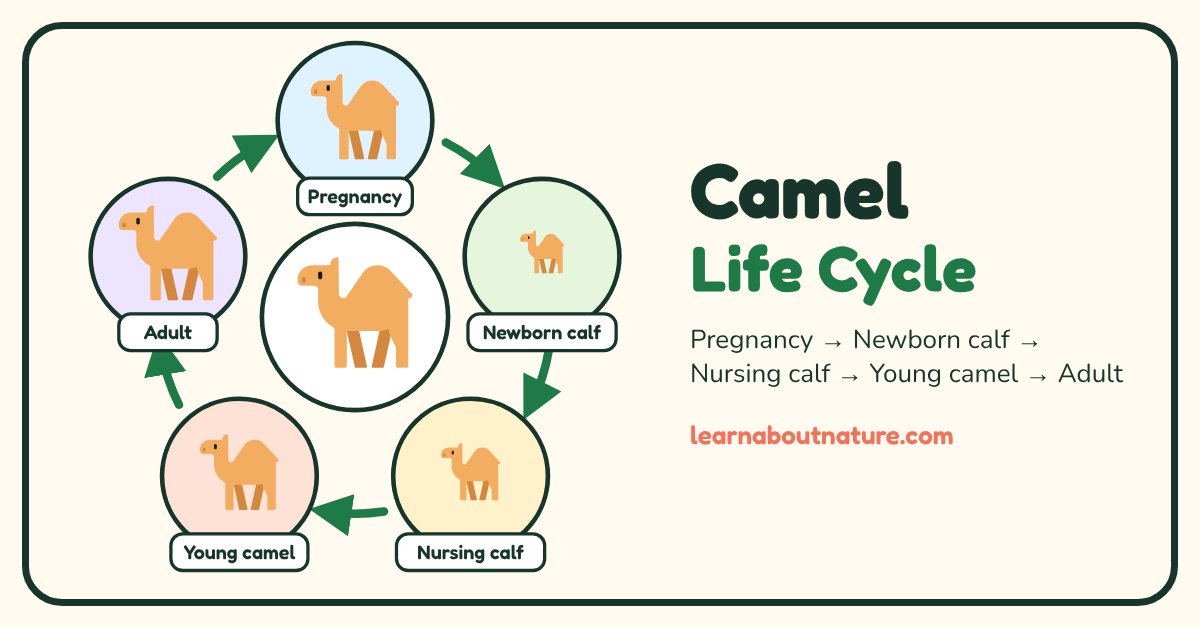
Quick answer: A camel’s life cycle has five stages: pregnancy, newborn calf, nursing calf, young camel and adult. A dromedary mother is pregnant for about 13 months and has one calf, born without a hump. The calf walks within hours, nurses for a year or more, and grows into an adult that can breed at about 4 to 6 years.
Camels are famous for crossing hot, dry deserts where few other large animals could survive. There are two main kinds: the one-humped dromedary, also called the Arabian camel, and the two-humped Bactrian camel of Central Asia.
This page follows the dromedary, which makes up about 90 percent of the world’s camels. Dromedaries have lived alongside people for thousands of years and today exist almost entirely as domestic animals, though some herds roam free. Their life cycle is slow and steady, with a long pregnancy and a calf that stays with its mother for a long time.
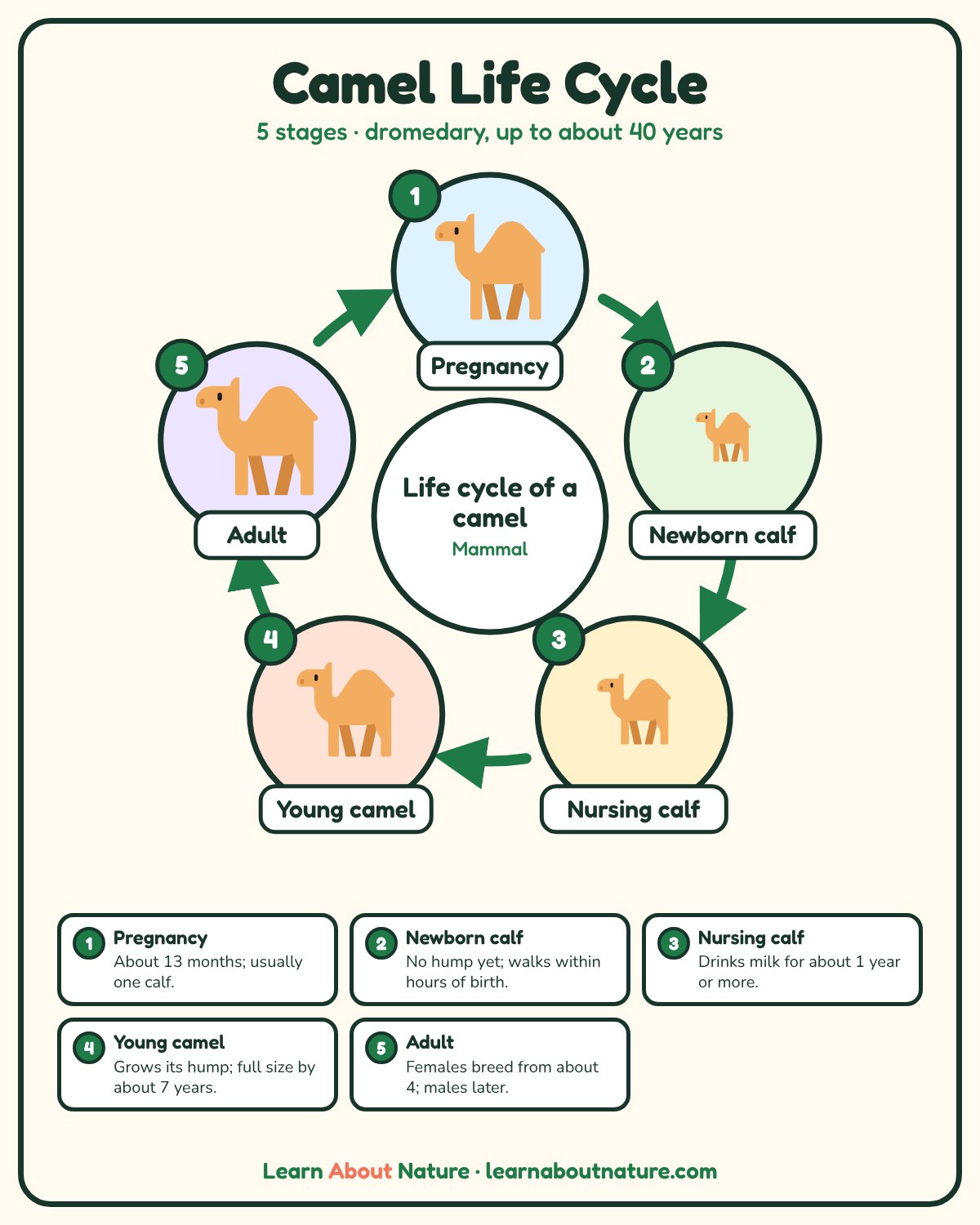
Teachers and students: you’re welcome to use this diagram in lessons and projects with credit to Learn About Nature.
Free printable: Download the Camel life cycle worksheet (PDF) – label the diagram, cut and sequence the stages, and match key words. Answer key included.
Camel Life Cycle Quick Facts
| Main example | Dromedary (Camelus dromedarius) |
| Pregnancy | about 13 months |
| Babies per birth | 1 calf (twins very rare) |
| Weight at birth | about 77 lb (35 kg) on average |
| Nursing | about 10–18 months |
| Breeding age | females about 4–5, males about 6 years |
| Full size | about 7 years |
| Adult weight | about 880–1,320 lb (400–600 kg) |
| Lifespan | up to about 40 years |
Mating and Breeding
Dromedaries usually breed in the cooler, rainier part of the year, so that calves are born when there is more food around. The exact months depend on the region.
During the breeding season, adult males, called bulls, become restless and noisy. A bull may blow a pink, balloon-like flap of skin called a dulla out of the side of his mouth, gurgle loudly and stand as tall as he can to show off. Rival bulls sometimes fight by pushing, biting at each other’s legs and trying to knock each other down.
Stage 1: Pregnancy
Camel pregnancies are long. A dromedary mother, called a cow, carries her calf for about 13 months. Some last a little more than a year, while others go on for a few weeks longer. A large study of dromedaries found an average of about 384 days.
Because pregnancy takes so long, and the mother nurses her calf for a year or more afterward, a female camel usually has a calf only about once every two years. Twins are very rare.
When it is nearly time to give birth, the mother often leaves the herd and finds a quiet, sheltered spot with some plants nearby.
Stage 2: Newborn Calf
A baby camel is called a calf. Newborn dromedaries are large babies, on average about 77 lb (35 kg), though weights vary a lot from calf to calf.
A calf is born without a hump. Instead, it has just a small bump of skin topped with a tuft of curly hair where the hump will grow. Its coat is often lighter and fluffier than an adult’s.
Camel calves are up on their long legs very quickly. A newborn can usually stand and walk beside its mother within a few hours, and by the end of its first day it can move around freely. This matters in the open desert, where a calf must keep up with its mother. After a couple of weeks, mother and calf rejoin the herd.
Stage 3: Nursing Calf
For the next year or more, the calf drinks its mother’s milk. Calves nurse for about 10 to 18 months, depending on how much food is available. During that time, they also start nibbling the same leaves, grasses and thorny desert shrubs that adults eat.
The mother stays close and protects her calf. Camels in a herd keep in touch with grunts, moans and bellows, and calves stay near their mothers as the herd moves from place to place in search of food and water.
Camel milk is also an important food for people in many dry regions. In herds kept by people, the calf and the herders often share the mother’s milk.
Stage 4: Young Camel
Once it stops nursing, the young camel eats plants on its own and slowly grows its hump. The hump is not full of water, as many people think. It is a store of fat that the camel can use for energy when food is scarce. When a camel goes a long time without eating, its hump shrinks and may flop to one side.
Young camels gradually become independent between about one and two years old. They stay with the herd, which usually includes several females and their young, and learn where to find food and water by following older animals.
Young camels keep growing for several years. They reach their full adult size at about 7 years old. In herds kept by people, young camels are often trained during these years to carry loads or riders.
A young camel’s body also gets better at saving water as it grows. Camels lose very little water when they breathe out, they produce dry droppings, and their body temperature can rise during the hot day and drop at night, so they sweat less. These tricks let adult camels travel long distances between water holes.
Stage 5: Adult
Female dromedaries become mature at about 3 years old and usually have their first calf at around 4 or 5. Males mature later, at about 5 to 6 years, and become fully grown bulls by about 7.
A grown dromedary stands about 6 to 7 ft (1.8 to 2.1 m) tall at the shoulder, with the hump rising even higher. Adults usually weigh about 880 to 1,320 lb (400 to 600 kg), and males are a little bigger than females.
Adult camels are built for the desert. They can go a week or more without drinking and can survive losing up to about 40 percent of their body weight from thirst and hunger. When they finally reach water, they can drink up to about 32 gallons (145 liters) in one session. Long eyelashes, closable nostrils and wide, padded feet help them cope with sand and heat.
How Long Do Camels Live?
Dromedary camels can live for about 40 years, and some may reach 50 in human care. In zoos, though, many camels live into their late teens or twenties.
People first domesticated dromedaries in Arabia about 4,000 years ago, and camels soon became vital for carrying goods and people across the desert. Today, most dromedaries live in herds managed by people, who rely on them for milk, meat, wool and transport. The only large free-roaming herds are feral camels in Australia, descended from animals brought there in the 1800s.
Dromedaries are not endangered, because millions are kept by people across Africa, the Middle East and Asia, and a large feral population roams the Australian outback. Their two-humped cousin is a different story. The wild Bactrian camel of China and Mongolia is Critically Endangered. Only around a thousand remain, threatened by hunting, mining and competition with livestock for water and grazing.
Dromedary vs. Bactrian Camel
Both camels have similar life cycles, with long pregnancies, one calf at a time and a long nursing period. The biggest difference you can see is the number of humps, but they also live in very different climates.
- Dromedary: one hump, short coat, lives in hot deserts of Africa, the Middle East and South Asia.
- Bactrian camel: two humps, shaggy winter coat, lives in cold deserts and steppes of Central Asia.
- Calves of both kinds are born without humps.
- Domestic Bactrian camels are common, but truly wild Bactrian camels are very rare.
Interesting Camel Facts
- A camel’s hump stores fat, not water.
- Camel calves can walk within hours of being born.
- A thirsty camel can drink about 32 gallons (145 liters) in one go.
- Camels can close their nostrils to keep out blowing sand.
- People first tamed dromedaries in Arabia thousands of years ago.
Camel Life Cycle for Kids
Here is the camel life cycle in simple steps:
- Pregnancy: The baby camel grows inside its mother for more than a year.
- Newborn calf: The calf has no hump yet and stands up on wobbly legs.
- Nursing calf: The calf drinks its mother’s milk and stays close to her.
- Young camel: The young camel eats plants and grows its hump.
- Adult: The grown-up camel can cross the desert and have calves of its own.
Key words: calf – a baby camel; dromedary – a camel with one hump; Bactrian camel – a camel with two humps; hump – a lump on a camel’s back that stores fat for energy; herd – a group of camels that live and travel together; domestic – kept and cared for by people.
Try this: Draw a dromedary and a Bactrian camel side by side, then label the humps, eyelashes, nostrils and padded feet, and write one way each part helps a camel live in the desert.
Related Life Cycles and Guides
- Otter life cycle
- Polar Bear life cycle
- Rhino life cycle
- Rabbit life cycle
- Wolf life cycle
- Fox life cycle
- All animal & plant life cycles
Camel Life Cycle FAQs
How long is a camel pregnant?
A dromedary camel is pregnant for about 13 months. Some pregnancies are a little shorter and some last several weeks longer, and one large study found an average of about 384 days. Mothers almost always have just one calf at a time.
Are baby camels born with a hump?
No. Camel calves are born without a hump. They have only a small bump of skin with a tuft of curly hair where the hump will grow. The hump develops as the young camel grows and stores fat from its food.
How long do baby camels drink milk?
Camel calves nurse for about 10 to 18 months, depending on how much food is available. They start nibbling plants while still drinking milk, and they often stay with their mothers for a year or two before becoming fully independent.
What is a baby camel called?
A baby camel is called a calf. An adult female is called a cow, and an adult male is called a bull. Calves can usually stand and walk beside their mothers within a few hours of being born.
How long do camels live?
Dromedary camels can live for about 40 years, and some in human care have reached around 50. Many zoo camels live into their late teens or twenties. They grow slowly, reaching full adult size at about 7 years old.
Sources: Camelus dromedarius (dromedary) – Animal Diversity Web; Camel – San Diego Zoo Wildlife Alliance Animals and Plants; Genetic parameters of birth weight trait in dromedary camels – PMC; Dromedary camel – Ultimate Ungulate; Camel – Britannica

Nato is a content writer and researcher with a background in psychology who’s eager to explore the wonders of nature. As a travel enthusiast and animal lover, she hopes to inspire others to discover and cherish the beauty and importance of the natural world. She also writes about the history of candy and snacks for Snack History and about food and healthy eating for The Fitchen.