Raccoon Facts for Kids: Habitat, Diet and Fun Facts
Quick answer: A raccoon is a medium-sized mammal with a black mask across its eyes and a bushy, ringed tail. Native to North and Central America, it lives in forests near water and also in cities. Raccoons are omnivores that eat fruit, nuts, insects, crayfish, eggs and leftovers. Their front paws are extremely sensitive.
Few wild animals are as easy to spot as a raccoon. The black “bandit mask” across its eyes and the dark rings on its bushy tail give it away, even in the beam of a flashlight at night.
Raccoons are smart, curious and very good at using their hands. They have learned to live almost anywhere, from swamps and forests to backyards and big cities. Here is what makes them such successful animals.
Teachers and students: you’re welcome to use this fact sheet in lessons and projects with credit to Learn About Nature.
Free printable: Download the Raccoon fact file worksheet (PDF) – draw the animal, fill in the facts and match key words. Answer key included.
Raccoon Quick Facts
| Class | Mammal |
| Family | Procyonidae (raccoons, coatis, ringtails) |
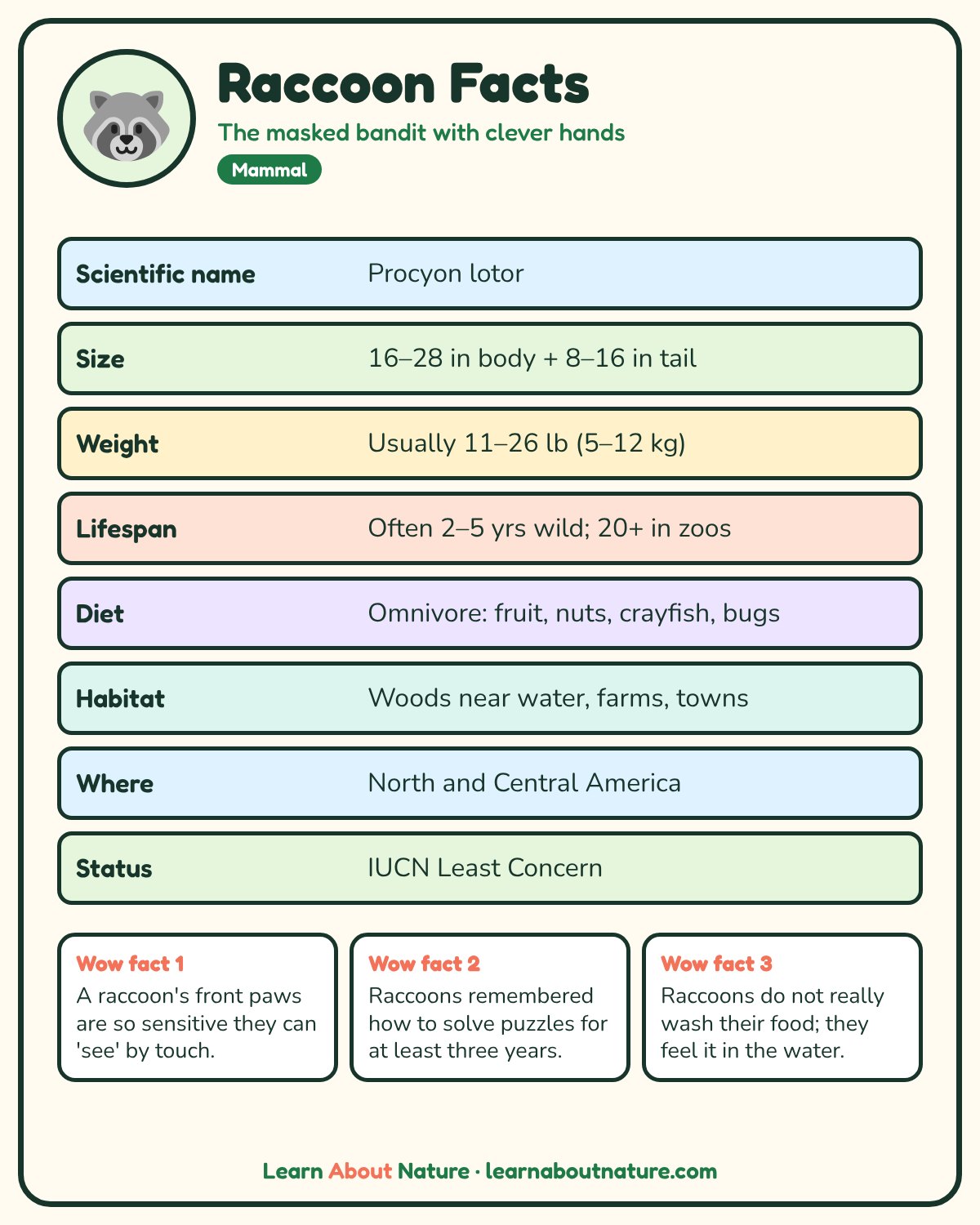
| Scientific name | Procyon lotor |
| Size | Body 16–28 in; tail 8–16 in |
| Weight | Usually 11–26 lb (5–12 kg) |
| Diet | Omnivore |
| Lifespan | Usually 2–5 years in the wild; 20+ in captivity |
| Baby name | Kit |
| Kits per litter | Usually 2–7, often about 4 |
| Conservation status | Least Concern (IUCN) |
What Is a Raccoon?
The raccoon is a mammal in the family Procyonidae, which also includes coatis and ringtails. It is a carnivore by family tree, but it eats a lot of plants too, so it is an omnivore by diet.
Its scientific name is Procyon lotor. The word lotor is Latin for “washer,” because people used to think raccoons washed their food. The English name comes from a Powhatan word that means something like “animal that scratches with its hands.”
Where Do Raccoons Live?
Raccoons are native to North and Central America, from southern Canada through most of the United States and Mexico to Panama. They have also been brought to parts of Europe and Japan, where they now live in the wild. In Europe, Germany has the largest number.
In nature, raccoons like woods near streams, lakes and marshes, where there are trees for dens and water for food. But they are very adaptable. Many live on farms and in suburbs and cities, where they sleep in hollow trees, storm drains, sheds, barns or attics and find food in gardens and trash cans. Some cities have far more raccoons per square mile than nearby forests.
What Do Raccoons Eat?
Raccoons eat almost anything they can find. In one large analysis, their diet was about 40 percent invertebrates (animals without backbones, such as insects, worms and crayfish), about 33 percent plants, and about 27 percent vertebrates such as fish, frogs, small rodents and bird eggs.
In spring and early summer they eat more animals, like crayfish and insects. In late summer and fall they feast on fruit, berries, acorns and other nuts, and sometimes corn, to build up fat for winter. In towns they also raid garbage, compost and pet food left outside.
Body, Hands and Senses
A raccoon’s body is about 16 to 28 inches (40 to 70 cm) long, plus a tail of about 8 to 16 inches (20 to 40 cm). Most weigh about 11 to 26 pounds (5 to 12 kg), and males are usually heavier than females. A raccoon can weigh up to twice as much in early winter as it does in spring.
Its most amazing tool is its front paws. Each has five long, flexible fingers, and the skin is packed with touch sensors. A large part of the raccoon’s brain is used just for processing touch. With its paws, a raccoon can feel the shape of a crayfish under a rock, open a latch or untie a loose knot.
The dark mask may help cut down glare at night. Raccoons see well in the dark, hear well and have a good sense of smell. They can climb trees head first going up and come down head first too, thanks to back feet that can turn around. They are also good swimmers.
Raccoon Babies
Baby raccoons are called kits (sometimes cubs). Raccoons mate in late winter, and a mother is pregnant for about 63 to 65 days. She usually gives birth in spring in a safe den, such as a hollow tree.
A litter usually has about 2 to 7 kits, most often around 4. Newborns are tiny and helpless, with their eyes closed. Their eyes open when they are roughly three weeks old. By around 6 to 9 weeks they start eating solid food and following their mother on short trips.
Kits are usually weaned by about 16 weeks. Many stay with their mother through their first winter and go off on their own the next spring.
- Pregnancy: about 63–65 days
- Kits per litter: usually 2–7, often 4
- Weaned: by about 16 weeks
- Leave mother: often the following spring
How Raccoons Behave
Raccoons are mostly nocturnal, which means they are active at night and rest during the day. Seeing one in daylight does not always mean it is sick; it may just be searching for food. Adults mostly live alone, though related females may share an area, and young males sometimes form small groups.
Raccoons do not truly hibernate. In cold places they may sleep in their dens for days or weeks during snowstorms, living off stored fat. They can lose a large part of their body weight over a hard winter.
Raccoons are very clever. In studies, they solved puzzle boxes and remembered how to open them for at least three years.
Predators, Threats and Conservation
Coyotes, bobcats, wolves, cougars and great horned owls hunt raccoons, especially young ones. People are a bigger threat: many raccoons are hit by cars, and some are hunted or trapped. Disease, especially canine distemper, also kills many raccoons.
Raccoons can carry rabies and other diseases that can spread to people and pets. That is why you should never touch, feed or try to pet a wild raccoon, even a baby that looks lonely. If one seems sick or hurt, tell an adult, who can call local wildlife officials.
The IUCN Red List lists the raccoon as Least Concern. Raccoons are common and widespread, and their numbers have grown in many areas. In Europe and Japan, where they are not native, they are considered an invasive species.
Raccoons vs Red Pandas and Coatis
Several animals look a bit like raccoons. The coati, which lives from the southwestern United States to South America, is a true cousin in the raccoon family. It has a longer, upturned snout and often holds its ringed tail straight up. Unlike raccoons, female coatis live in groups and are active mostly by day.
The red panda of the Himalayas and China also has a ringed tail and a masked face, and people once grouped it with raccoons. Scientists now place it in its own family, the Ailuridae. It eats mostly bamboo.
The raccoon dog of East Asia, despite its name and its raccoon-like mask, is actually a member of the dog family. These look-alikes show that a mask and a ringed tail have appeared more than once in different groups of mammals.
Fun Facts About Raccoons
More reasons raccoons surprise people:
- Raccoons often dabble their food in water, which makes their paws even more sensitive to touch.
- A raccoon’s back feet can rotate so it can climb down a tree head first.
- Raccoons can run about 10 to 15 miles per hour (16 to 24 km/h) for short distances.
- In captivity, raccoons have lived more than 20 years.
- The name Procyon means “before the dog” in Greek.
Fast Facts for Young Readers
- Raccoons have a black mask and a ringed tail.
- They are most active at night.
- Raccoons eat almost anything, from fruit to crayfish.
- Their front paws work a lot like little hands.
- Baby raccoons are called kits.
- Raccoons are good climbers and good swimmers.
- Never touch or feed a wild raccoon.
Key words: omnivore – an animal that eats both plants and animals; nocturnal – active at night and resting during the day; kit – a baby raccoon; den – a sheltered home, such as a hollow tree, where an animal rests or raises young; adaptable – able to change habits to survive in many different places.
Try this: Try a touch test like a raccoon: put small objects in a bag or bowl of water and have students identify them by feel alone, without looking.
Related Guides
- Giant Panda facts for kids
- Elephant facts for kids
- Fox facts for kids
- Hippo facts for kids
- All animal facts for kids
Raccoon FAQs
Do raccoons really wash their food?
Not exactly. Raccoons often dip and rub food in water, but scientists think this is not about cleaning. Wetting their paws makes the touch sensors in their skin even more sensitive, helping them feel what they are holding. In the wild, they also find much of their food, like crayfish, by feeling around in water.
Do raccoons hibernate?
No. Raccoons do not truly hibernate. In cold areas they may sleep in their dens for long stretches during snowy weather, living off the fat they stored in the fall. They wake up and come out to look for food when the weather is milder.
What do raccoons eat?
Raccoons are omnivores. They eat insects, worms, crayfish, frogs, fish, bird eggs and small rodents, plus fruit, berries, acorns, nuts and corn. In towns and cities, they also eat garbage, compost and pet food left outside.
How long do raccoons live?
In the wild, many raccoons die in their first two years, often from cars, disease or predators. Those that survive commonly live about 5 years, and a few reach more than 10. In captivity, raccoons have lived more than 20 years.
Are raccoons dangerous?
Raccoons usually avoid people, but they are wild animals that can bite and scratch, and they can carry rabies and other diseases. Never touch, feed or corner a raccoon. If you see one that seems sick, hurt or unafraid of people, tell an adult so they can contact local wildlife officials.
Sources: Animal Diversity Web: Procyon lotor; National Wildlife Federation: Raccoon; Wikipedia: Raccoon (diet, cognition, range and IUCN 2016 assessment)

Nato is a content writer and researcher with a background in psychology who’s eager to explore the wonders of nature. As a travel enthusiast and animal lover, she hopes to inspire others to discover and cherish the beauty and importance of the natural world. She also writes about the history of candy and snacks for Snack History and about food and healthy eating for The Fitchen.