Parts of an Egg: Labeled Diagram of a Chicken Egg
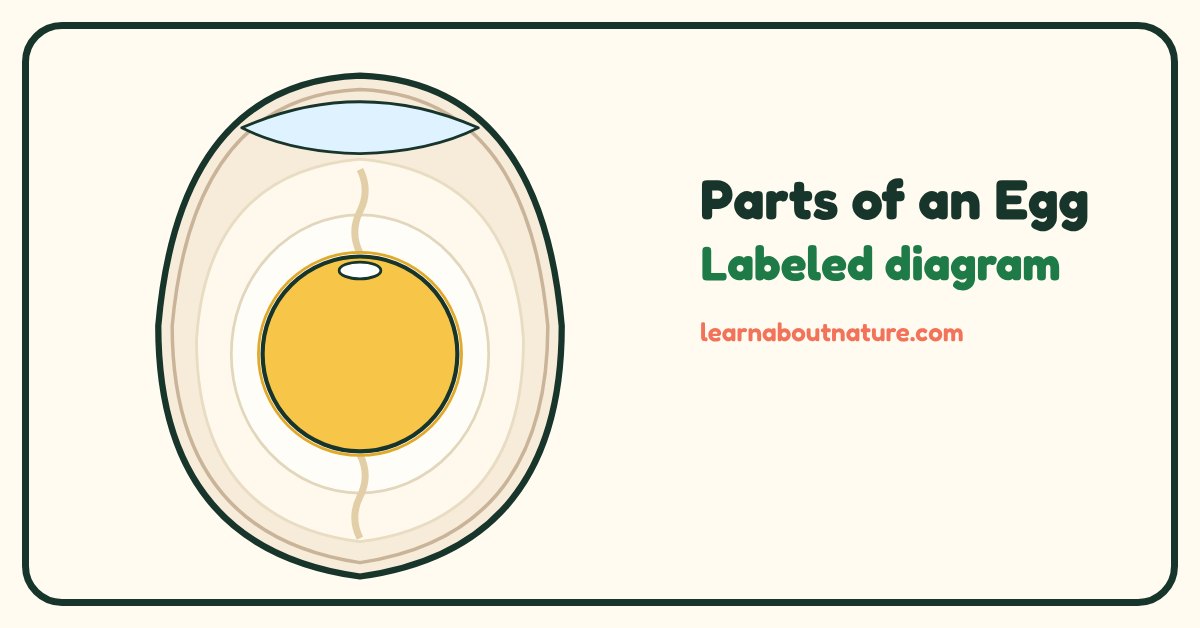
Quick answer: The main parts of a chicken egg are the hard shell with its thin cuticle, two shell membranes, an air cell at the wide end, thin and thick albumen (egg white), two rope-like chalazae, and the yellow yolk wrapped in the vitelline membrane. A pale spot on the yolk, the germinal disc, is where a chick can begin to grow.
Crack open a chicken egg and you will see the yellow yolk and the clear egg white. But an egg has more parts than that. Each one has a job, from keeping germs out to holding the yolk steady to feeding a growing chick.
This guide explains the parts of an egg from the outside in, using an ordinary chicken egg as the example. The same basic parts are found in the eggs of other birds, too, from tiny hummingbird eggs to huge ostrich eggs.
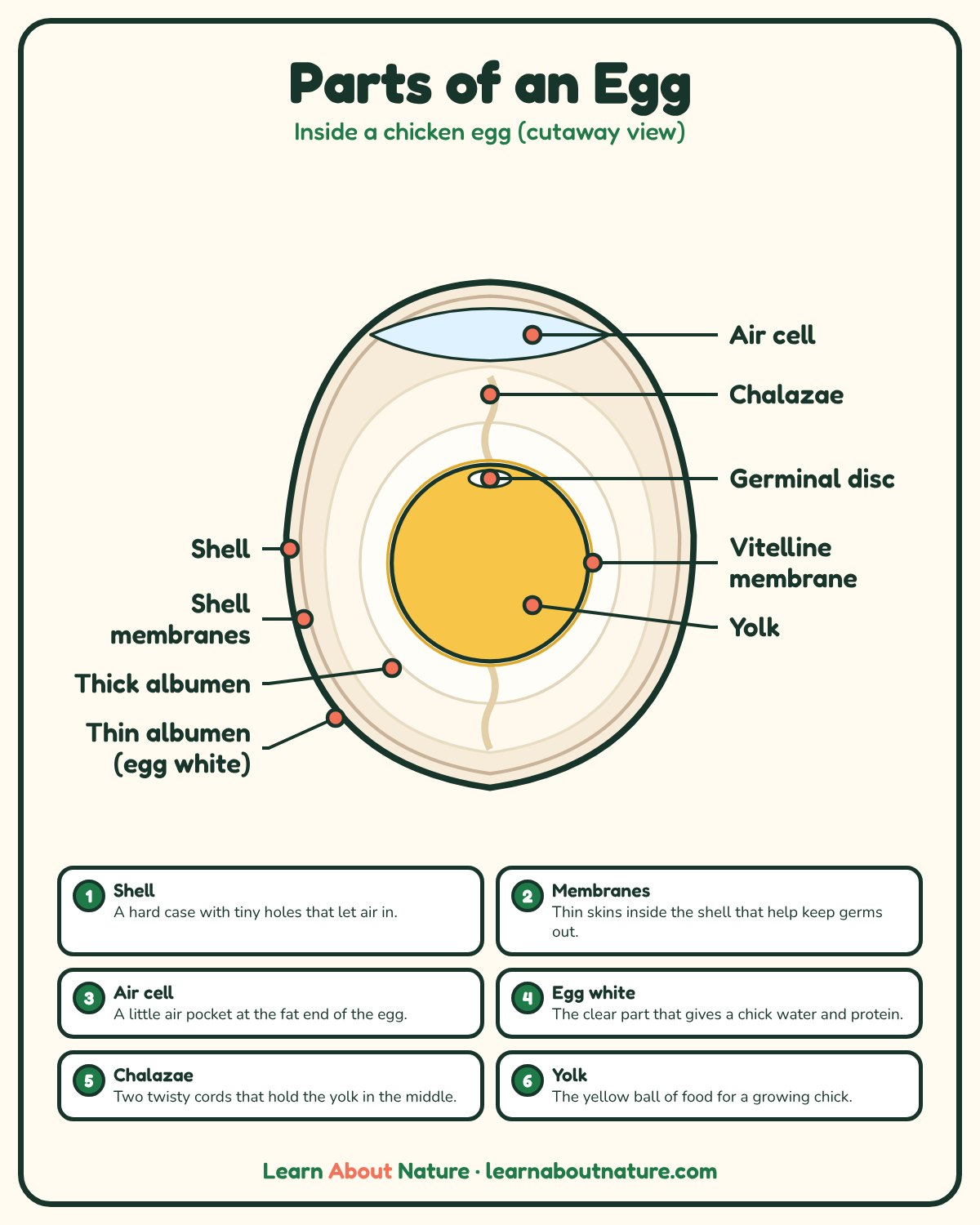
Teachers and students: you’re welcome to use this diagram in lessons and projects with credit to Learn About Nature.
Free printable: Download the Parts of an Egg labeling worksheet (PDF) – label the parts using the word bank. Answer key included.
Parts of a Egg and What They Do
| Part | What it does |
|---|---|
| Shell | Hard outer case that protects the egg; mostly calcium carbonate |
| Pores | Tiny holes that let oxygen in and carbon dioxide and water vapor out |
| Cuticle (bloom) | Thin coating that slows water loss and helps keep bacteria out |
| Outer shell membrane | Lines the shell; a barrier against bacteria |
| Inner shell membrane | Surrounds the egg white; separates from the outer membrane to form the air cell |
| Air cell | Pocket of air at the wide end; the chick’s first breath comes from here |
| Thin albumen | Watery egg white that supplies water and protein |
| Thick albumen | Firm egg white that cushions the yolk |
| Chalazae | Twisted cords that hold the yolk in the center |
| Vitelline membrane | Clear skin that keeps the yolk in a ball |
| Yolk | Food store of fat, protein, vitamins and minerals |
| Germinal disc | The egg cell; where a chick begins if the egg is fertilized |
The Egg Body Plan
A bird egg is built like a packed lunch box. On the outside are protective layers: the shell, a thin coating called the cuticle, and two shell membranes. Inside is a supply of water and protein (the albumen, or egg white) and a store of fat and protein (the yolk).
By weight, an average chicken egg is about 58 percent egg white, about 31 percent yolk and about 11 percent shell. The yolk holds most of the fat, while the white is mostly water with some protein.
The Shell and Cuticle
The shell is made mostly of calcium carbonate, the same mineral found in chalk and seashells. It looks solid, but it is covered with thousands of tiny holes called pores. A chicken eggshell has about 7,000 of them, with more at the wide end. Pores let oxygen in and let carbon dioxide and water vapor out, so a developing chick can breathe.
Over the shell is a very thin protein layer called the cuticle, or bloom. It is added just before the egg is laid and dries within minutes. The cuticle partly seals the pores, slowing water loss and helping keep bacteria out.
Shell color comes from pigments added in the last stage of shell-making, and it depends on the breed of hen. A brown egg and a white egg have the same parts inside.
Shell Membranes and the Air Cell
Just inside the shell are two thin, papery shell membranes, an outer one stuck to the shell and an inner one touching the egg white. They are made of tangled protein fibers and form another barrier against bacteria. You can see them when you peel a hard-boiled egg.
The two membranes are pressed together everywhere except at the wide end of the egg. There they separate to form the air cell. A freshly laid egg is warm, since a hen’s body is about 106°F. As the egg cools, its contents shrink a little and air is drawn in to fill the gap.
The air cell keeps growing slowly as the egg loses moisture over time, so a large air cell is a sign of an older egg. In a fertilized egg that is being incubated, the chick pokes its beak into the air cell at about day 20 and takes its first breath of air before hatching.
Albumen: Thick and Thin Egg White
The albumen is the egg white. In a raw egg it is clear, and it turns white when cooked because heat changes the shape of its proteins. Albumen is about 88 percent water and 11 percent protein.
Egg white is not all the same. Poultry scientists describe layers of thin albumen, which is watery and runny, and thick albumen, which is firm and jelly-like. The thick albumen surrounds the yolk and cushions it. When you crack a fresh egg onto a plate, the thick white stands up around the yolk while the thin white spreads out. In older eggs, the thick white slowly becomes thinner.
For a growing chick, the albumen supplies water and protein, and some of its proteins help fight bacteria.
Chalazae: The Yolk’s Anchors
The chalazae (say kuh-LAY-zee; one is a chalaza) are two twisted, whitish cords on opposite sides of the yolk. They are made of twisted protein fibers and stretch toward the two ends of the egg.
The chalazae work like the ropes of a hammock. They hold the yolk near the center of the egg and let it turn, so the yolk does not bump against the shell. Some people think the chalazae are an embryo or a sign of a bad egg, but they are a normal part of every egg. Fresh eggs often have the most noticeable chalazae.
The Yolk, Vitelline Membrane and Germinal Disc
The yolk is the egg’s food store. It is about half water, with roughly one-third fat and the rest mostly protein, plus vitamins and minerals. A thin, clear skin called the vitelline membrane wraps around the yolk and keeps it in a neat ball. When this membrane breaks, the yolk runs.
The yolk forms in the hen’s ovary and is built up in layers. At its center is a small core of paler yolk. The color of the yolk, from pale yellow to deep orange, depends mostly on what the hen eats.
On the surface of the yolk is a small whitish spot called the germinal disc, or blastodisc. This is the hen’s egg cell. If the egg is fertilized by sperm from a rooster, the cell divides into a tiny group of cells called the blastoderm, which can grow into a chick when the egg is kept warm. Only this small spot becomes the chick. The rest of the yolk and white is its food and water.
How a Hen Makes an Egg
It takes a hen about 24 to 26 hours to make one egg. The parts are added in order as the yolk travels through a long tube called the oviduct:
- Infundibulum (about 15 minutes): catches the yolk after it leaves the ovary. Fertilization happens here.
- Magnum (about 3 hours): adds the thick and thin albumen and the chalazae.
- Isthmus (a little over 1 hour): adds the two shell membranes.
- Shell gland or uterus (about 20 hours): adds water and minerals, builds the hard shell, adds color and coats the egg with the cuticle.
- The finished egg then leaves the hen’s body through the vent and is laid.
Fertilized and Unfertilized Eggs
Most eggs sold in grocery stores come from hens kept without roosters, so they are not fertilized and cannot become chicks. A fertilized egg has the same parts, but its germinal disc has a slightly different look, often described as a small ring or bull’s-eye.
If a fertilized egg is kept warm by a hen or an incubator, a chicken embryo develops for about 21 days. Blood vessels spread over the yolk to carry food to the embryo, and the chick grows until it fills most of the shell. It then breaks into the air cell, breathes air and chips its way out.
Fun Facts About Eggs
- A chicken egg has about 7,000 pores, but you cannot see them without magnification.
- The air cell is always at the wide end of the egg, which is one reason eggs are often stored pointed end down.
- Reptile eggs also have shells and membranes, but many, such as most turtle and snake eggs, have soft, leathery shells instead of hard ones.
- A whole chicken egg has about 6 to 7 grams of protein.
- All bird eggs have a yolk, albumen, membranes and a hard shell, whether they come from a hummingbird or an ostrich.
Parts of an Egg for Kids
- Shell: a hard case with tiny holes that let air in.
- Membranes: thin skins inside the shell that help keep germs out.
- Air cell: a little air pocket at the fat end of the egg.
- Egg white: the clear part that gives a chick water and protein.
- Chalazae: two twisty cords that hold the yolk in the middle.
- Yolk: the yellow ball of food for a growing chick.
- Germinal disc: the tiny spot where a chick can start to grow.
Key words: albumen – the egg white; chalazae – twisted cords that hold the yolk in the center of the egg; air cell – a small air pocket at the wide end of an egg; cuticle – a very thin coating on the outside of an eggshell, also called the bloom; germinal disc – the small spot on the yolk where a chick can begin to develop; oviduct – the tube inside a hen where an egg is built.
Try this: Crack a raw egg onto a white plate and find the thick white, thin white, yolk and chalazae. Then peel a hard-boiled egg and look for the shell membranes and the dent left by the air cell at the wide end.
Related Guides
- Chicken life cycle
- Parts of a Feather
- Bird life cycle
- Owl life cycle
- Bird anatomy
- All labeled anatomy diagrams
Parts of an Egg FAQs
What are the parts of an egg?
A chicken egg has a shell covered by a thin cuticle, two shell membranes, an air cell at the wide end, thin and thick albumen (egg white), two chalazae, a yolk wrapped in the vitelline membrane, and a small germinal disc on the yolk where a chick can start to grow.
What is the white stringy thing in an egg?
The white, rope-like strands next to the yolk are the chalazae. They are twisted strands of protein that hold the yolk near the center of the egg. They are a normal part of every egg, are safe to eat, and are often easier to see in very fresh eggs.
Why is there an air pocket in an egg?
An egg is warm when it is laid. As it cools, the contents shrink slightly and air comes in through the pores, collecting between the two shell membranes at the wide end. The air cell gets bigger over time as the egg loses moisture, and a chick takes its first breath from it before hatching.
Which part of the egg becomes the chick?
Only the germinal disc, a tiny spot on the surface of the yolk, becomes the chick, and only if the egg has been fertilized and kept warm. The yolk and egg white are not turned into the chick directly. They are its food and water while it develops for about 21 days.
How long does it take a hen to make an egg?
A hen takes about 24 to 26 hours to make one egg. Most of that time, about 20 hours, is spent in the shell gland, where the hard shell forms. The egg white, chalazae and shell membranes are added earlier as the yolk moves through the oviduct.
Sources: The Parts of the Egg – Penn State Extension 4-H Embryology; Eggs: Structure – University of Illinois Extension; Have You Thought About an Egg Lately? – Alberta Agriculture; Formation of the Egg – Ohio State University Extension (Ohioline)

Nato is a content writer and researcher with a background in psychology who’s eager to explore the wonders of nature. As a travel enthusiast and animal lover, she hopes to inspire others to discover and cherish the beauty and importance of the natural world. She also writes about the history of candy and snacks for Snack History and about food and healthy eating for The Fitchen.