Orca Facts for Kids: Killer Whale Habitat, Diet and Fun Facts
Quick answer: An orca, or killer whale, is the largest member of the dolphin family. Orcas live in every ocean, especially in cold waters, and travel in close family groups called pods. Different groups eat different food, from salmon and other fish to seals and even large whales. They are top predators with no natural enemies.
With its shiny black back, bright white patches and tall dorsal fin, the orca is one of the easiest ocean animals to recognize. It is also one of the smartest and most powerful hunters on Earth.
Orcas live in tight family groups, “talk” with clicks and whistles, and pass hunting tricks from mother to calf. Here is what makes them so special, and why they are called killer whales even though they are really dolphins.
Teachers and students: you’re welcome to use this fact sheet in lessons and projects with credit to Learn About Nature.
Free printable: Download the Orca fact file worksheet (PDF) – draw the animal, fill in the facts and match key words. Answer key included.
Orca Quick Facts
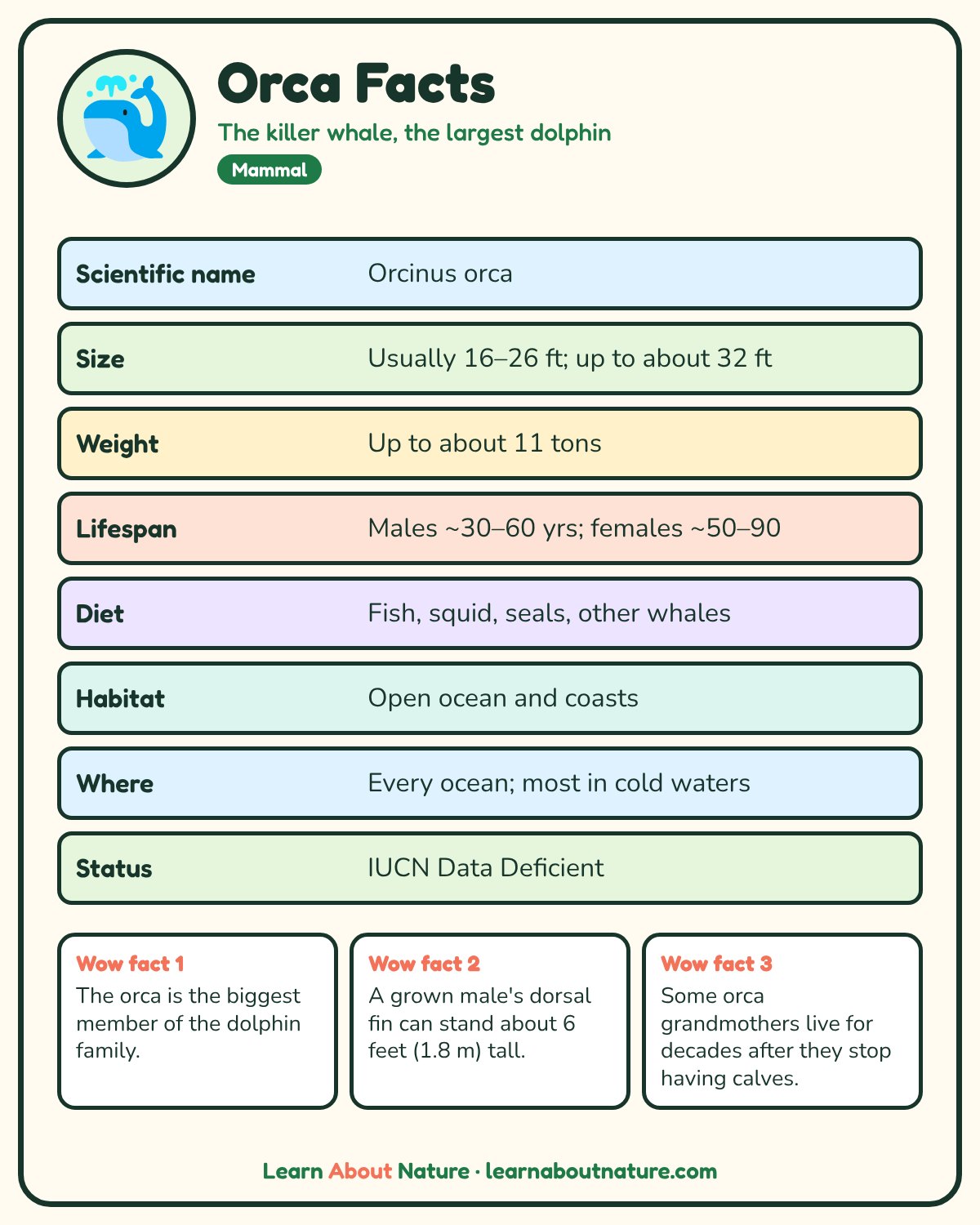
| Class | Mammal |
| Family | Dolphin family (Delphinidae) |
| Scientific name | Orcinus orca |
| Length | Usually 16–26 ft (5–8 m); up to about 32 ft |
| Weight | Up to about 11 tons |
| Top speed | About 30 mph (48 km/h) in short bursts |
| Lifespan | Males about 30–60 years; females about 50–90 |
| Group name | Pod |
| Baby name | Calf |
| Conservation status | Data Deficient (IUCN) |
What Is an Orca?
An orca is a toothed whale and the largest member of the dolphin family, Delphinidae. So it is a whale in the broad sense, but its closest relatives are dolphins such as the bottlenose dolphin, not the great whales like blue whales or humpbacks.
The name “killer whale” probably comes from old sailors who saw orcas hunting whales and called them “whale killers.” Today, many people prefer the name orca, from the scientific name Orcinus orca. Like all mammals, orcas breathe air, are warm-blooded and feed their young milk.
Where Do Orcas Live?
Orcas live in every ocean in the world. They are the most widely spread of all whales and dolphins, found from the icy waters around Antarctica and the Arctic to warm tropical seas. They are most common in cold, food-rich waters, such as the coasts of Alaska, British Columbia, Norway and Antarctica.
Some orcas stay near the coast, while others roam far out to sea. Some groups follow their favorite prey, such as salmon runs in summer or seal pups in spring.
What Do Orcas Eat?
Orcas are apex predators, which means no other animal hunts adult orcas. As a species they eat almost anything in the sea, but each population tends to specialize. Scientists call these different groups ecotypes.
In the northeastern Pacific, “resident” orcas eat mostly fish, especially salmon. “Transient” orcas, also called Bigg’s killer whales, hunt seals, sea lions, porpoises and sometimes larger whales. “Offshore” orcas feed far from land and eat fish, including sharks. Elsewhere, orcas eat herring, tuna, rays, squid, penguins and even great white sharks.
Orcas are clever hunters. In Antarctica, some groups swim side by side to make a wave that washes a seal off a floating piece of ice. In Argentina, some orcas surge right up onto the beach to grab sea lion pups and then wriggle back into the water. Young orcas learn these tricks from older family members.
Body and Senses
Orcas are big. Adult males are usually about 20 to 26 feet (6 to 8 m) long, and females about 16 to 23 feet (5 to 7 m). The largest can reach about 32 feet (9.8 m) and weigh up to about 11 tons. A male’s tall, straight dorsal fin can be about 6 feet (1.8 m) high, while a female’s is shorter and curved.
Each orca has a gray “saddle patch” behind the dorsal fin. Scientists use the shape of the fin and the saddle patch, plus nicks and scars, to tell individuals apart.
Orcas have 40 to 56 cone-shaped teeth for gripping prey. They find food using echolocation: they make clicking sounds and listen for the echoes bouncing back. They usually cruise at a few miles per hour but can burst to about 30 miles per hour (48 km/h).
Orca Babies
A baby orca is called a calf. A mother is pregnant for about 15 to 18 months, one of the longest pregnancies of any whale or dolphin. She gives birth to one calf, tail first, and it can swim right away.
A newborn calf is about 7 to 8 feet (2.1 to 2.5 m) long and weighs roughly 300 to 400 pounds (136 to 181 kg). Its white patches often look slightly orange or yellowish at first. Calves drink milk for at least a year and stay close to their mothers for years. In some populations, a female has a calf only about once every five years.
Females are usually ready to have their first calf at about 10 to 13 years old.
- Pregnancy: about 15–18 months
- Calves per birth: 1
- Size at birth: about 7–8 ft long
- Nursing: at least 1 year
Pods and Family Life
Orcas are very social. They live in groups called pods, which often contain a few to around 20 related whales. In fish-eating resident orcas, sons and daughters stay with their mother for life. The oldest female, often a grandmother or great-grandmother, usually leads the family.
Orcas are one of very few animals, along with humans and a few other toothed whales, that go through menopause. Older females stop having calves but keep living for decades. Studies suggest these grandmothers help their families survive, for example by leading them to salmon when food is scarce.
Pods communicate with clicks, whistles and pulsed calls. Each pod has its own set of calls, a kind of family dialect that calves learn as they grow up.
Threats and Conservation Status
Adult orcas have no natural predators. Their main threats come from people: shortage of prey such as salmon, chemical pollution that builds up in their bodies, noise and disturbance from boats, oil spills and getting tangled in fishing gear.
The IUCN Red List lists the orca as Data Deficient. This means scientists do not have enough information to judge the risk for the species as a whole, partly because there may be several different types of orca that could one day be treated as separate species. Some groups are clearly in trouble. The small orca population in the Strait of Gibraltar is listed as Critically Endangered by the IUCN, and the Southern Resident orcas off Washington and British Columbia are listed as endangered in the United States, with only 74 counted in July 2025.
Worldwide, NOAA Fisheries estimates there are about 50,000 orcas.
Orcas vs Other Dolphins
Orcas share many features with smaller dolphins such as the bottlenose dolphin. Both are toothed whales that breathe through a single blowhole, use echolocation, live in social groups and communicate with whistles and clicks.
The biggest difference is size. A bottlenose dolphin usually grows to about 6 to 13 feet (2 to 4 m) long, while a large male orca can be more than twice as long and many times heavier. Orcas also have a rounder head with no long beak, bold black-and-white coloring, and much taller dorsal fins.
Their diets are different, too. Most dolphins eat fish and squid. Orcas are the dolphins best known for hunting other marine mammals, including seals, sea lions and even other dolphins and whales. That makes the orca the top predator of the dolphin family.
Fun Facts About Orcas
Here are a few more orca surprises:
- Orcas are found in more parts of the ocean than any other whale or dolphin.
- Female orcas can live to at least 90 years, while males usually live much shorter lives.
- Scientists can recognize individual orcas from photos of their fins and saddle patches.
- Orcas have one of the largest brains of any ocean animal.
- There are no records of wild orcas killing a person.
Fast Facts for Young Readers
- An orca is also called a killer whale.
- Orcas are really the biggest kind of dolphin.
- Orcas live in every ocean in the world.
- They live in family groups called pods.
- A baby orca is called a calf.
- Orcas use clicks and echoes to find their food.
- Grandma orcas often lead the family.
Key words: pod – a family group of orcas that travels and hunts together; echolocation – finding things by making sounds and listening for the echoes; apex predator – an animal at the top of the food chain that no other animal hunts; ecotype – a group of orcas with its own favorite food, habits and calls; dorsal fin – the tall fin on an orca’s back.
Try this: Test echolocation: one blindfolded student claps while a partner holds a large book near or far away, and the student guesses the distance from how the sound changes.
Related Guides
- Whale life cycle
- Jellyfish facts for kids
- Starfish facts for kids
- Blue Whale facts for kids
- Dolphin facts for kids
- All animal facts for kids
Orca FAQs
Is an orca a whale or a dolphin?
Both, in a way. An orca is a toothed whale, but it belongs to the dolphin family, Delphinidae, and is the largest member of it. Its closest relatives are other dolphins, not big whales like the blue whale or humpback whale.
Why are orcas called killer whales?
Long ago, sailors saw orcas hunting and killing other whales and called them “whale killers.” Over time the name turned into “killer whale.” Many people now prefer the name orca, which comes from its scientific name, Orcinus orca.
What do orcas eat?
It depends on the group. Some orcas eat mostly fish, such as salmon or herring. Others hunt seals, sea lions, porpoises, penguins, sharks and even large whales. Each population learns its own hunting methods and favorite foods from older family members.
How long do orcas live?
According to NOAA Fisheries, male orcas live about 30 years on average and can reach at least 60, while females live about 50 years on average and can reach at least 90. Older females often keep living for decades after they stop having calves.
Are orcas endangered?
The IUCN Red List lists the orca as Data Deficient because there is not enough information to judge the species as a whole. Some populations are in danger, though. The Southern Resident orcas are endangered under US law, and the Strait of Gibraltar population is listed as Critically Endangered by the IUCN.
Sources: NOAA Fisheries: Killer Whale; IUCN SSC Cetacean Specialist Group: Red List status of cetaceans; Aquarium of the Pacific: Orca (Killer Whale); Wikipedia: Orca

Nato is a content writer and researcher with a background in psychology who’s eager to explore the wonders of nature. As a travel enthusiast and animal lover, she hopes to inspire others to discover and cherish the beauty and importance of the natural world. She also writes about the history of candy and snacks for Snack History and about food and healthy eating for The Fitchen.